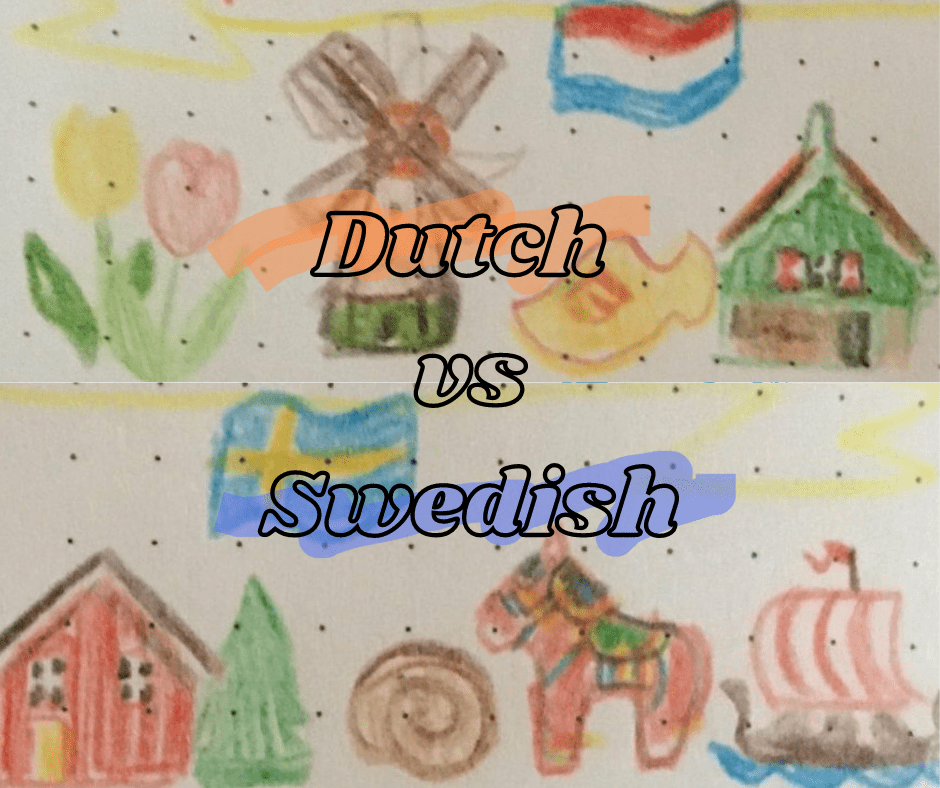
Both Swedish and Dutch belong to the Germanic language family: Dutch is a West Germanic language, as German and English; while Swedish is North Germanic, learn to tell it apart from all the other Nordic languages. They are therefore closely related, but of course not as close as Scandinavian languages to each other.
They are not well known languages worldwide and for this reason i decided to use them in a infographic comparison assignment! You can see it better here.
Countries and number of speakers
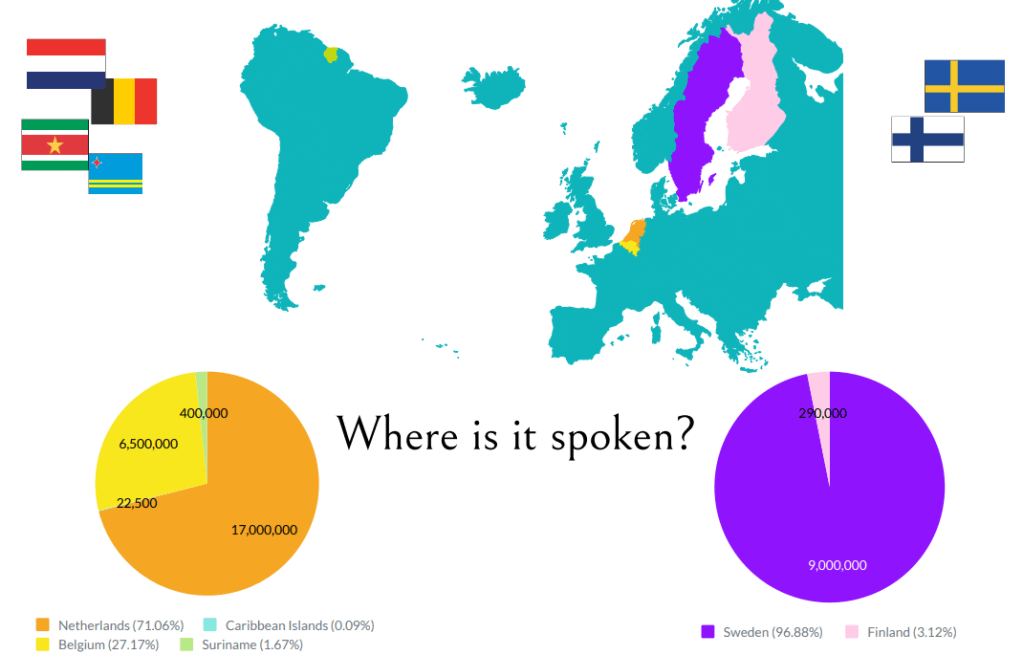
- Dutch is mainly spoken in the Netherlands, with 17 millions of speakers.
- In Belgium, it is spoken by 54% of the population, in Flanders. That makes up for 6,5 millions of speakers.
- You might be surprised to see South America on the map, that’s because Dutch is also an official language in Suriname, a former colony, and on small Caribbean islands: Curaçao, Aruba, Sint Maarten, which are constituent countries of the Kingdom of the Netherlands.
- It used to be spoken or is on the verge of extinction in the area around Duinkerk, northern France; and Indonesia.
- Afrikaans is considered a daughter language of Dutch and is spoken by 17 million people in South Africa in Namibia, of which 7 millions speak it as their mother tongue.
- Swedish is spoken in Sweden (9 million speakers) and by Swedish minorities in Finland, mostly concentrated in the south and west coastal regions and the autonomous Swedish-speaking archipelago Åland. Swedish Finns are around 290,000. 3 municipalities in mainland Finland have Swedish as the sole official language.
- There used to be a Swedish-speaking minority in Estonia From the 13th to 20th century, particularly on the islands; but almost all Swedish Estonians fled to Sweden during World War II. Only around 300 of them remain.
- In the early 18th century Estonia was ceded to the Russian Empire and around 1,000 Swedish Estonians were forced to move to Ukraine, to a village now called Gammalsvenskby, (“Old Swedish Village”). A few elderly people in the village still speak a Swedish dialect, most likely facing extinction.
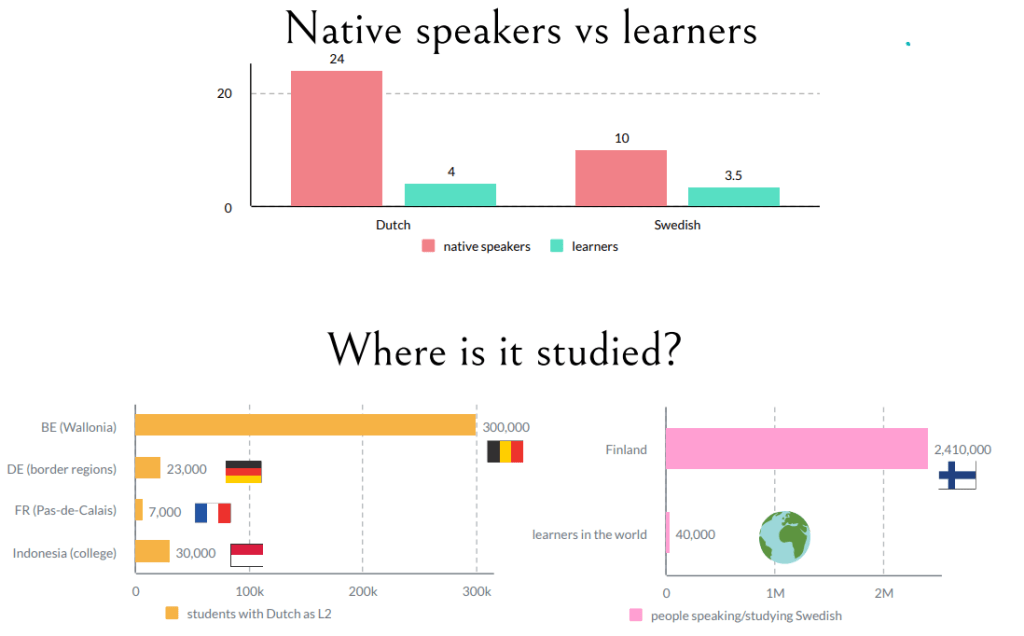
Finding precise and correct data about the learners of these languages was quite hard, not considering people who self-study the language (I would fall under this category).
I tried to find data about students enrolled in language courses, finding numbers of those who study Dutch as a school subject: In Belgium, not surprising considering it is a national language, it is studied in Wallonia (French-speaking area) by about 300,000 people. Dutch can be found in German schools in areas sharing a border with the Netherlands: Niedersachsen, Nordrhein-Westfalen. A small portion of France in the very north of the country, Pas-de-Calais used to be Dutch-speaking, the language is still taught to some 20,000 pupils.
Unfortunately I couldn’t find data about Universities offering Dutch courses and the number of students over the world, but i thought it was relevant to add that in Indonesia around 30,000 students take Dutch courses in college. Because of its colonial past as part of the Dutch Indies, Dutch still plays a role in Indonesian history and its law, making it important for the students to have some knowledge of the language and its vocabulary in some fields.
Swedish is not really a school subject anywhere but in Finland, where it is a compulsory subject for everybody. This is because of the significant Swedish influence on Finland and the fact that Finland used to be part of the Swedish Empire. According to the sources I found, people reported to be able to speak Swedish are around 2 millions in Finland. I found that there are about 40,000 people being enrolled in Swedish language courses worldwide.
What are the languages like?
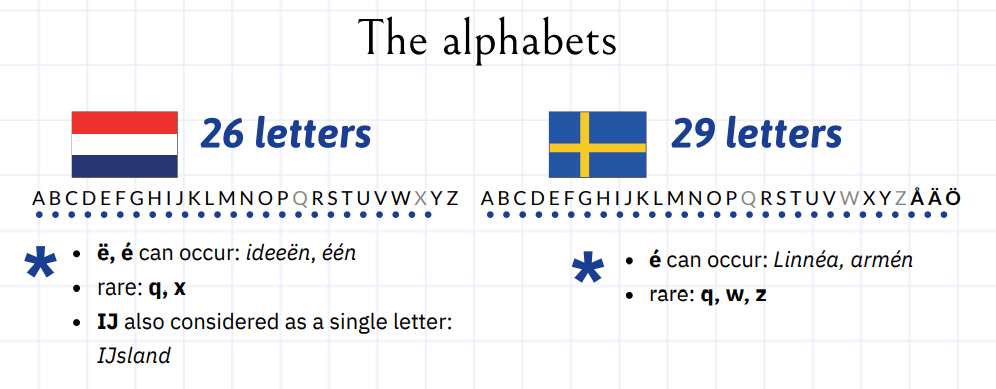
Swedish has three extra letters: Å, Ä, Ö, placed at the end of its alphabet, longer than the Dutch alphabet which includes 26 letters and not any more than in the English one. Despite this, Dutch does consider IJ as a single letter producing a single sound and you can find it written as Y in old texts and it still is in Afrikaans, Dutch daughter language. (Try writing I and J in italic and you’ll see they look like Y together!). I and J are written in capital letters when IJ is at the beginning of a word: IJsland is Iceland.
Both Dutch and Swedish alphabets include letters that are only used in foreign words: Q can be found in some Swedish surnames as -quist, written in a fancy way when latinising names was fashionable. W and Z appear only in foreign words in Swedish, but it is a very common letter in Dutch. X is not present in Dutch, and not much more in Swedish, but it is still found in a few words as exempel.
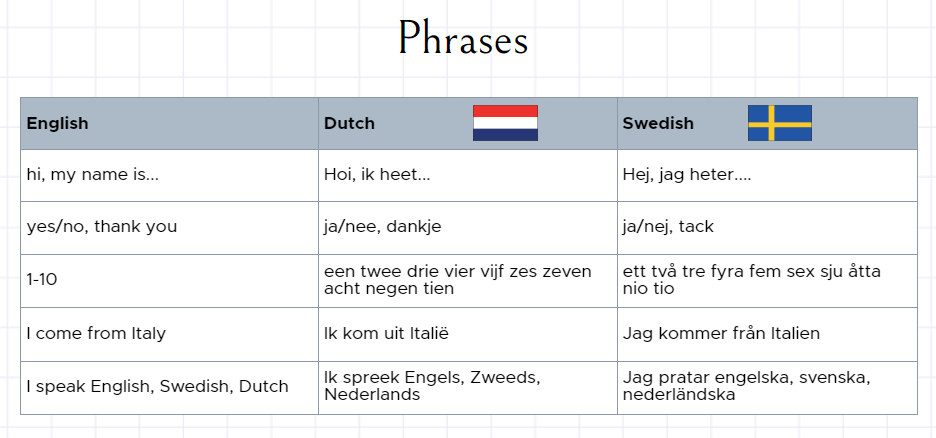
Since they both belong to the Germanic language family, Swedish and Dutch have many similarities in vocabulary, often shared with English as well. You can notice them in the table I made.
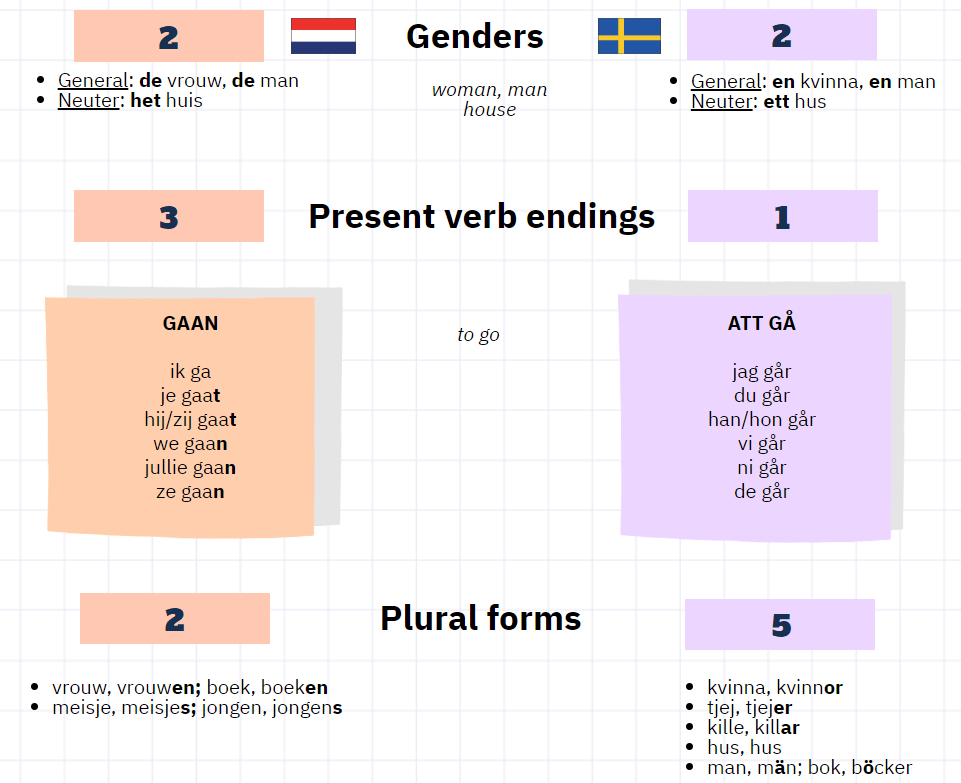
Both Swedish and Dutch have two genders: old masculine and feminine ended up being merged in a single, general gender; which exists with a neutrum gender:
- in Dutch de is the general article het “the” is the neutrum article, both take een “a(n)” in the indefinite form though. En kvinna, ett hus become kvinnan, huset if you want to say “the woman, the house”.
- In swedish en and ett are respectively the general and the neutrum indefinite articles. In the Scandinavian definite forms the article goes to the end of the word:
This unfortunately does not mean that all living things take the general article and objects the neutrum article: there are some rules for endings and categories of words but you cannot guess the gender in a nature-logical way. Child is neutrum in both languages: het kind, ett barn; and girl is paradoxically netrum in Dutch: het meisje (as weird as it might sound, there are reasons for this I will explain if anyone wishes me to).
Swedish verbs always take the same conjugation in all persons: -(a/e)r for present tense. Dutch verb declension is slightly more complicated, but not as much as other languages. You might say it is a simplified version of German (which is honestly what the Dutch language is as a whole..).
Dutch plurals are either -en or -s, while Swedish tends to often take -r but with different vowels preceding it: words ending in -a take -or, in -e take -ar and if it doesn’t have a vowel ending in the singular form it can take -er but not necessarily. There are also words that change their root vowel and/or add up -er: as man/men in English we have en man/män in Swedish, or en bok/böcker (books). While many neutrum words usually stay the same in the plural form, there are cases as ett land/länder (countries).
Loanwords to and from Dutch and Swedish
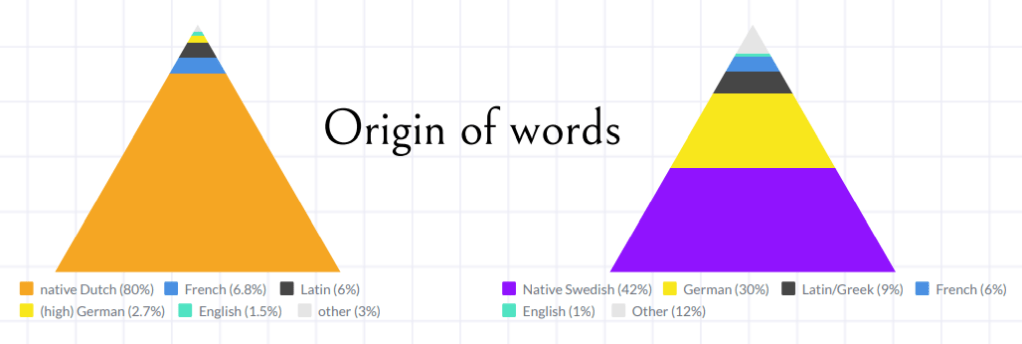
loanwords from other languages in Swedish and Dutch
Swedish has a visibly large amount of words with their origin in German, due to the time of the rise of the Hanseatic League in the 13th and 14th century, providing Swedish Commerce and administration with a large number of Low German-speaking immigrants. Many loanwords are about trade and town life, such as stad (from Stadt, city), köpman (from Kaufmann, businessman), borgmästare (from Borgermester, mayor) och betala (from betalen , to pay).
Latin and Greek have a significant number of loanwords in Swedish and Dutch just like in most European languages. This goes for many science-related terms, although some terms were substituted with pure-Dutch terms in some fields: Physics and Mathematics are called Natuurkunde and Wiskunde (“nature-science”, “knowledge-science”, verb and vowel are werkwoord and klinker (“work-word”, “sounder”). Swedish has adopted fysik, matematik, verb, vokal; similarly to German, Italian and many others.
More loanwords came from French: paraplu, bureau and so on. Swedish adapted most french loanwords to its spelling: paraply, byrå; while Dutch often maintained the original French spelling: bureau, paraplu, crèche, other times also adapting it as in kostuum (from costume). A large amount of the most recent loanwords comes as you might think from English.
Loanwords from Dutch and Swedish
Some Loanwords from Dutch are Waffle from wafel; Cookie from koekje/koekie, Skate from schaats, but it also had a significant influence on naval terms: Yacht from jacht, short for jachtschip, lit. “hunting ship”; Skipper from Middle Dutch scipper (now schipper), lit. “shipper”; Cruise from Dutch kruisen, “to cross, sail to”. Iceberg probably comes from ijsberg “ice mountain”. Landscape, geek, decoy, pickle, frolic among others also came through Dutch.
The presence of the Dutch during the time of colonization in North America in the 1600s had its effects: Santa Claus comes from Middle Dutch Sinterklaas “Saint Nicholas”, bishop of Minor Asia who became a patron saint for children, celebrated on the 5th and 6th December in the Netherlands and Belgium. Yankee probably comes from Jan-Kees, a person name. Some places around what was called New Amsterdam, a.k.a New York City, have names with Dutch origin: Coney Island from Conyne Eylandt lit. “Rabbit Island” (in modern Dutch konijn and eiland); Harlem and Brooklyn were named after the Dutch towns Haarlem and Breukelen;
Without going back to the influence Old Norse had on shaping English, There aren’t that many loanwords from modern Swedish in it. Some are lingonberry; aquavit (the spirit); ombudsman, a person responsible for investigating complaints against the state.
Many are scientific terms and were constructed with Greek or Latin roots by Swedish scientists: Dynamite from dynamit, coined in 1867 by Swedish chemist and inventor of dynamit, Alfred Nobel; Nickel, coined in 1754 by Swedish mineralogist Axel von Cronstedt, a shortening of kopparnickel, meaning ‘copper-colored ore’. Moped, a complicated abbreviation of (trampcykel med) mo(tor och) ped(aler), “(pedal cycle with) mo(tor and) ped(als)”, coined in 1956. You can find more here.
Language History
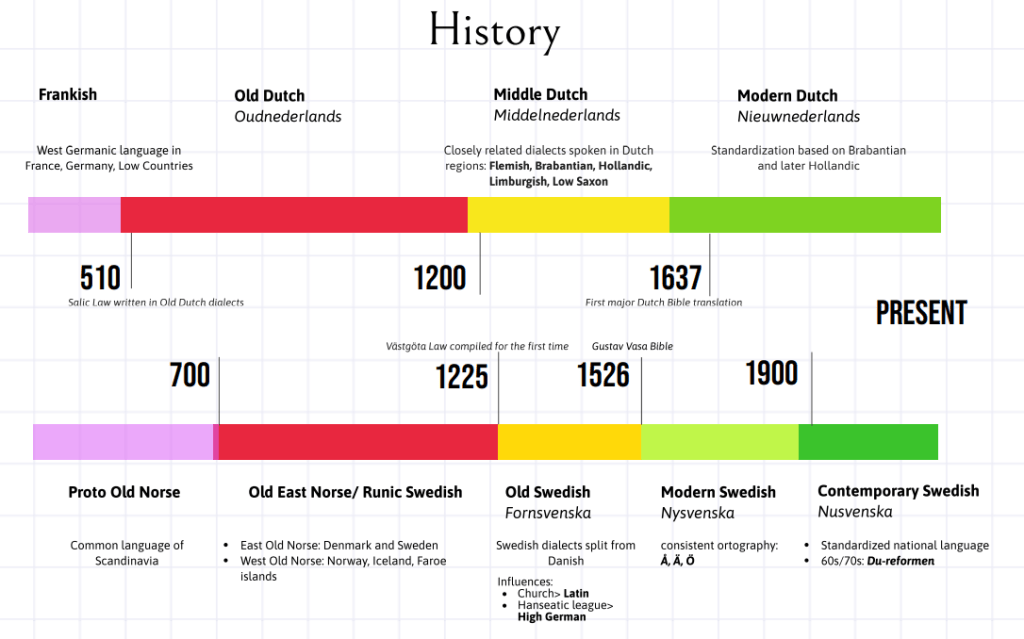
Both Swedish and Dutch have their origin in Proto-Germanic. Dutch evolved then from Frankish, spoken by Germanic tribes in the continent; and Swedish from Old Norse, the common language of people living in Scandinavia during the Viking Era.
Medieval Swedish and Dutch
- Old Norse underwent more changes which resulted in the appearance of two similar dialects: Old West Norse (Norway, the Faroe Islands and Iceland) and Old East Norse (Denmark and Sweden). with the usage of runic alphabet. From 1200 onwards, the dialects in Denmark began to diverge from those of Sweden. In 1225 the Västgöta Law is believed to have been compiled, among the most important documents of the period and oldest Swedish law codes in the latin alphabet.
- The early form of Dutch was a set of Franconian dialects: Flemish , Brabantian and Limburgish in the South; Hollandic and Low Saxon in the North of today’s Dutch speaking area.
Modern language & standardization
the advent of the printing press and the European Reformation had great influence in the standardization of languages, The Bible played a significant role, with major translations into Swedish and Dutch between the 16th and 17th century.
- The Swedish translation of the Bible ordered by the monarch Gustav Vasa introduced the letters Å Ä Ö (previously spelt as æ/a’, ao, oe) and the spelling “ck” in place of “kk”, distinguishing it clearly from the Danish Bible. All three translators came from central Sweden which is generally seen as adding specific Central Swedish features
- Dutch had Brabandic and dialects of Flanders as the most influential varieties in its standardisation, later replaced by Hollandic once Antwerp fell under the Spanish army and Holland became the Dutch-speaking area’s powerhouse. the Statenvertaling (“state translation”), the first major Bible translation into Dutch, was created so that people from all over the new republic could understand. It used elements from various dialects but was predominantly based on the urban dialects of Holland of post 16th century.
The du-reformen
A very significant change in Swedish occurred in the late 1960s, with the so-called du-reformen, “the you-reform”. Previously, the proper way to address people of the same or higher social status had been by title and surname, with the use of herr (“Mr” or “Sir”), fru (“Mrs” or “Ma’am”) or fröken (“Miss”). With the liberalization and radicalization of Swedish society these class distinctions became less important, and du became the standard in any context.
I might write a similar article with infographics differentiating the 3 Scandinavian languages or the other Nordic languages in the future, give me feedback!
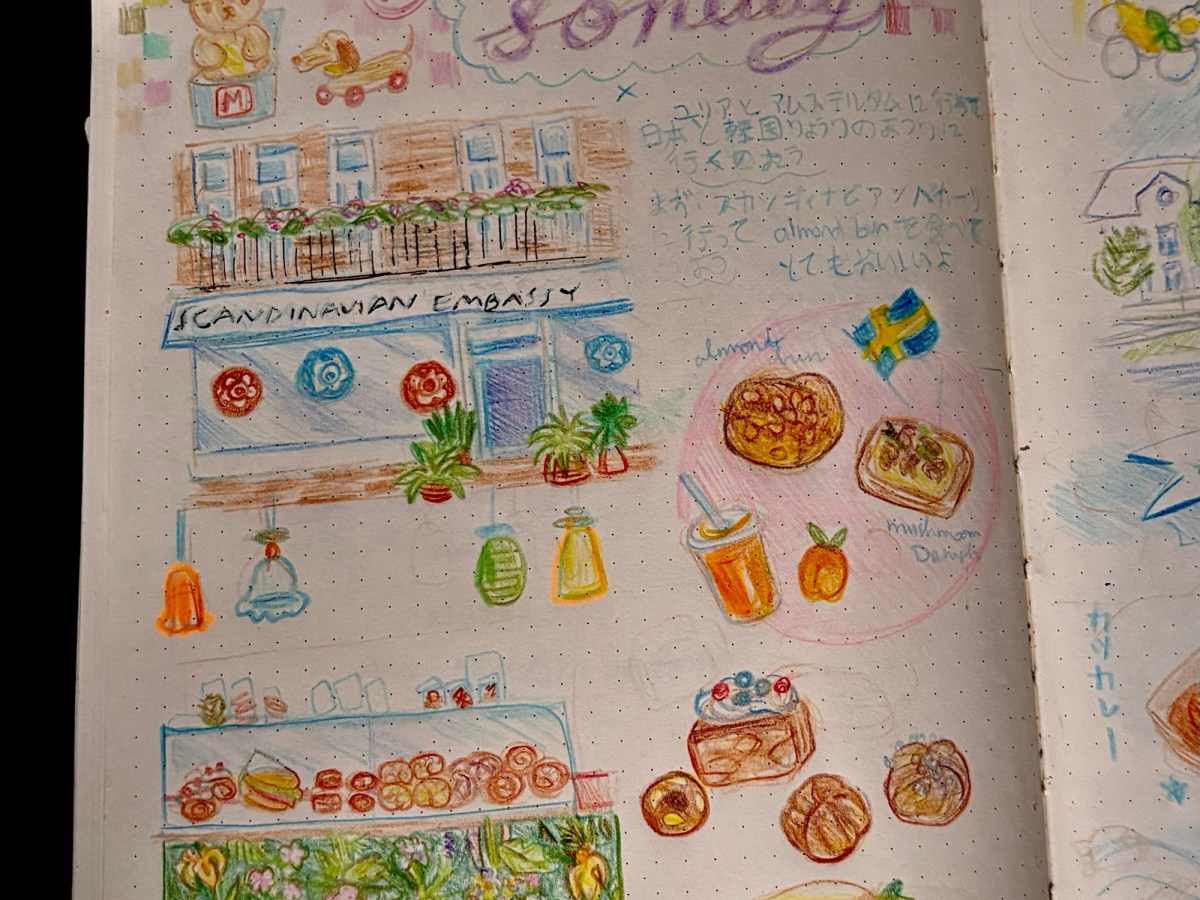
Scandinavian Embassy‘s bakery and cafe in Amsterdam zuid
On a trip to Amsterdam, I decided to test Scandinavian Embassy and both of its two locations, starting with the bakery in europaplein. The two locations are in Amsterdam zuid: Saphatipark and Europaplein: in the former, a more central location, you can sit but it has fewer items than the bakery in Europaplein. The bakery,…

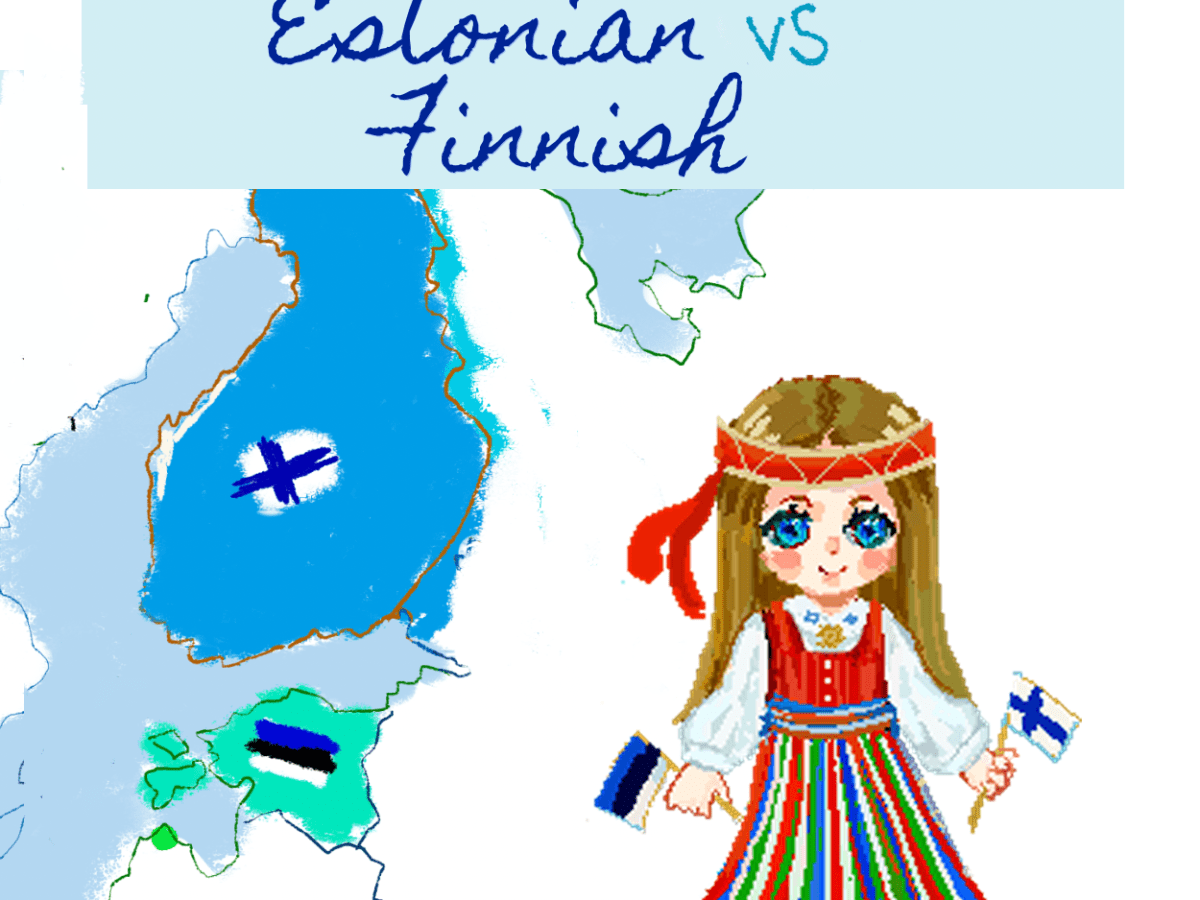
An introduction to Estonian: sister language of Finnish
Estonian is a Finnic language, sharing many similarities with its ‘bigger’ sister Finnish, while being unrelated to all their bigger language neighbours
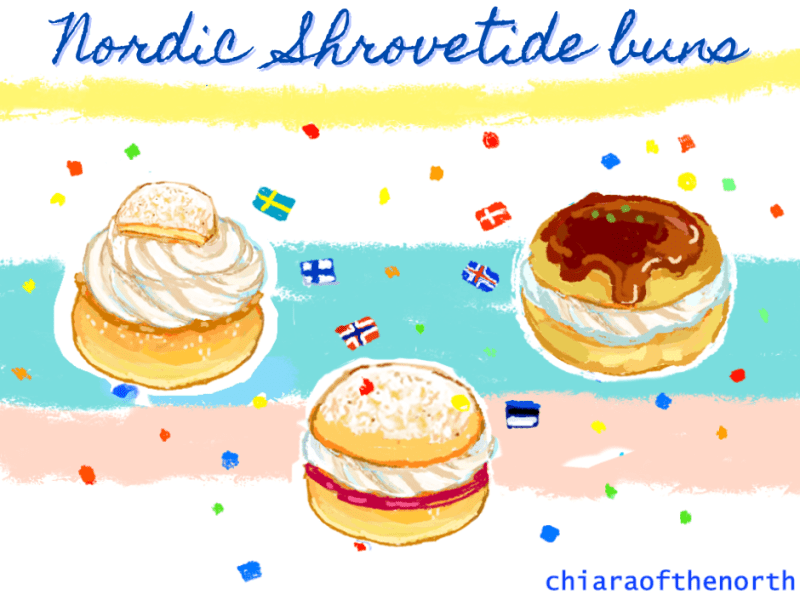
Scandinavian carnival buns (and where to eat them in the Netherlands)
Cream buns are enjoyed in Nordic and Baltic countries during shrovetide, between January and February. Sweden’s classic semla has almond paste, while other countries variations include jam, vanilla cream, and chocolate icing top.
 a Polyglot illustrating Scandinavia