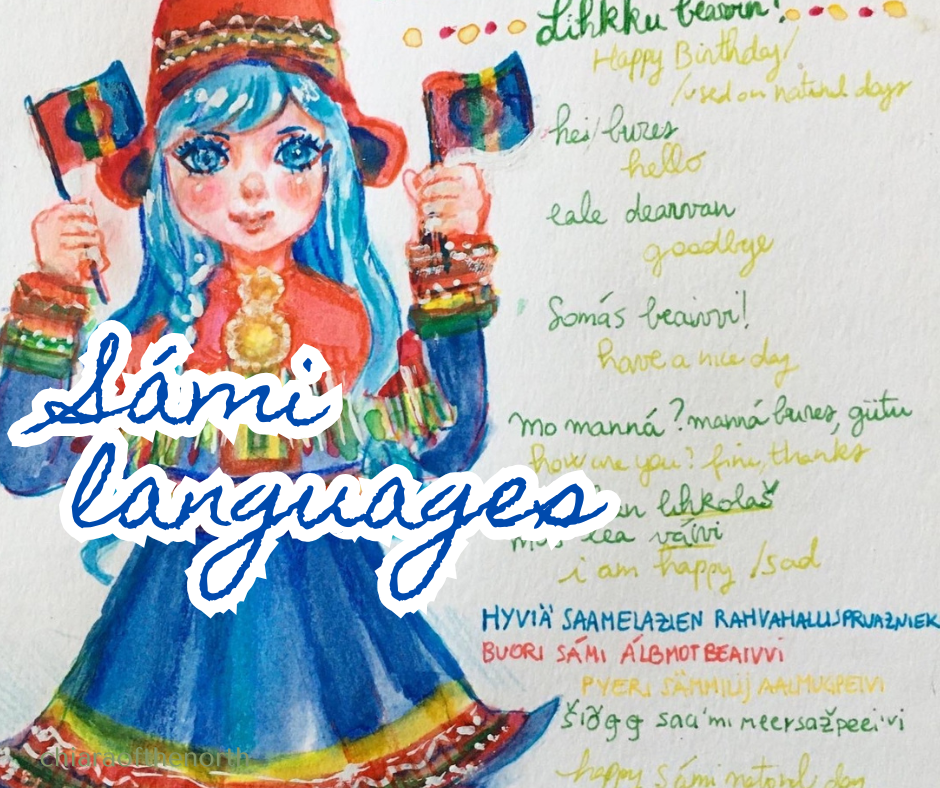
The Sámi people (Sámit/Sápmelaš in sami languages) are Northern Scandinavia’s indigenous people. I have talked about Sámi people and their National Day last year. This year I will focus on their languages, which are related to Finnish and Estonian, and completely different from Scandinavian languages as Swedish and Norwegian or other Indoeuropean languages as Russian.
Sámi languages speakers are approximately 30,000-40,000, out of around 100,000 people identifying as Sámi.
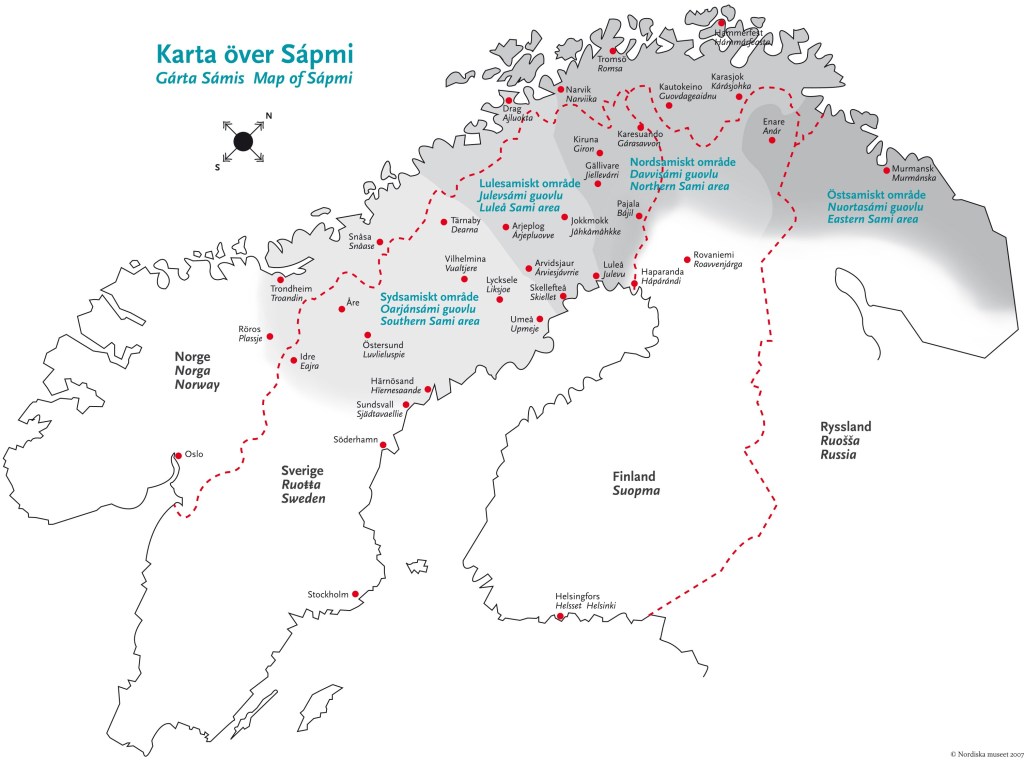
There are 10 distinct variations (of which 6 have standard written forms). They are not mutually intelligible to each other, although there is intelligibility among neighbor variants, which makes the Sámi languages a dialect continuum. According to the Store Norske Leksikon South and North Sami are as far as Norwegian and Icelandic.
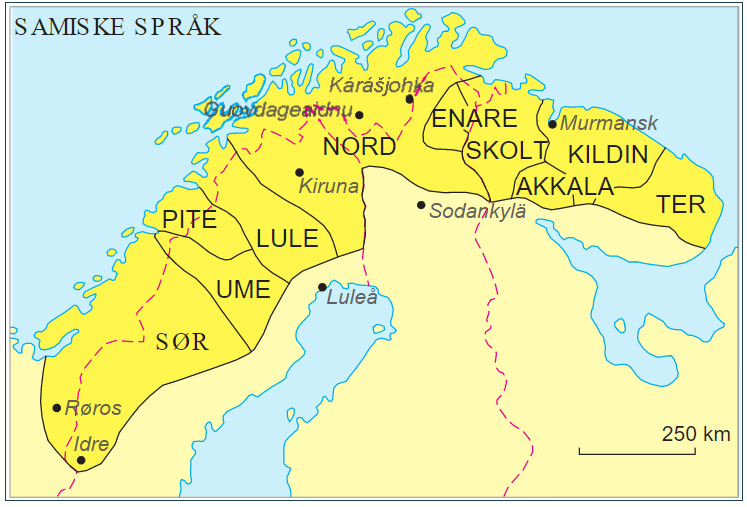
They can be divided into Eastern and Western language groups:
Western Sámi languages
| Language | Name in respective Sami language | Countries | No of speakers |
| North Sami | Davvisámegiella | Norway, Sweden, Finland | 15,000 (75% of all Sami languages speakers) |
| Lule Sami | Julevsámegiella | Norway and Sweden | 2000 |
| South Sami | Åarjelsaemien gïele | Norway and Sweden | 500 |
| Pite Sami | Bidumsámegiella | Sweden | 20 |
| Ume Sami | Ubmejensámien giella | Sweden | 20 |
Eastern Sámi languages
| Language | Name in respective Sami language | Countries | No of speakers |
| Inari | Anarâškielâ | Finland | 400 |
| Skolt | Sää’mǩiõll/nuõrttsää’m | Finland and Russia | 400 |
| Kildin | кӣллт са̄мь кӣлл | Kola peninsula, Russia | 750 |
| Ter | Saa’mekiill: | Russia | fewer than 10 |
| Akkala | Ákkil sámegiella | Russia | considered extinct. There are translations of the New Testament into it from 1755 and the bible in 1811 |
Sami and Finnic Languages
Sámi languages belong to the Uralic language family and are most closely related to the Baltic-Finnic languages (as Estonian, Finnish, and Karelian). You can read a quick guide to tell apart all Nordic languages. Here is a basic vocabulary comparison to give you an idea:
| Swedish/Norwegian | North Sámi | Finnish | Estonian | |
| nature | natur | luondu | luonto | loodus |
| Forest | skog | meahcci | metsä | mets |
| Shaman/witch | häxa/hekse | noaidi | noita | nõid |
| Brother | bror | viellja | veli | vend |
| day | dag | beivi | päivä | päev |
| life | liv | eallin | elämä | elu |
| love | kärlek/kjærlighet | ráhkisvuohta | rakkaus | armastus |
| mother | mor | eadni | äiti | ema |
| reindeer | ren | boazu | poro | põhjapõdrad |
As you might notice, historically related words in Finnish with p, t, k have b, d, g in Sámi.
Sámi language features
Note: what follows refers mainly to North Sámi
Noun cases: like Finnish Sámi languages are agglutinative and highly inflected, nouns and adjectives change form according to their grammatical roles. Northern Sámi has 7 noun cases.
Sámi verbs have dual forms: Other than three singular and plural persons the verb conjugations can indicate an action by two people (plural is more than two).
Sámi originally had no words beginning with two or more consonants: Spasibo (спасибо) became pass’bo in Kildin Sámi. Similarly to Finnish tuoli, kuoli from Swedish stol, skola.
Vowel harmony in Sámi languages: As in Finnish, Sami languages have some kind of vowel harmony, the given name Knut become Knavhta, adding a third vowel.
Unique letters of Sami alphabets: Scandinavian varieties of Sámi languages use the Latin alphabets, with additional characters: The unique letter “Ŧ/ŧ”, similar to English th in “thin” and Thorn þ still used in Icelandic. “Đ/đ” is equivalent to Icelandic ð. Other letters occurring in Sámi languages are Áá Čč Ŋŋ Šš Žž.
| English | North Sami | Lule Sami | South Sami | Ume Sami | Pite Sami | Inari Sami | Skolt Sami |
| Sámi Land/area | Sápmi | Sábme/Sámeednam | Saepmie | Sábmie | Sábme | Säämi | |
| Sámi Traditional clothing | Gákti | Gábdde/Gáppte | Gapta/Gaeptie/Gåptoe | Gápttie | Gáppte/Gåppto | Mááccuh | määccaǩ |
| Sámi National Day | Sámi álbmotbeaivi | Saemiej åålmegebiejjie | Säämi aalmugpeivi – | Saaʹmi meersažpeiʹvv | |||
| Happy New Year! | Buorre Ođđa Jahki! | Buorre Ådå Jahke! | Buerie Orre Jaepie! | Buörrie Urra Jáhpie! | Buorre Årrå Jahke! | Pyeri uđđâ ihe! | Pyeri uđđâ ihe! |
| Merry Christmas! | Buorit Juovllat | Buorre Javla! | Lahkoe Jåvlh | Buörrie Juvlla! | Buorre Jåvvlå! |
Language status and discrimination
All the Sámi languages are considered endangered, this is due in part to historic laws prohibiting the use of Sámi languages in schools and at home in Sweden and Norway. Sámi languages were illegal in Norway from 1773 until 1958. Special residential schools that would assimilate the Sámi into the dominant culture were established, and access to Sámi instruction as part of schooling was not available until 1988.
Samer.se underlines that in the 60s and 70s many Sámi parents did not speak Sámi to their children. This was a reaction to the negative experiences and the discrimination faced in Swedish schools, which however resulted in depriving children of their mother tongue, and many suffered from that as adults.
In the last decades of the past century this attitude started to change, granting the rights to have education in Sámi languages and esthablishing funds for the promotion of Sámi culture and languages. Sami languages have obtained official status in a few municipalities, where they can be used in government services, courts, pre-schools and nursing homes.
- Norway: Sámi languages have official status in 9 municipalities in the counties of Finnmark and Troms.
- Sweden: official status in 4 municipalities, Since 2002 Sámi languages have been recognised as minority languages.
- Finland: official status in 4 municipalities.
- Russia: Sámi people are recognised as an indigenous people but their languages have no official status.
Art and media in Sámi languages
The first two recorded Sámi poems are by Sámi priest and poet Olaus Sirma (1655-1719), included by Johannes Schefferus of Uppsala in his book Lapponia in 1673.
Parne miela Piägga miela,
Noara Jorda kockes Jorda.refrain of Moarsi favrrot/The Beloved One, translated in “a Lapland song” by Henry Wadsworth Longfellow (1807-1882) and included in the long poem “My Lost Youth”
A boy’s will is the wind’s will,
the thoughts of youth are long, long thoughts.
The oldest Sámi language newspaper is Nuorttanaste (Eastern Star), a religious paper began in 1898 and still published in Norway. The Sámi-Swedish bilingual Newspaper Samefolket began in 1918, and Sapmelas, founded in 1934 and renamed in in 1993 Odda Sapmelas (The New Sámi) is published in Finland.
Various Sámi units of national broadcasting company exist: NRK Sápmi (Norway), Yle Sámi Radio (Finland), Sameradion (Sweden).
The 1970s saw a blossoming of Sámi language literature that has continued to the present, with Sámi artists focusing their work on Sámi language and Sámi traditional themes. Prominent figures include Nils-Aslak Velkeapää (writer, singer, multimedia artist); Paulus Utsi (poet); Vuokko Arvonen (feminist writer); Nils Gaup (filmmaker); Mari Boine and Sofia Jannok (singers). In Norway, the yearly Riddu Riđđu festival in Olmmáivaggi/Manndalen features music, art, theater from Sápmi, including Sámi rap music, yoik rock and dramas from Beaivváš Sámi Našunálateáhter, the Sámi national theatre.
Online Resources to learn Sámi languages
Find resources to learn Sami languages in my resources list page
Subscribe for more language info and resources:
Sources for this article:
- Sanders, Ruth H. The languages of Scandinavia (2017) The University of Chicago Press
- Samer.se
- Den Store Norske Leksikon
- Valokki and Talvatis on tumblr
- Omniglot.com


7 thoughts on “Sámi languages”