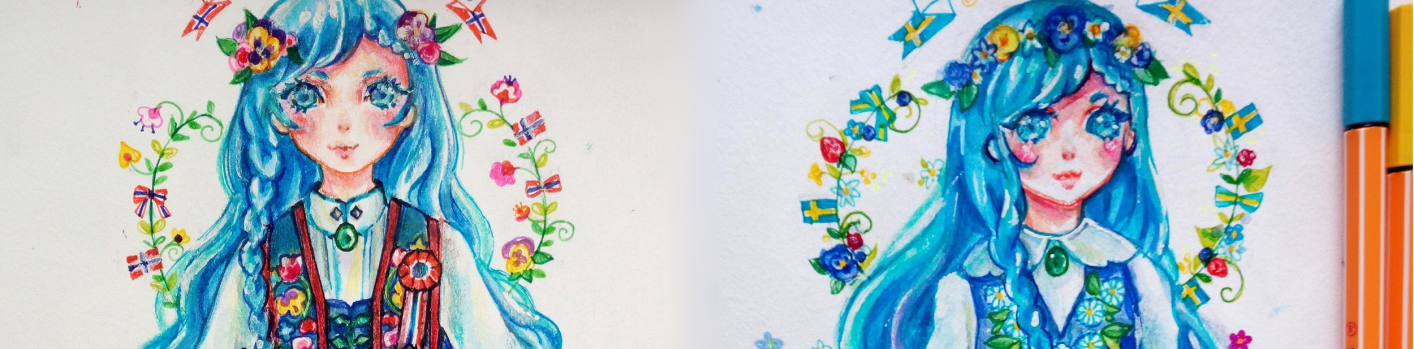
My birthday falls on Sami national day, and to honour the sami people (who used to be called Lapps), I decided to write an an article about their traditional clothing, after Swedish and Norwegian costumes.
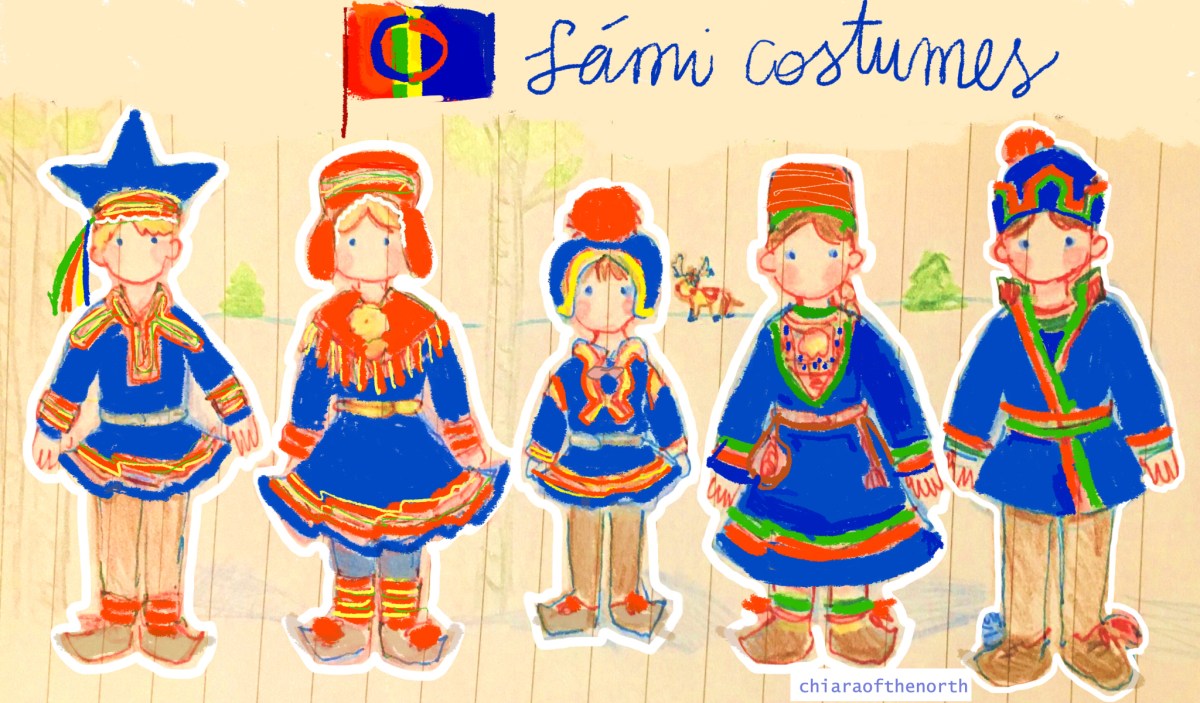
The main part of the Sami traditional costume is called gapta/gåptoe, in southern Sami, gábdde in Lule Sami, gákti in Northern Sami. In Swedish and Norwegian repectively kolt and kofte. Sami costumes include hats, belts, jewellery as brooches, mittens, shoelaces.
There are traditional superstitions tied to the costumes, for example, if the shoelace came loose, someone was thinking about that person or was about to joke about them.
Sami handicrafts, Duodji, also include making your own clothing, and that is still the case for some families. Natural resources determined the material to produce clothing, which consisted in just skin and fur until the middle ages and the introduction of fabric.
In 1940 the archeologist Gutorm Gjessing and his wife Gertrjud were the first to write about Sami clothing, in their book Lapdrakten.
Sami costume variations
Sami Costumes vary depending on the geographical area and gender, with bright colors that are also present in the Sami flag: red, white, yellow and Green. The base color of dresses is most often blue, especially since the post-war period, with edges and details in red, yellow and green. In the 1960s, Sami women started sewing summer costumes with floral-patterned cotton, as you can see in this music video of Sami singer Elin Oskal..
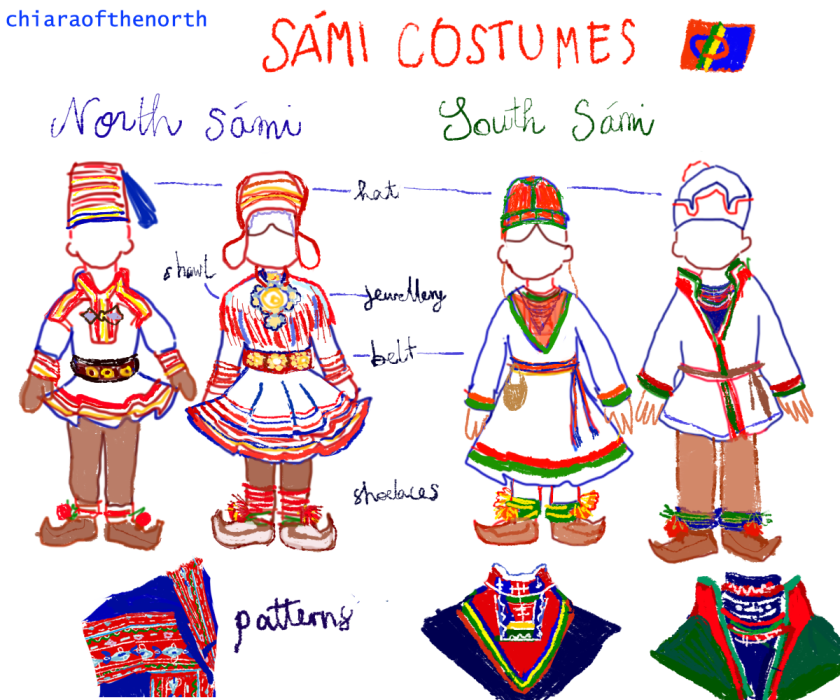
Generally, variations in Sami costumes follow Sami languages and ethnical groups within Samis. However, because of nomadic life depending on reindeers, designs from different groups ended up influencing each other.
Although Sami costumes vary district by district, there is a marked difference between North and South Sami variations. The most notable is the neck style and length: long dress and v-neck with intricated decorations on the the breastplate for women costumes to the south of Jokkmokk, with a shawl on top and a more “curled up” end in the North Sámi versions.
Other variations depend on gender or status: Skolte-sami women hats change for girls, married and single women; Lule and South Sami dresses have red breastplates for women and blue for men.
Sami iconic hats
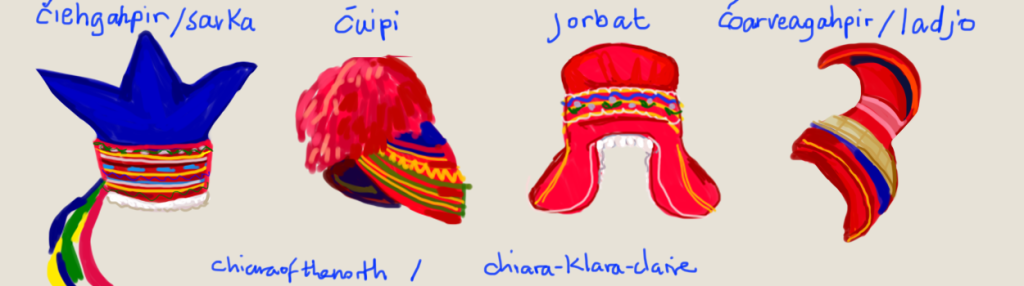
An important part of Sami costumes is the hat, which also strongly differ depending on gender, area and status. Various types of hats exist (see picture), different for men and women. Among others:
men hats: Four Winds Hat, čiehgahpir or Šávka, with summer and winter variations (also stjernelue in Norwegian “star hat”), used in East Finnmark, Karasjok, Kautokeino, North-East Norway; ćuipi, a kind of poofball hat with a big red pom pom, used in Karesuando, Swedish Lapland.
Women hats: Jorbat, the hat with the big ‘ears’; Ládju/ladjo, also called čoarvegahpir (čoarvi – horn, gahpir – hat), which stopped being used a hundred years ago, but still exists in eastern Sami areas now under Russia.
Costumes as a symbol of Sámi identity
Some Sami grow up wearing it, others only use it for their confirmation ceremony, others got it as adults, taking pride in their ethnic identity, which was repressed and discouraged due to discrimination and forced assimilation in the past. A revival lead to reconstruct costumes also in areas where they were disappeared, similarly to what happened with Norwegian bunads.
In the 1970s, Sami movements made it an important symbol for Sami identity, leading many young Sami to sew their own costumes. Wearing Sami costumes became a new tradition in some contexts, as during Sami national parliament assemblies in Sweden, Norway and Finland.
Sources (Norwegian):
- Store Norske Leksikon https://snl.no/samisk_drakt
- Samiskeveivisere https://samiskeveivisere.no/article/gakti-gapptie-gapta-gaeptie-gappte-maaccuh-maceh-maccak-macca%C7%A9/
Beautiful Finnish Idioms that do not exist in other languages
Unique Finnish expressions emphasizing typical traits of Finnish culture, as its connection to nature and a melancholic feeling.

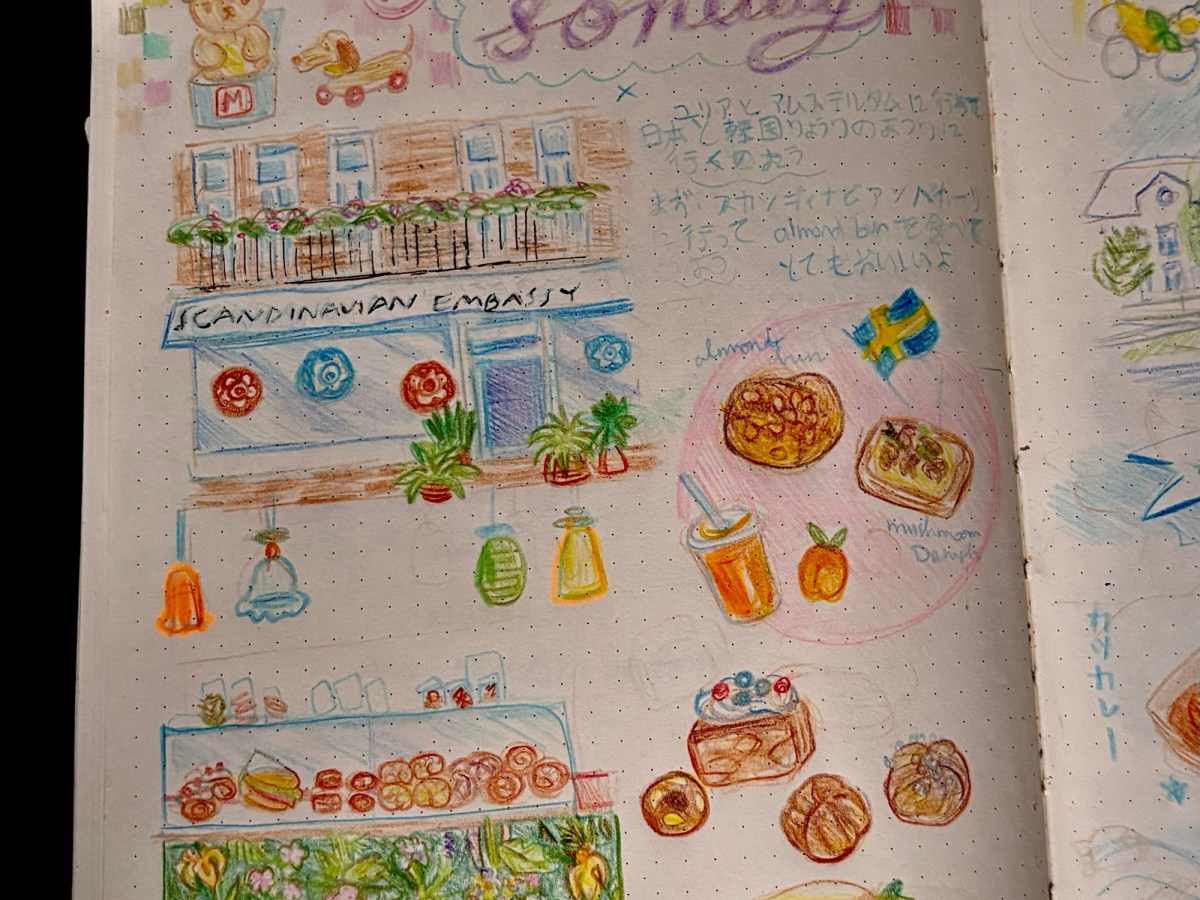
Scandinavian Embassy‘s bakery and cafe in Amsterdam zuid
On a trip to Amsterdam, I decided to test Scandinavian Embassy and both of its two locations, starting with the bakery in europaplein. The two locations are in Amsterdam zuid: Saphatipark and Europaplein: in the former, a more central location, you can sit but it has fewer items than the bakery in Europaplein. The bakery,…
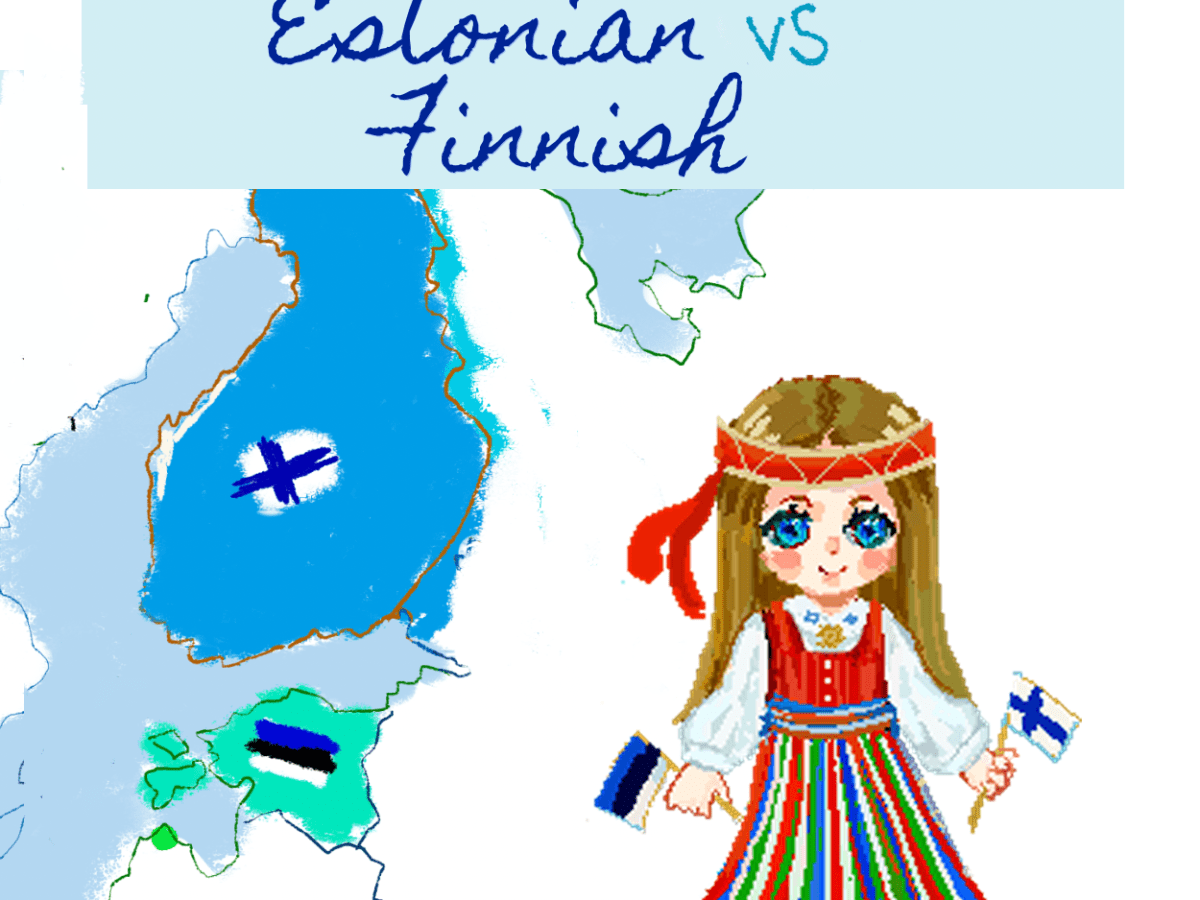
An introduction to Estonian: sister language of Finnish
Estonian is a Finnic language, sharing many similarities with its ‘bigger’ sister Finnish, while being unrelated to all their bigger language neighbours
 a Polyglot illustrating Scandinavia
I would like to know how Sami languages influence Nordic languages and vice versa. Is it easy for speakers of Germanic languages to learn Sami languages?
LikeLike
Hi! Sami language are completely unrelated to Germanic languages and belong to the Uralic family, as Finnish. So No, learning a Sami language (just like learning Finnish) will most likely be quite challenging for the different vocabulary and grammar.
LikeLike
I asked a linguistic expert if it happens often that languages of different language families influence each other when they have contact like Arabic- Persian- Turkish. That’s his answer: “It’s not unique at all; in fact, I’d even go so far as to say that such things happens at some point to every language! The longer speakers of different languages are in close contact with one another, the more likely they are to adopt features of each other’s languages”
LikeLike
Thanks for your answer. I know that they belong to a very different language family. Sometimes languages from different language families influence each other a lot when the speakers have a lot of contact like Arabic – Turkish – Persian: three very different language families but very similar cultural heritage and a lot of loan words. ( About 80% of old Turkish words were Arabic)
LikeLike