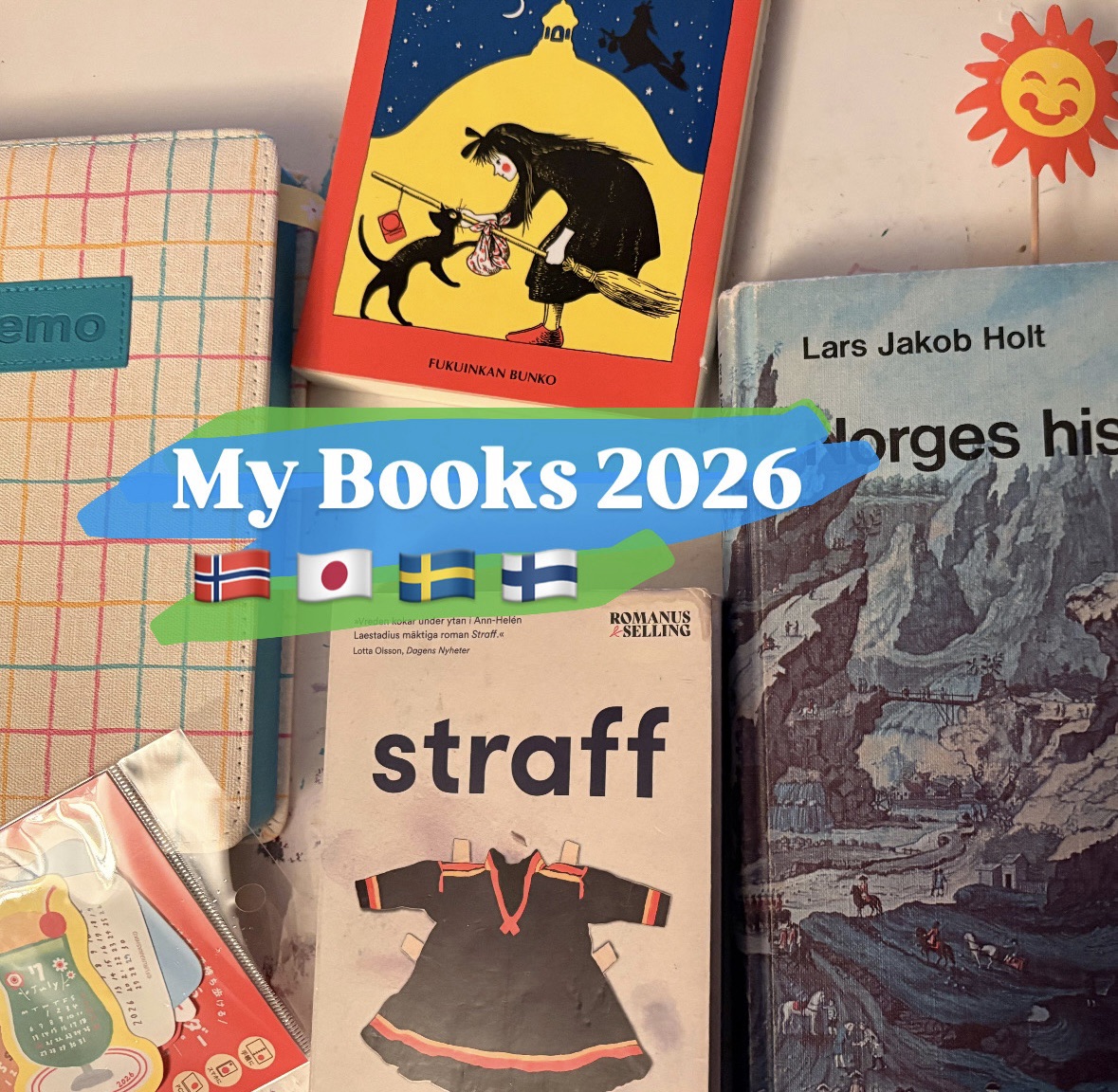
my 2026 language plans with books: continue reading Swedish novels and Norwegian non-fiction, and studying Finnish.
As I did for my Nordic books 2025, here is an updated list of books I will be reading and textbooks I want to use in 2026
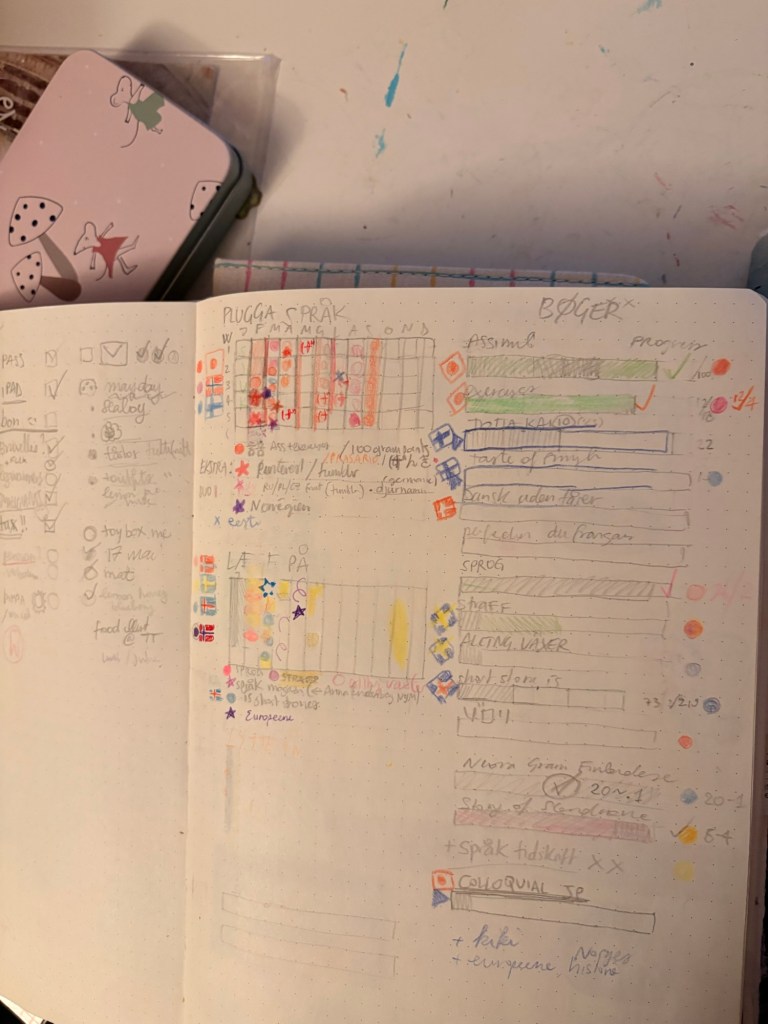
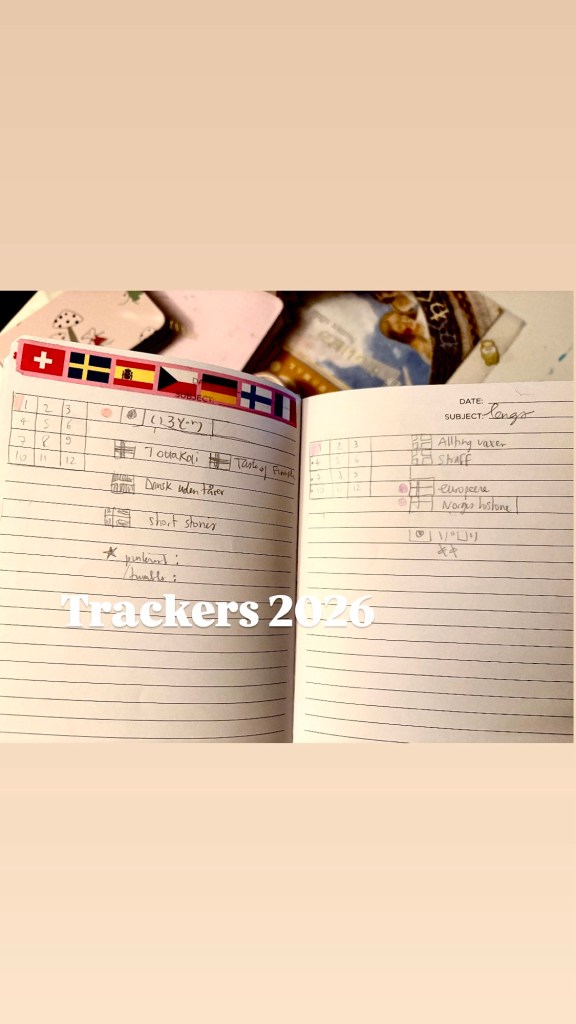
Below my trackers for 2025 and 2026: in 2025 I mostly studied Japanese and read Swedish novels
Book I am reading in Swedish and Norwegian
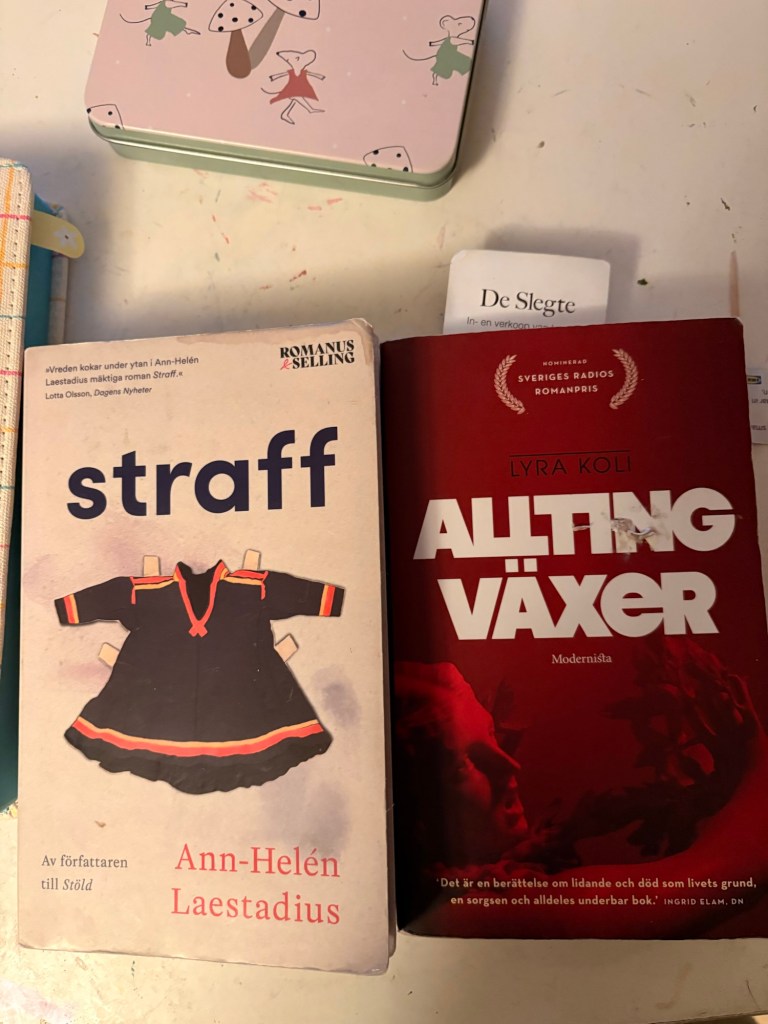
Novels to finish
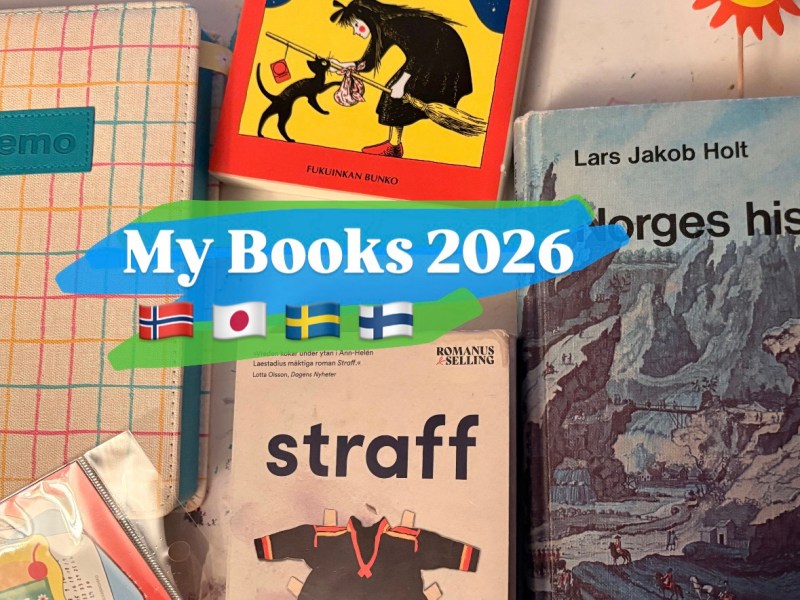
Straff, Ann-Helen Laestadius – Sami kids taken away from their families to a Sami-hostile environment, who meet again 30 years later.
Allting växer, Lyra Koli – dystopic novel about a Scandinavian girl set in a post- world war and climate catastrophe world.
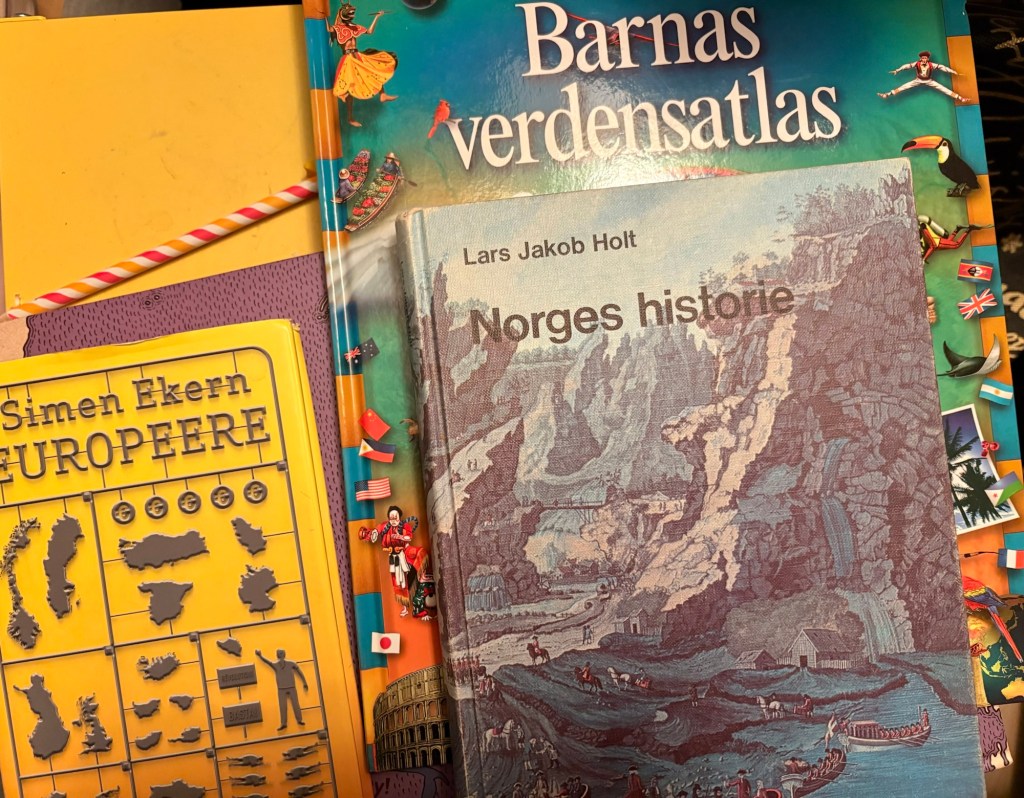
Norwegian books got from the thrift book shelf at the Norwegian Seamen Church
Europeere, Simen Ekern – an essay on the European Union, written around 10 years ago. This was how I opened my 2026 readings!
Norges Historie – encyclopedia-ish book on Norwegian History, from Vikings to the 70s, when it was published
Books to study Finnish
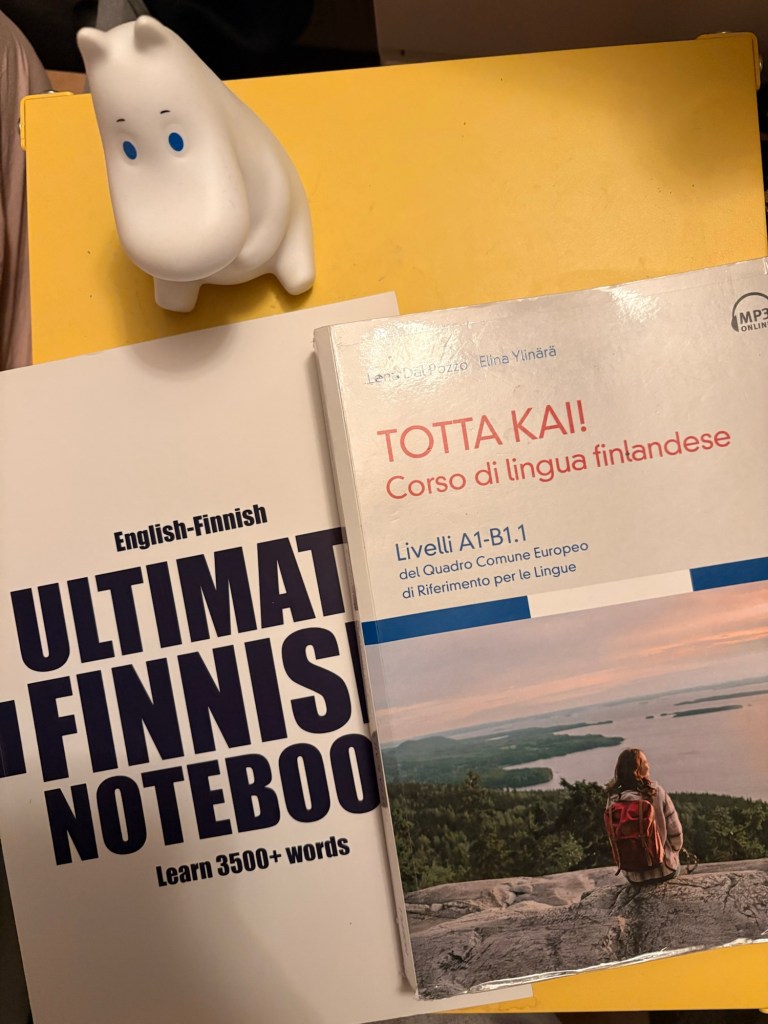
Later this year, I want to try focusing on Finnish for a while. I still have my coursebook I purchased a couple years ago, and can work on vocabulary thanks to the Ultimate Finnish Notebook (get a discount on such books for a lot of languages! – code ChiaraBeretta)
Due to my limited time, i had no time for Finnish last year, also because I tried to fully focus on studying Japanese (as for Japanese – I will use Irodori/いろどりfree online textbooks/resources). I recently purchased an Assimil book for Finnish, which should make learning Finnish while commuting easier thanks to it’s compact format and bite-size lessons
Icelandic and Danish for fun
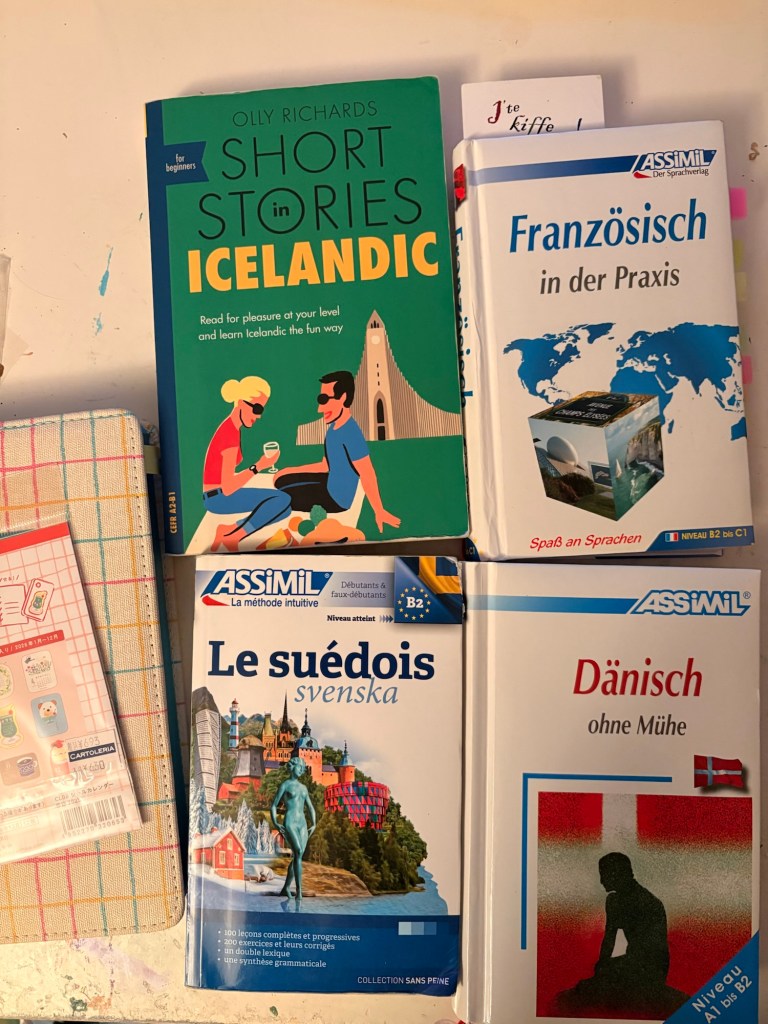
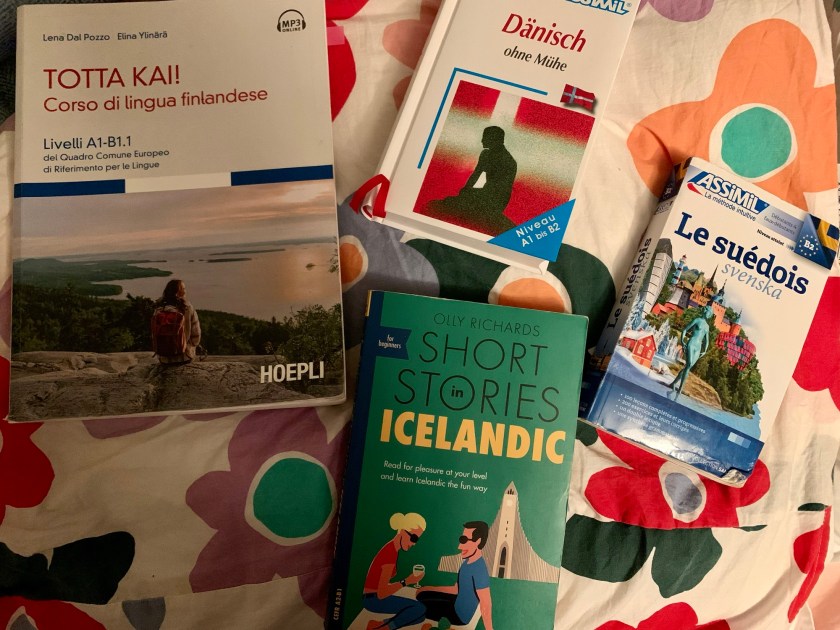
As I wrote last year, I might try to improve my Danish with the German Assimil edition. Other books, as Swedish assimil and Short Stories in Icelandic, were started in the past and I might continue (for Icelandic) or review (for Swedish) them later.
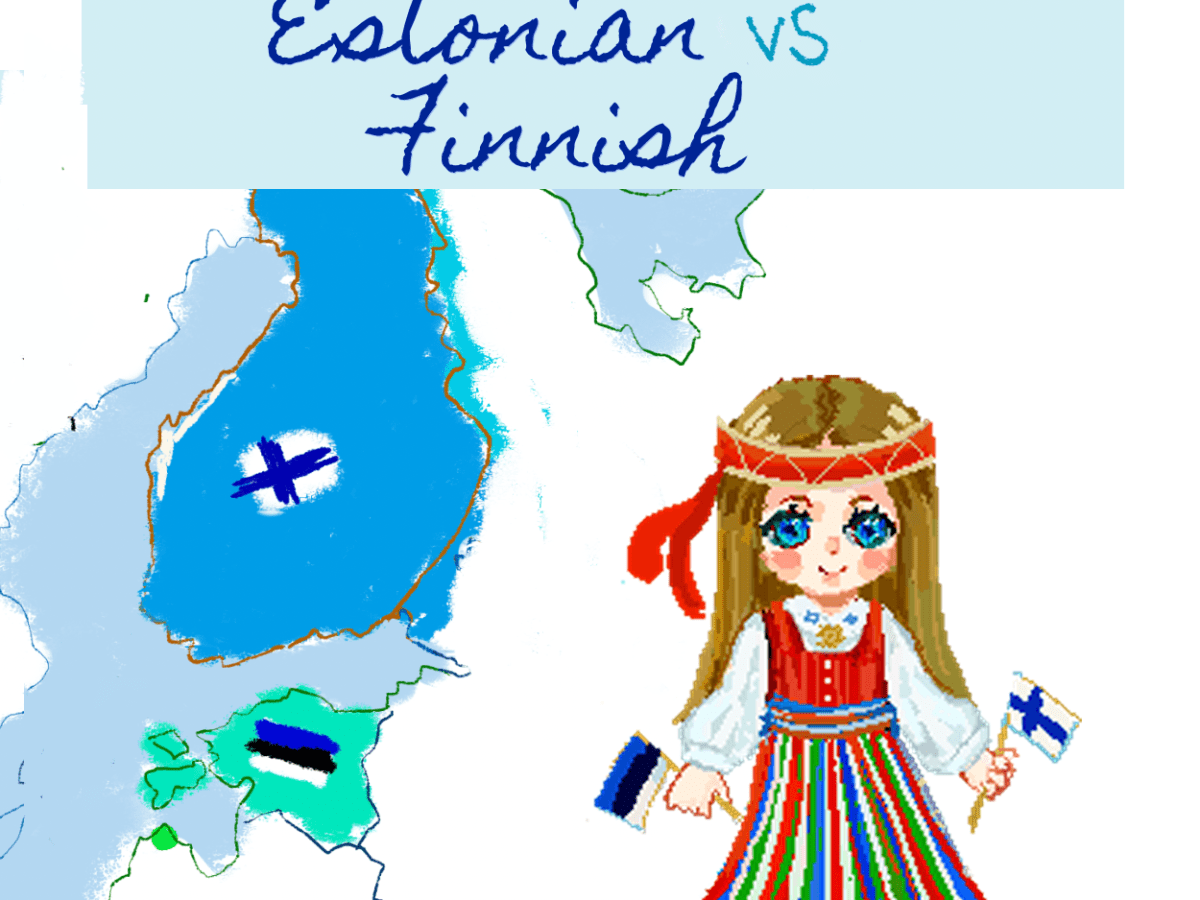
Estonian is a Finnic language, sharing many similarities with its ‘bigger’ sister Finnish, while being unrelated to all their bigger language neighbours
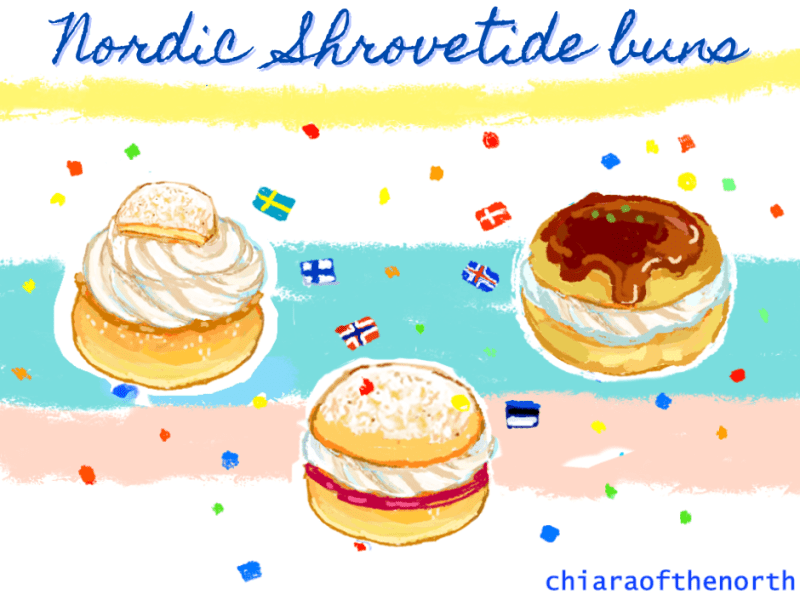
Cream buns are enjoyed in Nordic and Baltic countries during shrovetide, between January and February. Sweden’s classic semla has almond paste, while other countries variations include jam, vanilla cream, and chocolate icing top.
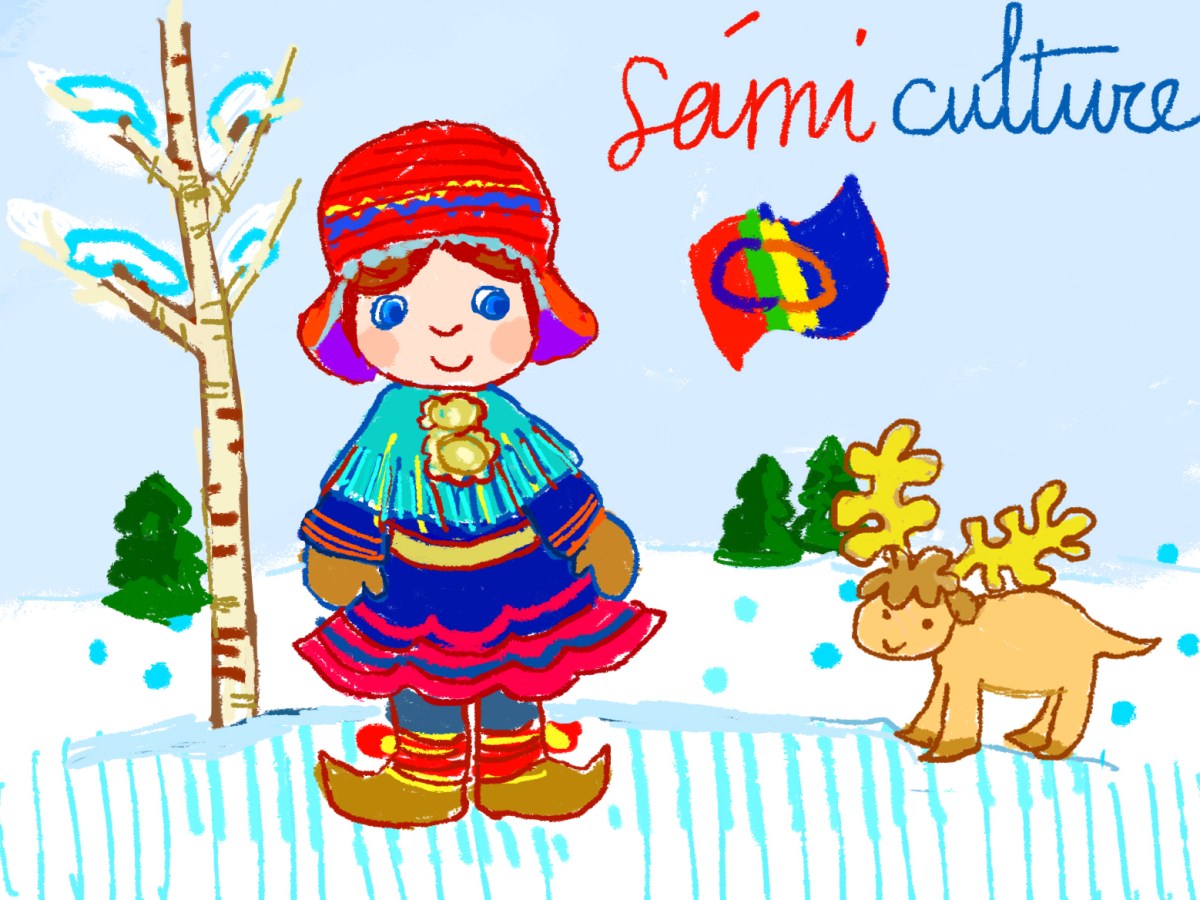
Sámi people, indigenous people of North Scandinavia, have a distinct culture, symbolised by its unique flag and traditional clothing, and part of it are Duodji handicrafts and unique musical expression through yoik.
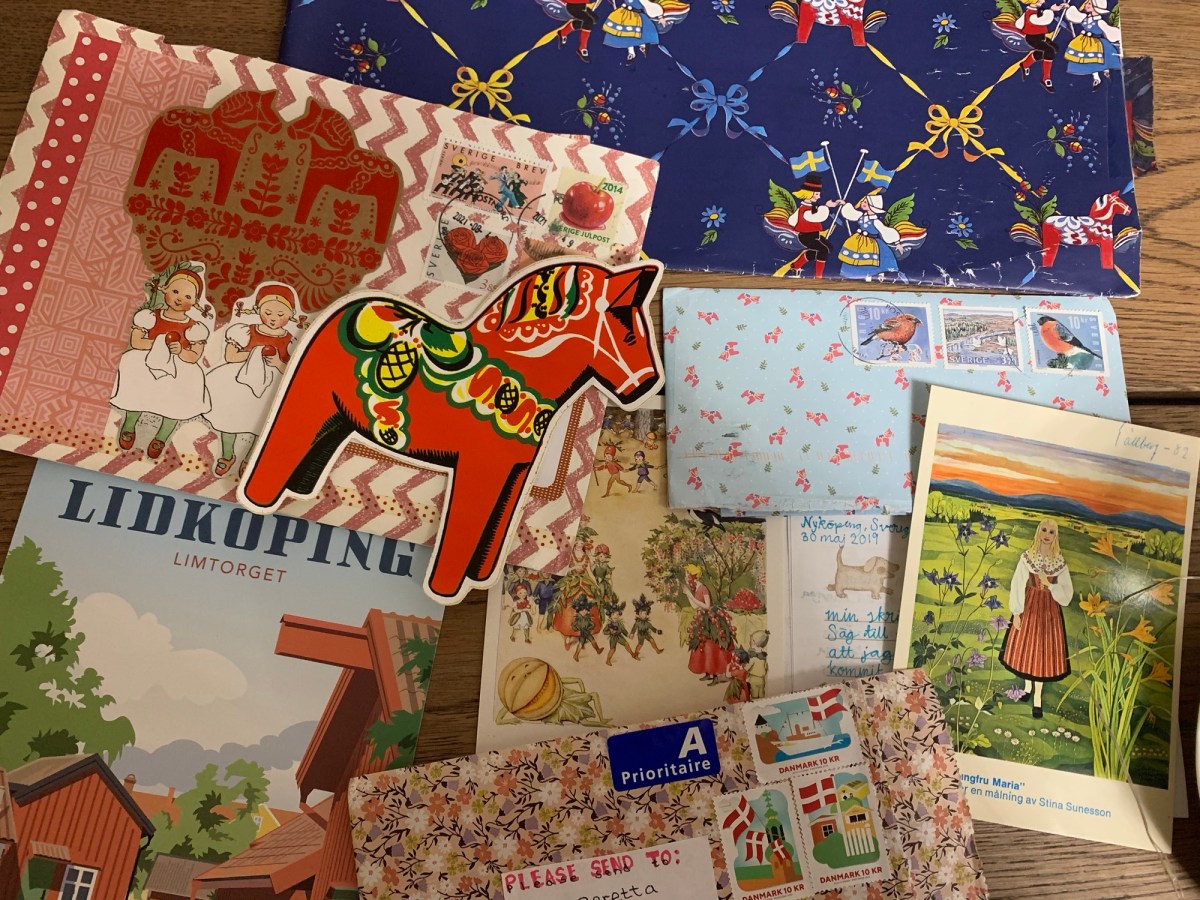
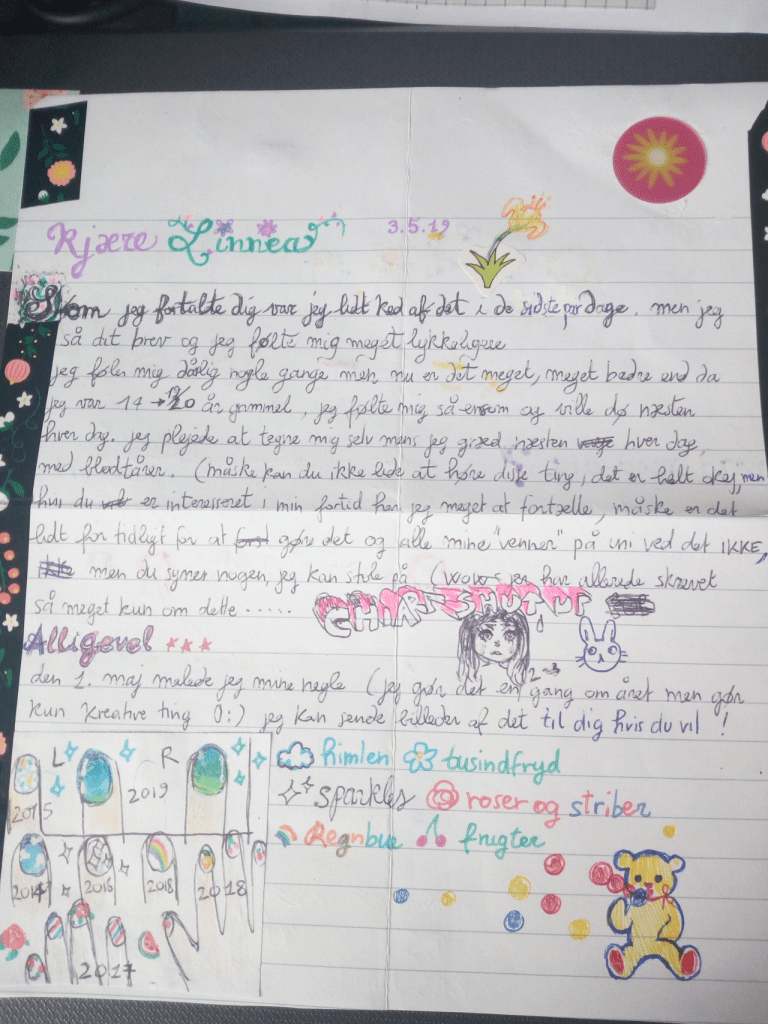
Snailmail is a great way to practice languages at your own pace, make friends and get creative at the same time!
I have been into penpalling/snailmail since my early teenage years, and I started using this hobby more recently as a way to practice languages.
I actually started learning Danish and Norwegian by writing letters in them. I spoke decent Swedish already and could read them, but had to look for a lot of words and correct grammar forms, and that was a boost, learning actively while having fun and being creative! At the moment, I am actively using my Finnish and Japanese with my penpals from Finland and Japan.
How to find penpals: hashtags, communities, websites
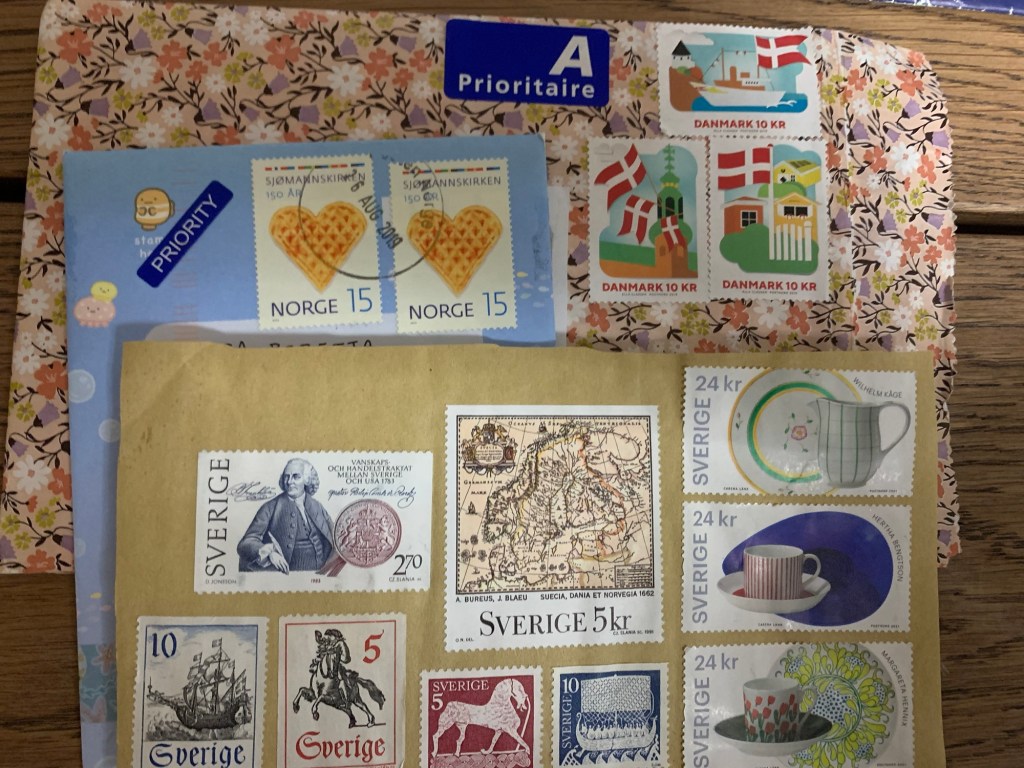
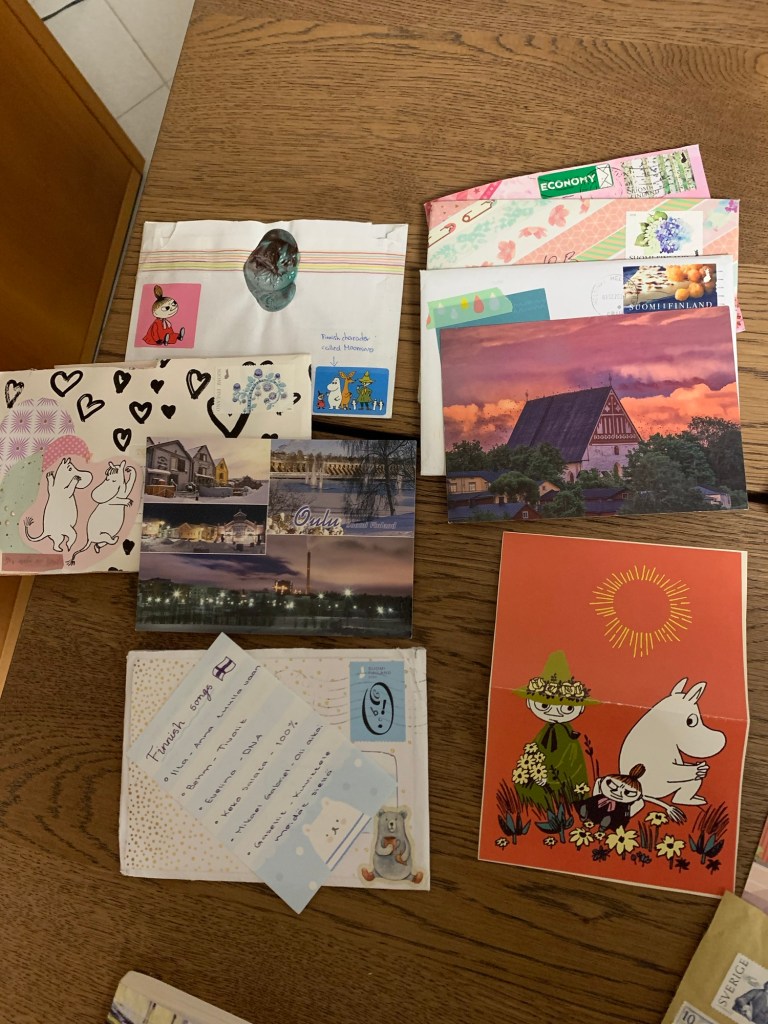
Pretty stamps from Scandinavia!From a Finnish penpal
One of the ways to find other people interested in penpalling is searching with the right hashtags on social media as instagram and tiktok. For example #penpalswanted , #lookingforpenpal, etc. In some cases snailmail accounts give a chance to comment and introduce themselves under a post to those looking for a penpal.
There are also websites made for people looking for a penpal, for example Global Penfriends, interpals.net... Here you can select a country and age to find your future penpals! Other websites are country-specific as Pen friends clubs of Japan.
introduce youself with a video or post adding the hashtags above, or interact and send messages to other penpal-wannabes. Talk about your interests, your aesthetic, show your letters and. No creativity, special things you’d send as stickers, postcards..
Get creative: material you need & ideas. pinterest board
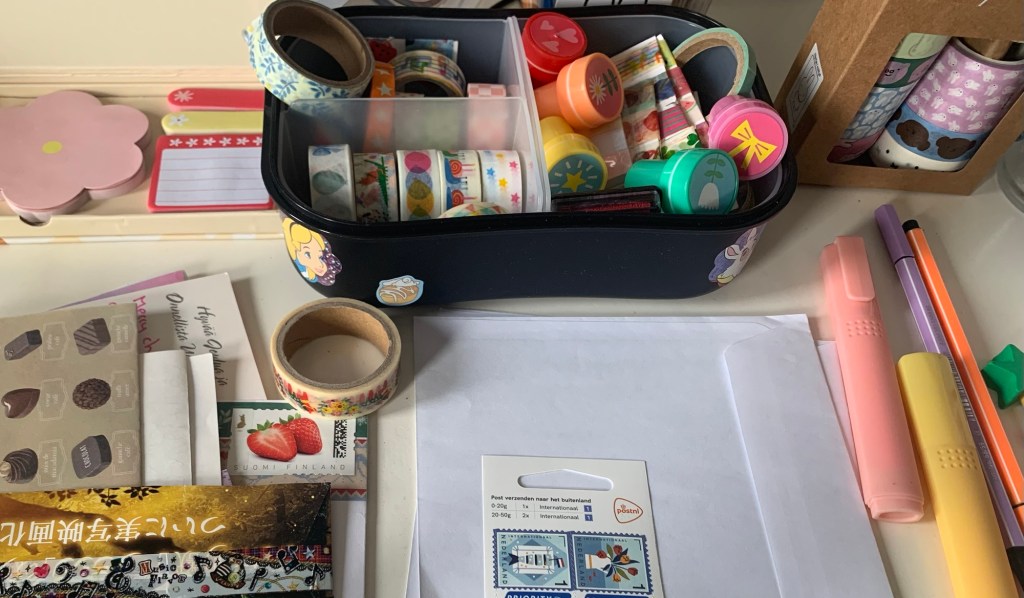
Some of my snailmail material: washi tapes, stamps and pretty sticky notes
There are no right or wrong things to include in a letter, but usually, the more things you include in it, the nicer it is for your penpal receiving it!
In this Pinterest board I add inspirational pictures for my letters. Some ideas:
washi samples, stickers
memo notes
postcards
cutouts (pictures from magazines..)
Questions for your penpal
songs
Similar the length of your letter is up to you. When practicing languages, the longer the more space to improve! It can be as personal as you want it to.
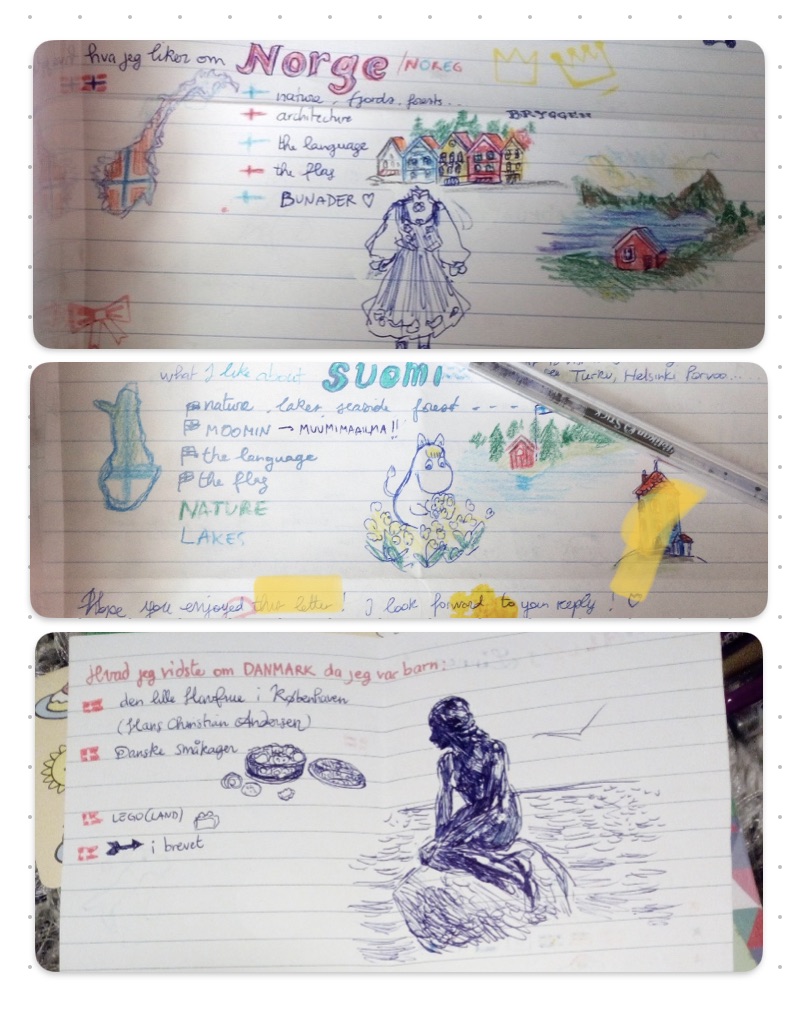
fun fact: When writing to a new penpal, I always write/doodle about things I like or know about the other person’s country, copying illustrations from books I had as a child among others 🙂
Stick to the language
As I mentioned in my blog post about practicing a language spoken in a country with high English proficiency, it is important to find a space whee you force yourself to use that language no matter what – and writing letters is a perfect solution for that. It is a relaxed, fun way to practice taking your time, both when reading others’ letters and writing your own. You can look up words, and exercise writing in other scripts too if needed! Just handwriting å, æ or ð feels quite satisfaying to me.
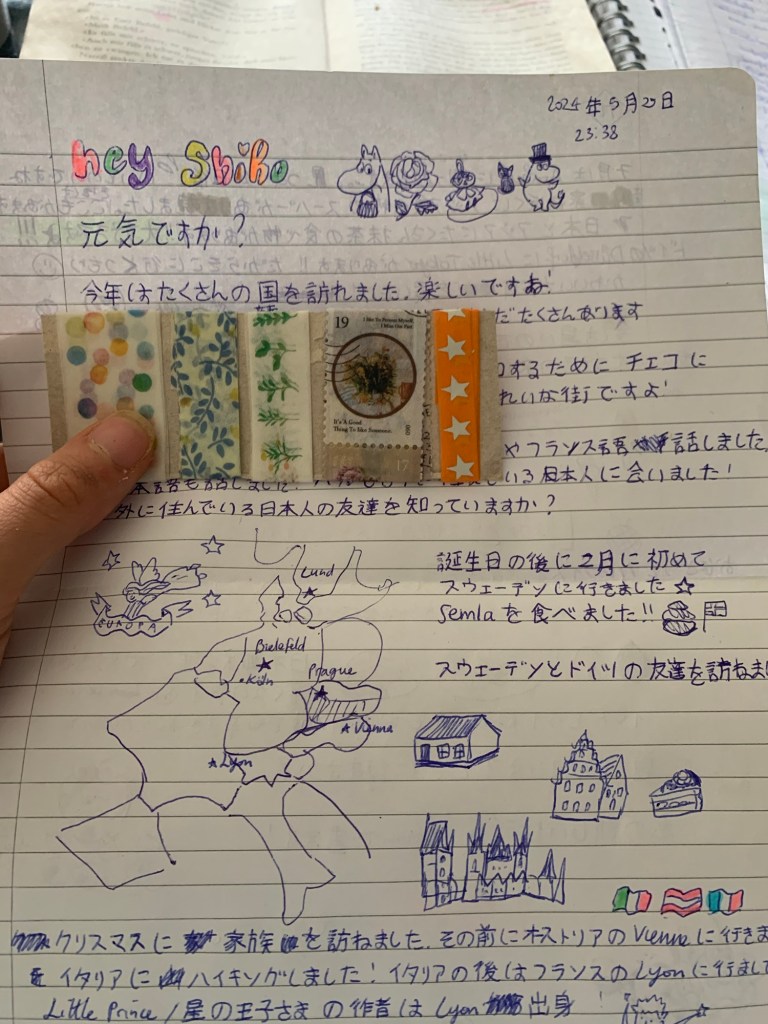
For a Japanese penpalFor a Danish penpal
Penpal etiquette
If you are the one asking to become penpals and get a yes – write first. It is also possible to do swaps – one-shot mail exchanges where you send more things than in an ordinary penpal letter. In that case, sending it at the same time would be a fair option if you inform yourselves about what the other person likes to begin with.
In the first letter, introduce yourself and your interests, what you like/dislike..
Try to put similar effort in letters as your penpals do, or ask them what they’d like to receive – it would be a bit unfair if someone uses a lot of materials, decorations and small gifts while you send a half empty sheet in a blank envelope.
If you do not feel like continuing writing to a penpal – that’s totally okay, but let the penpal know.
Novels, non-fiction and coursebooks to learn Nordic languages I plan to or might use this year, from Swedish to Icelandic.
I already had these books in 2024, started some of them during the year but still have some to begin yet:
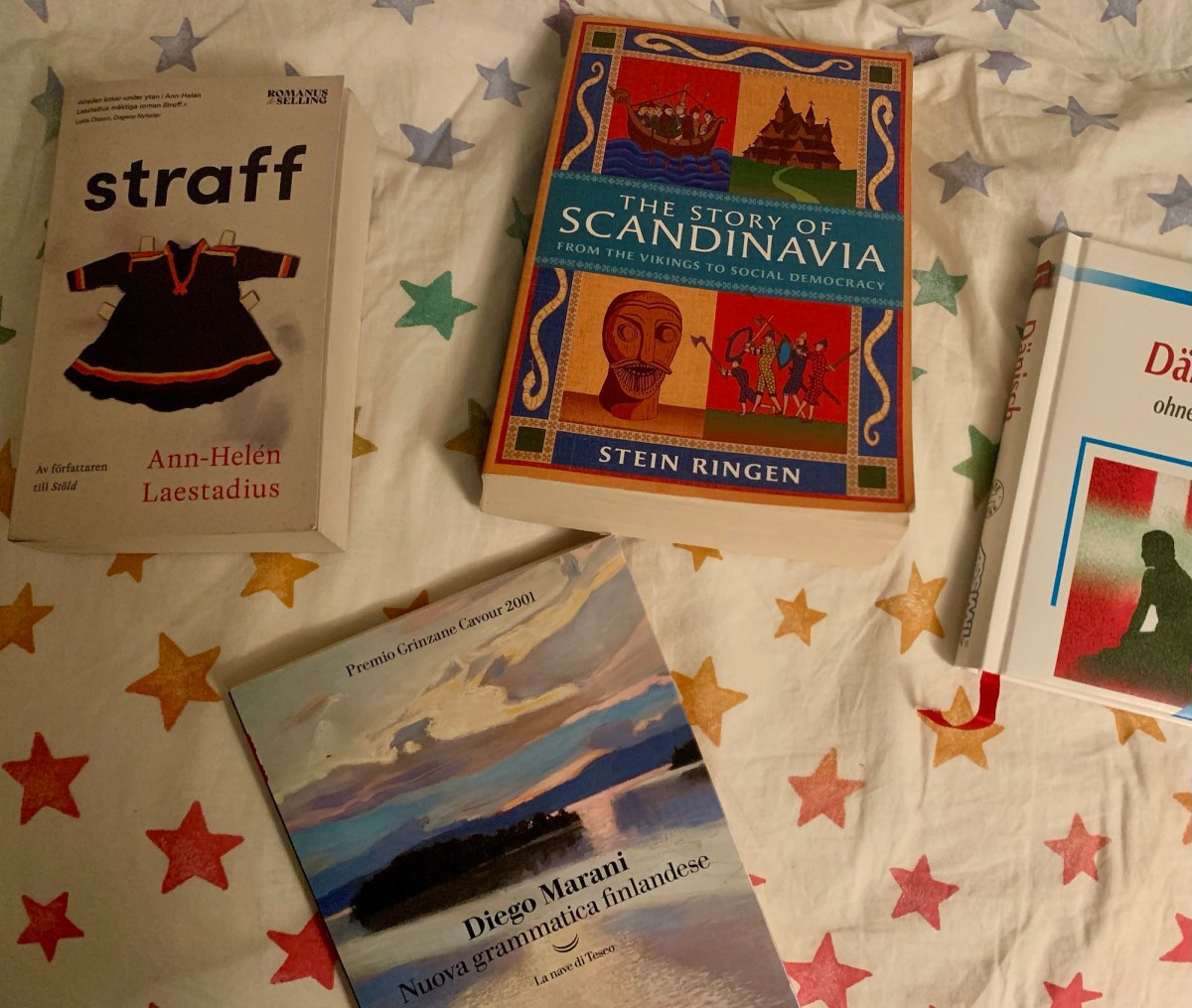
Story of Scandinavia, Stein Ringen – detailed history of Sweden, Denmark and Norway from Viking Age to Present!
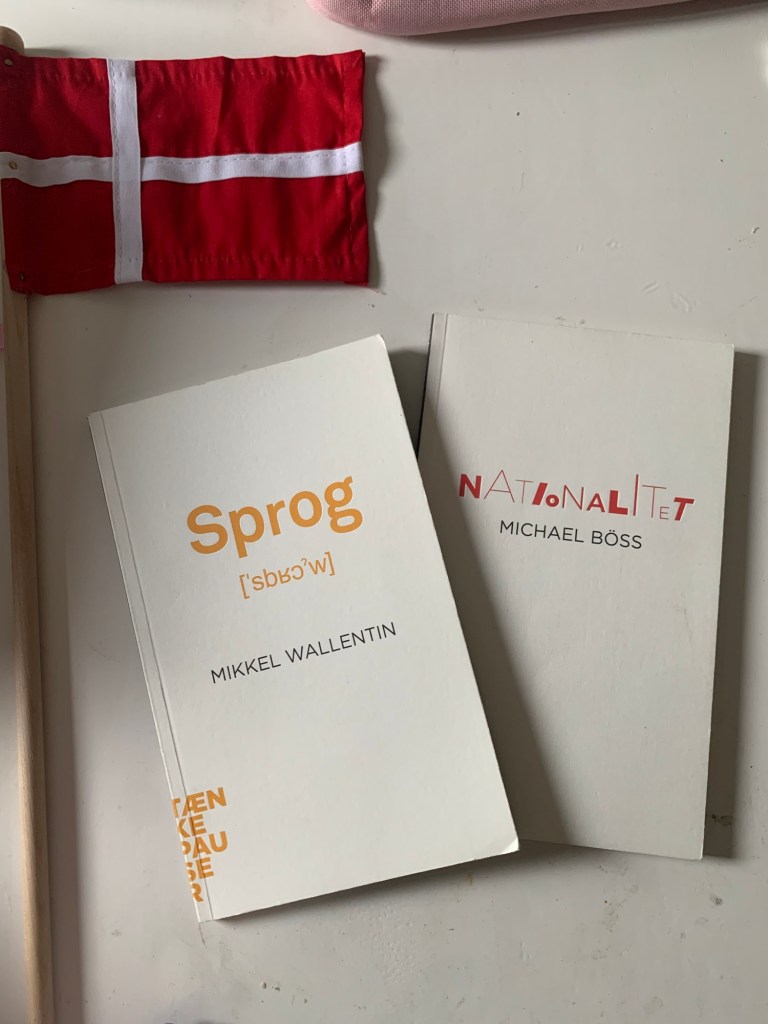
Sprog, Mikkel Wallentin – a booklet about language as a way to communicate and its peculiarities, part of the series Tænkepauser by Aarhus University.
Started (and already finished) in 2025:
New Finnish Grammar (Nuova Grammatica Finlandese), Diego Marani – novel about a soldier found in an italian harbour without any memory of his past and believed to be Finnish, he will be brought to Finland to re-learn his language and culture.
A few novels I still have to start:
Straff, Ann-Helen Laestadius – Sami kids taken away from their families to a Sami-hostile environment, who meet again 30 years later.
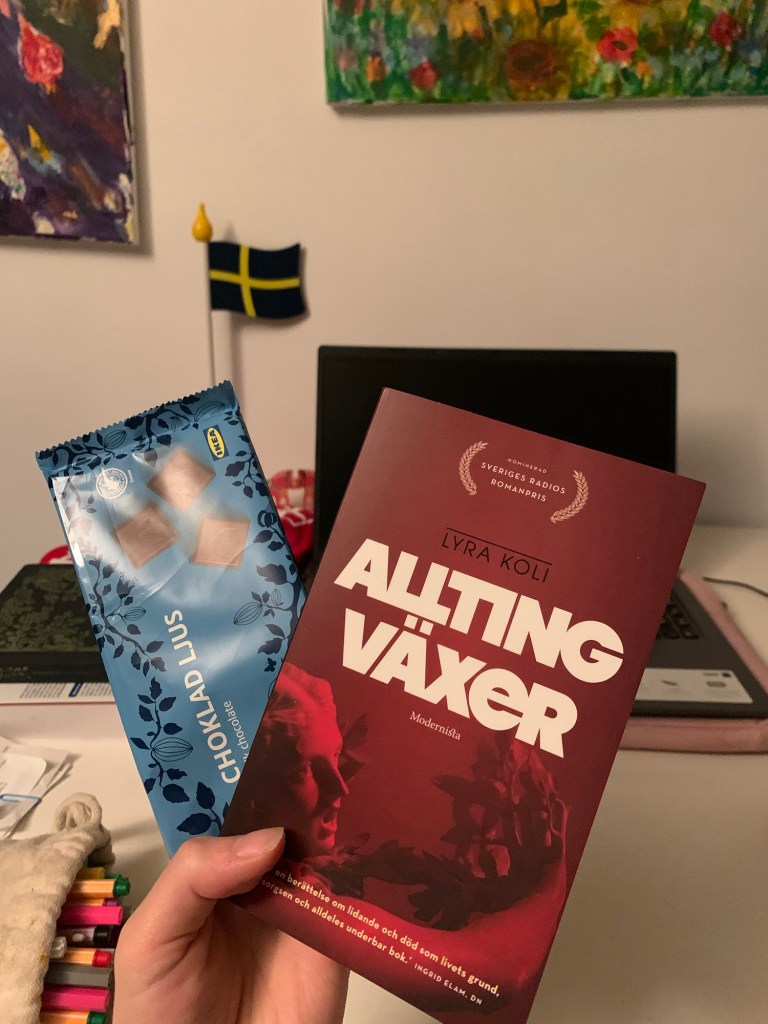
Allting växer, Lyra Koli – dystopic novel about a Scandinavian girl set in a post- world war and climate catastrophe world.
Language books
This year I want to begin by focusing on Japanese, but also Finnish, continuing the coursebook by Hoepli (from Italian).
I am looking forward to improve my Danish a little with the German Assimil edition. Other books, as Swedish assimil and Short Stories in Icelandic, were started in the past and I might continue (for Icelandic) or review (for Swedish) them later.
That was pretty much all for now.. Let’s hope 2025 continues better than how it started, for me by being sick…
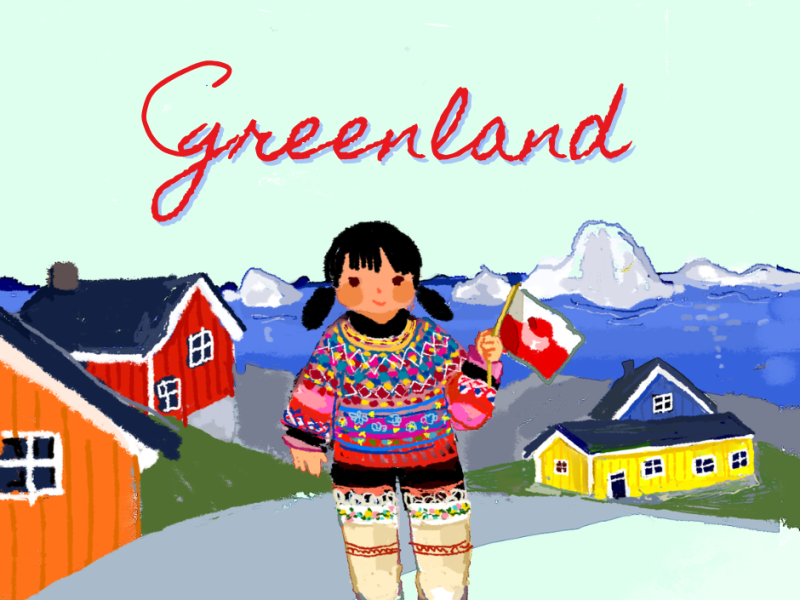
Discover Greenland, home to the Inuit Kalaallit, and its most iconic aspects as its flag, language and folk costumes. The biggest island of the world has a rich history of indigenous culture intertwined with Norse colonization and later Danish rule.
4 tips to practice a language as Swedish and Dutch, where most people are fluent in English and foreigners struggle to improve the local language.
You are learning a language and would be eager to use it when you are in the country where it is spoken. But what if everybody switches to English the second they hear you are not from there?
This is a typical problem in Holland and Scandinavia, where most people speak English well, and the fact that English will simply always work better and be the easiest option prevents you from attempting at speaking anything else.
I have had experiences with Dutch, Swedes, Swedes and Norwegians in various contexts and with the given language being at various levels at different times, and these are a few tips to exercise the language if you are not (or do not feel) fluent yet:
1. important information in English, smalltalk and chitchat in local language
Sometimes you just have to be sure you know what is going on and what you need to do, other times you can miss some parts of a dialogue without causing yourself any damage – in the latter give a go at your target language, you’ll never understand 100% anyway if you never practice.
example: Last time I was in Denmark, I heard a confusing announcement on the train. As i wanted to be 100% sure my train would reach my destination, I first asked that in English to the person sitting next to me, to switch to Danish right after having received that piece of information, (saying that I actually did speak Danish) and had a nice conversation in it.
If your level is still basic, do make sure to (be able to) say small things like hi/thanks/sorry/excuse me/good evening etc. You’ll get those small expression stuck in your head, and give yourself and others the feeling you do speak the language, which is a better start than not using it at all.
3. Prepare what you want to say in advance, or fake it until you make it.
Sometimes you can look up how to properly say something in advance, as in shops and restaurants – things like ‘do you have a free table’ ‘i would like to this and that’, or even look up some extra vocabulary for a conversation of which you already know the topic.
Also: in given contexts like shops the things you get asked tend to be standard, as ‘do you want a bag?/receipt..’ , so you know what words might be pronounced, anticipating what you’ll be asked, and be less scared you will not understand.
example: I had to talk to a Norwegian client on the phone, so I wrote down what I would say, and looked up vocabulary I needed: that means learning new words and getting to practice with them!
3. Find ‘comfort zones’ and people with whom you stick to the language
If your level in a language is not very high, you might not dare making attempts with strangers. I am a quite shy person myself, other than a perfectionist, so I know that feeling well. But you learn a language by practicing it (and making mistakes), and as soon as you have someone or somewhere to freely practice -no matter how off your grammar is, how many gaps you have in your vocabulary, how many times you ask for repetitions – do it. Having active conversations is also important to absorb the language yourself and learn from your language partner.
With strangers you can stick to English if you feel uncomfortable otherwise, but it is good to have a situation in which you’ll always stick to the language (This counts also when chatting online!). Or at least often enough that your default language is Swedish, Finnish, etc. You learn to swim by swimming – but it does not have to be in the open sea from moment one.
Other options if you do not know anybody, you can use find tandem partners on apps such as hellotalk, tandem etc. and give yourself the rule to rather use translators, but never use English. Events as language cafés are also great occasions to practice if you find any!
keypoint: sometimes it is a matter of self-confidence more than language level
The thing with Swedish, Dutch, Danish etc. is, you might be pretty good at them, but if you are a bit insecure, allowing yourself to use them language over English will be hard. In countries where the average level of English is poor, that is of course completely different.
So you’ll just exercise your Italian, Japanese, Spanish, etc. without thinking much about whether you are good enough at it. You might barely know how to order a drink in Italian or Japanese, but still, you’ll do it, because they will understand it better than in English, even with bad pronunciation or grammar. Maybe they will be relieved they can use their language with you, while the Dutch either want to help you by using a language you are more fluent in or just want to have a smooth communication.
It does take some self-confidence to stick to a language if the counterpart easily switches to English! Even if it does not necessarily mean you are bad at it. It is all about finding contexts and people to use the language, broadening them gradually as you get more comfortable or fluent enough to use it for everything.
How I have done it: First I would use Dutch only in written form and with given people, then I got to the point I’d dare using it with strangers, in shops, but not at an airport desk, then I started using it even for formal things like registering at the municipality , but I did not switch back to Dutch if people switched to English. Now i stick to Dutch, always. With Danish I am in the phase where I could use it in formal context but do not always dare due to fear of not understanding. But I did ask for information in Danish at a museum desk, which I did not do one year ago.
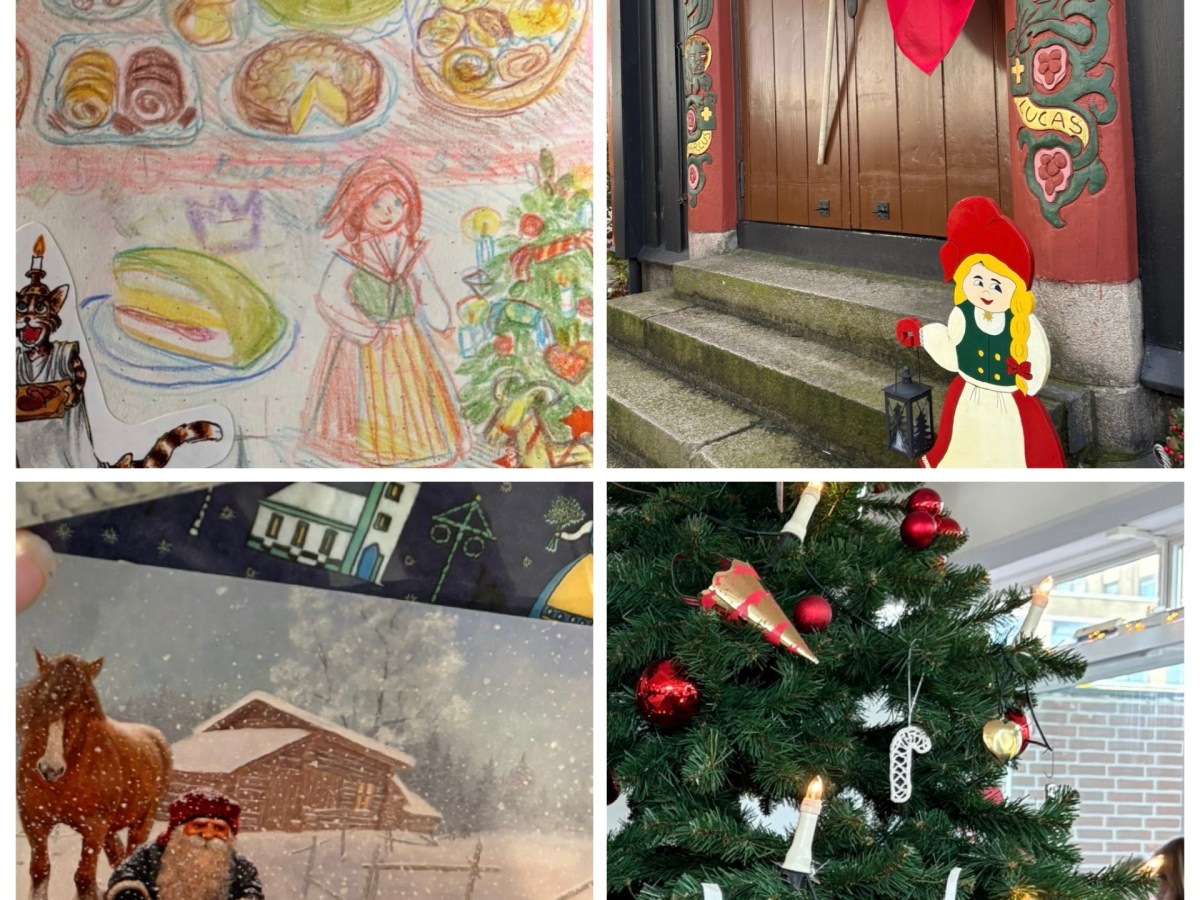
Norwegian, Danish, Finnish and Swedish Christmas markets in Rotterdam. Christmas decorations, imported typical Nordic products for sale, a cafe with lunch and cakes in each of them!
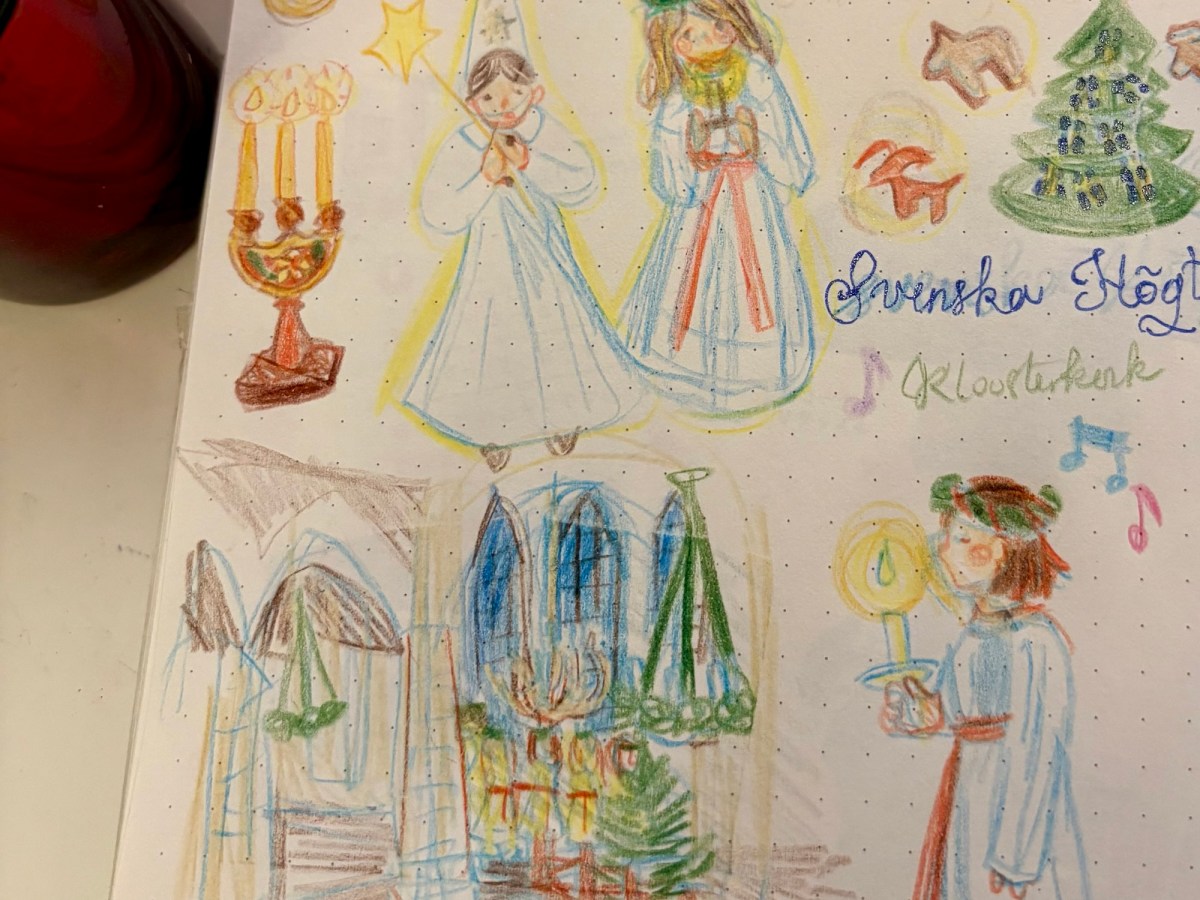
Lucia brings light in the darkest night of the year and is a mix of pagan and christian traditions. It is celebrated in Scandinavia with processions, saffron buns and church concerts.
I joined the polyglot gathering in Prague, an event for language lovers with lectures and activities
First of all, to be updated about language events you can follow me on instagram at @ chiaraspeaksnordic
In May 2024 i went to the Polyglot Gathering – an event I had been dreaming about for a while, but did not know if I would never manage to join. However, after stumbling upon its existence not too long before it would take place, In the course of a few days I figured out I could actually make it! Here is my experience at it.
Sign-up, info Pre-gathering and visiting Prague
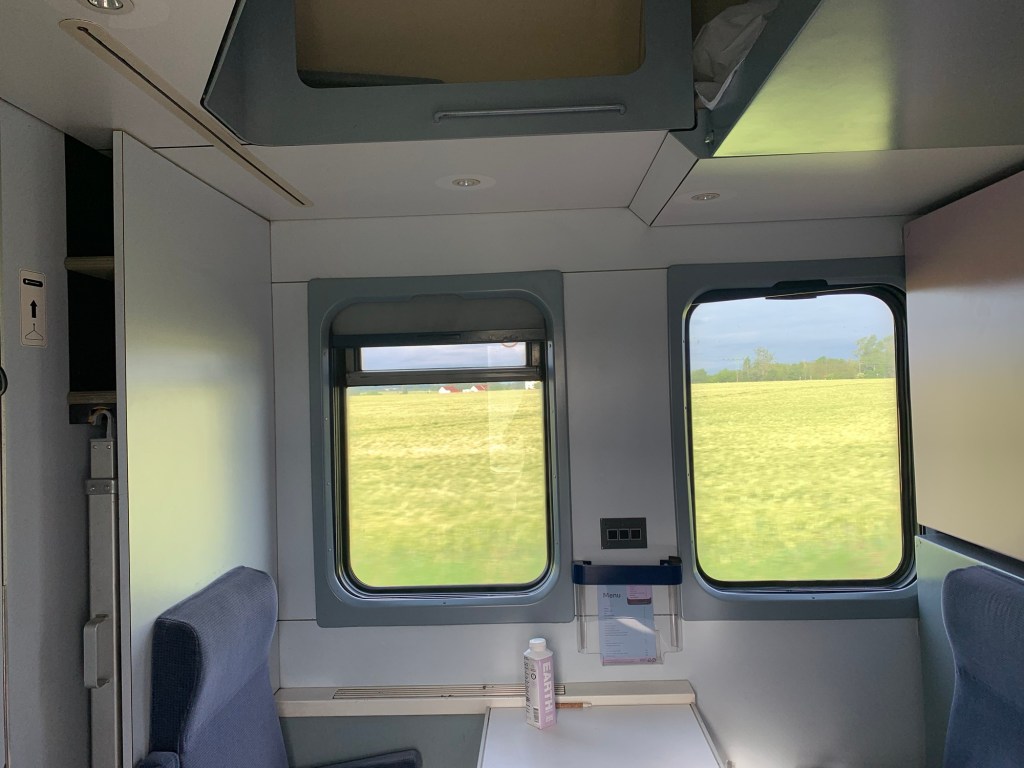
After checking out programs of past editions, info and such on the Polyglot Gathering website, I signed up a couple weeks before the event would take place. By signing up early on you would get discounts, so next time I’ll try to do this asap. The main thing to be sure about was getting there, and turns out there is a European Sleeper train to Prague.
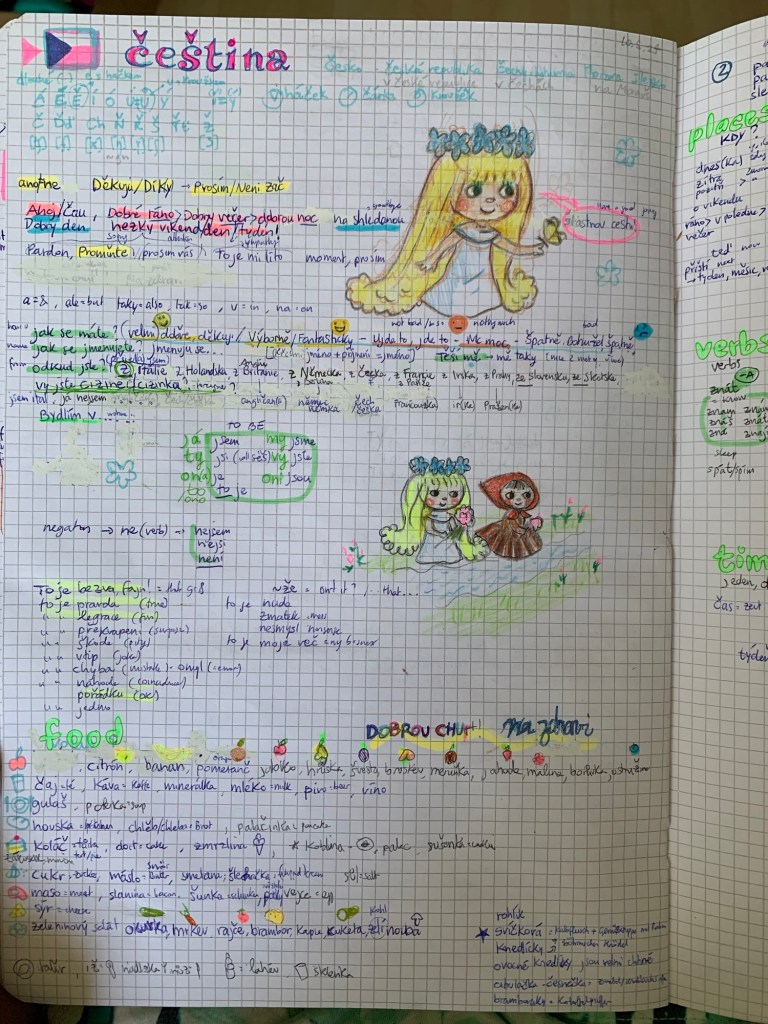
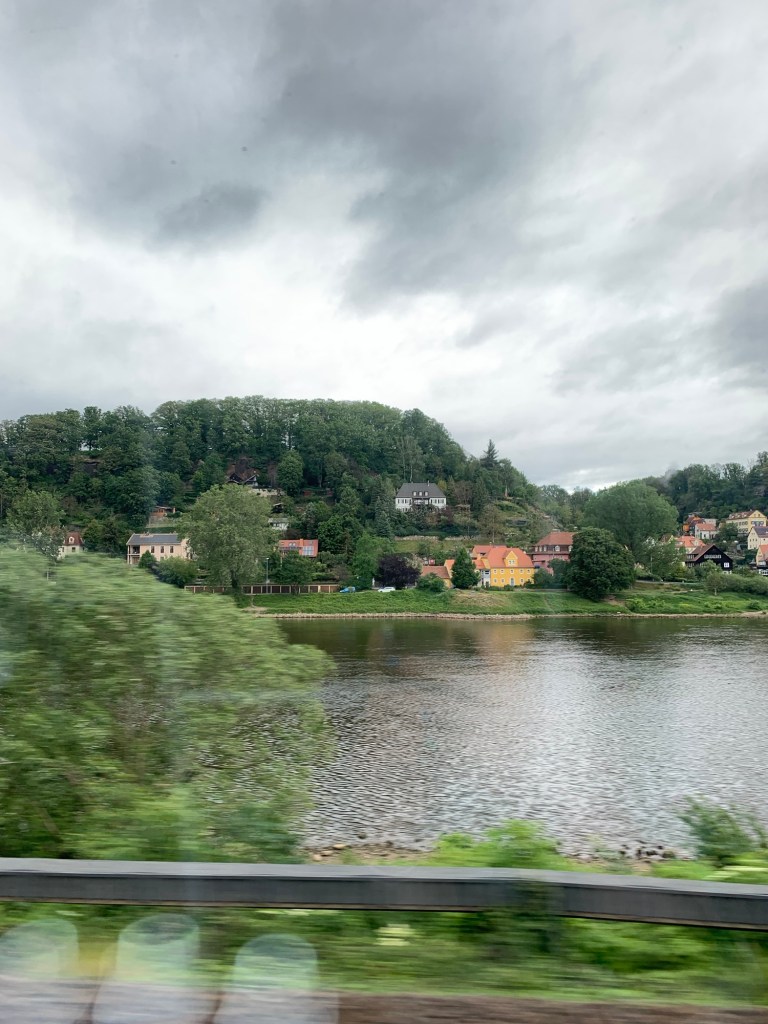
I attempted at studying Czech before leaving..Saxonian Switzerland from the train
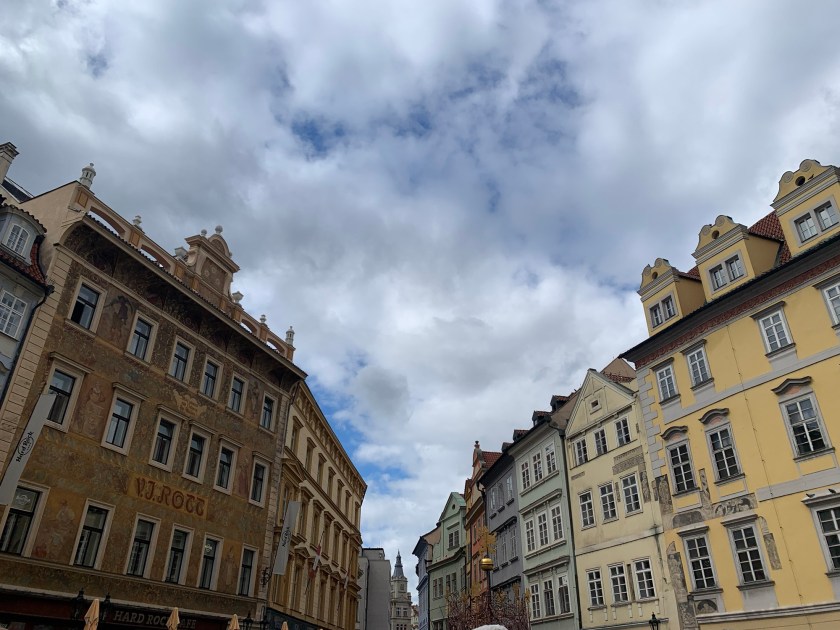
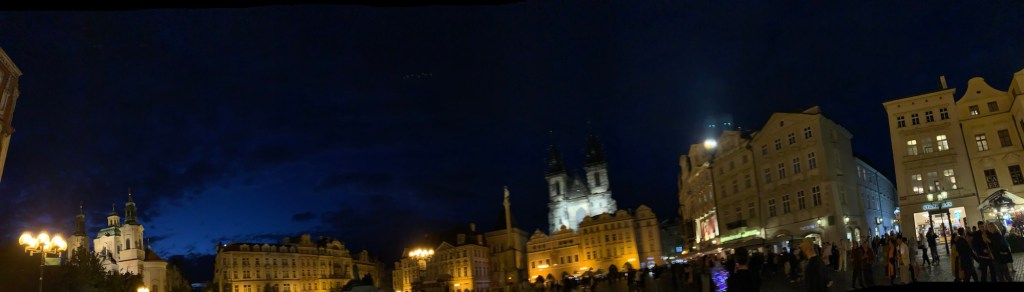
I arrived there around 11am and had planned to just walk around on Saturday as it would have been a pity to just stay inside a building (and pay for an entire day of activities) while I had a brand new city and country to explore. I also tried the most touristy street food, the Trdelník (chimney). BUT of course, without ice cream, unlike everybody. I had lunch at the Havelska Koruna, budget authentic Czech food restaurant.
A challenge related to the Gathering was learning Czech. Having to start from scratch, I tried to focus on practical stuff as food vocabulary in the little time I had, and didn’t manage to go much further than memorizing words for apples and potatoes.
having to look up stuff slowed down my deciding process… That was frustrating! This was my first time in a country with a language I do not understand at all, last time I was 13… One thing I really look forward to if next year’s gathering will still be in Czechia, will be improving my Czech skills, if anything to navigate these things more efficiently.
Sunday: The Gathering
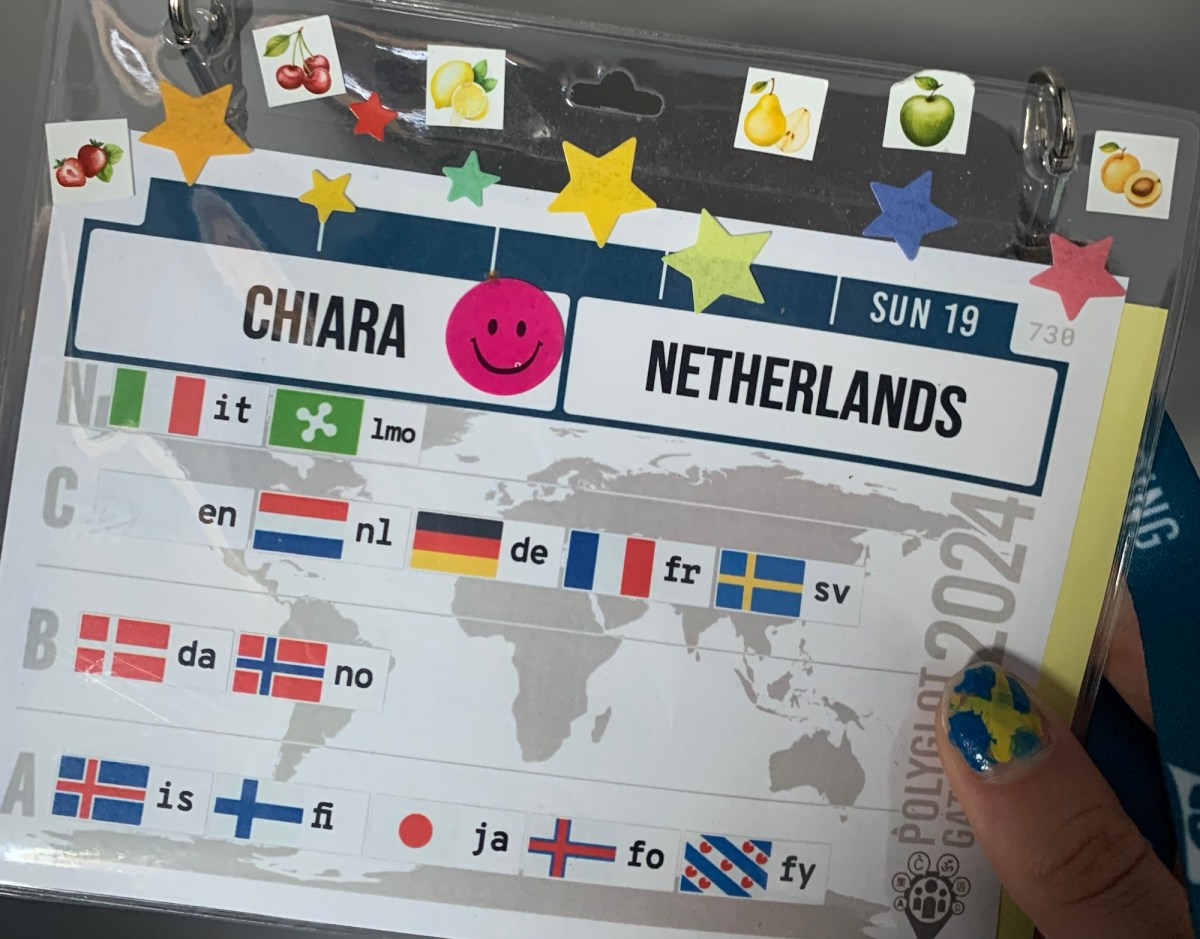
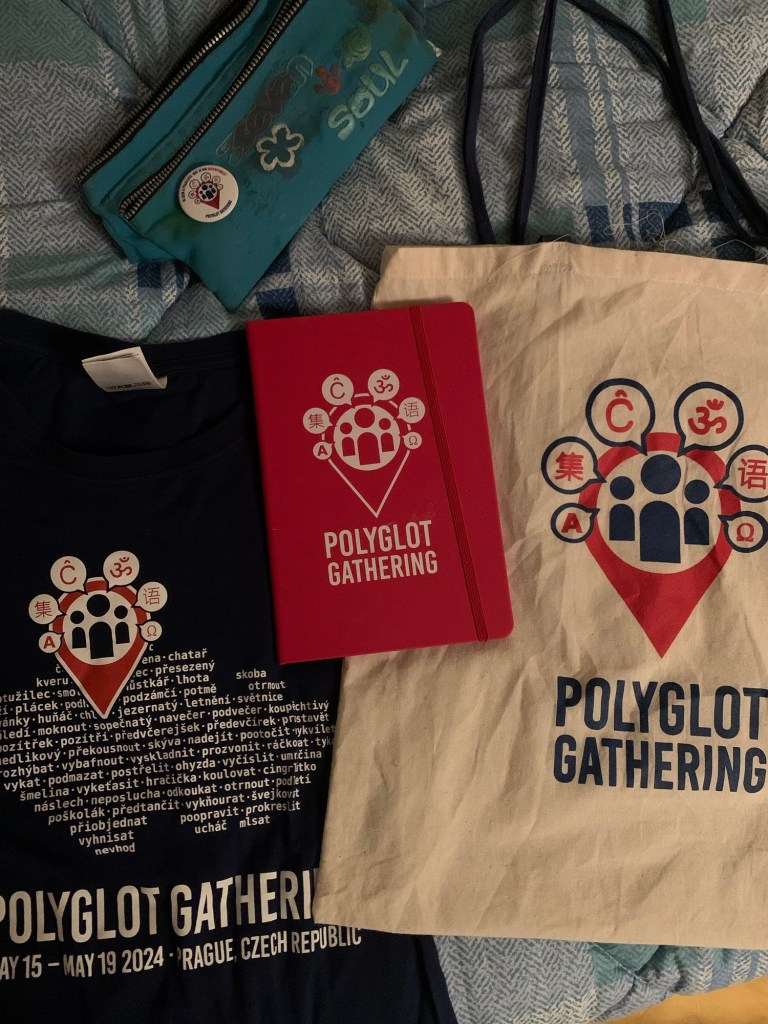
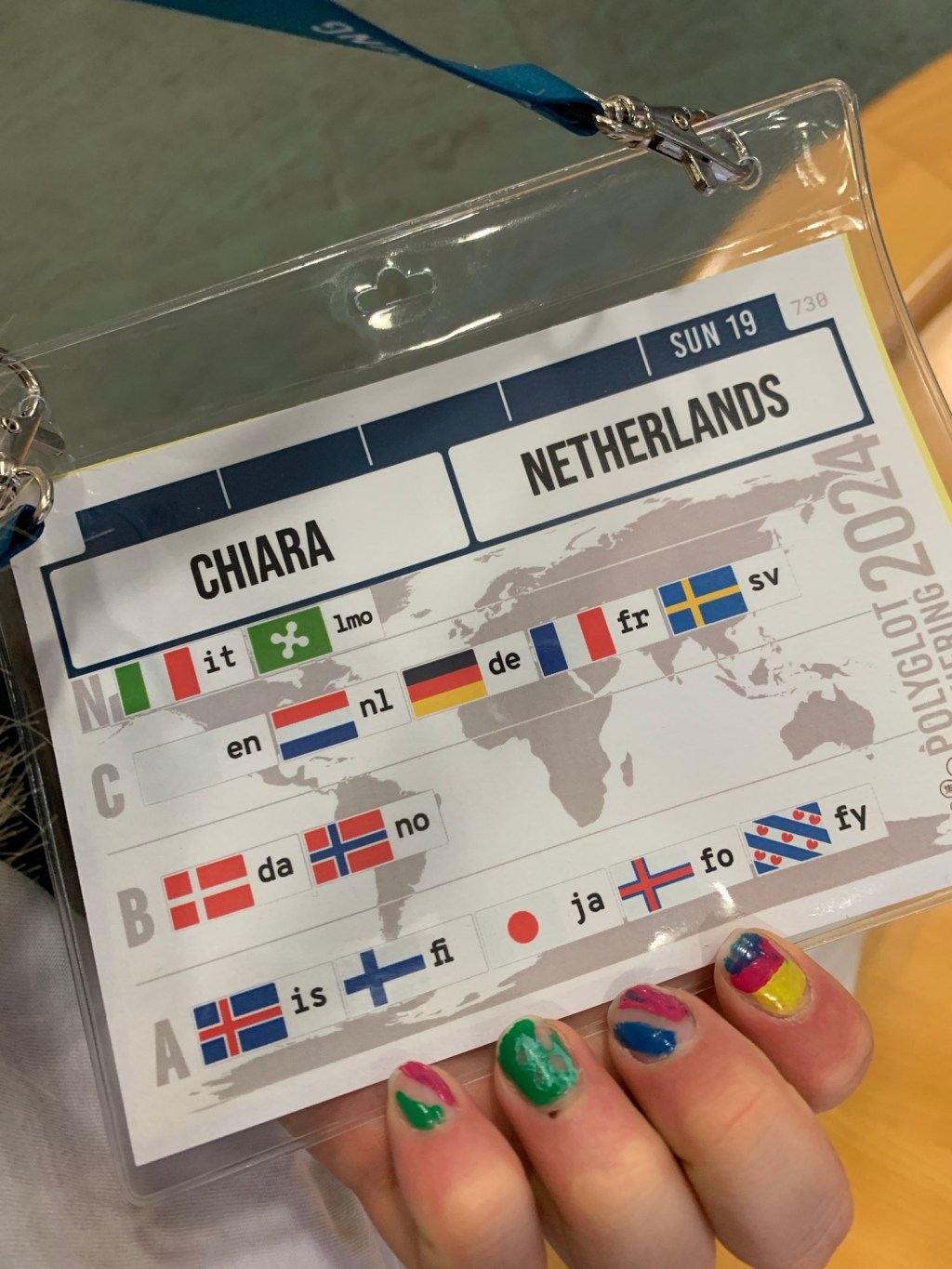
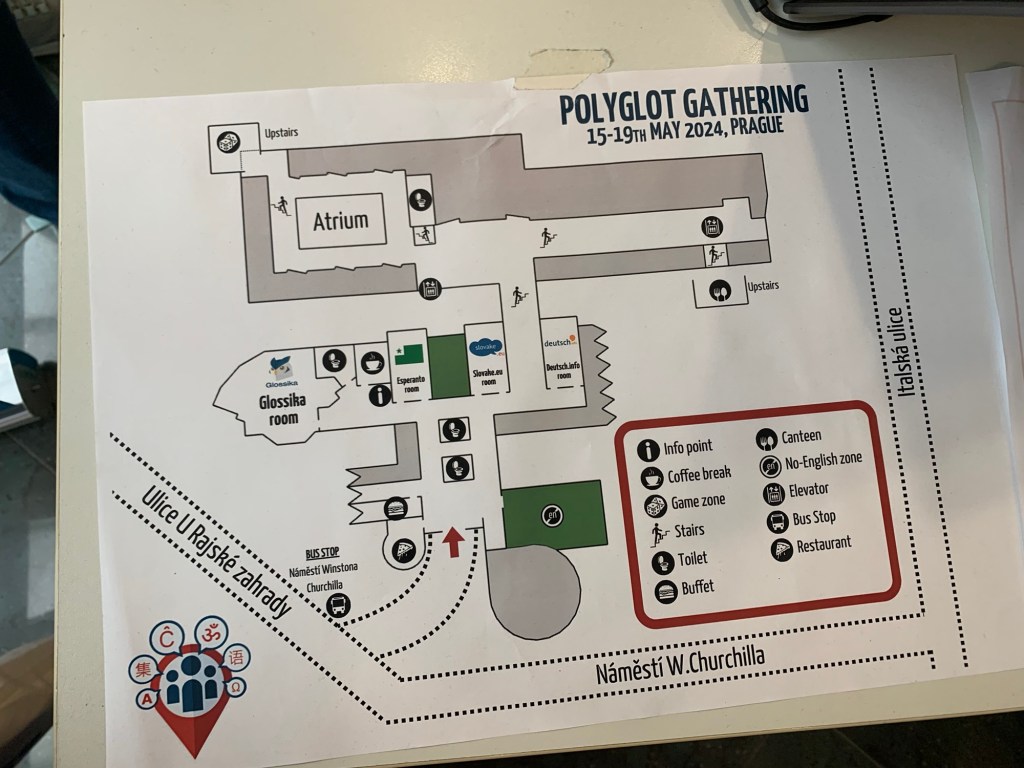
Anyway, I was ready to join the Gathering on Sunday, the last day of it. I met two Italian girls walking just outside the University building where the event took place, so I didn’t have to figure out myself how to exactly come in, as it was not super clear. As I registered I was given a tote bag with a notebook, a pen, few pins, a bottle of water and of course my language tag that I had filled in while signing up for the Polyglot Gathering! And, a t-shirt, that I had added to my registration.
tote bag, notebook, pin and tshirtA few people were actually curious about the Lombard and Frisian flags
I announced on social media I’d go, and found out a (Swedish-speaking) friend would be there. So I ended up speaking a lot of Swedish which on its turn attracted fellow Scandinavians hearing us..
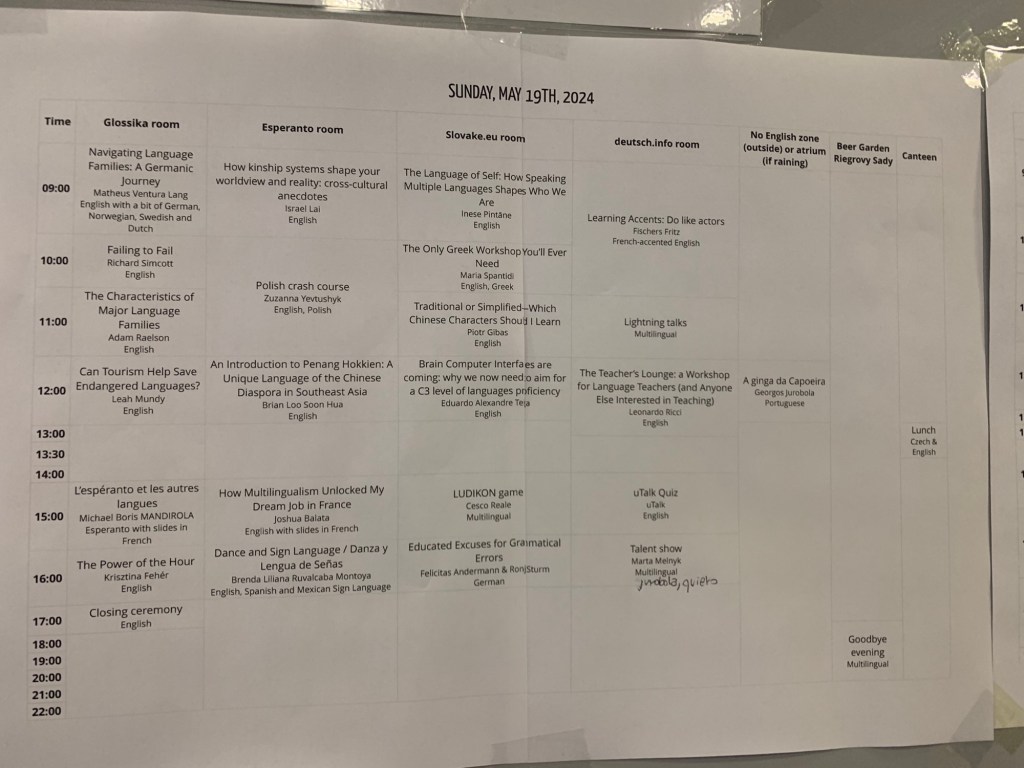
I could already see the program (see below for the last day) shortly before the Gathering started, so i knew more or less what lectures I wanted to join.
Besides lectures there were also activities as language practice rooms (and a “no English Zone”), talent shows, quizzes, workshops, tasting international snacks.. But that will be for another time …I eventually picked these lectures:
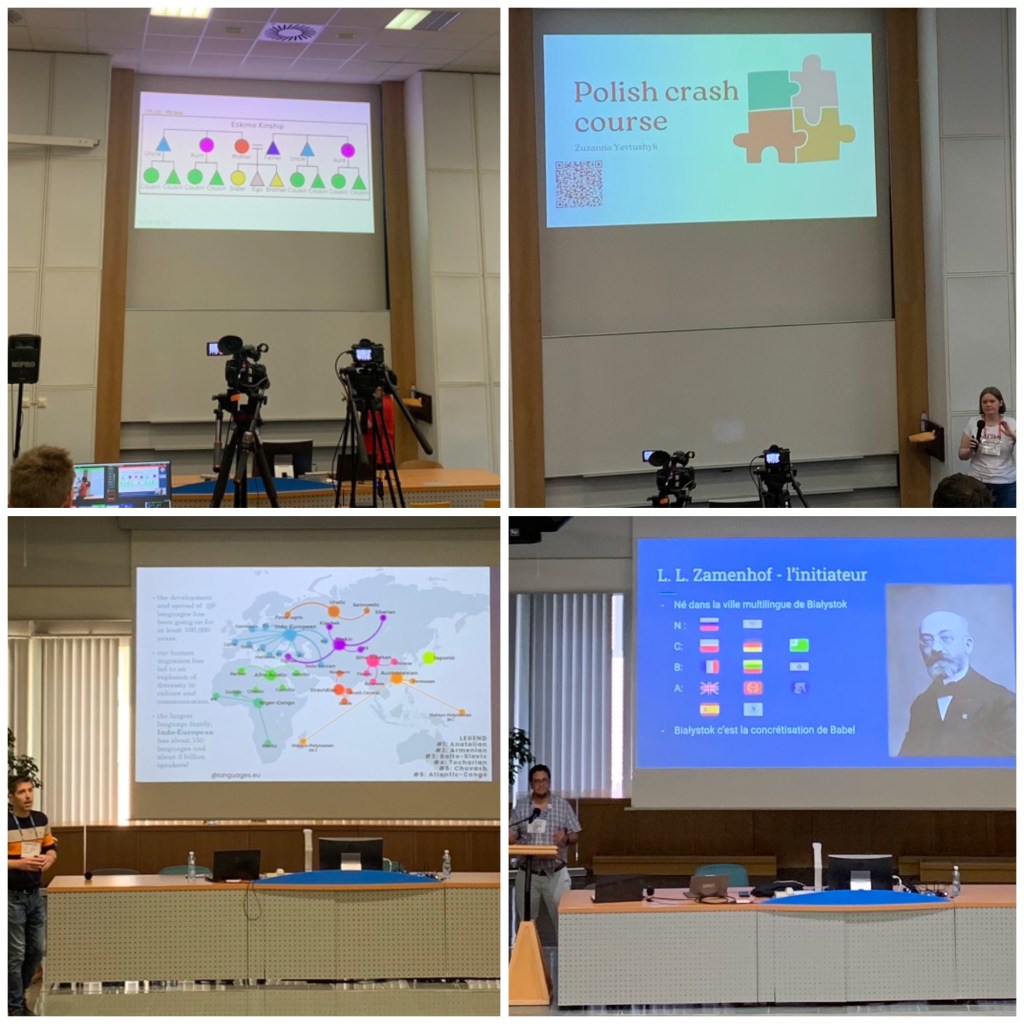
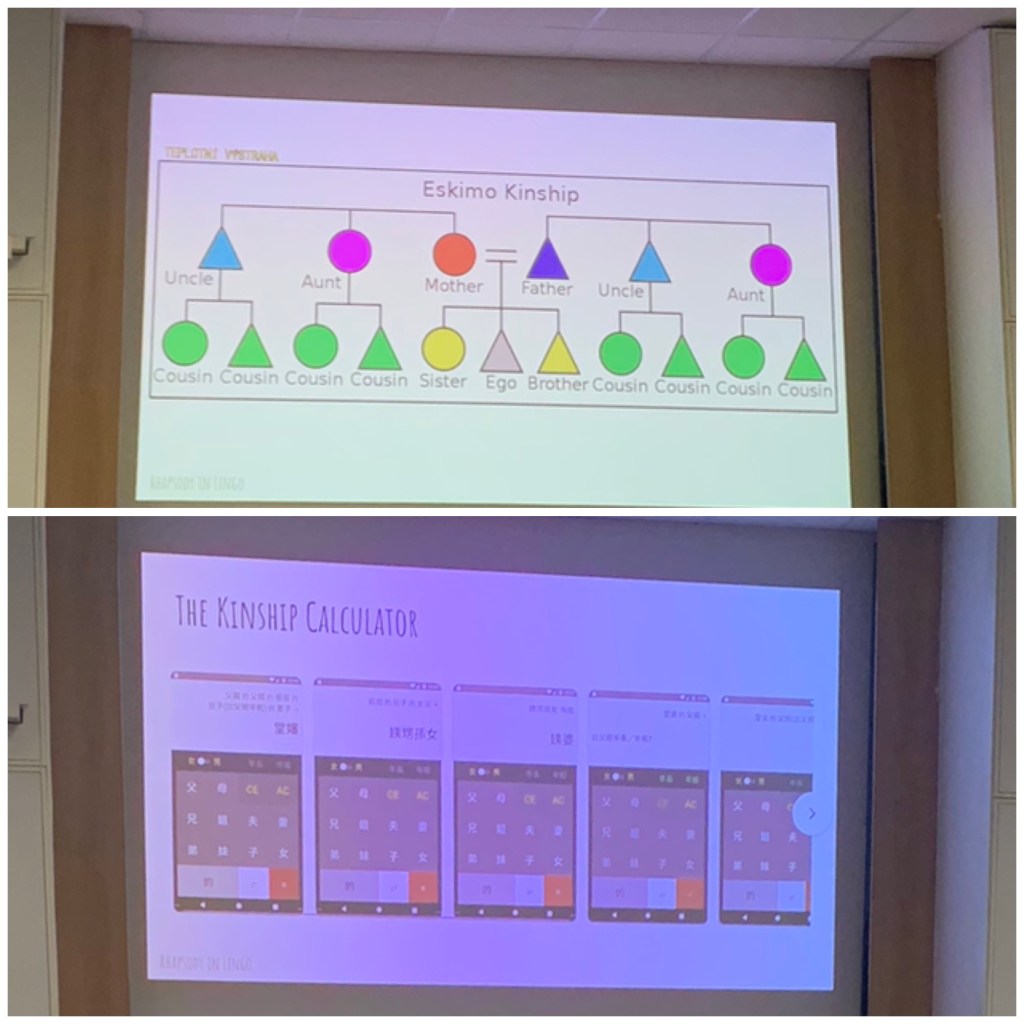
How Kinship systems shape your worldview and reality: cross-cultural anecdotes, by Israel Lai
Polish crash course (1/2 of it) by Zuzanna Yevtushyk
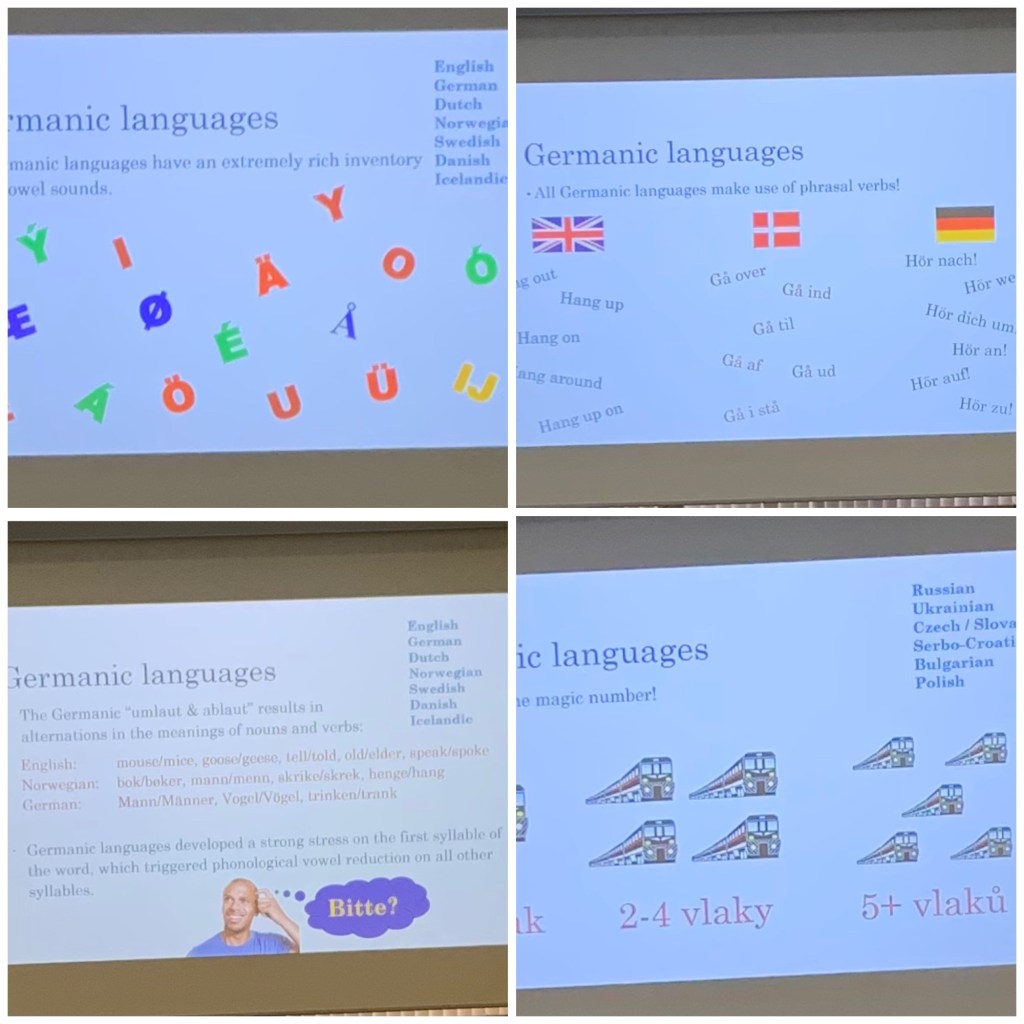
Characteristics of major language families (mainly Romance, Germanic, Slavic and facts about further ones), by Adam Raelson
Brain computer interfaces are coming- Why we now need to aim to C3 level
Esperanto and the other languages (slides in French and lecture in Esperanto)- by Michael Boris Mandirola
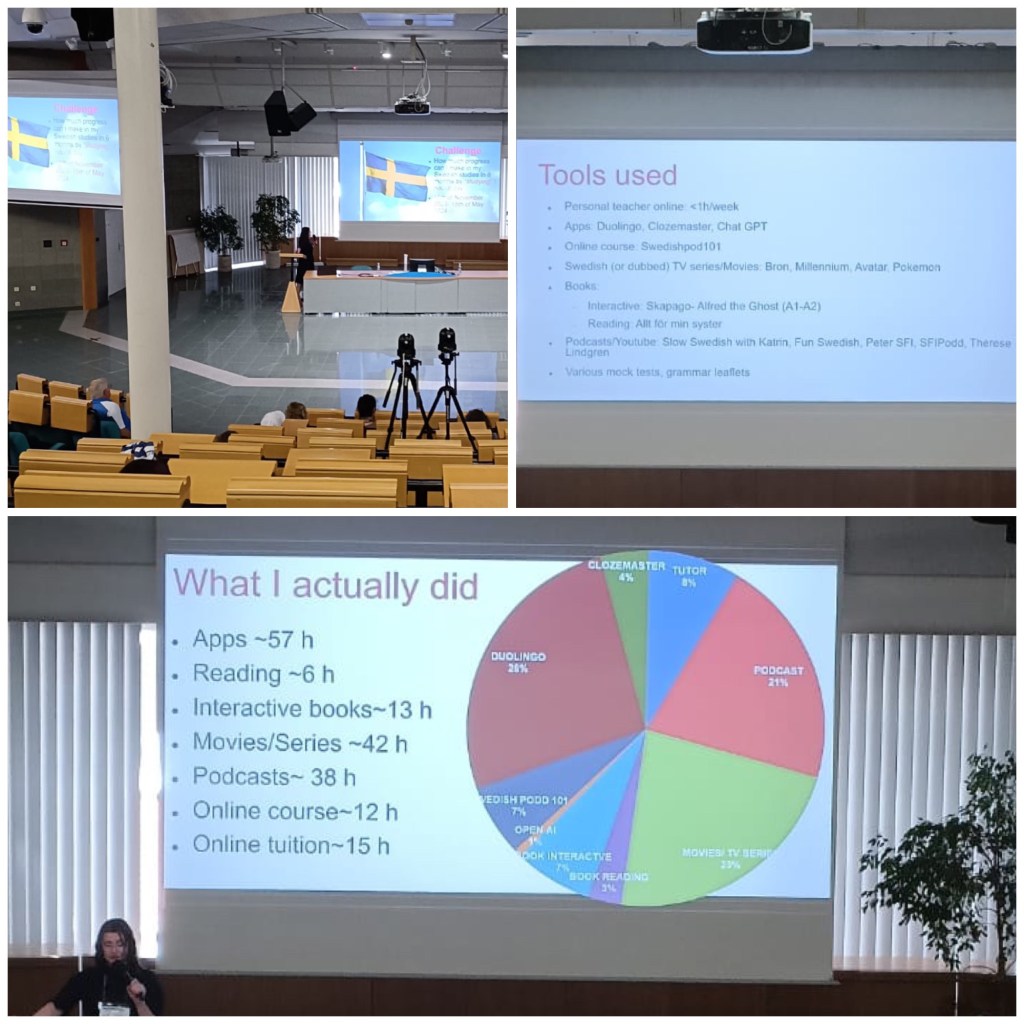
The Power of the Hour – Swedish in 6 months by Krisztina Féher
one time slot had multiple interesting courses, others not as much, but most lectures were definitely interesting! I would have gone to a Chinese lecture instead of another one about competing with AI intelligence if I had to do this again, but for the rest I was satisfied with my choices. It was also a pity I had to leave the Polish Crash Course halfway through to go to the Languages Families lecture. Although I must say my brain cells were getting tired, the Czech I had learned wasn’t helpful beyond the first three sentences.
I’d say my favourites were the one about language families and hearing about the strategies used to learn Swedish one hour a day – the way she tracked it was quite inspiring and gave me good insights. Learning about different ways different languages name family members was also pretty cool! See some slides below.
Breaks
Between each lecture there was a break, and you could get coffee or tea. and there were stands selling books, gadgets and stuff.
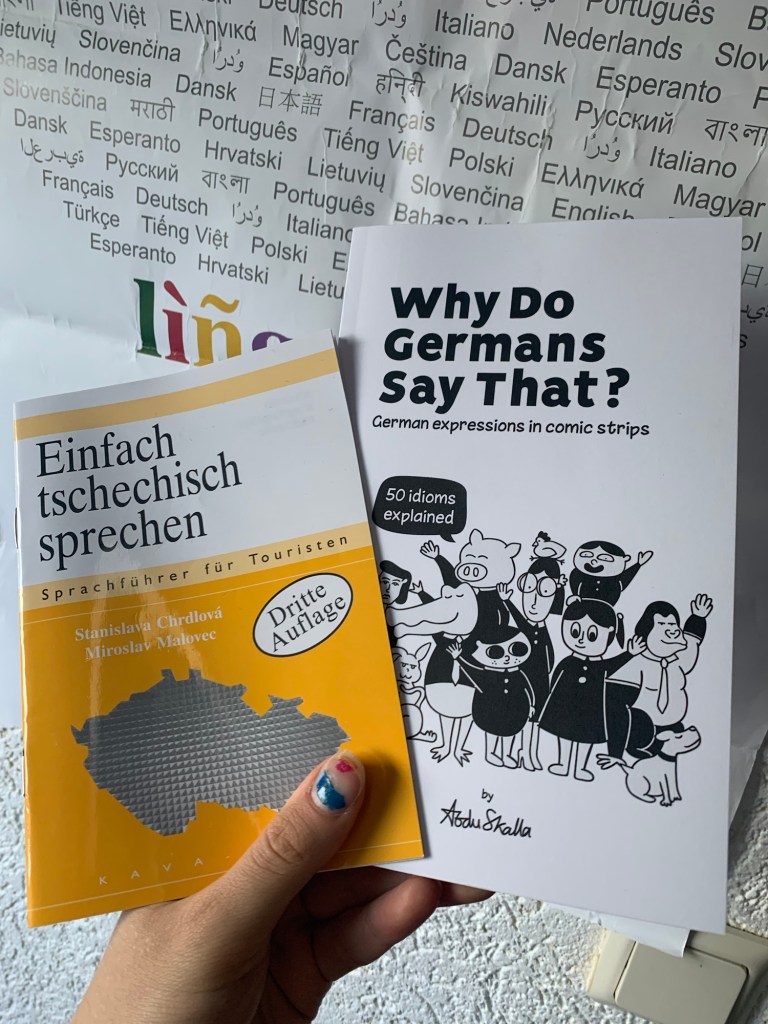
One was mostly just about Esperanto though – seems to be pretty big at language nerds events. I got a book explaining German idioms, and a tiny tourist phrasebook for Czech. Might be handy for another time!
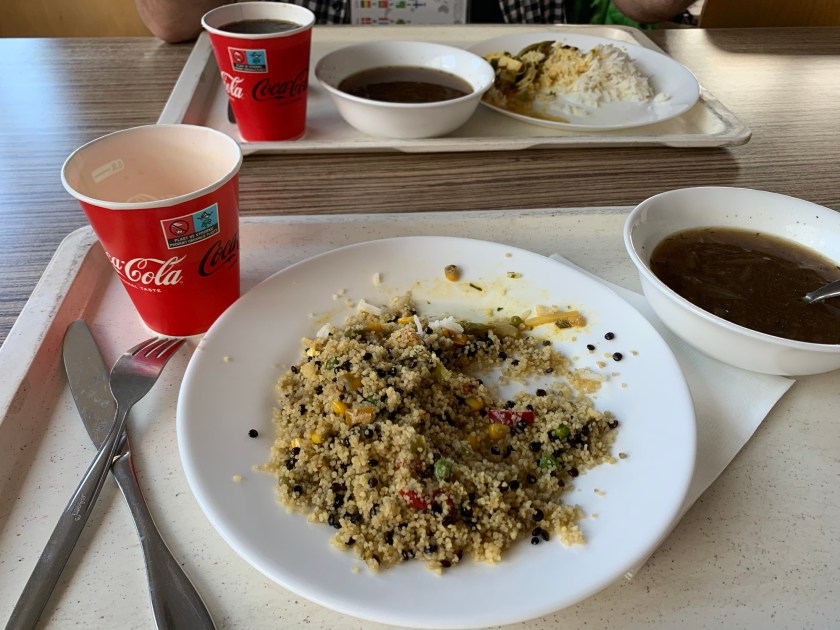
The main break was of course lunch, a couple hours. You had the option to get lunch either everyday or not at all at the canteen, and it was available in 3 versions: meaty, vegetarian and vegan. Here too, you had to choose one and stick to it for all the days you’d stay there.
The best thing would be having the menu to begin with and freely deciding which version to pick, but I understand that’s for organisational reasons.
I was there only one day so I did not have to stick to only meat or only vegan dishes for 5 days. And I knew I would eat typical Czech food with meat outside anyway, so it was okay. On Sunday the vegetarian version was curry rice, the vegan couscous, the meaty schnitzel. And of course I got soup as side dish, typical Czech.
Closing ceremony & Final Evening
As it was the last day, the final ceremony took place at the end of the lectures, and it was a sum up of the event, organisational effort of the team behind it, Slovakian Edukácia@Internet as main party, thanking all partners and sponsors. and insights about where the Gathering will be next here. Which might be Prague again. Or somewhere in central Europe. Sorry, non-Europeans…
Once the Gathering was over, we still had the possibility to meetup with other polyglots at the beer garden in the evening. As I had only been there that day, I had not had the chance to really chat a lot with others yet. It was quite fun and got to talk to quite a few people – notably a person I am a mutual follower of on tiktok, it was quite amazing to see her in real life – unexpectedly!! I also got Polish chocolates :). Afterwards some people went to pubs – I had a bit trouble switching from Swedish to norwegian after a drink, I must say.
Though English stayed in most contexts as the lingua franca, I still got to speak quite a few languages. I look forward to the next time I will be able to join it, hopefully for longer than just one day!





 a Polyglot illustrating Scandinavia