simple and iconic Scandinavian recipes to make yourself for a typical Nordic dinner
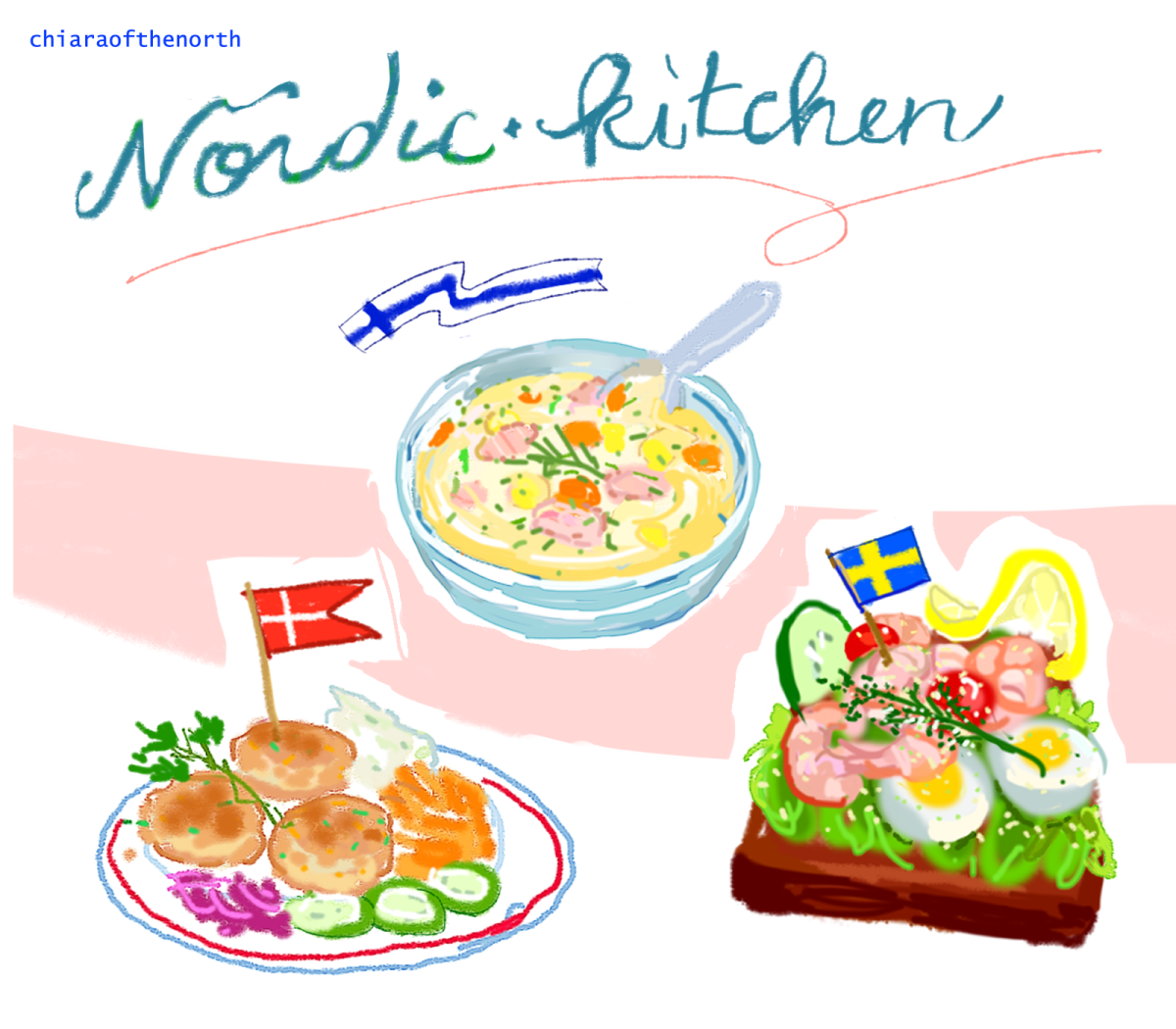
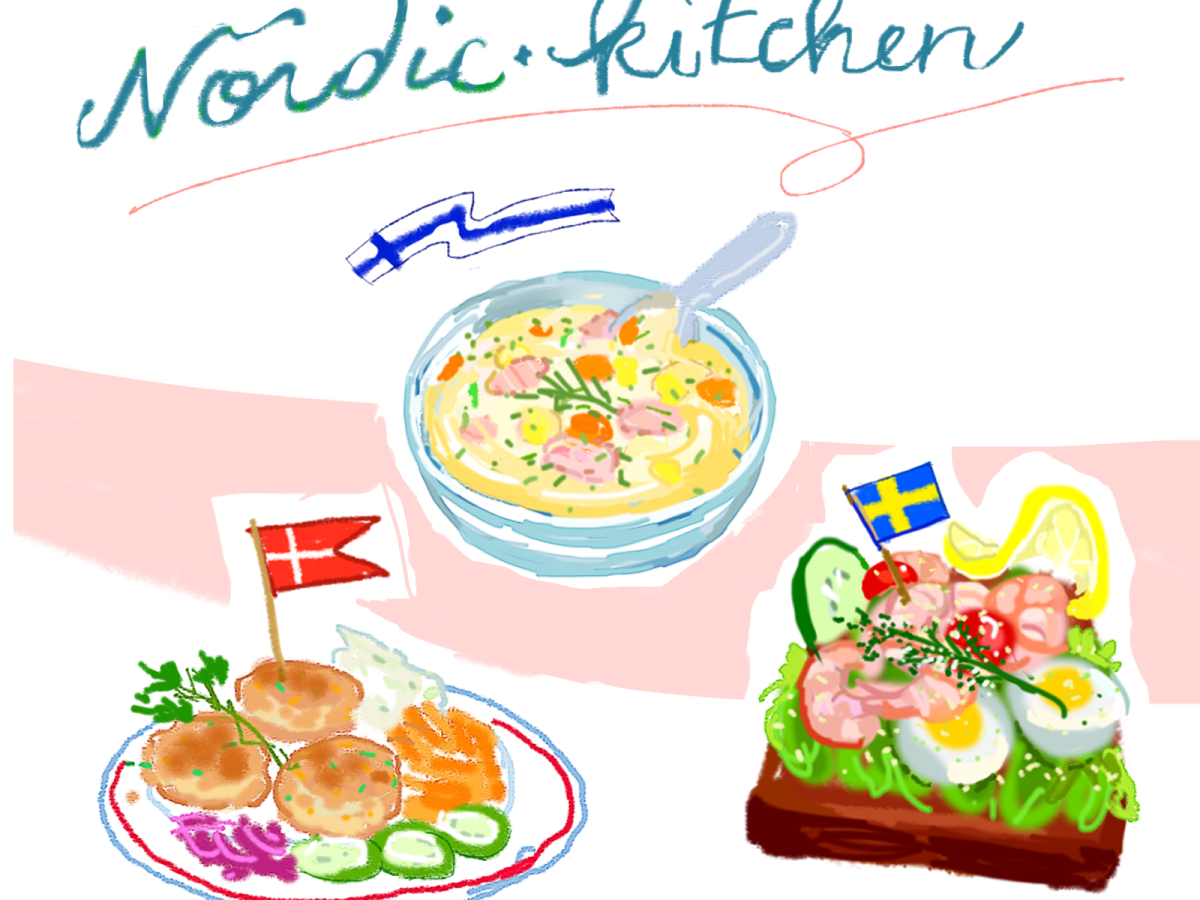
I have been testing Nordic dishes as someone with not-so-incredible cooking skills who likes to cook simple things, and these are three delicious and easy meal ideas I can present you, in time/complexity order from the easiest:
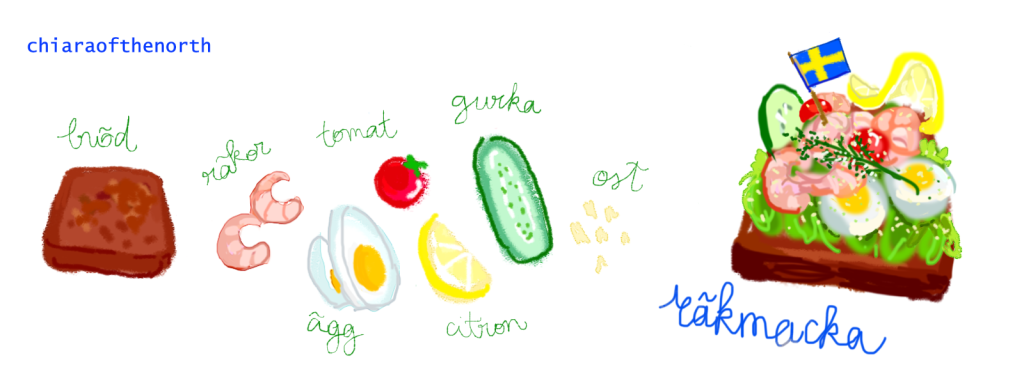
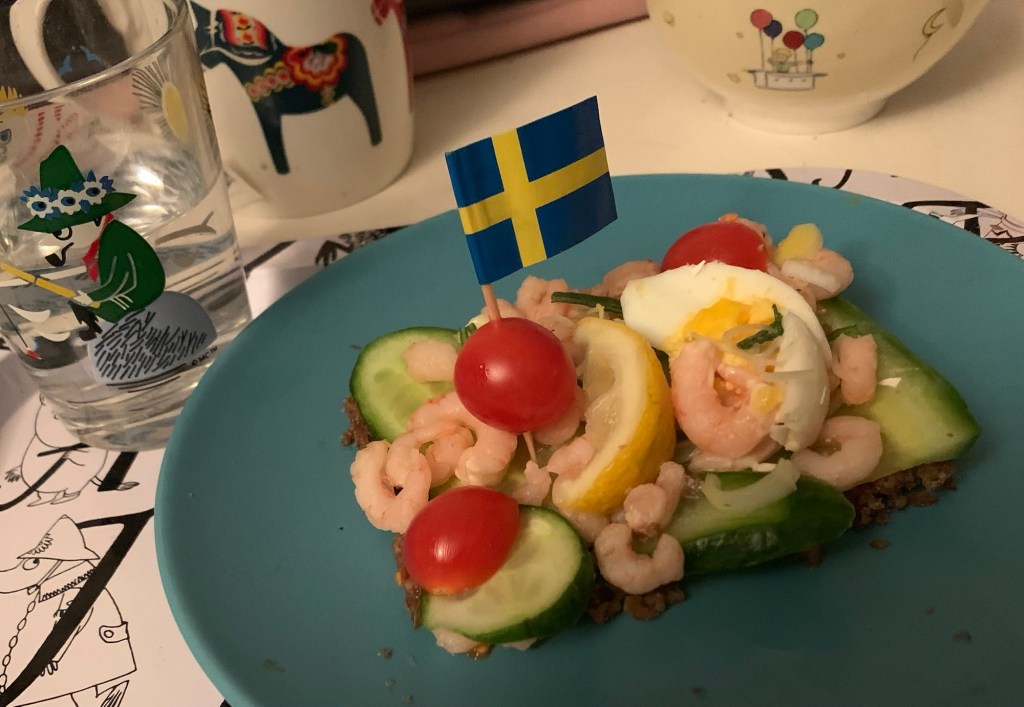
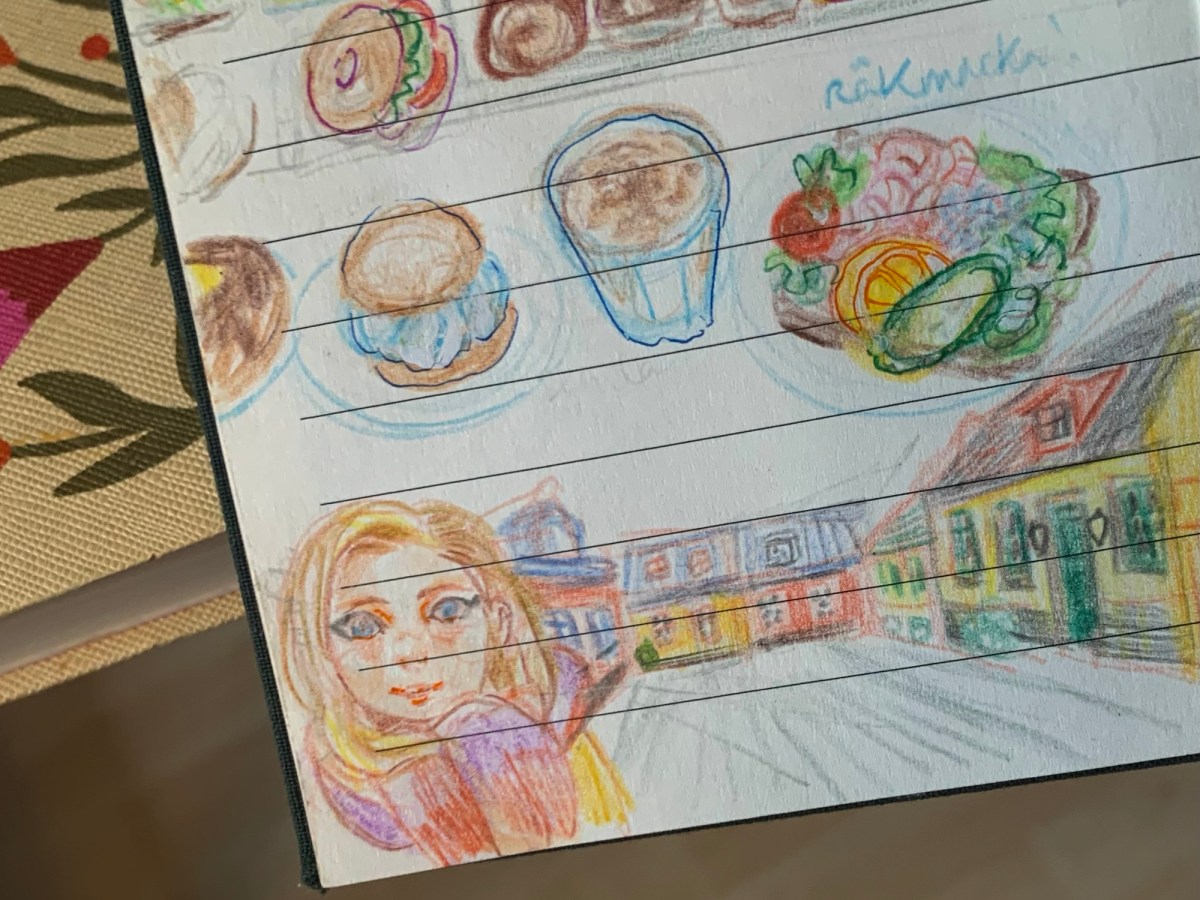
1. Räkmacka – Swedish Shrimp open sandwich
Typically found at cafés as savoury option for a fika, but you can easily make it yourself – (rye) bread with Shrimps, cucumbers and tomato slices on salad, often egg and lemon – add whatever you like and make it look fancy!
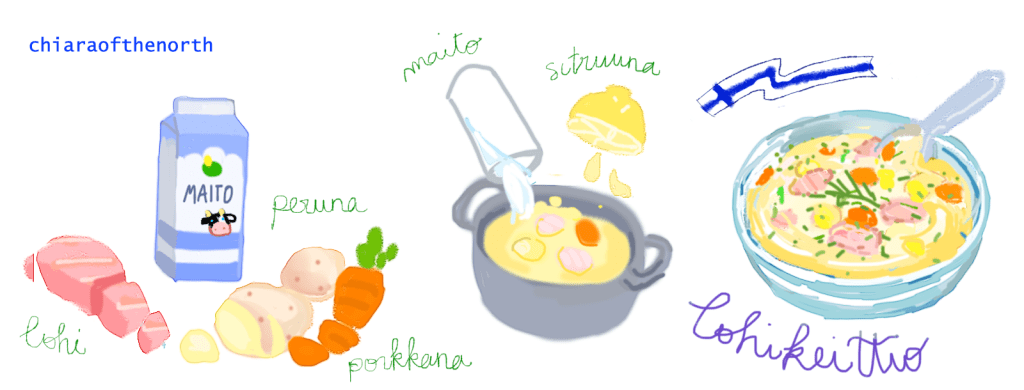
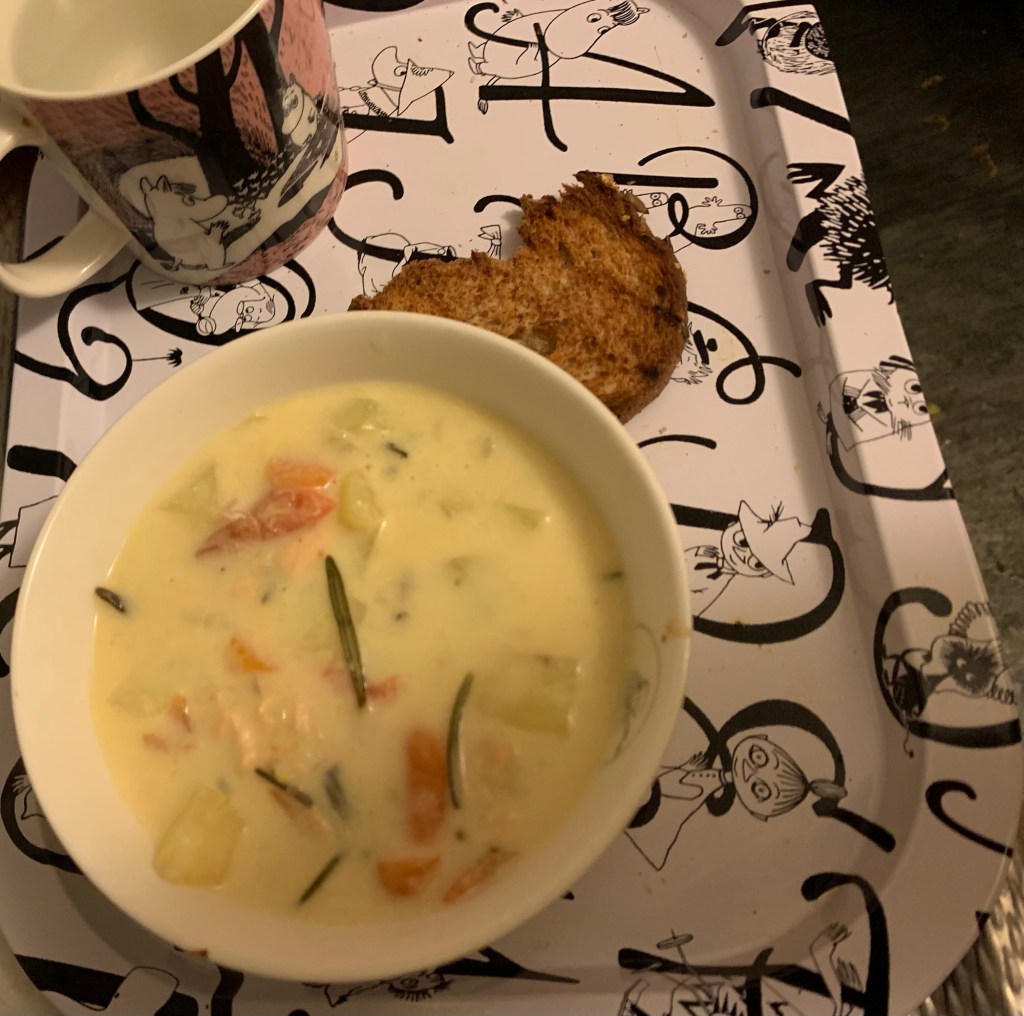
2. Lohikeitto – Finnish salmon soup
soup with chopped salmon, based off milk and lemon juice, and enriched by veggies as potatoes and carrots.
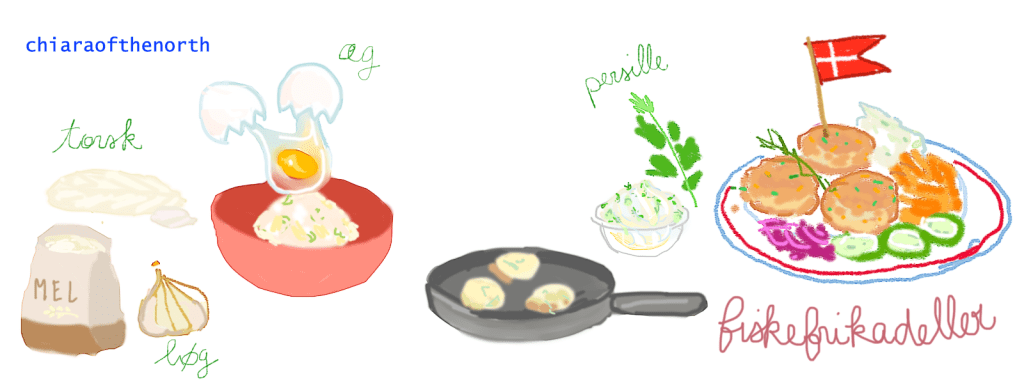
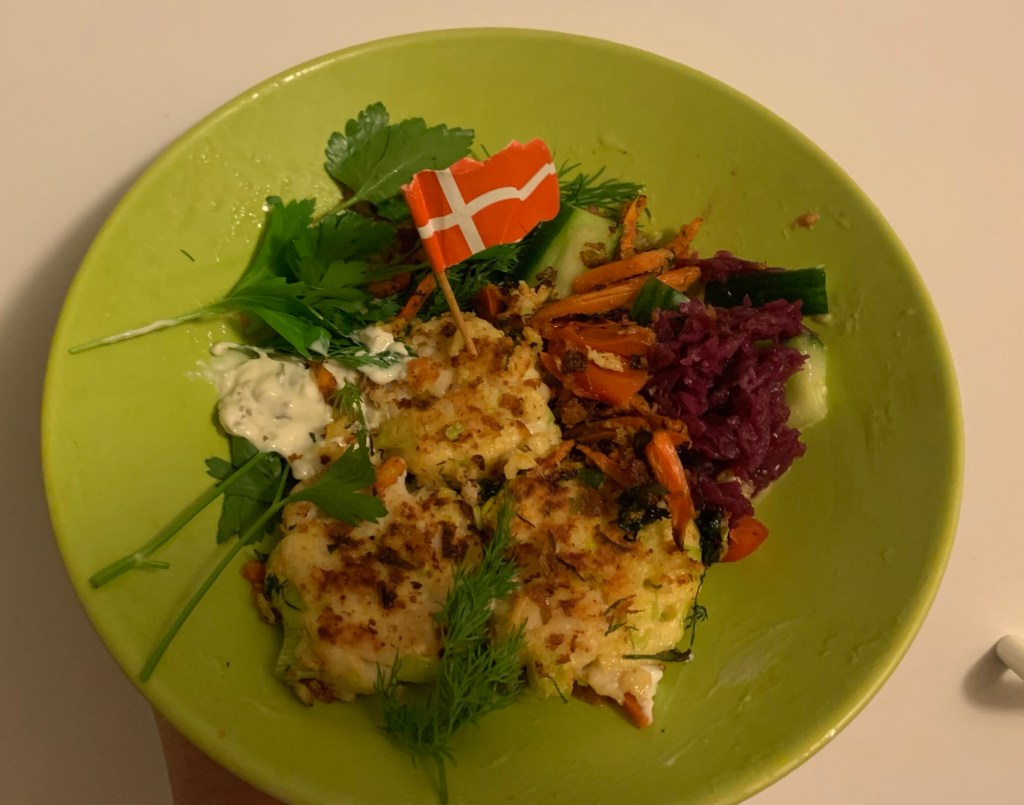
3. Fiskefrikadeller – Danish fishballs
Make balls after mixing fish chunks (I have used pangasius and cod) with egg, flour, spring onion – I also like to add carrot bits -, Fry them in a pan on both sides. Garnish with herbs as parsley. Complete the plate with some fresh veggies to the plate as cucumber and red cabbage. Enjoy the fishballs with remoulade sauce as the Danes do!
Here are pictures of my experiments:
räkmackalohikeittofiskefrikadeller
Disclaimer: these are my creative versions, and I do not follow 1:1 classic recipes. You find plenty of other references online! You can still see more Scandinavian and Nordic food on this blog, from my trips in Scandinavia and to Nordic cafés elsewhere.
Norwegian, Danish, Finnish and Swedish Christmas markets in Rotterdam. Christmas decorations, imported typical Nordic products for sale, a cafe with lunch and cakes in each of them!
Lucia brings light in the darkest night of the year and is a mix of pagan and christian traditions. It is celebrated in Scandinavia with processions, saffron buns and church concerts.
Traditions and popular things to do in Norway around and on Christmas day: from movies to cookies
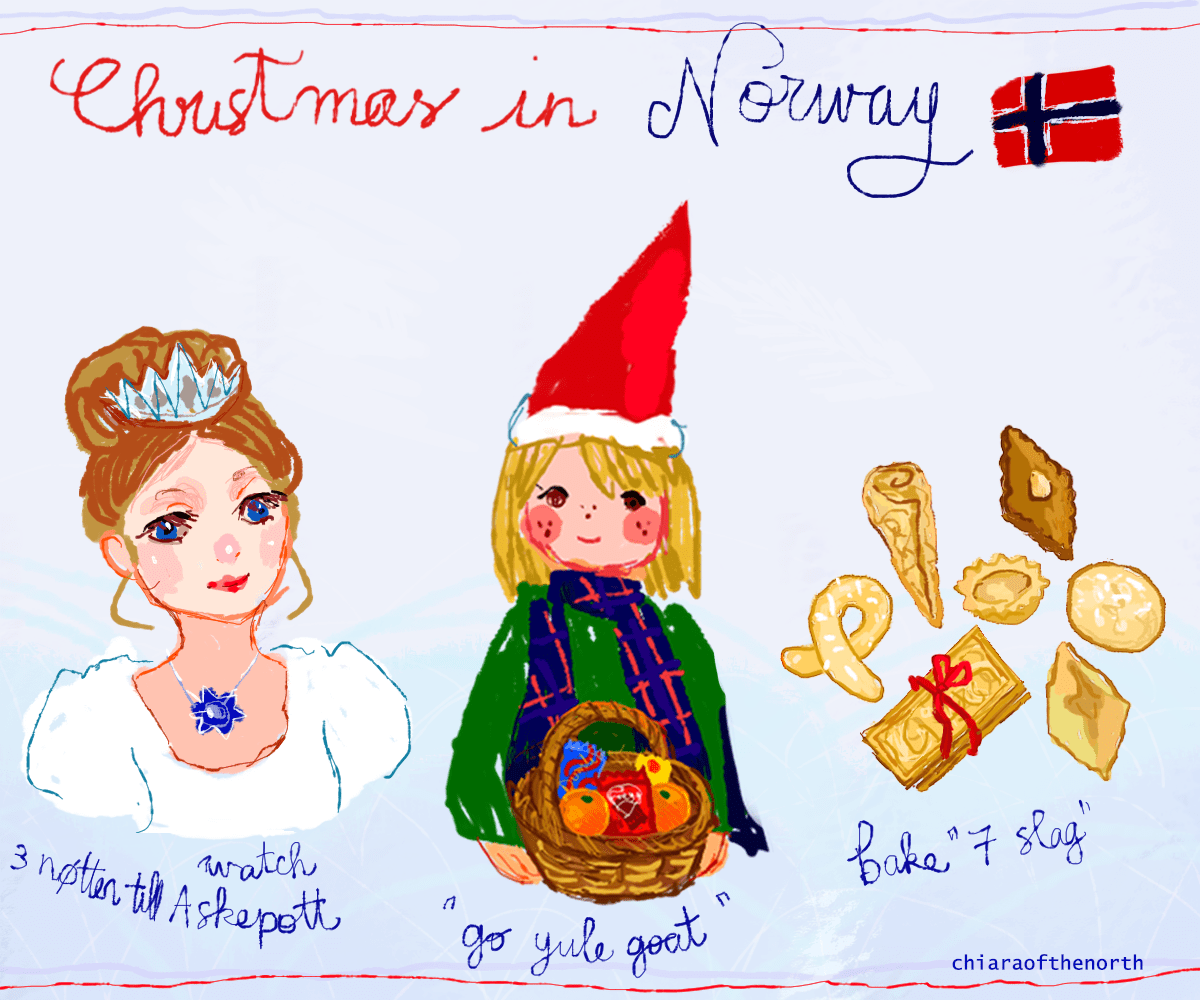
After Scandinavian Christmas Traditions and Finnish Christmas facts, I am continuing this series with Norway!
Watching Czech Cinderella
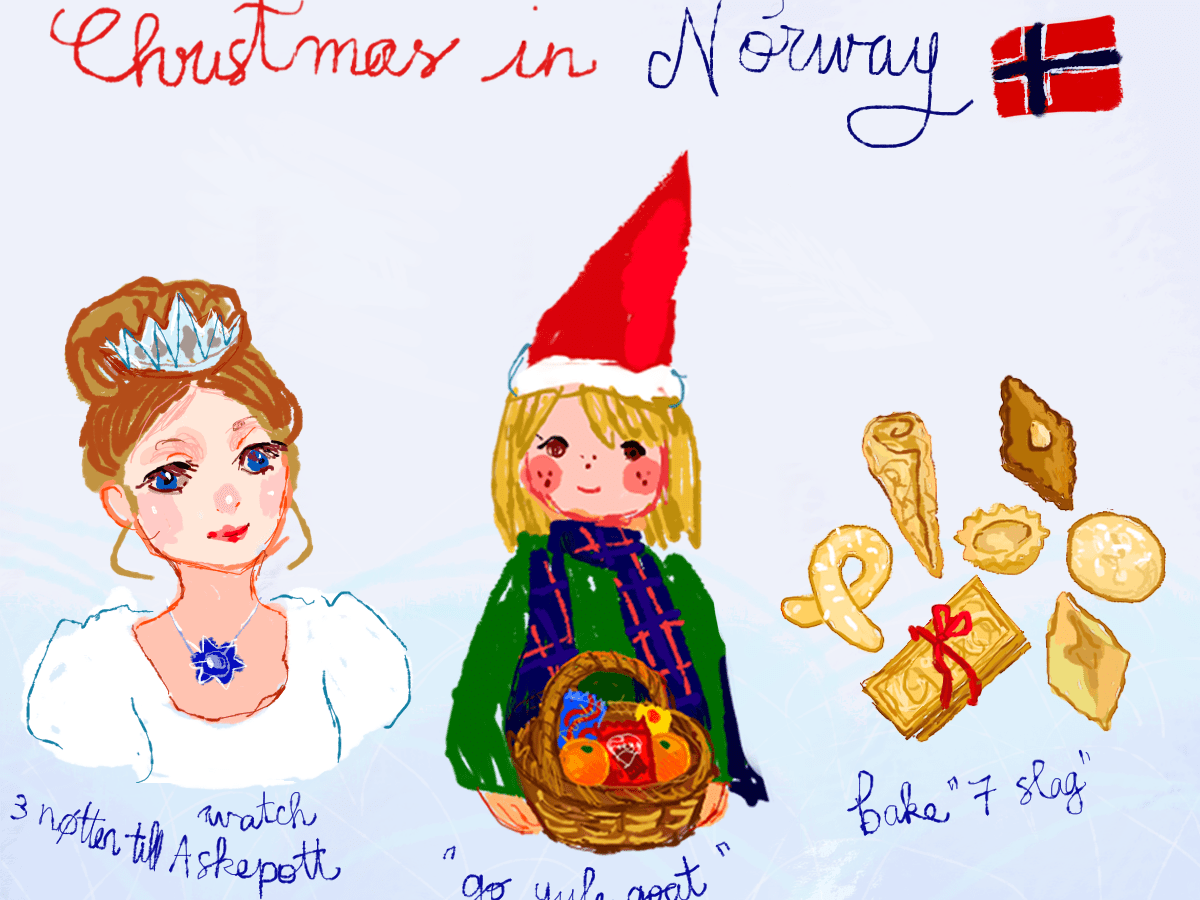
An iconic Christmas movie In Norway is actually Czech, from 1973: 3 nøtter til Askepott (3 wishes for Cinderella), broadcasted on Christmas eve in Norway since 1996 – Norwegians made a remake in 2021 though. Another popular Christmas movie in Norway is Reisen til Julestjernen (journey to the Christmas Star), a Norwegian production from 1976, in which a princess disappears to look for the Christmas Star…
‘Going Yule goat’ or Christmas trick-or-treating
In the period of Romjul, between Christmas and New Year, some Norwegian children go around with a Nisselue (Santa hat), with red cheeks and freckles painted on their face, or as angels, shepherds and other Christmas figures, singing Christmas Carols from door to door, in exchange for sweets. This is called å gå julebukk – to go Yule Goat..a sort of christmasy halloween. According to the Store Norske Leksikon it 14% of interviewed Norwegians or their children was going julebukk in 2017.
Baking 7 cookies
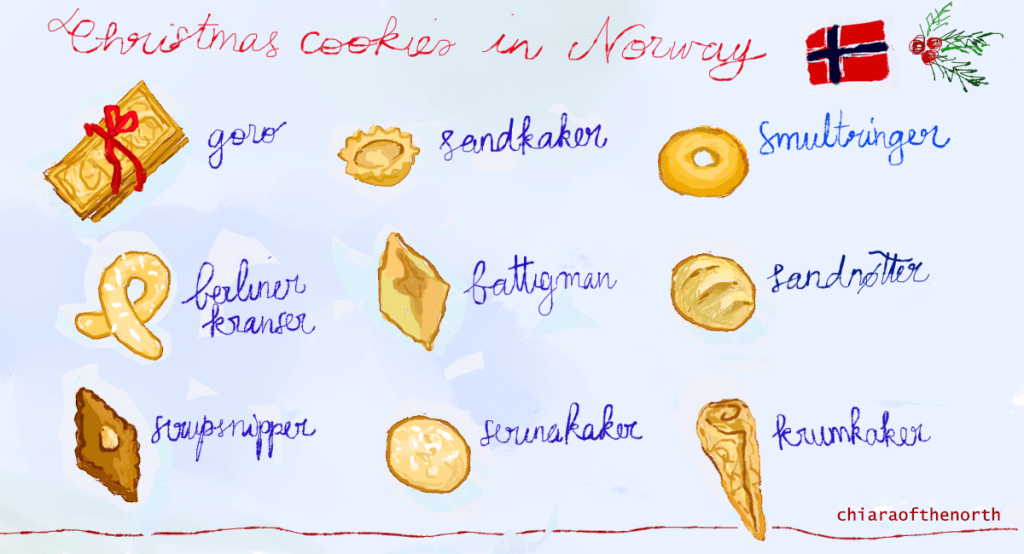
Some Norwegians bake the ‘Seven types’ – 7 different type of cookies, deSyv slag in Norwegian. Baking seven different types of cookies is a tradition that exists also in Sweden. There is no fixed list, but the classical types are Sandkaker, Pepperkaker (gingerbread cookies), Fattigmann ‘poor man’, Goro from Danish god raad, one of the oldest types from the 1800s- made with an iron press with patterns – Krumkaker, Berlinerkranser, Serinakaker.
Kransekake, kokosmakroner, sirupsnipper, sandnøtter and smultringer are also popular to be included in the syv slag according to godt.no.
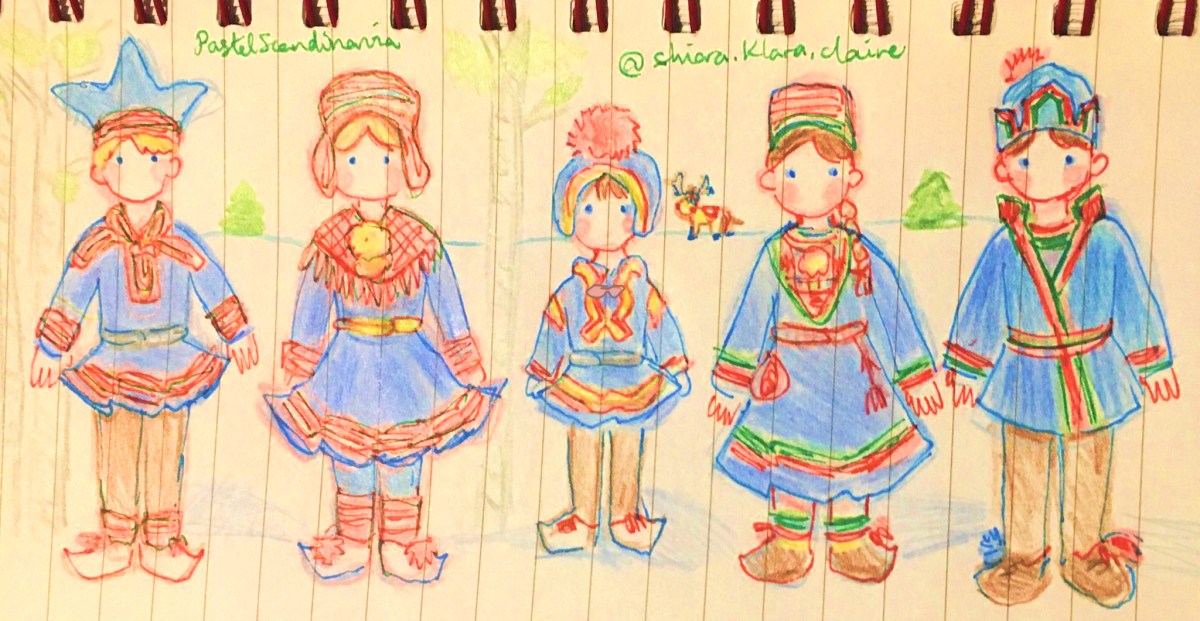
Sami traditional costumes: hats and dresses from Lapland
My birthday falls on Sami national day, and to honour the sami people (who used to be called Lapps), I decided to write an an article about their traditional clothing, after Swedish and Norwegian costumes.
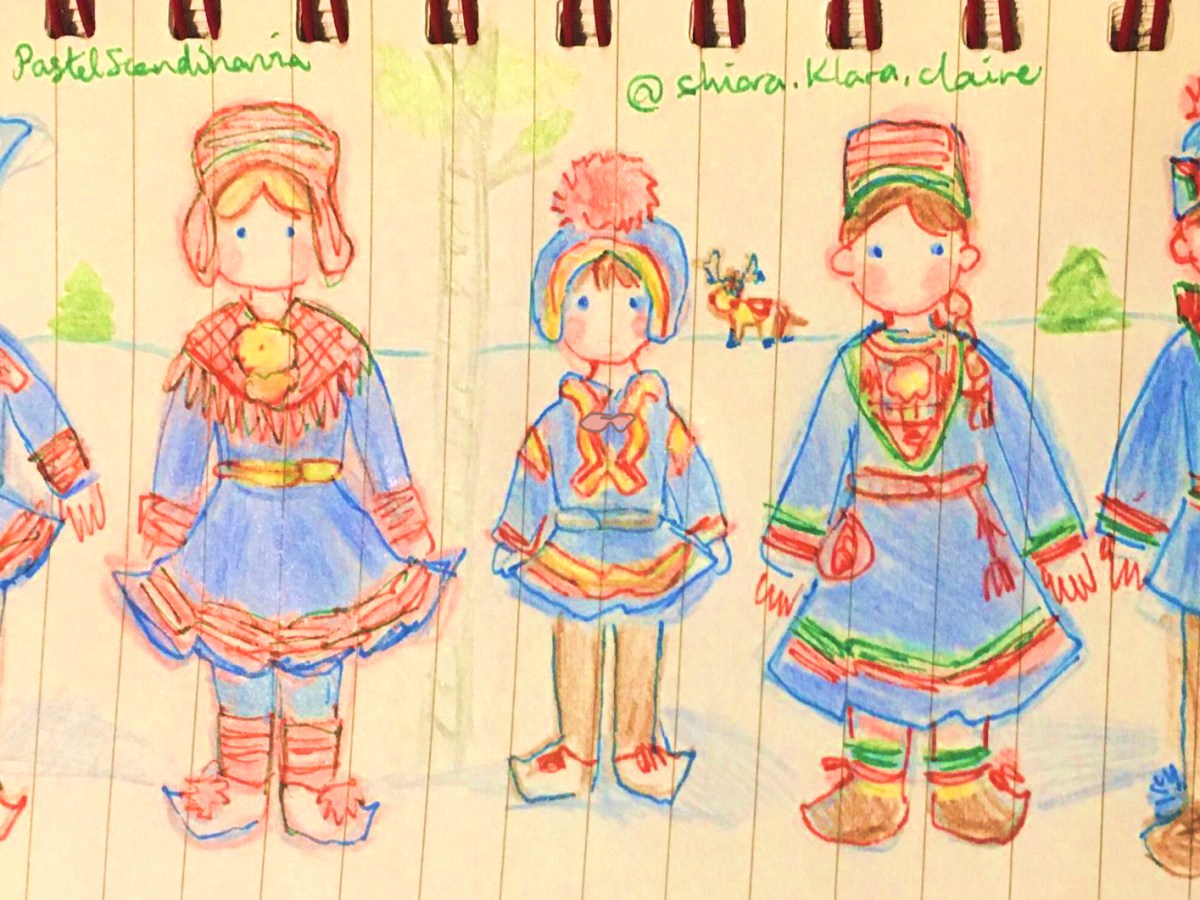
The Sami traditional costume is called gapta/gåptoe, in southern Sami, gábdde in Lule Sami, gákti in Northern Sami. In Swedish and Norwegian repectively kolt and kofte. It includes hats, belts, jewellery as brooches and mittens.
Sami handicrafts, Duodji, also include making your own clothing, and that is still the case for some families.
Sami costume variations
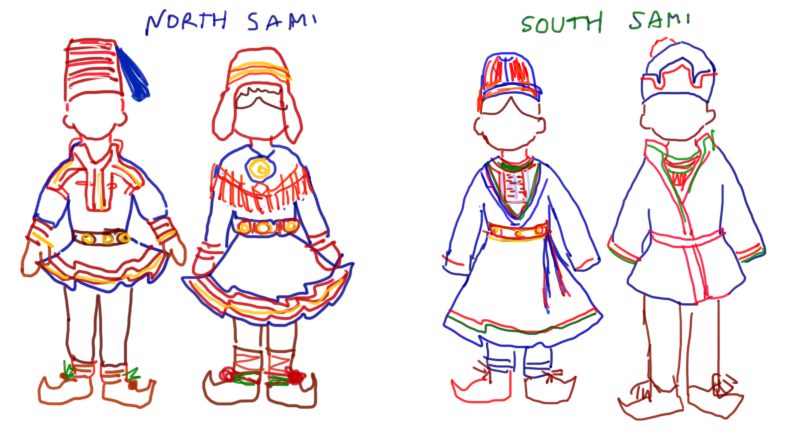
Sami Costumes vary depending on the geographical area and gender, but can have differences due to status, with different color orders and decorations. The base color is most often blue, with decorations in red, white, yellow and Green.
Generally, variations in Sami costumes follow Sami languages and ethnical groups within Samis. However, because of nomadic life depending on reindeers, designs from different groups ended up influencing each other.
The biggest differences I have noticed are between North and South Sami costume is the more “curled up” shape in the North Sámi versions, and the fact it, without surprise, looks more meant for cold climates, more often including a shawl for women. Nowadays it possible to see more modern kofte/kolt with different patterns, as you can see in this music video.
Sami iconic hats
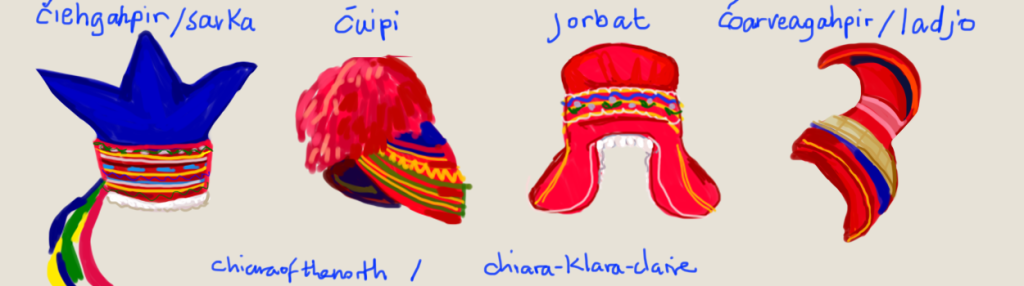
An important part of Sami costumes is the hat. Various types of hats exist (see picture), different for men and women. Among others:
men hats: Four Winds Hat, čiehgahpir or Šávka, with summer and winter variations (also stjernelue in Norwegian “star hat”), used in East Finnmark, Karasjok, Kautokeino, North-East Norway; ćuipi, a kind of poofball hat with a big red pom pom, used in Karesuando, Swedish Lapland.
Women hats: Jorbat, the hat with the big ‘ears’; Ládju/ladjo, also called čoarvegahpir (čoarvi – horn, gahpir – hat), which stopped being used a hundred years ago, but still exists in eastern Sami areas now under Russia.
Costumes as a symbol of Sámi identity
Some Sami grew up wearing it, other only used it for their confirmation ceremony, others get themself a sami traditional costume as adults. The tradition to wear it has almost disappeared in the coastal areas, but a revival lead to reconstructing them, similarly to what happened with Norwegian bunads.
In 1940 the archeologist Gutorm Gjessing and his wife Gertrjud were the first to write about Sami clothing, in their book Lapdrakten.
In the 1970s, Sami movements made it an important symbol for Sami identity. Wearing Sami costumes became a new tradition in some contexts, as during Sami national parliament assemblies in Sweden, Norway and Finland.
The Fjallkona is the personification of Iceland and has a big role in the Icelandic national day, between poetry and parades
June, 17th, is Iceland’s national day, Þjóðhátíðardagurinn. The day was established after Iceland’s independence from Denmark in 1944, on the independentist Jón Sigurðsson’s birthday.
The day is marked by parades, with marching bands and flag-bearing troops from the national scout movement. After the parades, it’s time for the town’s elected ‘lady of the mountain’ to recite a poem. Her identity is however secret until the ceremony. Before that, authorities and freshman students in Reykjavík have laid wreaths to honour Jón Sigurðsson. You can see the program for 17 júní in Reykjavík.
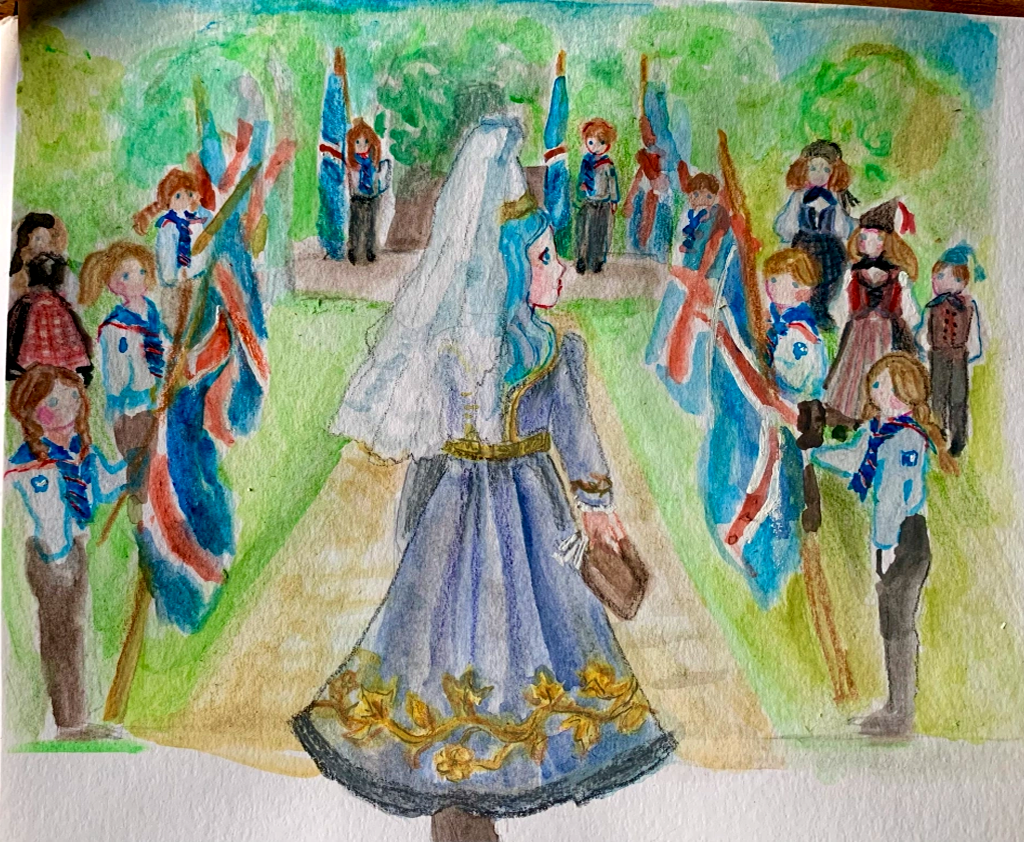
The woman representing the fjallkona, literally ‘lady/maid of the Mountain’, wears the skautbúningur, dark dress with golden embroidery and a sort of horn-shaped headgear, inspired by the ancient krókfaldur with a veil. The first time a woman represented the fjallkona with a skautbúningur was actually in Winnipeg, Canada in 1924, where many Icelanders migrated in the 1870s.
skautbúningur and kyrtill dresses are worn by the fjallkona, both designed by Sigurður Guðmundsson in the 19th century
Icelanders are encouraged to wear a folk costume on the national day, Þjóðbúningur. There are officially several types among which the Upphlutur for women and Hátíðarbúningur for men, not too different from other Nordic folk costumes as Norwegian Bunads and Swedish Folkdräkter, often black but also in colours as red or blue. part of the outfit is a tail cap.
Icelandic national day feels to me kind of a mix between Norway’s 17 (!) mai, with national dresses, parades and marching bands, and Lucia, with its elected Lucia/Fjallkona!
Where does the Fjallkona come from?
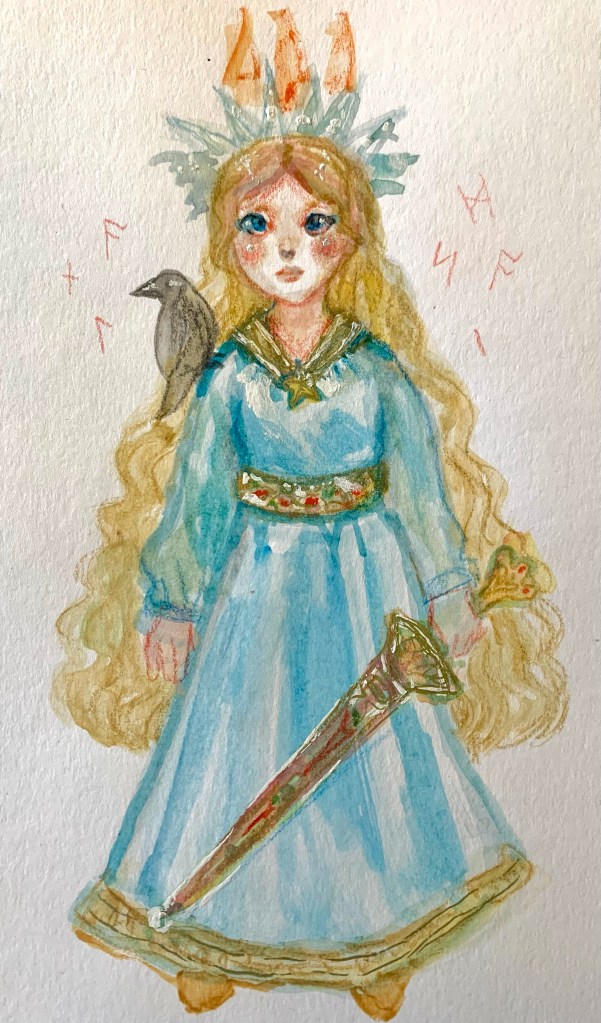
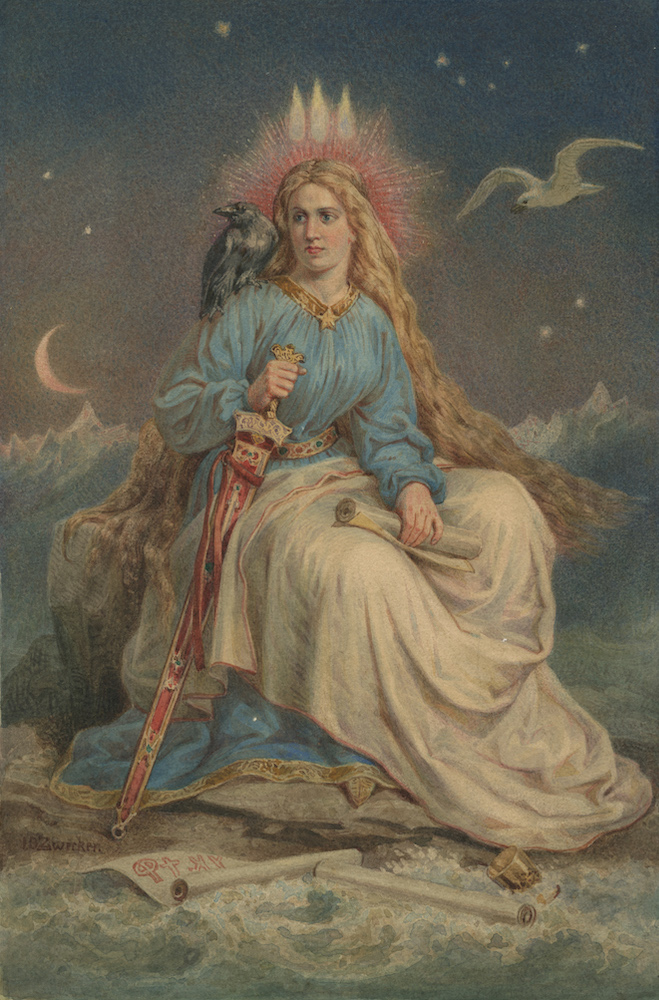
the Fjallkona is the female personification of Iceland. She represents Iceland’s spirit and its nature. Its name appears in the poem Eldgamla Ísafolda.k.a. Íslands minni by Bjarni Thorarensen in the early 19th century. Its most popular depiction is the painting by German painter Johann Baptist Zwecker in 1866.
Eldgamla Ísafold/ ástkæra fósturmold/ fjallkonan fríð!/ mögum þín muntu kær/ meðan lönd gyrðir sær og gumar girnast mær/ gljár sól á hlíð.
(Ancient land of ice / beloved nurturing soil / fair mountain woman. /May you love your sons, while countries barricade their waters / and men yearn for maidens / the sun glistens on a hillside.)
In Zwecker’s painting, made for the last volume of a collection of Icelandic folk tales, Icelandic Legends, the fjallkona has a crown of ice from which fires erupt, representing Icelandic nature with its glaciers and geysers. On her shoulder is a raven, symbol for the god Odin and norse mythology, and runes on a parchment, representing Icelandic culture.
It then gained popularity as symbol for the motherland, sometimes opposed to theDanish King as father under the Danish rule.
Icelandic patriotic poems
On the occasion of the institution of the Republic in 1944, a poem contest was held. Hver á sér fegra föðurland (who has a lovelier fatherland) and Land Míns Föður (My father’s land) were the winning poems. An extract from the two follows:
Hver á sér fegra föðurland / með fjöll og dal og bláan sand / með norðurljósa bjarmaband / Og björk og lind í hlíð? […]
Við heita brunna, hreinan blæ / og hátign jökla, bláan sæ / hún uni grandvör, farsæl, fróð / Og frjáls – við ysta haf.
Hulda (Unnur Bedediktsdóttir Bjarklind), ‘Hver á sér fegra föðurland’
Who has a lovelier fatherland / with fells and dales and bluest sand, with northern lights up aloft, and birch and lime on hilltops? […] With hot springs of a pure hue / majestic glaciers, a sea of blue / she remains thoughtful, peaceful, sage / and free, in the farthest sea.
Hvíslað var um hulduland / hinst í vestanblænum / hvítan jökul, svartan sand / söng í hlíðum grænum. / Ýttu þá á unnarslóð / Austmenn, vermdir frelsisglóð / fundu ey og urðu þjóð / úti´í gullnum sænum. […]
Hvort sem krýnist þessi þjóð / þyrnum eða rósum / hennar sögur, hennar ljóð / hennar líf vér kjósum. / Ein á hörpu íss og báls / aldaslag síns guðamáls / æ hún leiki,ung og frjáls / undir norðurljósum.
Jóhannes úr Kötlum, ‘Land Míns Föður’
There were whispers of a hidden land / hinst in the western blues / white glacier, black sand / singing on green slopes. / Push them on a path of success / Men of the East, warmed by the embers of freedom / found an island and became a nation / out in the golden seas. […] Whether this nation is crowned / with thorns or roses / its stories, its poetry / its life we choose. / Alone on the land of ice and fire / the eternal sound of her divine language / forever she moves, young and free / under the northern lights.
The ‘anchor’ language concept allowed me to learn Swedish, Dutch, Danish, Norwegian easily starting from studying properly only one language. This approach helps prevent confusion and builds a solid foundational understanding of language structures.
The Norwegian national costume, to be seen in all its glory on 17 may, and its old but not so old tradition
A bunad (plural bunader) is the Norwegian national costume. Bunads are among the most beloved folk costumes in the world, and the most worn in Europe. Other Nordic countries have their own folk costumes as well, but they are much less common and strictly connected to folk traditions as folk dances. Read about Swedish folkdräkter.
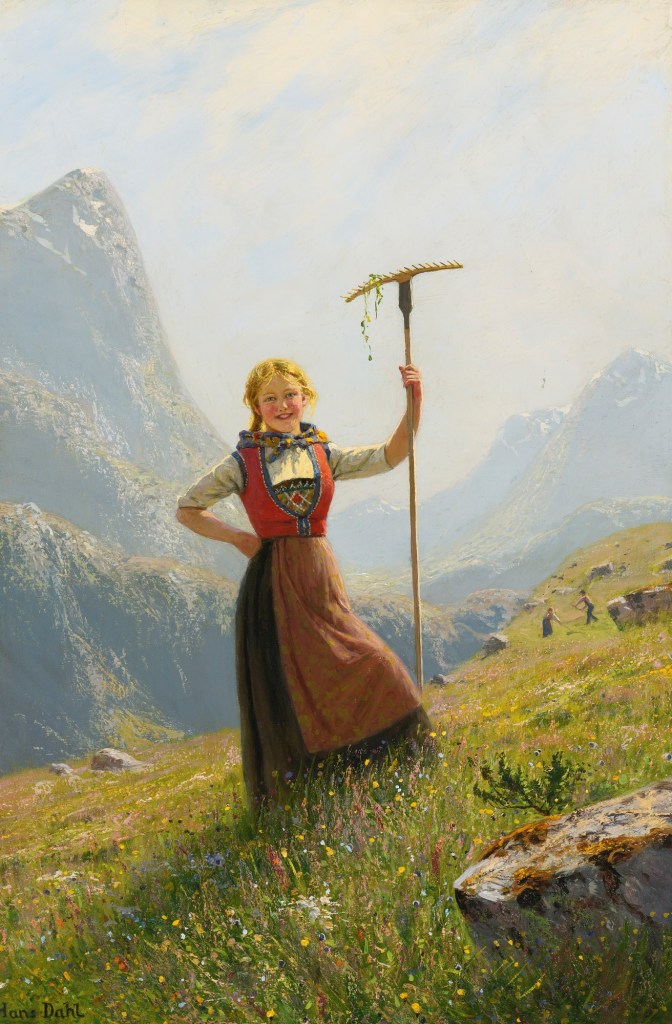
In Norwegian there’s a distinction between a Bunad and a folkedrakt (“folk costume”) , with the latter specifically used for costumes from the past. The word bunad, from Old Norse búnaðr began to be used in the 20th century, as the national costumes gained popularity with the rise of the National romantic movement in the 19th century, with artists as Adolph Tidemand and Hans Dahl depicting them.
Why bunads are so popular in Norway
After national romanticism, the use of bunads increased in the 1920s, but it was after the war that the national dress became even more popular, as a symbol of free and indepent Norway. First and foremost on the national day, and then for any festive occasions – as christenings and weddings. It is now officially seen as a gala attire, which can be for instance worn at the opening of the Stortinget, the Norwegian parliament. The best day to admire Bunads remains 17th May (Norway’s National day).
Young adults traditionally receive their bunad on their confirmation, as 15-year-olds, and it will last their entire lifetime. Crown princess Alexandra had hers sewn by her grandmother the Queen for this occasion. Purchasing a bunad costs thousands of euros/dollars, although lately low cost “China bunad” emerged.
Around 80% of Norwegian women owns a bunad. It is less common for men to wear it, with 20% having one, but the number is rising. In 1999, Pakistani-born Stortingen member Rubina Rana wore a bunad as the first person with migration background doing so in a 17 mai parade.
The diverse bunad designs
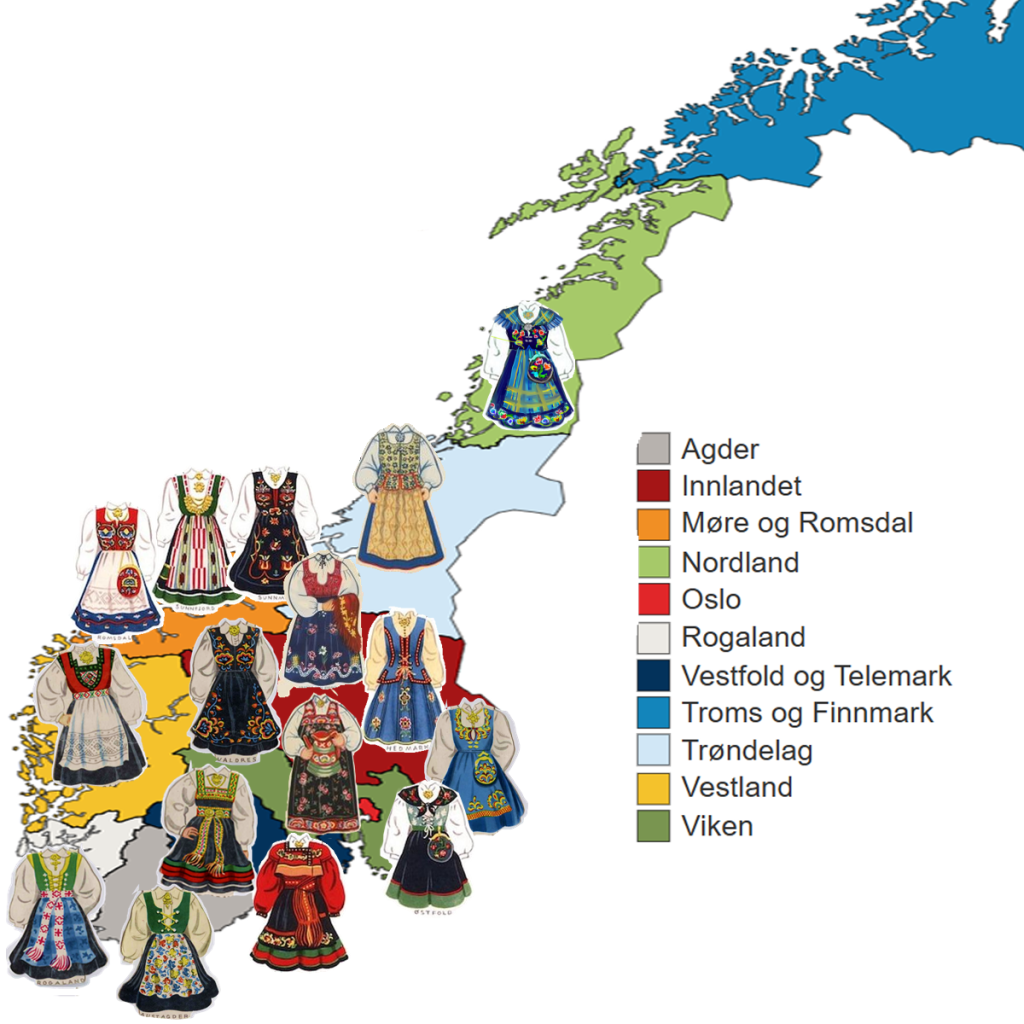
Norway’s fylker (counties) with some bunads from them
There are around 450 bunads in Norway, with each district having its own designs. They can be grouped into 5 categories of Bunads depending on how they were created, from traditionally in use to entirely recounstructed.
At the beginning of the 20th century Norway had just become fully independent and many were trying to promote Norwegian traditions and make the national identity stronger. In these years Bunads were being redesigned from old costumes with Hilda Garborg as leading figure for the movement. She published a very successful book called Norsk Klædebunad in 1917.
Bunads with the oldest tradition
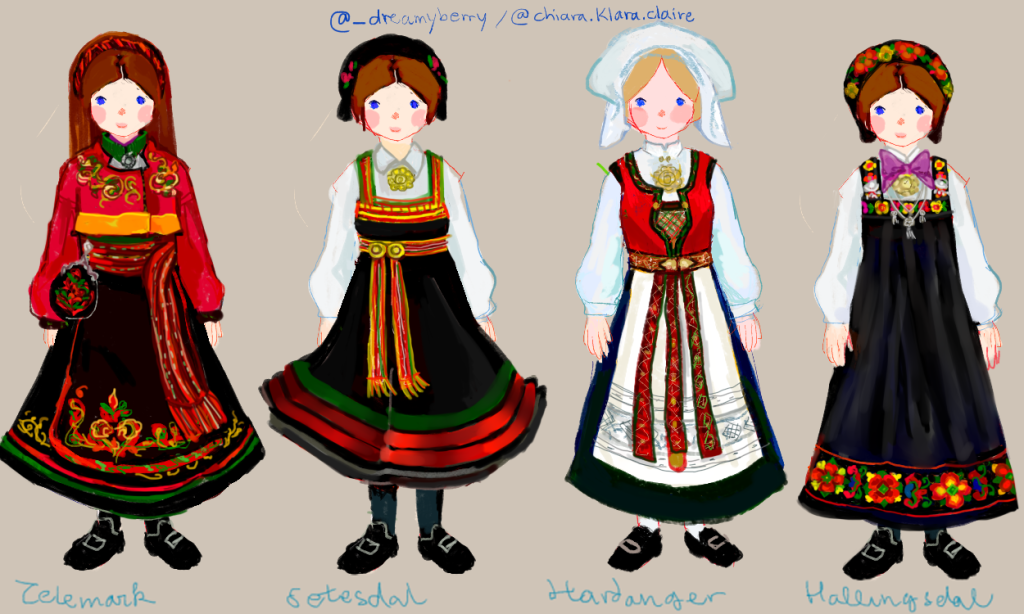
The Hardanger bunad, was established in its use and is retained as the most Norwegian, depicted in art and easily recognisable. Setesdal, Hallingdal and Telemark are the other districts with the oldest and most established bunad tradition.
More recent bunads
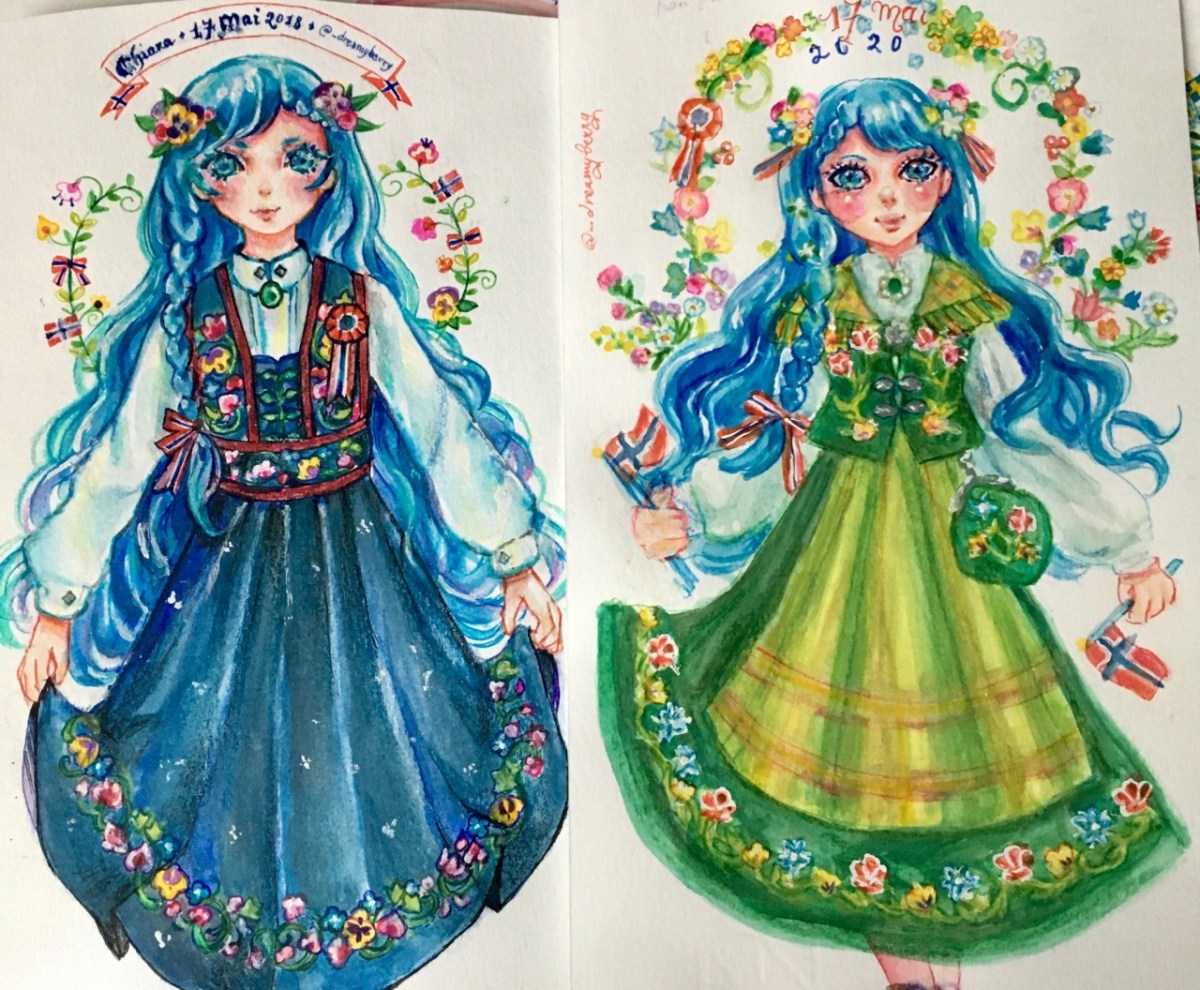
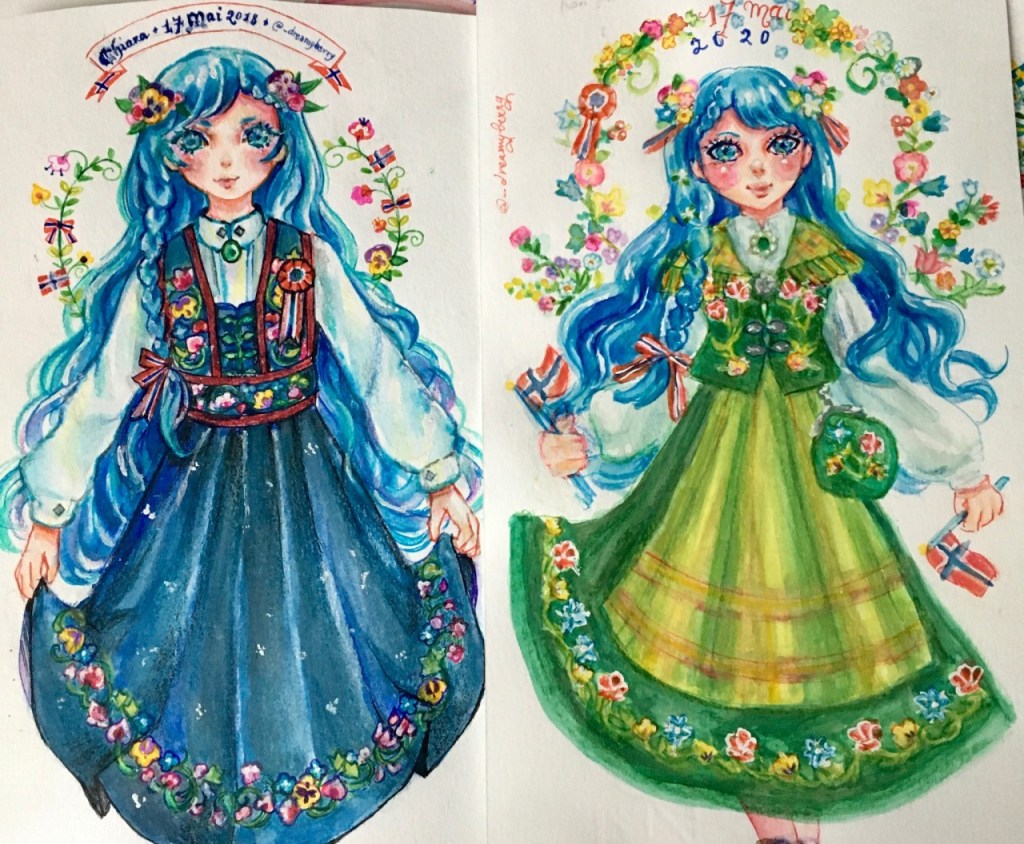
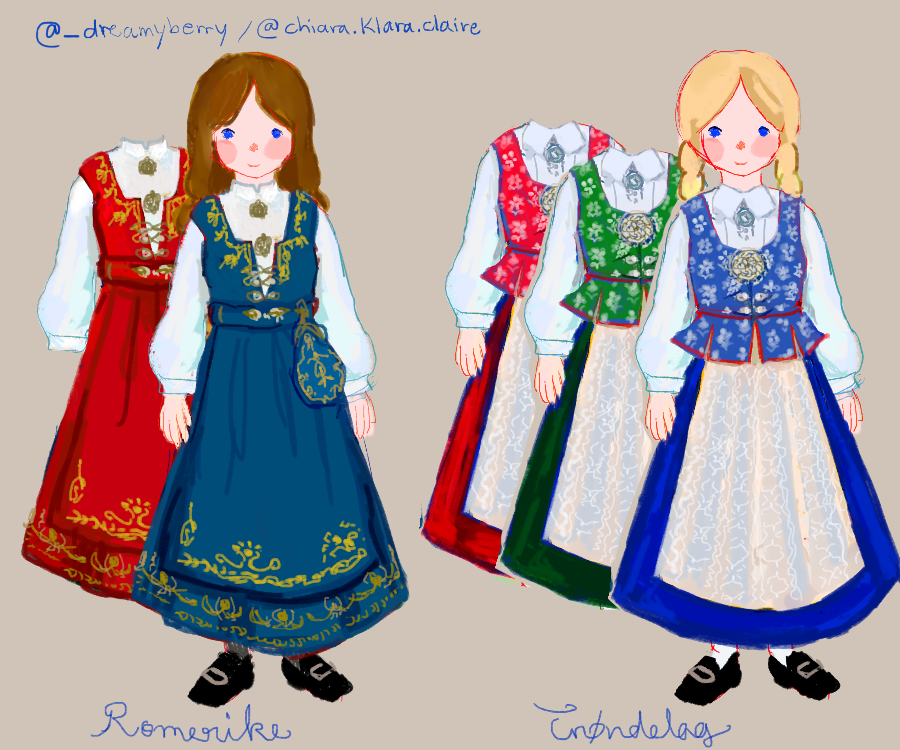
Flower embroideries are very common. Present among others in the Nordland bunad (considered by many Norwegians the prettiest bunad) and Gudbrandsdalen bunad. The same design can also come in different colours, with the Nordland bunad existing both in green and blue and the Trøndelag and Romerike bunads in blue, red and green.
Left to right: my flower-themed original character with by Gudbrandsdal and Nordland bunads. Romerike (South-East Norway, near Oslo), Trøndelag (North Norway)
Accessories of the Bunad outfit
Part of the bunad outfit is Sølje, hand-made silver or gold jewellery, which is very important and gets bigger with older one gets. Silver was believed to have magical powers!
Headdresses, as bonnets, used to be important as they indicated an individual’s social or marital status, but big ones as the hardanger bonnet are now scarcely used.
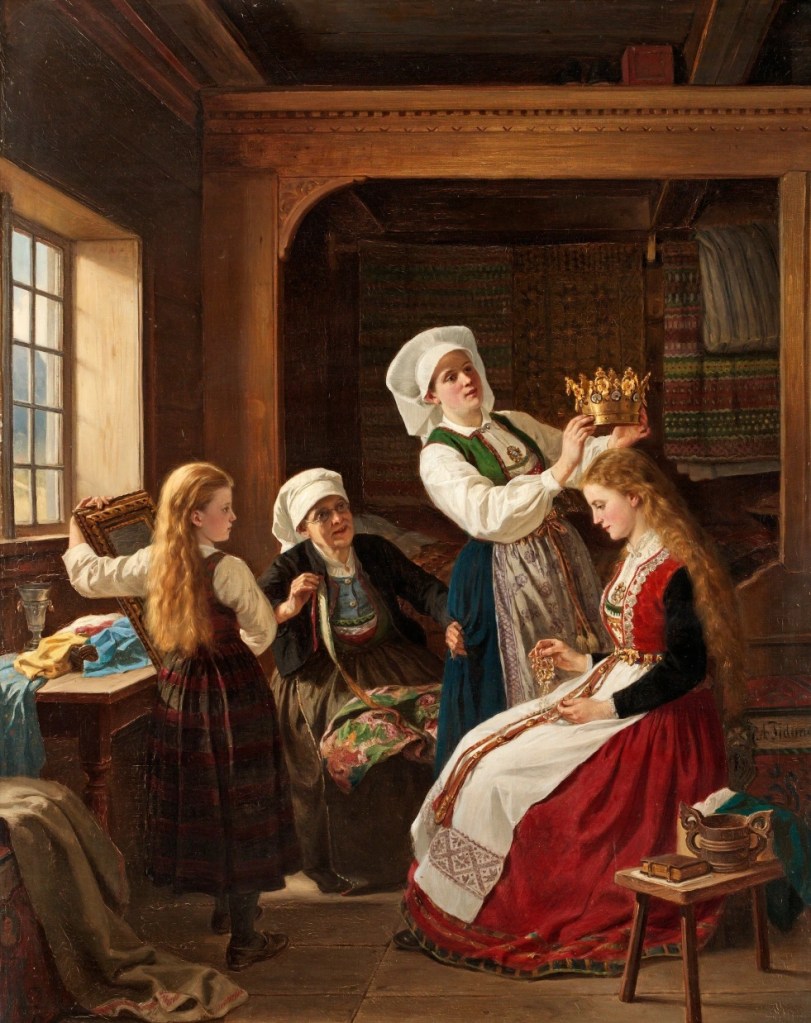
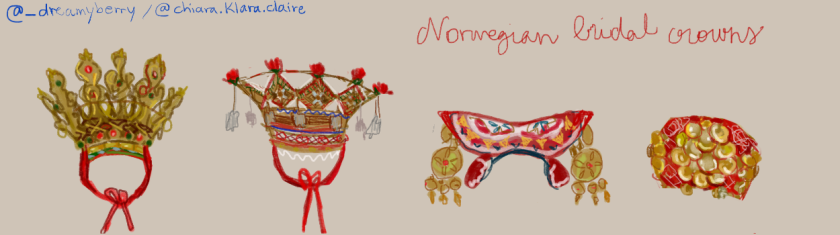
An elaborate with bridal crown can be used for a traditional Norwegian wedding, it was a sign of virginity in connection to the Holy Virgin. The bridal crown tradition goes as far back as the Middle Ages. Like bunads, there are many regional variations, which you can see on Whigofwhimsy.
The silver crown, present in many regional variations, Hardanger perlekrune, Voss, Setesdal
cinnamon buns, waffles, semlor and more: there is a special day dedicated to each in Sweden
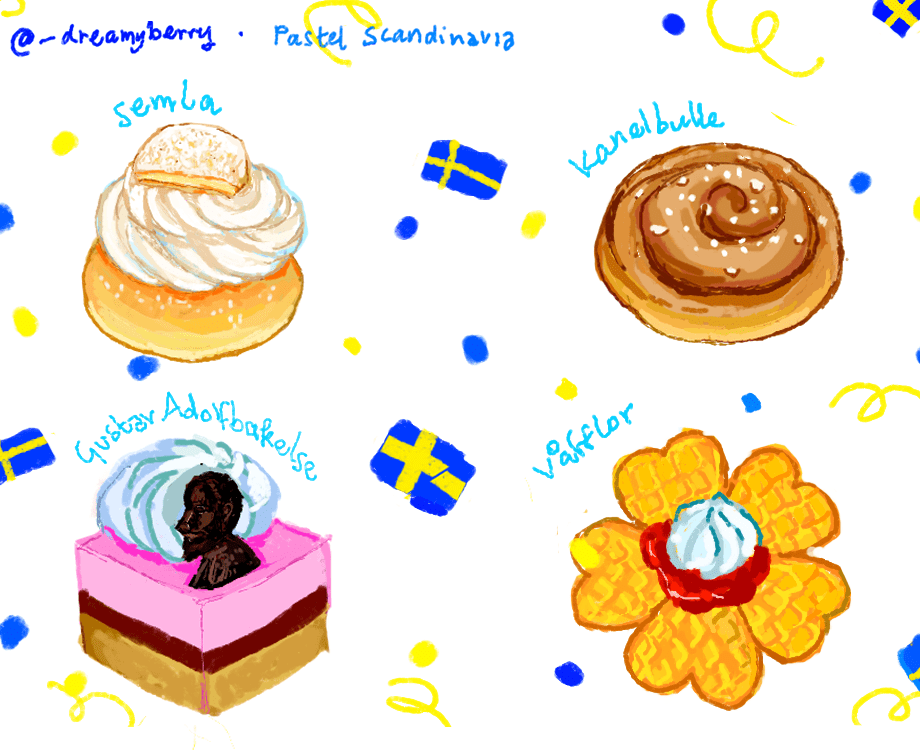
Soon it is time to eat semlor pastries in Sweden! Swedes have a few days dedicated to eating a specific thing. Whether it started to honour a king or just find an excuse to bake, time to mark some days on your calendar and join them in celebrating Swedish confectionery!
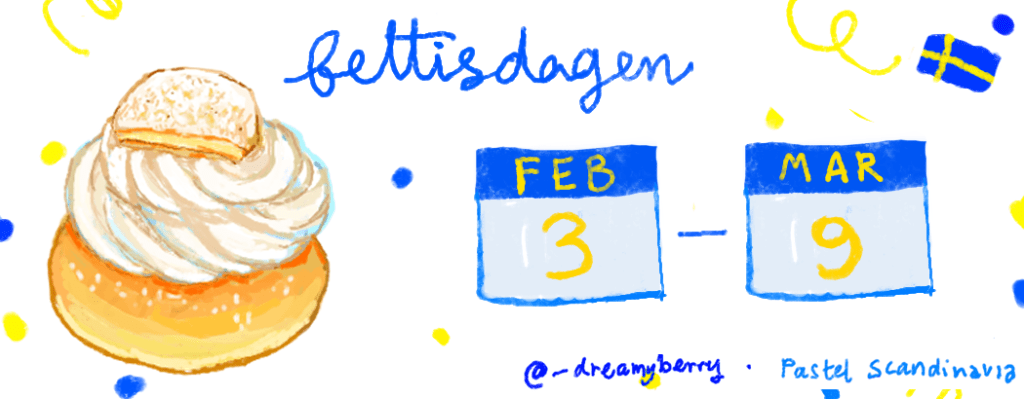
Semlor: February/March – Fettisdagen
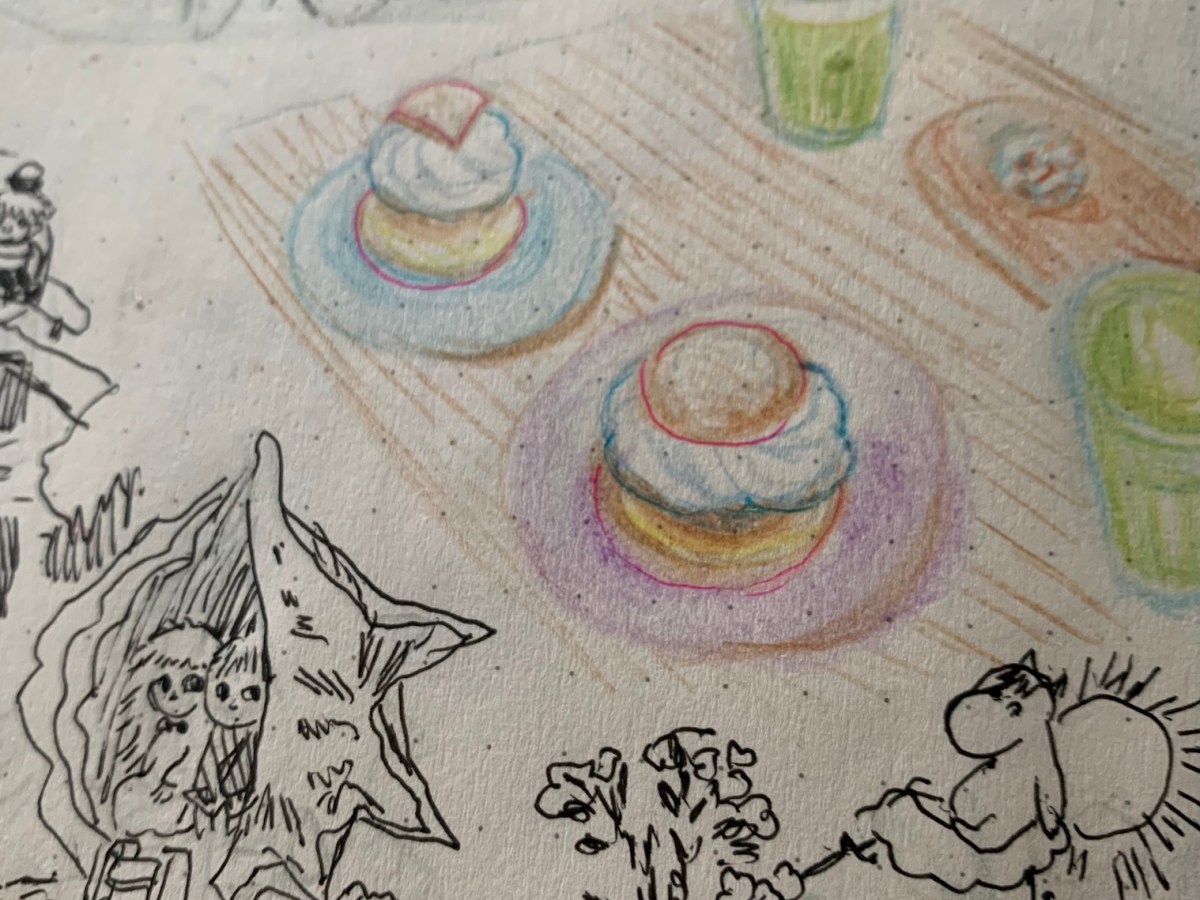
On Shrove Tuesday (fettisdagen, fet tisdag = fat Tuesday), 21 February in 2023, tons of of semlor are purchased in Sweden. A semla is a cardamom-spiced bun with almond paste and whipped cream. A perfect pastry you’d want to devour before the fastening time preceding Easter starts! Semlor are eaten in Swedish Finland too, but called fastlagsbulle there, and Fettisdagen is called fastlagstisdagen. Slightly different versions of semlor exist in the other Nordic countries too, and they are usually eaten on Shrove Monday instead: Bollur in Iceland, Fastelavnboller in Denmark/Norway. Unlike the Swedish semlor, they often have chocolate on top…
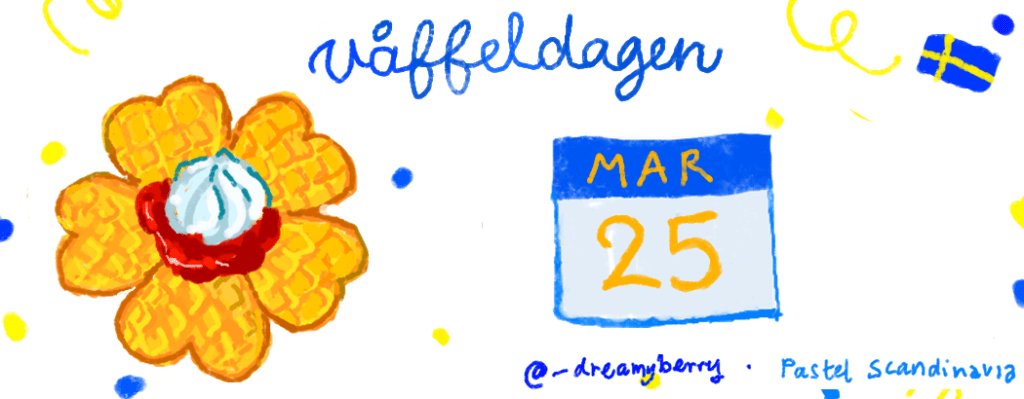
Waffles: 25 March – Våffeldagen
The christian feast of the Annunciation, in Swedish Vårfrudagen, lit. “Our Lady’s Day”, ended up becoming for most Swedes the similar-sounding våffeldagen (“waffle day”). This turned a religious day into a chance to eat heart-shaped waffles! It is also ”observed” In Norway and Denmark!
Cinnamon buns: 4 October – Kanelbullensdagen
Cinnamon bun day has been celebrated since 1999, and it was actually invented for commercial reasons: the person who made it up, Kaeth Gardestedt, was at the time working for an association of baking products producers. After almost 25 years people still bake cinnamon bunson 4th October!
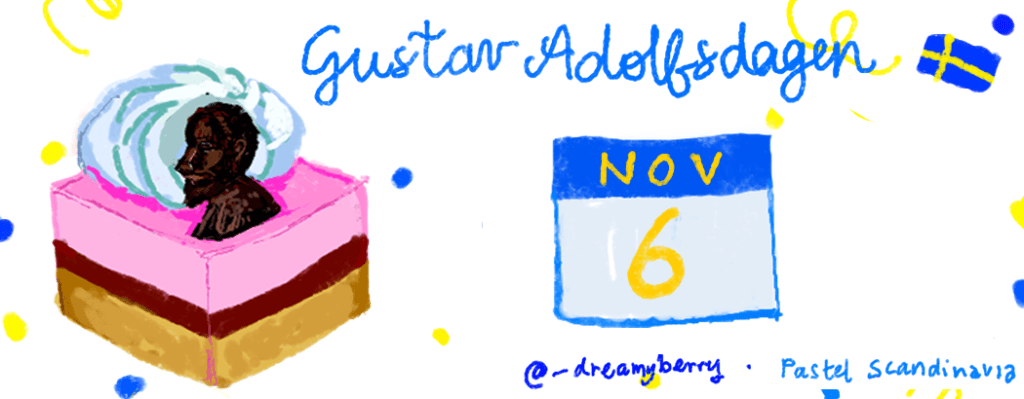
Gustav Adolf pastry: 6 November – Gustav Adolfsdagen
6th November is the date of the Swedish king Gustav II Adolf’s death in 1632. The king was very generous with universities as the one of Gothenburg, where a pastry was invented in his remembrance: Gustav Adolfsbakelse. It has been popular since the late 1800s. You can see it in a lot of variations, but what makes it a Gustav Adolf pastry is the chocolate bust of the king on top!
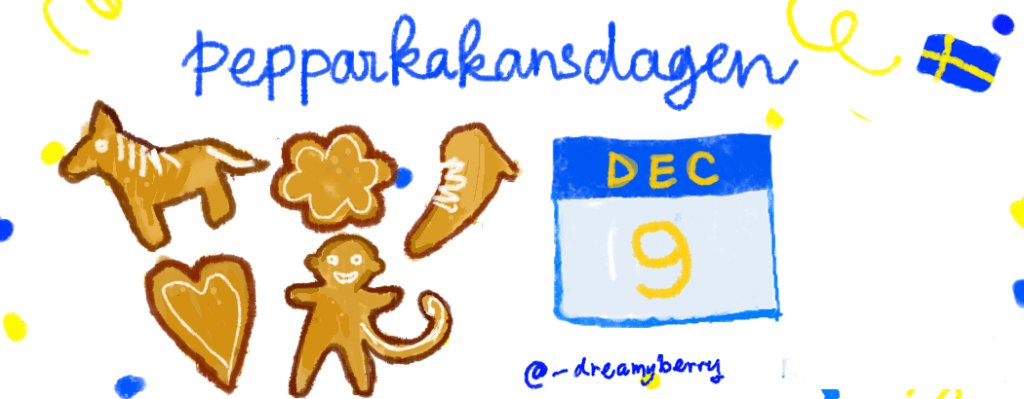
Gingerbread biscuits: 9 December – Pepparkakansdag
Gingerbread cookies, known as pepparkakor in Sweden, probably originated in Nuremberg, Germany, in the middle ages. Mentioned in Swedish in 1444 for the first time, the word pepper was used to mean spices in it, as pepper was the most common spice at the time. Baking them became a typical Christmas thing in Sweden and other countries, remember the episode of Pippi were she cuts them in the shape of her horse and monkey? Pepparkakansdag was, similarly to Kannelbullensdag, invented in 1996 by gingerbread maker Annas Pepparkakor.
Apparently there is also a Polkagrisensdag (candy cane day) on 20th April, but it mostly promoted in Gränna, near the Vättern lake. There Amalia Eriksson invented the polkagrisstång in 1859, the red-white peppermint candy cane, and many local shops celebrate this day.
How graduating from high school is like in Sweden, Denmark, Norway!
Hats and buses
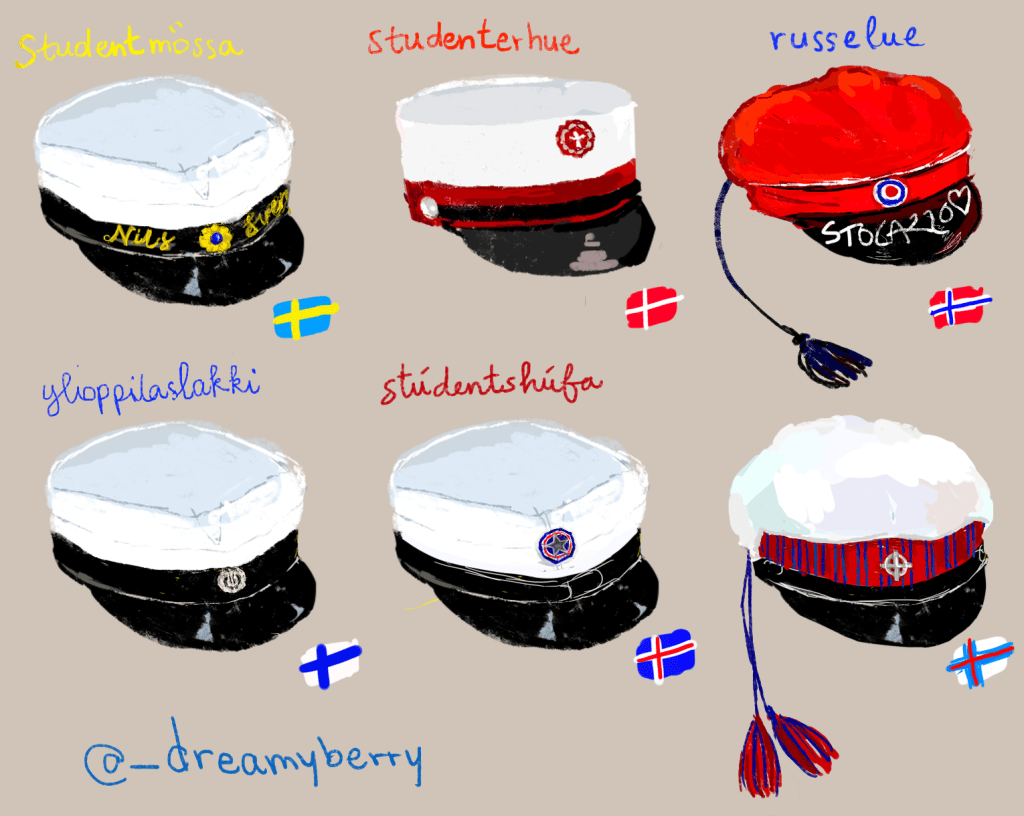
the symbol of High school graduation is a hat resembling a ship’s captain cap, the first time I saw a Swedish graduation celebration picture I was pretty confused about those hats, but it’s actually a tradition inspired by German students, spreading it to Nordic countries in the 19th century.
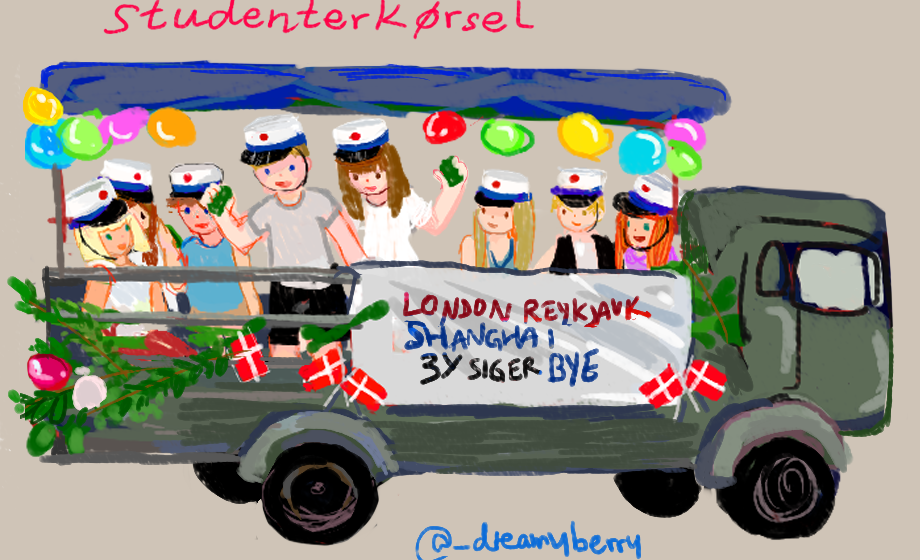
Another common thing in Scandinavian is that graduates celebrate around town on rented buses or trucks (sometimes saving up years just to rent one), generally playing loud music, drinking and just partying!
Denmark 🇩🇰
Danes have an oral exam as final. you have to decide who from your family is placing the hat, studenterhue, on your head, when you step out from it. It’s the norm to wear the graduation cap for at least 2 weeks, It is courtesy that people they meet on the street congratulate them, even if they don’t know each other.
The ribbon on Danish caps was originally only either blue (Mathematics students) or red (Arts students), it now comes in many different colors depending on the length of your education and which school you went to, see all possible variations on Alt.dk. There are lots of rules involving the studenterhue:
You can’t wear your cap before your last exam (it would bring bad luck)
your gradehas to be written in the center of the hat, and friends and family can leave autographs and short notes in it
friends bite in the shadow for good luck.
the students with the biggest and smallest hat size, and the ones with the highest and lowest grade average have to buy a box of beers for the class
the hat has to be cut in different ways if the student has drunk 24 units within sunrise, if he vomits, and so on to the point a which if the student goes to the hospital because of too much alcohol the whole shade is cut off.
more rules are related to having sex (heart on the sweatband if with the partner, lightning on the rim if not in a relation) , kissing someone (if same gender the cross has to be turned), breaking up (metals going off), taking a swim with only the hat on (wave in the rim)
If the student has been awake for 24 hours then the hat must be turned around (shadow in the back).
You can see more on this site dedicated to studenterhue rules (in Danish)!
The Studenterkørsel – student drive – is an important part of the celebration, renting a truck decorated with beech branches to party, drink and play loud music on (here‘s a site where the trucks & stuff can be arranged). It drives to each student’s home for around 15 minutes, for a short visit where parents give snacks and drinks before the next destination.
This can last one or two days and of course also the studenterkørsel has its own rules, among which running after the truck if you get an A in your last exam, and learning a battle cry to scream at passing student trucks!
Everyone greets and sends their congratulations when they see these trucks. On my very first day in Denmark Student buses were driving around (slowing down the bus I was on though, haha) and following my friend’s example we waved at them, flying my welcoming flag! It felt quite cool!
Sweden 🇸🇪
In Sweden there’s one big day, Studenten, but the celebration starts around the end of April, where students organize games which will give points deciding who will be the first student running out of the school on the gruaduation day; it can be anything from chill to embarrassing things to do, though maybe not as wild as what you’ll read for Norway. In May, there’s one day called Mösspåtaggning, on which students dress up nicely with their hat Studentmössa on, and with classmates they go to school and then to a restaurant or bar, celebrating that one month is left until the studenten time.
The big day of Studenten may vary depending on the school, but it is usually around 30th May to 15th June, with 6th June (Sweden national day) being the pitch.
This day starts with fellow students meeting up very early – between 4 and 7 am for the Champagnefrukost, Champagne breakfast
At 8-9 it’s time to leave for school, with some proving they can keep up with the celebration despite being drunk.
Around 10 everybody listens to the principal giving a speech, some students get diploma for things as All-A-Student etc.
At 11-12: photo shootings of classes!
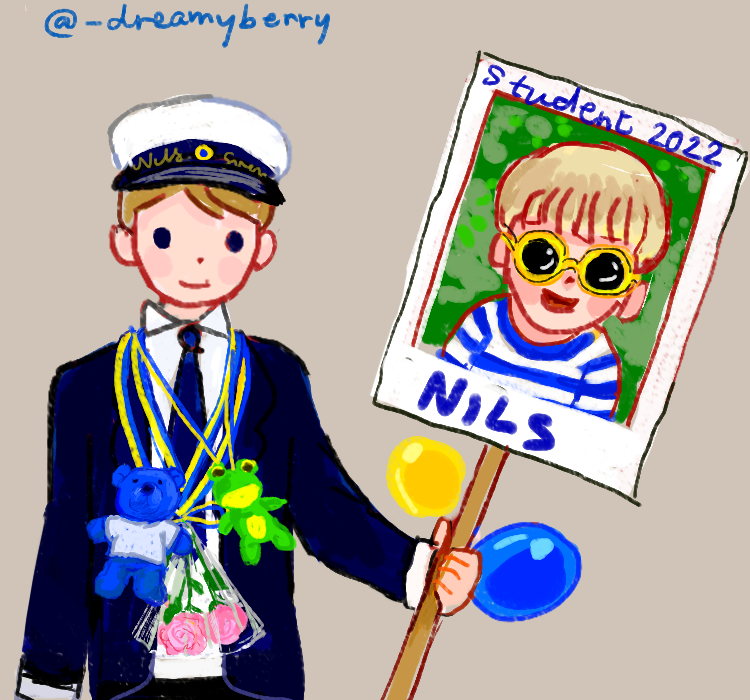
Once they got their diploma, Students run out of school to their families and friends, who are waiting for them holding a picture of the graduate as a baby or small child, and give them blue-yellow chains with flowers and trinkets as plushies!
The clothing for this day is quite formal, with boys wearing suits, girls usually a white dress. each student has their name and surname embroidered on the hat, which costs around 100 euros
After staying with their families for some time, studentsget on flatbed buses driving through the city as the Danes do, dancing, drinking and partying. In some cases they just walk around instead, something which has been encouraged by authorities after several accidents involving the flatbuses occured.
Norway 🇳🇴
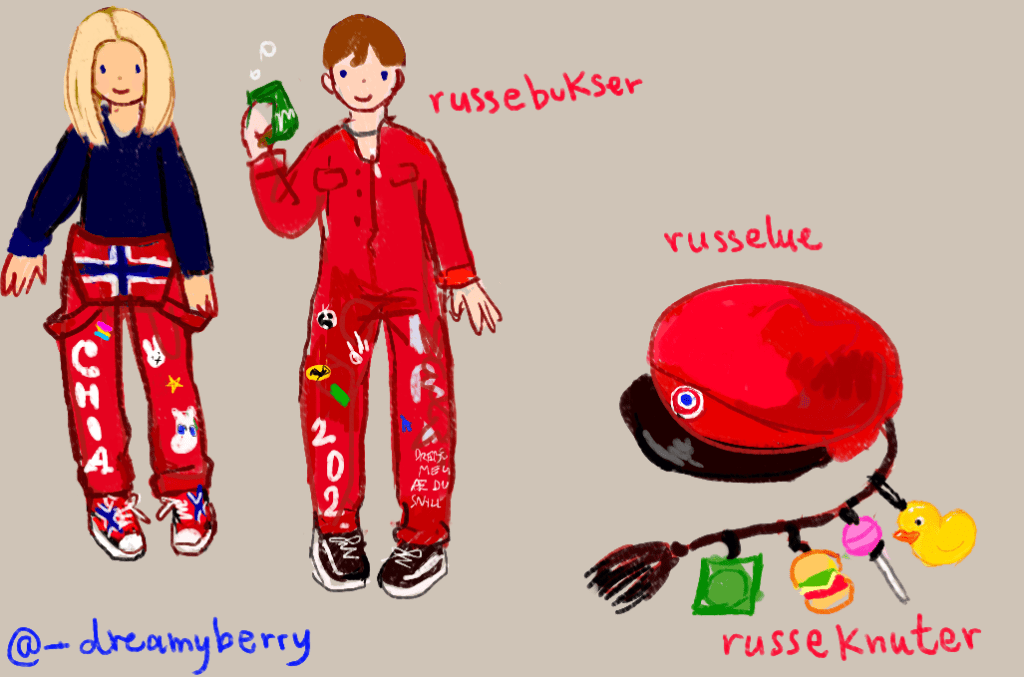
Norwegian graduation celebrations, Russ (short for russefeiring) is a big deal in Norway, with youngsters in overalls roaming cities for almost a month, from the end of April to the Norwegian Constitution Day, (read more about May 17th). On that day, the students are awarded their caps and join the parade in their overalls. The russ period has also become known as “the three-week binge” treukersfylla, continue reading to find out why…
The personalized overalls, russebukse, are usually red, or blue in case of financial and business studies, and personalized with patches. On this website Norwegians can get their russ equipment 😉
On the caps, Russeluer, Students write the Russ names they’ve been given, but the important part is a long cord, which gets knots (knuter) added for given dares completed before graduation: russeknuter. The tradition was introduced in the 40s, with different lists of around 100 dares for every school. Many dares involve sex and alcohol, and a lot are just hilarious. Classics are wearing loaves of bread on your feet for a whole day, not sleeping for 48 hours and bathing outside before 1st May. After criticism that russ was getting too wild, some new dares were invented to encourage teens to make good choices, such as getting tested for STDs or giving food to a homeless person.
Here are a few recurring ones (trinket – dare associated to it):
TAMPON – Put two tampons in your mouth and drink a pint of beer/cider.
TWIGS FROM THE GARDEN – Sleep in a tent in a teacher’s garden.
CANDY BURGER – Eat a cheeseburger in two bites.
“L” – Put an “L” (used for driving practice) on the back of a public transport vehicle.
CONDOM PACKAGE – Buy a pack of condoms using only body language.
BANKNOTE – Place a 5 minute poledance on a pole on a public transport.
RUBBER DUCK – Bathe with someone else in a canopy in front of the school, remember to scrub each other.
TOY FIRE TRUCK – Have safe sex during your period/with someone on theirs.
Here is the whole list of Russeknuter of Oslo for 2022 (in Norwegian). Because of what’s happening, this year there is a special Ukraine-knut, which can be gained if the class contacts a refugee centre and brings some fun activities to socially engage the young refugees there.
As the other Scandinavians Norwegians also rent or buy buses – thetradition of buying an old van or bus and painting it started in the 70s – but they do it on the next level, with their Russebuss, large coach buses completely decked out with colors, graphics, retrofitted and customized to become mobile partying units! The average Russbuss is used by 15 to 25 students and costs around $116,000!! Drivers are hired to drive them to Festivals and landstreff (national meetings) to meet Russ from whole Norway and party, party, party.
You may now wonder why students party that wildly in April. That’s because by the early 2000s, the authorities were worried about the impact all this partying and alcohol would have on the students’ grades, so the final exams in public schools were moved to early May. but what ended up happening was simply that the students started the russefeiring earlier.
Bonus: Finland 🇫🇮
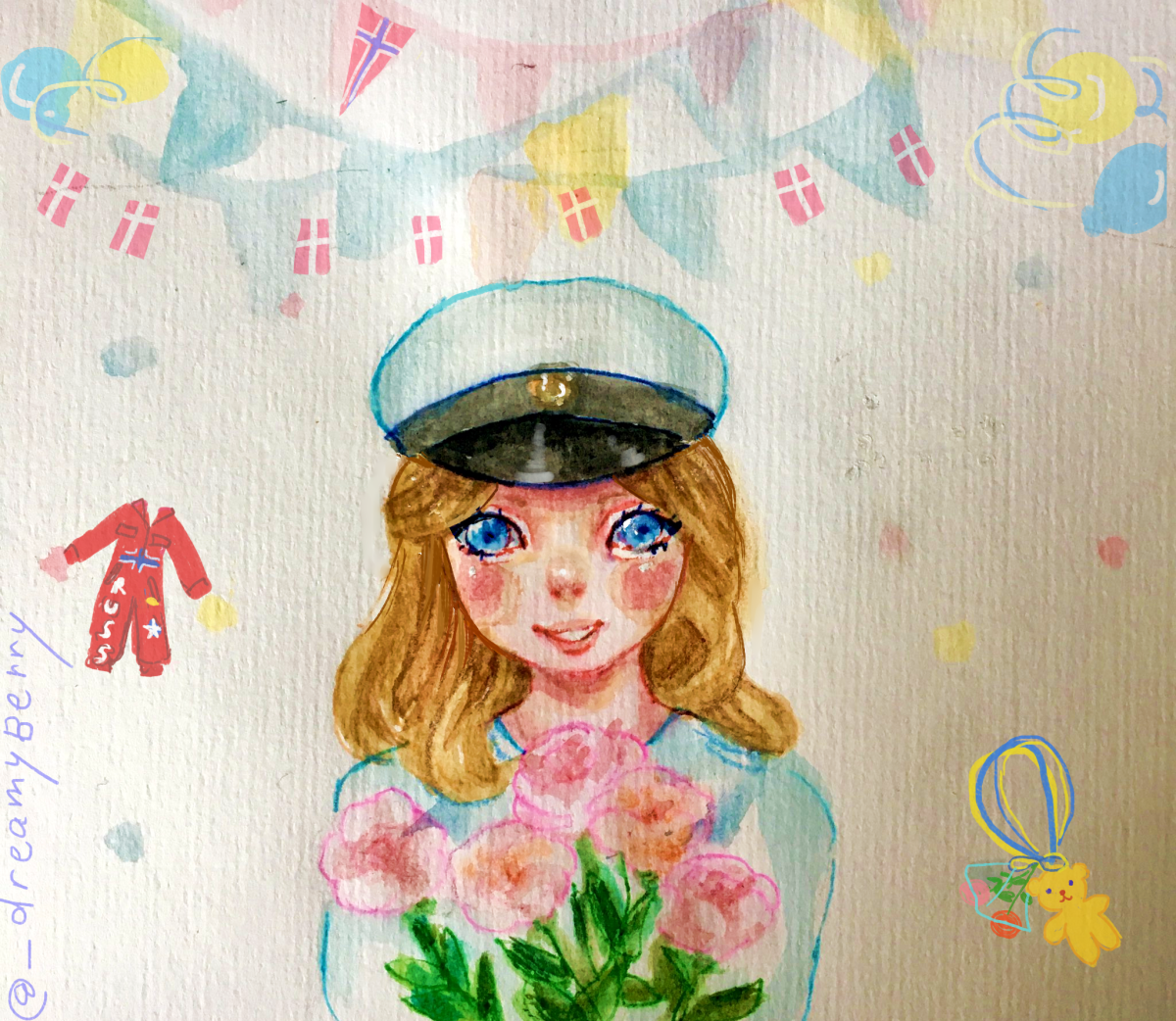
The girl I portrayed on the cover picture of this article is a Finn, (@alwaystimeforbujo on ig, she posts about bullet journaling), so here is something about Finland too:
The Finnish cap, Ylioppilaslakki, is similar to the Swedish version, but instead of coloured fabric cockade, it has a metallic, gold-colored cockade depicting the lyre of Apollo, the insignia of the University of Helsinki.
Truck parties are a thing in Finland too, but in February, when students begin preparing for their final exams. A typical thing they do is dressing up in various costumes visiting the town’s school and throwing candy!
From old folk dresses varying for each district to the Sverigedräkt, a national dress for all of Sweden
Swedish folk costumes, Folkdräkter, are an important part of a Swedish cultural heritage, and are symbols for local and national identity. There are 840 different variations (550 female outfits and 290 male ones). Some of them have a rather long history, dating back from the 17th century. Members of the Swedish royal family wears a blue and yellow dress with daisy decorations on some occasions – that dress is much more recent!
Different types of Swedish folk costume
Swedish folk costumes vary by region of origin, but in some they are more common, Dalarna has a very rich folk costume culture for example.
Some from Dalarna (Leksand, ?, Rättvik), central Sweden; and Norrbotten, northern Sweden
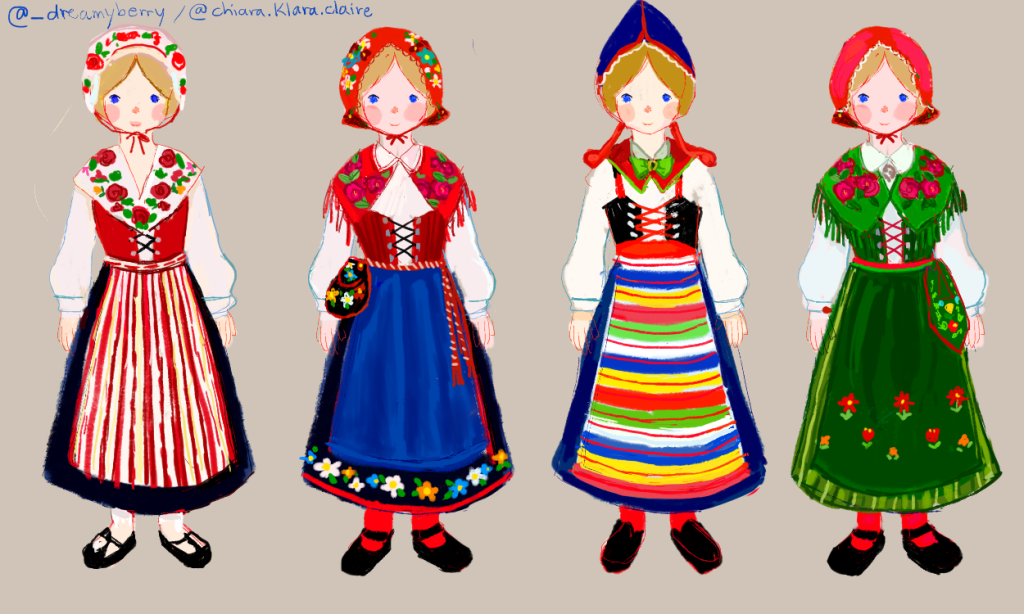
Each district had its own tailor, and some areas with natural boundaries and good communications within the district itself but poorer connections with the outside world would develop their own designs. Among typical features are flower patterns and headgear of all kinds, from bonnets to horn-shaped hats.
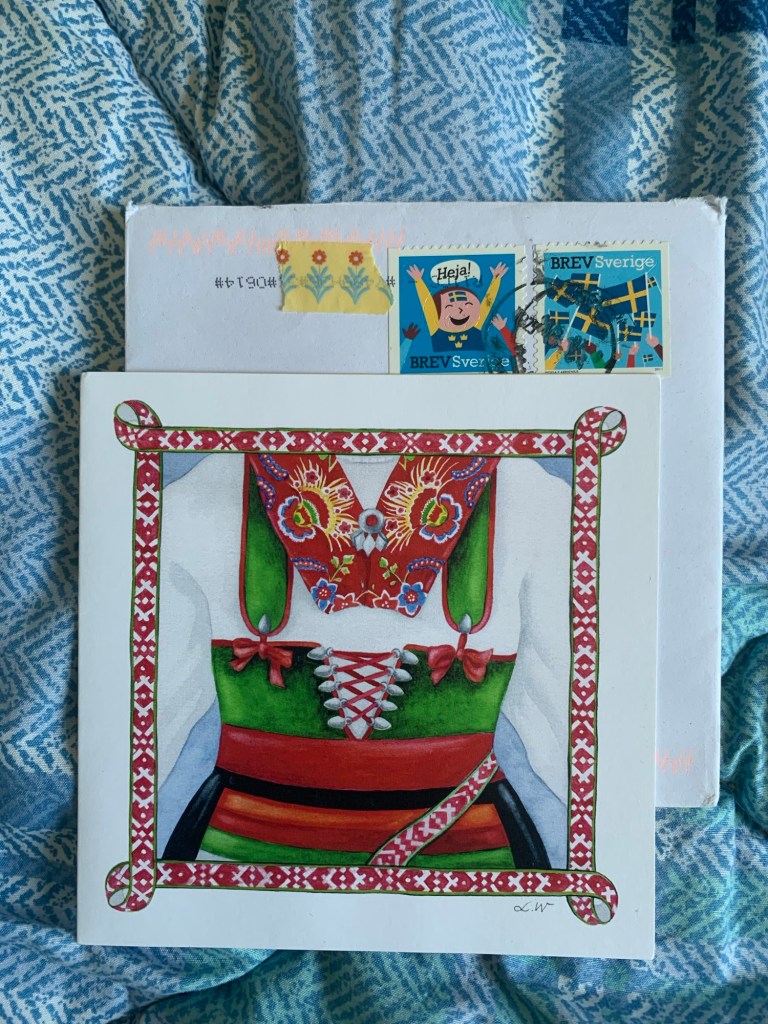
Postcard with a folk costume from Dalarna. Illustration by Lena Wikman,
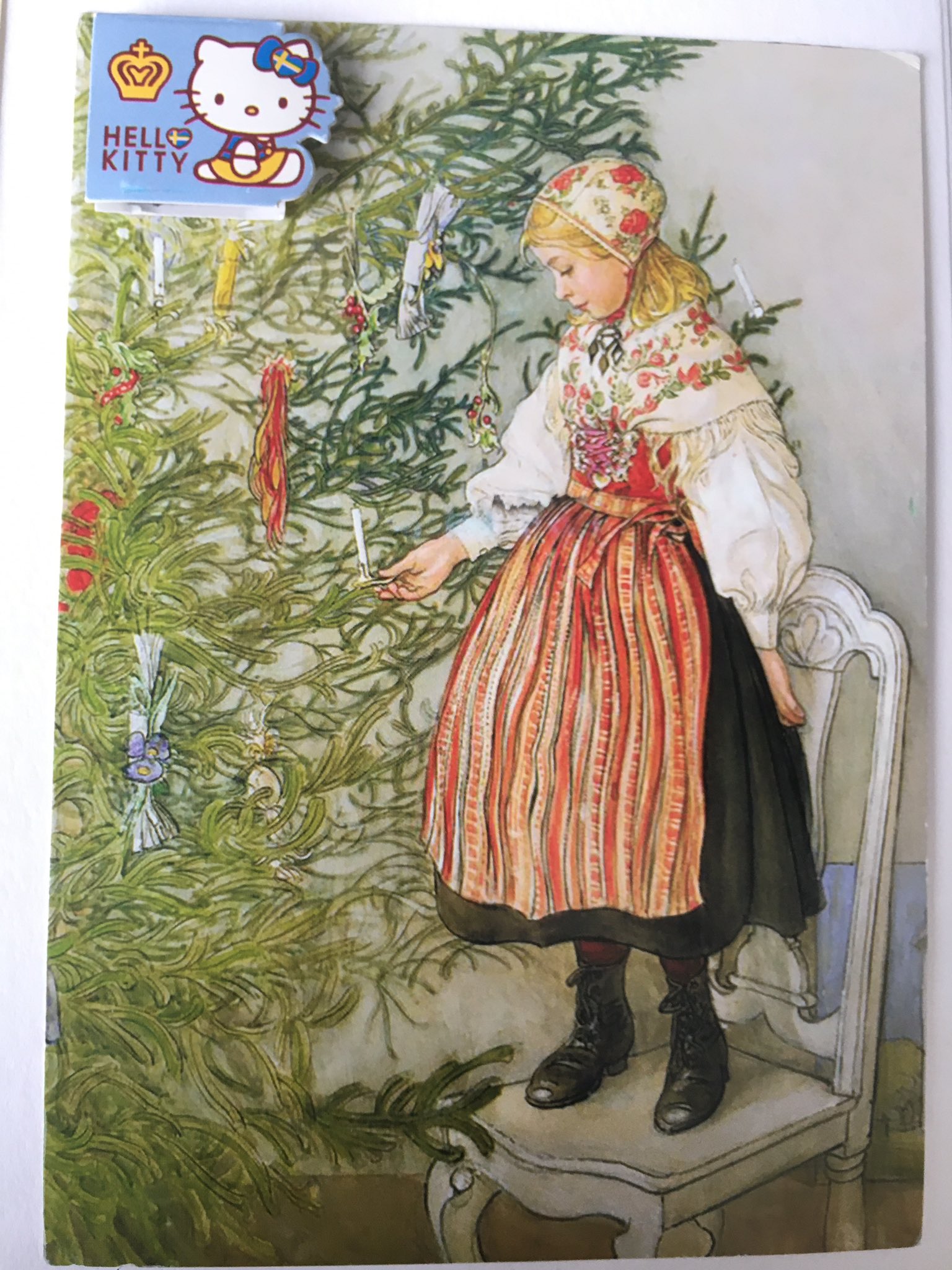
in the 1850s, with the industrialization of Sweden,folk costumes started to be abandoned – but around 1900, with the National romantic period, upper classes amused themselves by wearing them. Some artists also depicted them, Among others Jenny Nyström and Carl Larsson:
[…] In addition we need the bright colors of the peasant costumes. They have an invigorating effect on our senses that is all too often under-estimated and they are necessary as a contrast to the deep green pine forest and the white snow
Carl Larsson, from ‘Ett hem’ (A Home)
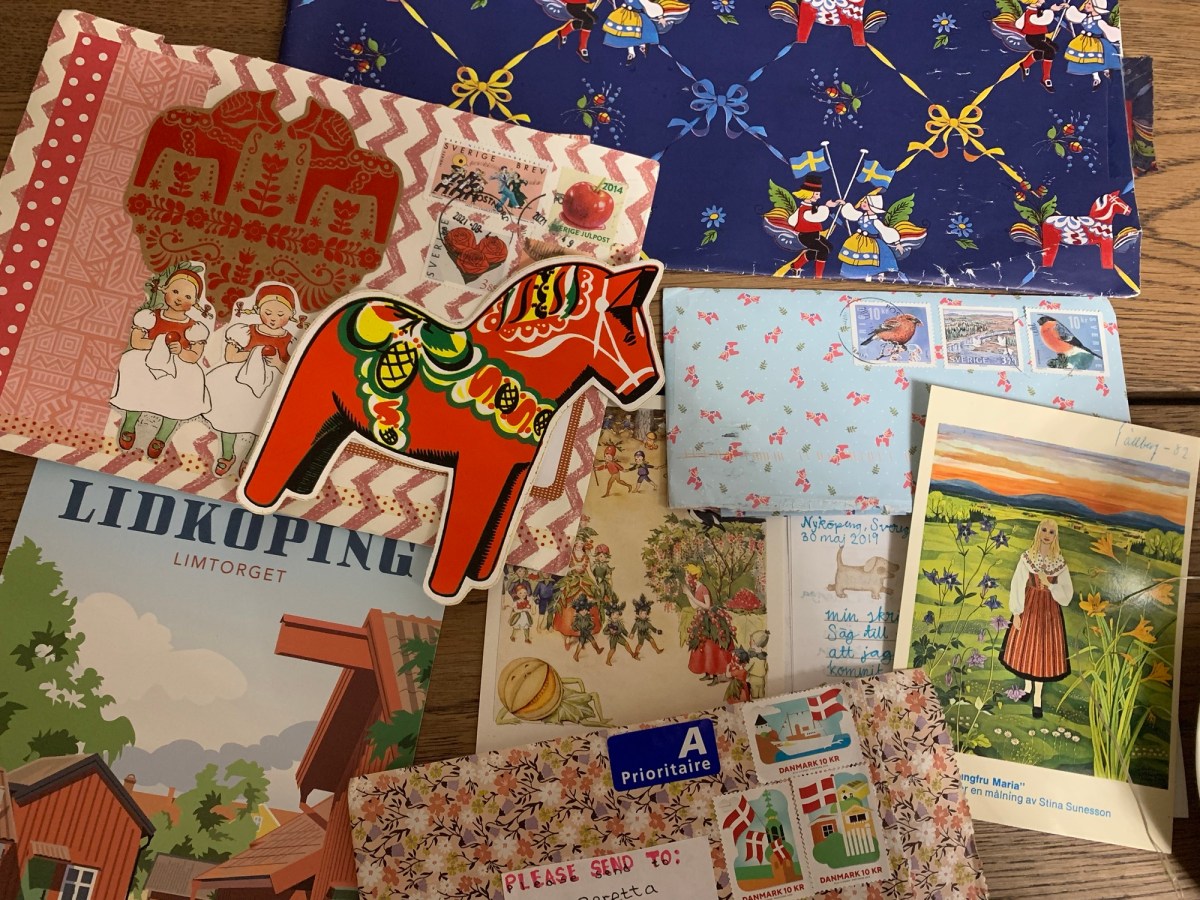
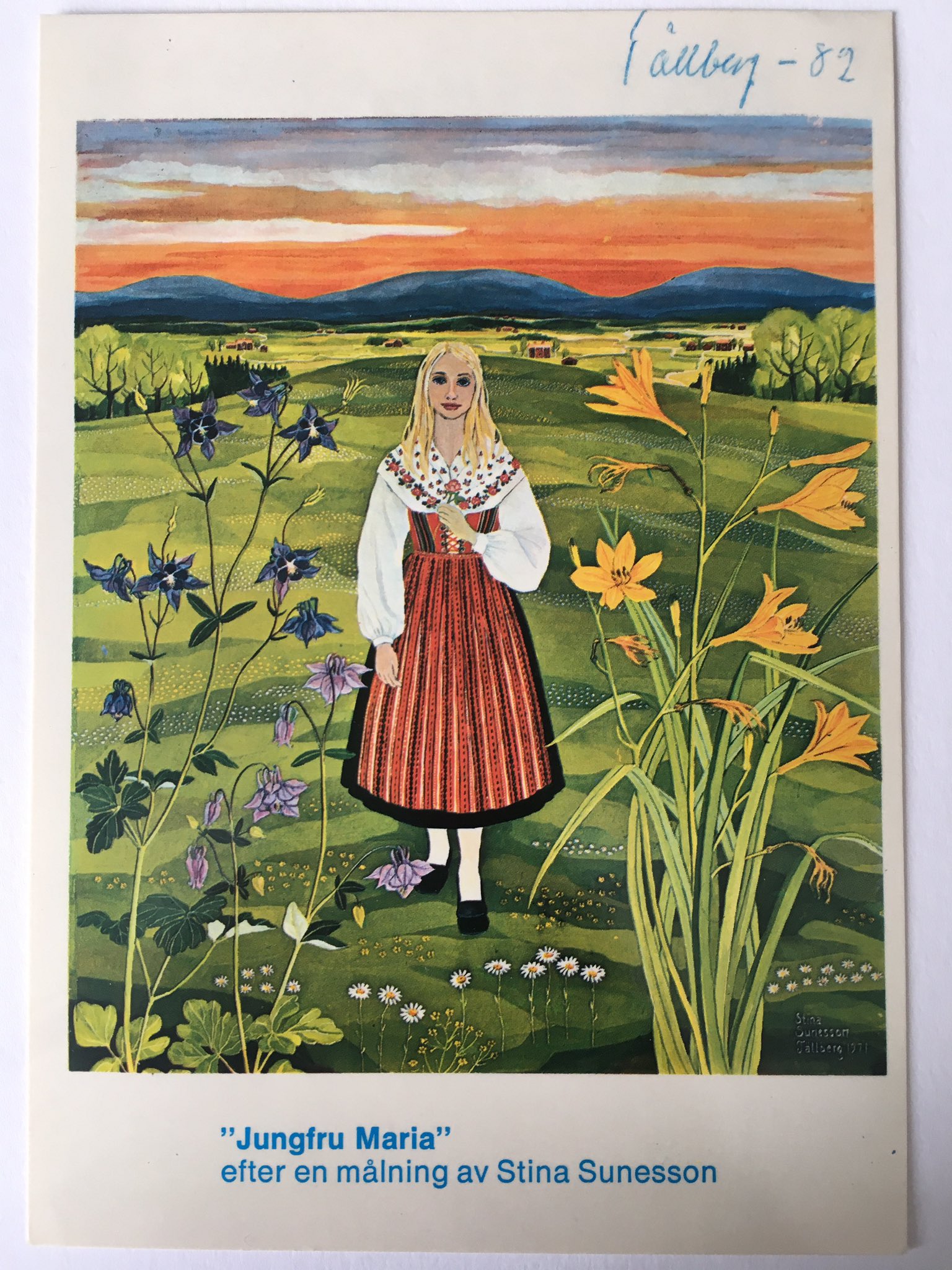
I got a couple postcards from Swedish penpals with paintings featuring folk costumes, by Carl Larsson (and I got a tiny Hello kitty in a svenska dräkten from the same person!) and Stina Sunesson
The invention of the Swedish National dress, Almänna svenska nationaldräkten
In 1983 Queen Silvia wore the Svenska dräkten on Sweden’s National Day, 6th June, starting a tradition. The dress she wore was relatively recent, designed by a woman called Märta Jörgensen.
Märta Jörgensen was an apprentice gardener when came to the Royal Castle of Tullgarn, in the province of Södermanland in 1900. There, all female employees wore a costume inspired by a traditional dress from Österåker, by decision of the then queen Victoria.
She then married and moved to Dalarna working as a teacher. In Falun she set up the Swedish Women’s National Costume Society, Svenska Kvinnliga Nationaldräkts-Föreningen in 1902. Her goal was to ‘achieve freedom from the dominant foreign fashion through the introduction of a national dress for Swedish women’, that had to be of a simple cut and design, influenced by national romanticism.
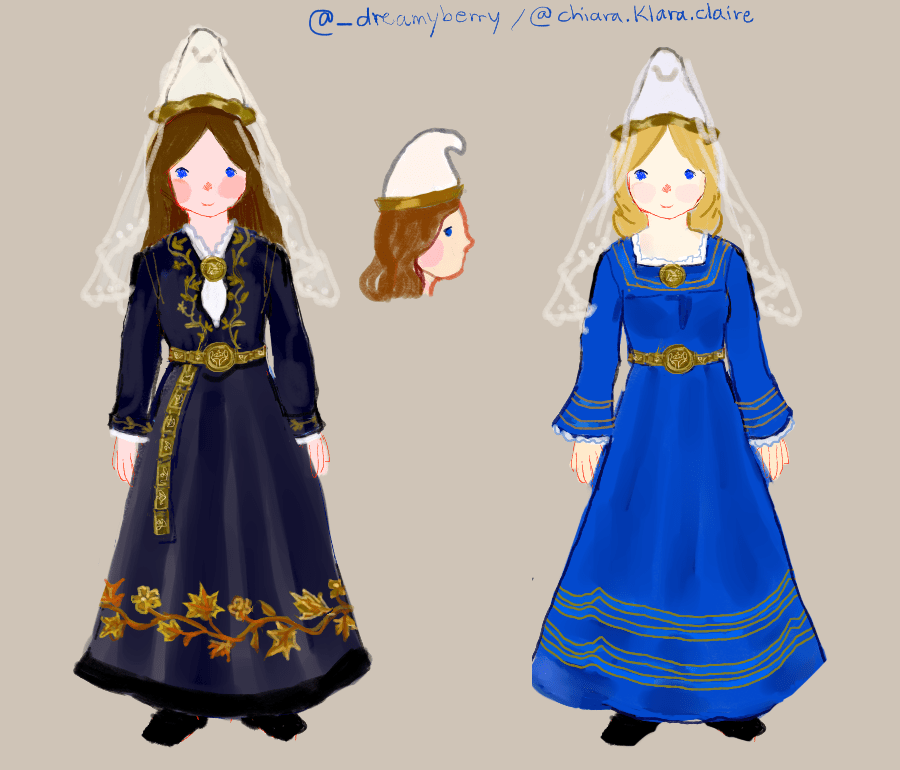
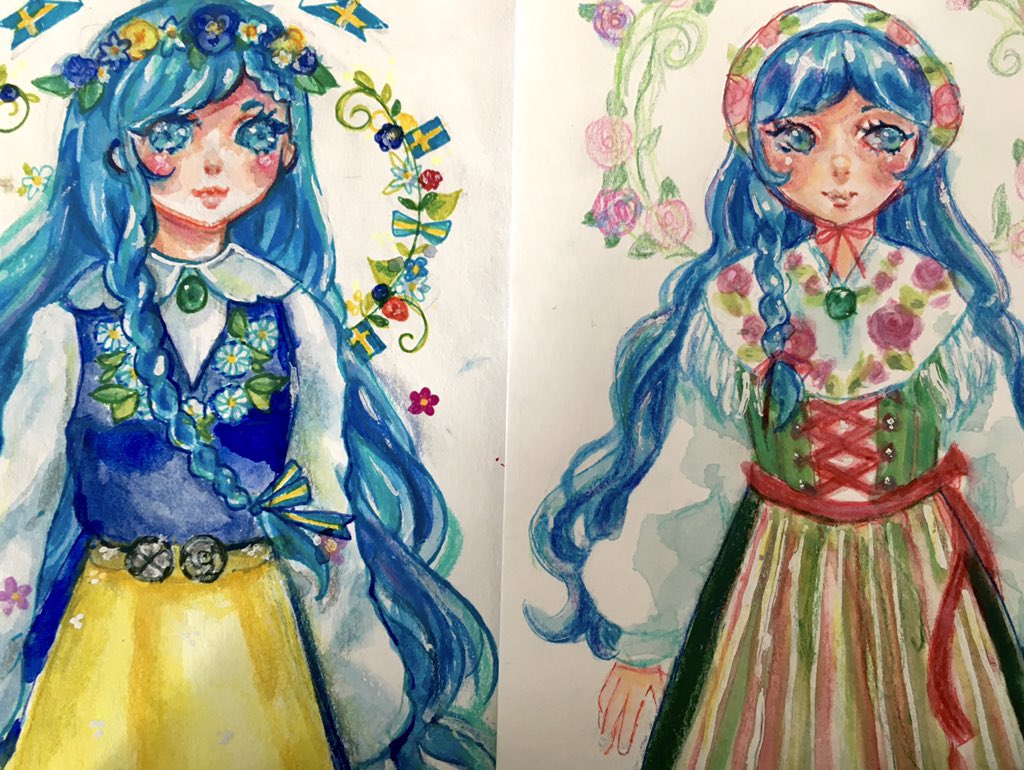
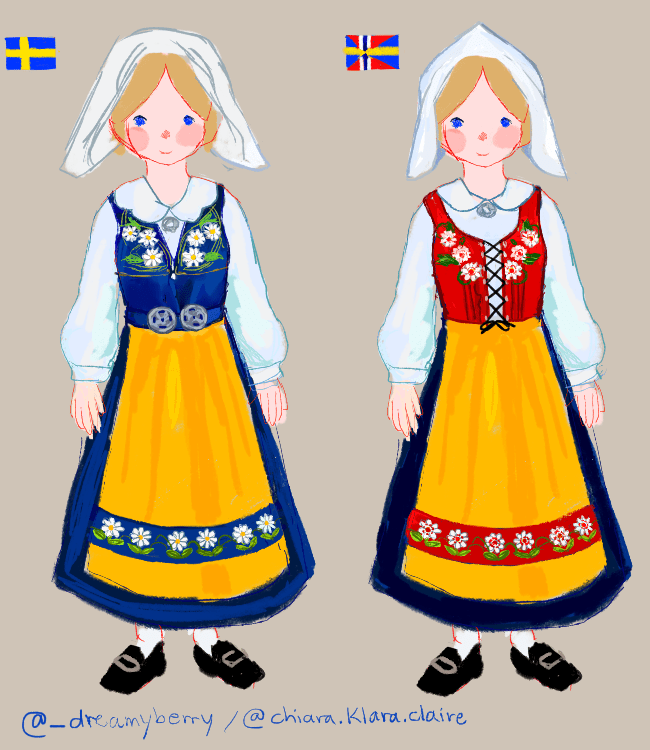
She designed two models, one for everyday wear, Blue with a yellow apron as the Swedish flag; the other for special occasions, with a red bodice, representing the Swedish-Norwegian Union (that lasted until 1905).
left one has been used by the royals, the right one is based on the few pictures I could find online.
The Costume Society had over 200 members in 1910, but interest decreased after WW2. Swedish folk costumes enjoyed however a comeback in the 70s. Queen Silvia wearing it on Sweden’s national day in 1983 made it the official national costume.
Side note – Definitions for Swedish folk costumes
Swedish folk costumes are called in various ways: folk folkdräkt (folk dress), landskapsdräkt(national costume), sockendräkt(provincial costume), bygde- or hembygsdräkt(parish or district costume), härads-dräkt (old jurisdictional county costume). The Swedish Museums have decided that the term folkdräkt can only be used for costumes from areas with a well documented, locally distinctive form of dress.
Astrid Lindgren’s homeland and locations of her movies
Astrid Lindgren’s birthday was on 14th November, to celebrate Scandinavia’s and the world’s favourite children author here’s an article about her homeland.
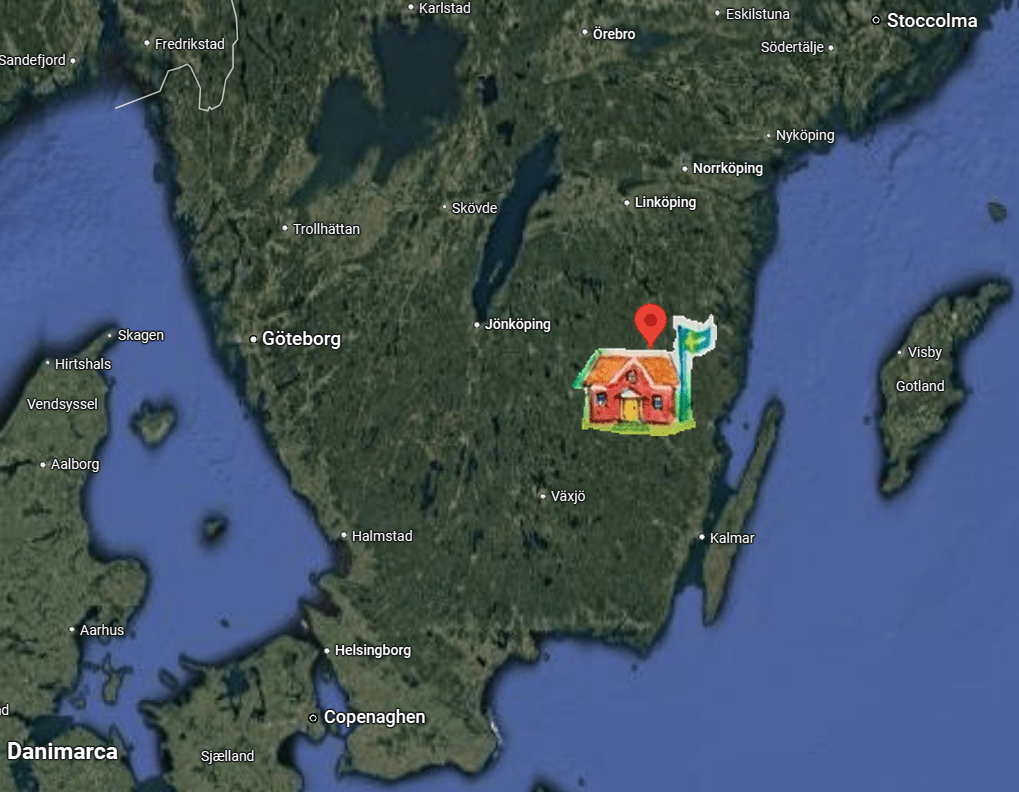
Astrid Lindgren came from Småland, a region in the south of Sweden full of idyllic villages, wild nature (51% of Småland is forests!) and old farms. There you can visit the places from her childhood that were sources of inspiration for books as Emil in Lönneberga, Bullerby/Noisy Village, PippiLongstockingand so on around the town of Vimmerby.
There were two things that made our childhood what it was – security and freedom.
From the book Mitt Småland (“My Småland”) by Astrid Lindgren and Margareta Strömstedt
Vimmerby and surroundings
Where Astrid Lindgren grew up
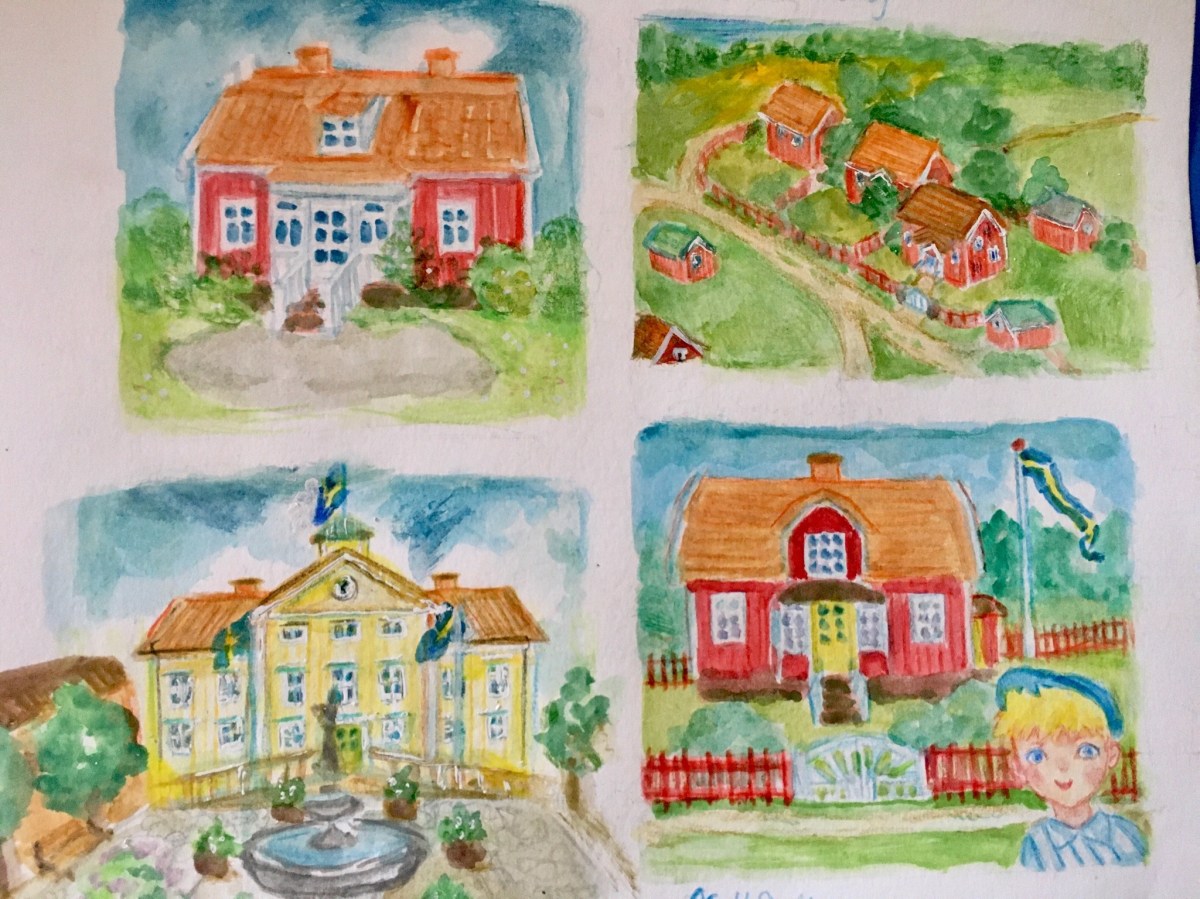
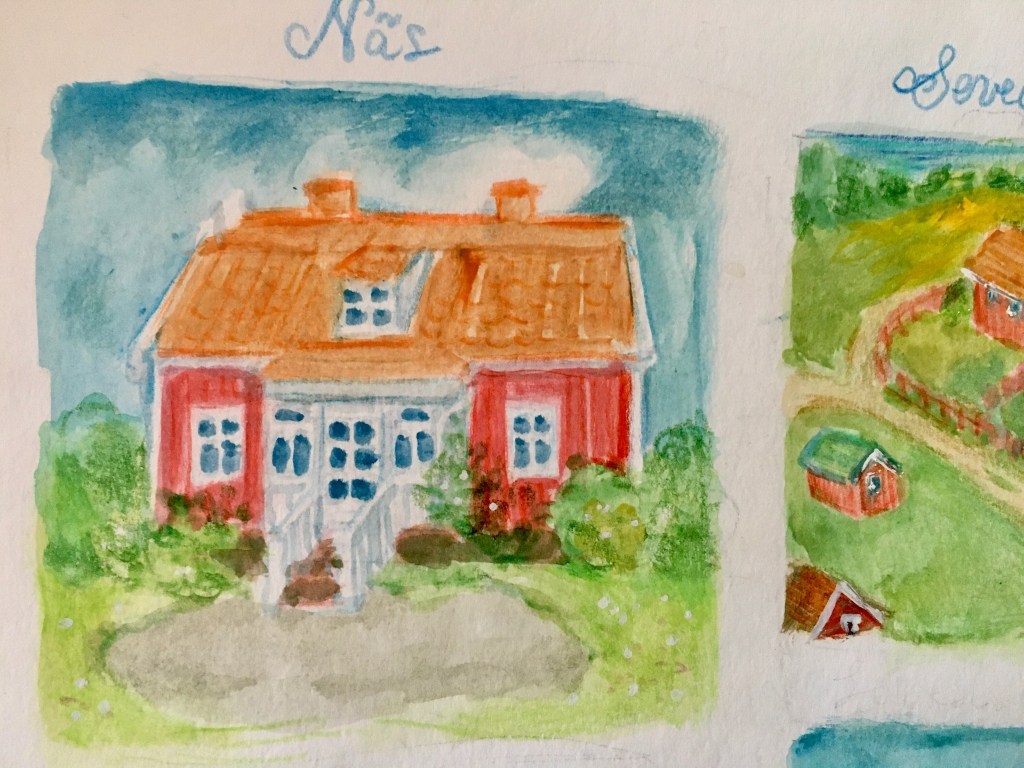
Astrid Lindgren’s family house in Näs
Astrid Lindgren spent her happy childhood on the Näs farm. The hollow elm which was Pippi’s “lemonade tree” (Sockerdricksträdet) is still in the garden.Astrid and her siblings had named it Owl Tree (Uggleträdet).
The farm is still owned by the family and is part of the cultural center, which was opened in 2007 for Astrid Lindgren’s 100th birthday. You can find out more about Astrid Lindgren, her life and work in exhibitions there.
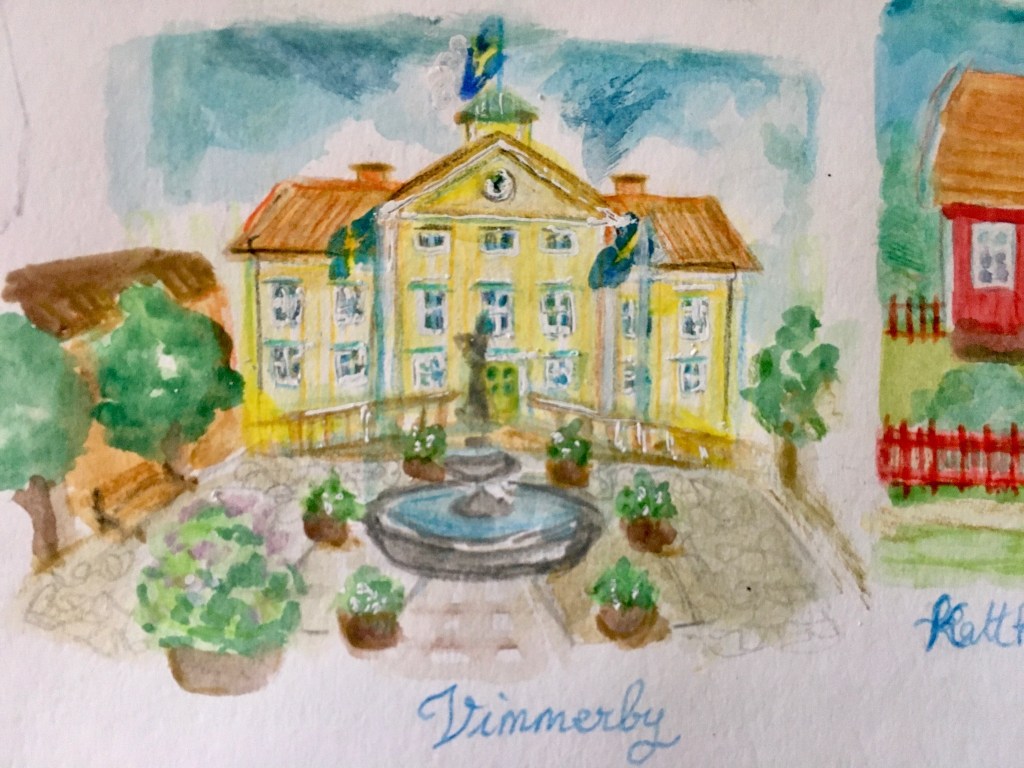
Vimmerby’s Town Hall
Vimmerby is the town were Astrid Lindgren grew up and went to school. The young Astrid played with her siblings and friends in the alleyways of this small town and in the surrounding woods. Her childhood provided the raw material for her stories. Here are some contained in Pippi Långstrump, her major success:
The game “Don’t touch the ground”, that Pippi plays one day with Tommy and Annika was also played Astrid Lindgren.
The message in a bottle in Pippi Longstocking Goes Aboard comes from a game Astrid played with her brother Gunnar and her two cousins.
Her brother Gunnar also invented the “things-finder” (sakletare)game.
Pippi’s freckles and red hair came from a friend of Lindgren’s daughter Karin.
in Furusund, where the summer house of the Ericsson family was, there was a girl who had a horse tied to the porch similar to Pippi’s Lilla Gubben.
She was also good at school to the point where she was called “Vimmerby’s Selma Lagerlöf” after her first essay was published in the local newspaper Vimmerby Tidning. She worked two years as a volounteer for it until she got pregnant at 18 and left the town.
Emil’s village and Bullerby
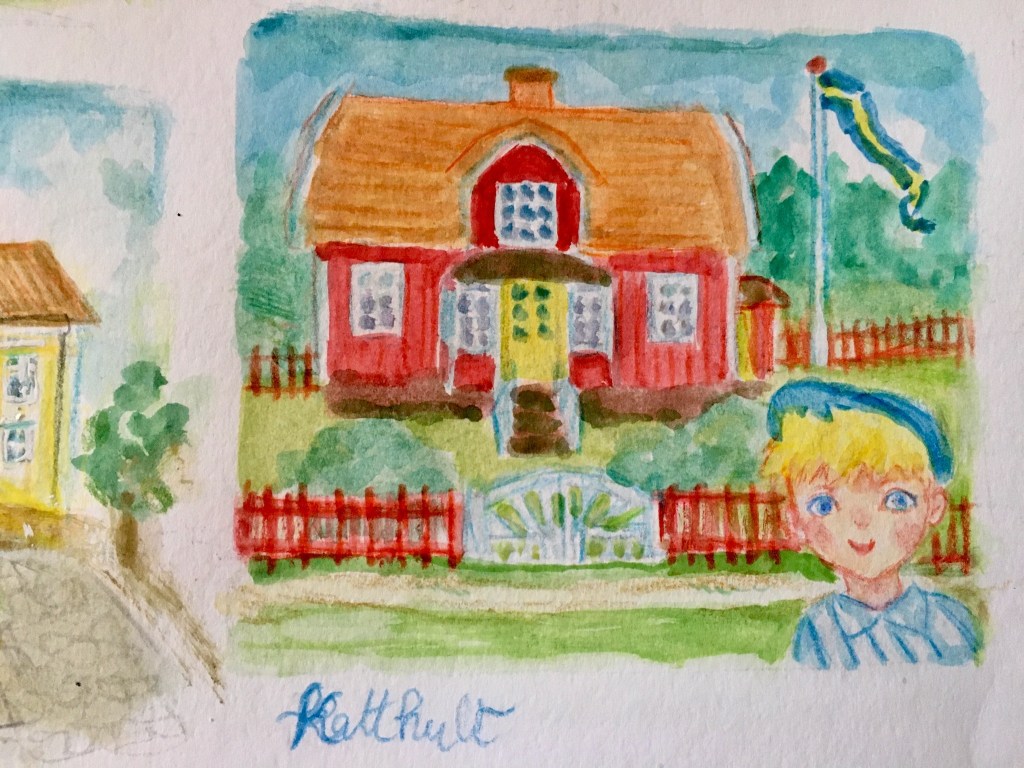
Around Mariannelund, just 20 km south of Vimmerby, is where the Emil of Lönneberga films were made from 1971 to 1874, in the Film village Filmbyn Småland. In this interactive museumyou will be able to have a look behind the scenes and see classic film clips, sing along to tracks and check out original props. Emil´s home, Katthult, is actually called Gibberyd, located between Lönneberga and Mariannelund.
Astrid Lindgren found the inspiration for Emil from the stories her father told about his childhood, but the character of Emil came to life when she was taking care of her three-year-old grandson, who was screaming with all his might. Astrid Lindgren asked the boy if he knew what Emil had done one day. Since the boy wanted to know that, he started being quiet to listen. From that moment, she went on telling her grandson about Emil and later wrote the stories down.
Sevedstorp and the surrounding area
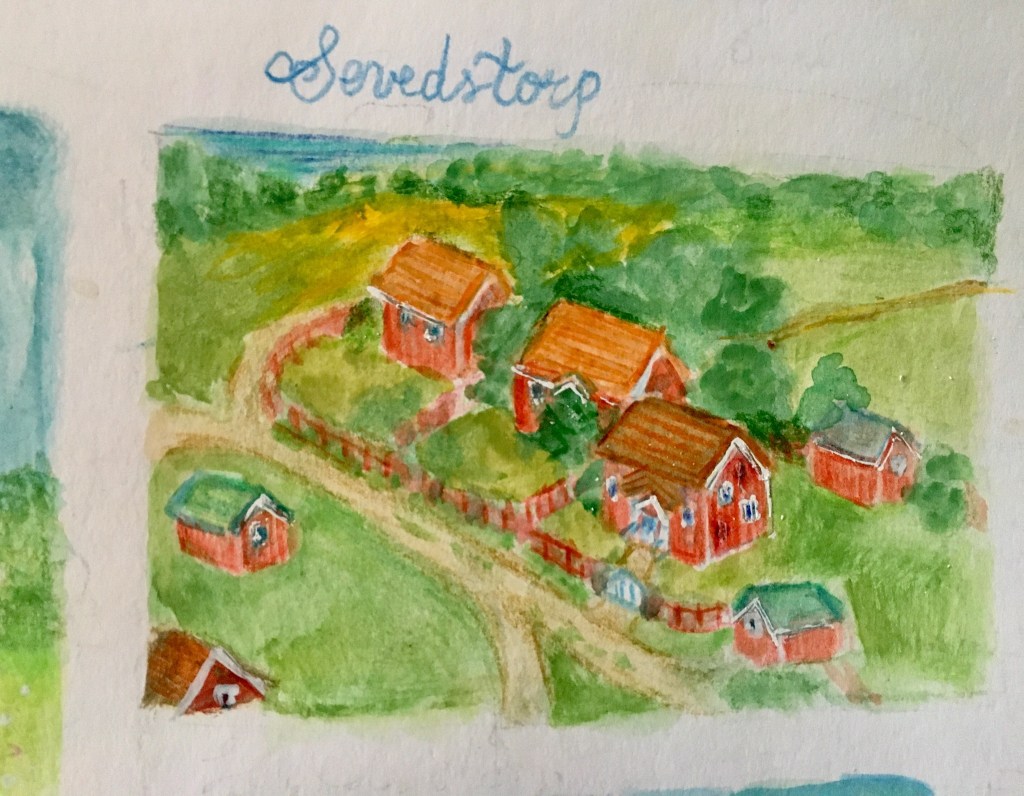
The village of Sevedstorp became Bullerby (Noisy Village) in the films. This hamlet was the childhood home of Astrid Lindgren’s father, and the three farms in Pelarne, 10 km from Vimmerby, were in fact also the model for the Bullerby. Astrid Lindgren‘s father Samuel August Ericsson grew up there with his four brothers and two sisters. Astrid Lindgren’s grandfather was also the model for Bullerby’s grandfather. The farms are however private property now.
I am sorry for all who do not live in Bullerby
Anna in Bara roligt i Bullerbyn
Astrid Lindgren’sAmusement Park: Astrid Lindgrens värld
And if you want to see everything at once, you can visit astrid lindgren’s world. The author’s theatre park, few minutes walking away from Näs, is where the characters and settings from Astrid’s most famous books are brought to life. It lets you truly immerse yourself in the stories of Astrid Lindgren. leap across the Hell’s Gap chasm with Ronja the Robber’s Daughter, meet Katla the dragon with the Brothers Lionheart or watch That Emil hoist little Ida up the flagpole.
Outside Småland
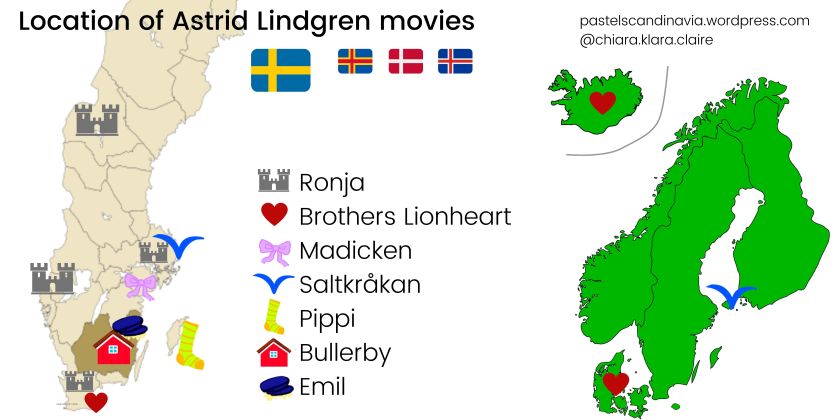
Here you can read (in Swedish) about the locations of the movies. However, not all films inspired by Astrid Lindgren books are located in Småland, in some occasions even outside Sweden!
Pippi Longstocking was filmed in the town of Visbyin Gotland, the largest island in the Baltic Sea. The shops were located in the St Hansgatan street in the centre. Villa Villekulla is a few kilometres outside Visby, later moved to the south of the town.
Brothers Lionheart: Tomelilla and in the hills Brösarps Backar in Österlen, south-eastSkåne. The town of Törnosdalen in the movie is in Den Gamle By, an open-air museum in the Danish city ofin Aarhus, in Jutland. Much was also in Iceland.
Madicken: Söderköping
Ronja: most scenes are near the mountainSörknatten i Dalsland. most scenes by the lake in Jämtland (lake Blåsjön). Other scenes are in the cave Tykarpsgrottan in Ignaberga, Skåne; and in the ruins of the Haga castle in Solna, near Stockholm.
Vi på Saltkråkan/ Seacrow island: islands in the Stockholm northern archipelago: most in Norröra, some Söderöra. A lot of scenes were also in Eckerö, in the archipelago of Åland (Finland).
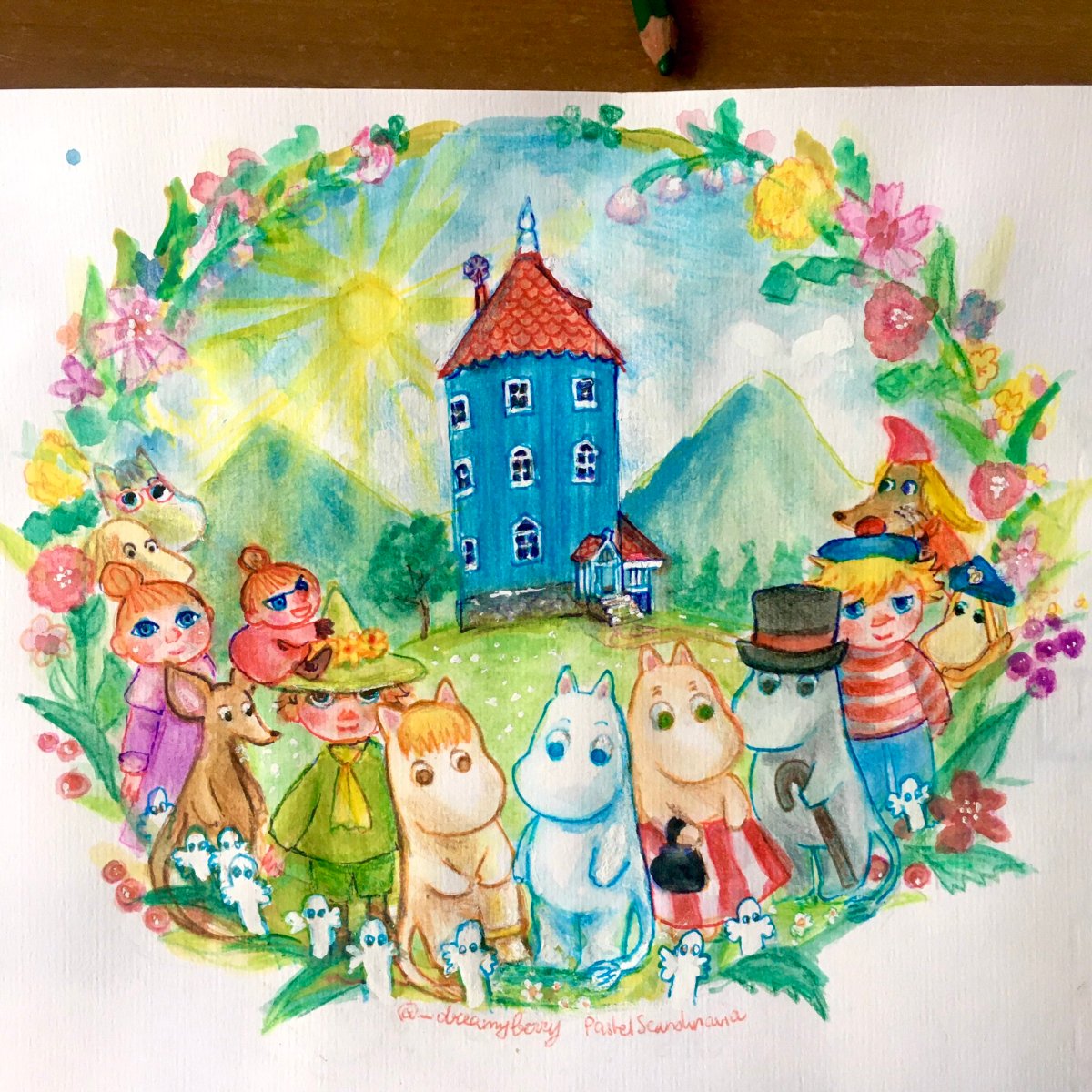
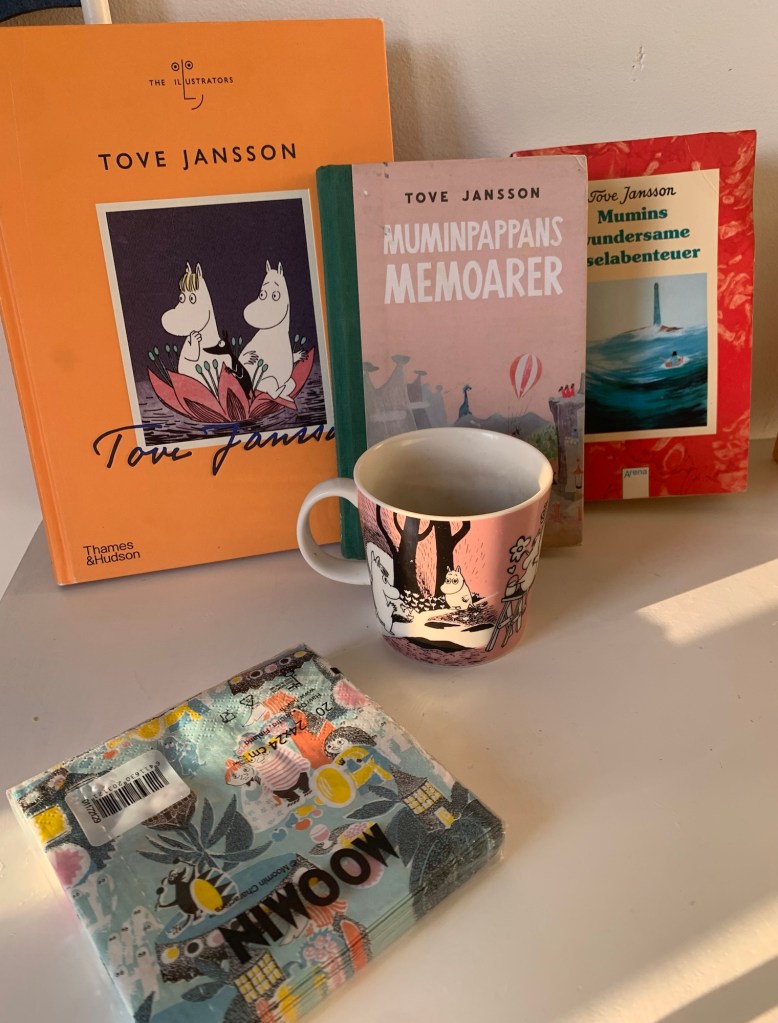
The Moomins, created by Tove Jansson, are the most famous and beloved Finnish characters, First appeared in books, then animated series. Still immensely popular in the Nordic region and Japan, they are feature in countless merchandise items, especially mugs!
The Moomins are a family of hippo-looking characters, created by Swedish-speaking Finnish illustrator Tove Jansson, who created Moomins during the Second World War, as ‘an escape from reality in a fairytale world’. Moomins are still incredibly popular in Nordic countries, and are often used as a Finnish cultural symbol.
Tove Jansson wrote and illustrated several books and strips between 1945 and 1980, which got translated into 38 languages. The first animated series is from 1969, but the most popular is from the 90s, and the most recent is from the 2020s. Other series were made with puppets and cutouts. and there’s even a Moomin opera! Here’s the Moomin timeline.
Moomin Characters
The core family of the moomins is Moomin himself muumipeikko in Finnish, and his parents, Moominmamma and Moominpappa, live in their iconic cylindric blue house (for a while they lived in a lighthouse and a theatre too). But the ‘family’ is not limited to them, and has incorporated other members:
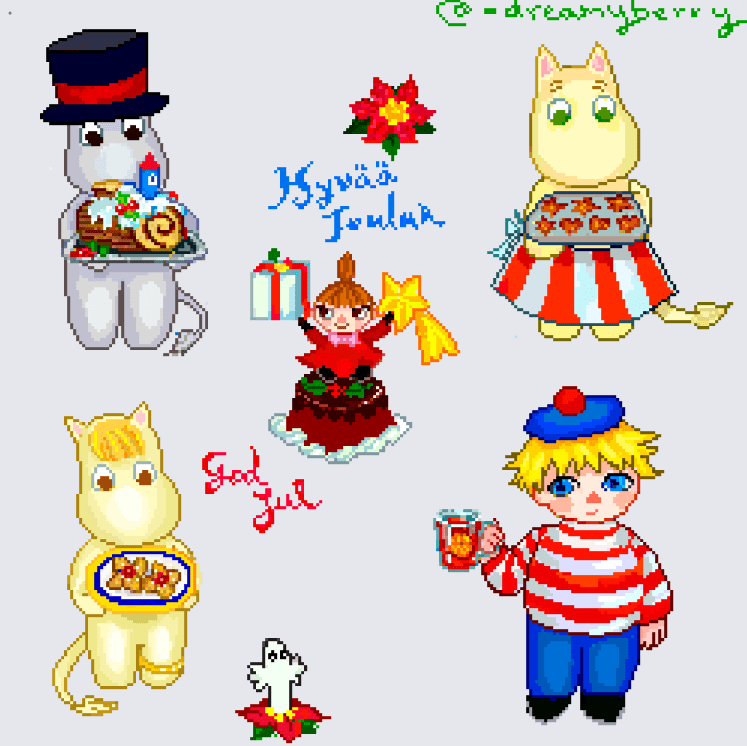
Moomin Pixel art I made!
the fearful Sniff
the naughty Little My, who teaches that being angry is okay too, sometimes.
Moomintroll’s girlfriend Snork Maiden,
the vagabond and freedom lover Snufkin, an artist soul,connected to a typical Finnish feeling of melancholy and solitude
Other characters who often appear are:
the bossy and stubborn Hemulens and the anxious Fillyjonk, representing the petty bourgeoisie of the time when Tove invented the Moomin world
the wise and pragmatic Too-Ticky,
Mymla, Little My’s big sister.
To the east borders of Moomin Valley there are lonely mountains (Ensliga Bergen), a mysteryous place where the monster Groke lives, who freezes everything she walks on and is hard to communicate with.
Many characters are actually invented after people from Tove Jansson’s life, as her parents , Too Ticky – her partner Tuulikki Pietilä.
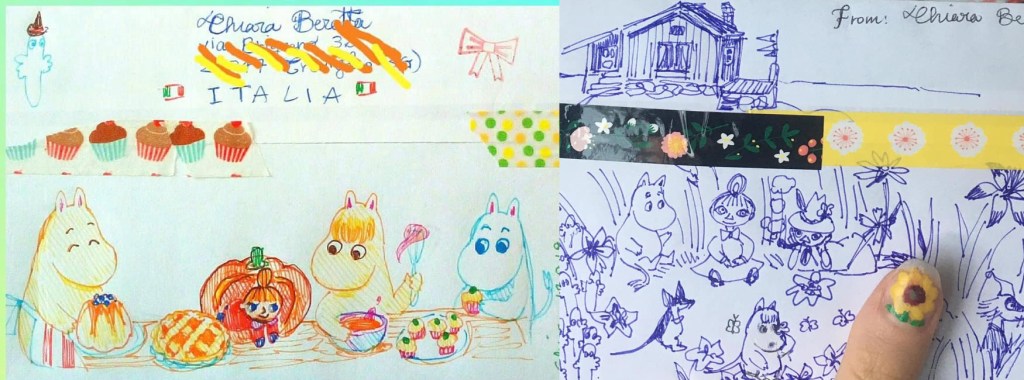
Letters i decorated with Moomin art.
Life in the peaceful Moomin world is often about enjoying small pleasures, as Moomin says:
I only want to live in peace and plant potatoes and dream!‘
‘One can’t be too dangerous, if they like to eat pancakes. Especially with jam on it’.
Moomin in Finland
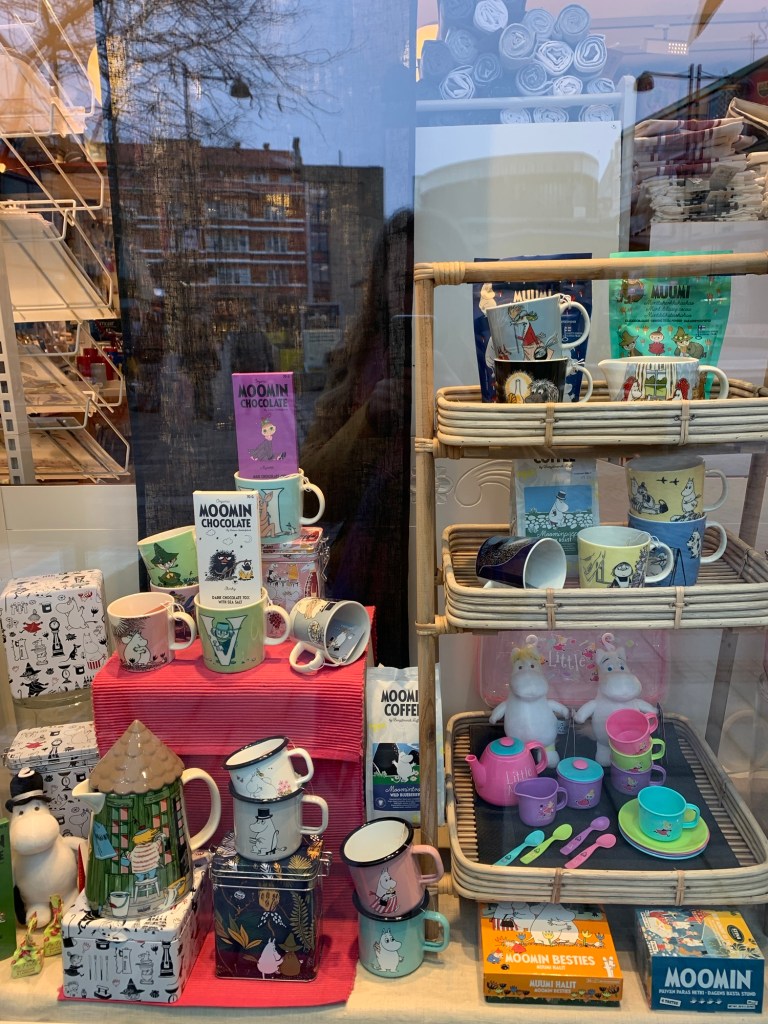
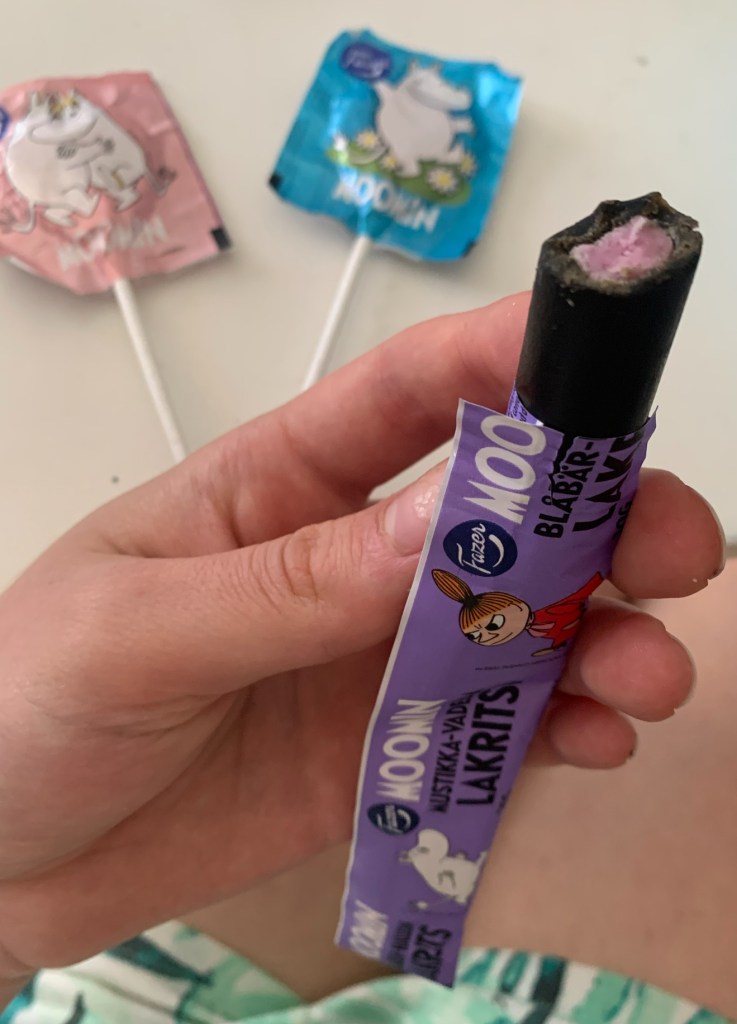
Moomins are still incredibly popular and easy to find in Finland: on Fazer candy and cookies, on finnish postage stamps (since 1988)… but the most classic item to own is probably moomin mugs: produced by Arabia since the 1950s. You can even fly on a Moomin FINNAIR plane, which of course fly to Japan.
Most Finns (and maybe Swedes or other Nordic peoples as well) have some kind of Moomin object. Even the former Finnish President Tarja Halonen has been known to wear a Moomin watch!
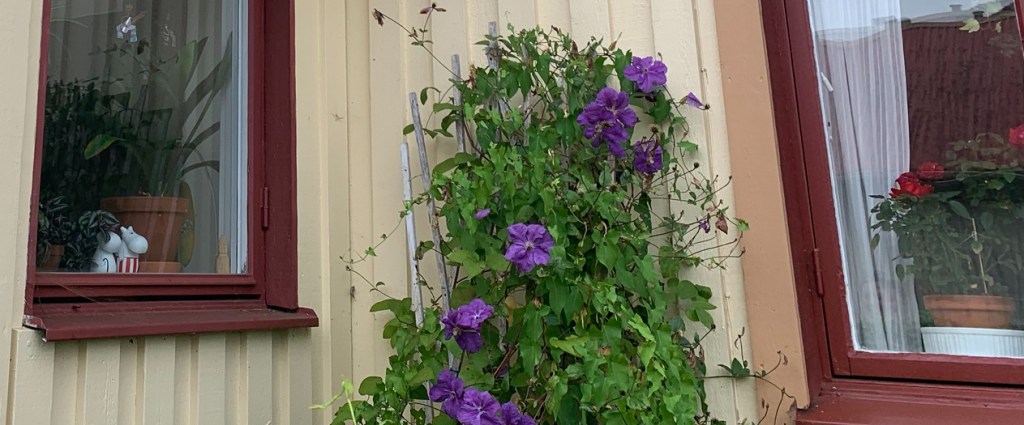
spot the moomins inside this Swedish house!
If you travel to Finland, you can also visit some Moomin-themed attractions:
Moomin World theme park (in Finnish Muumimaailma) in Naantali, near Turku, in 1993.
Tampere Art Museum has a Moomin section: Muumimuseo, which contains around 2000 original works of Tove Jansson, including a model of the Moominhouse, which Tove Jansson contributed to build.
Moomin ice cave is a 30 meters below of a Spa Hotel near Kuopio, it includes Moomin-themed ice sculptures, and offers activities for families with children.
Moomin shops, cafes and attractions in the world
The real Moomin Boom started in the 1990s, with the Japanese animated series Tales From Moominvalley. Moomin books were already bestsellers in Nordic and Baltic countries, but the animation made Moomin extremely popular in Japan among others.
Japan has a Moomin-themed park since 2015: MoominValley Park, in the prefecture of Saitama, near Tokyo.
Besides Moomin shops in Nordic countries (I have been in the Gothenburg one, Sweden), there are quite a few in Asia (most in Japan, but also Korea, Thailand, China and Hong Kong), and there is one in the USA, but not NYC or LA – in Hawaii! Not surprisingly due to the Japanese tourists…
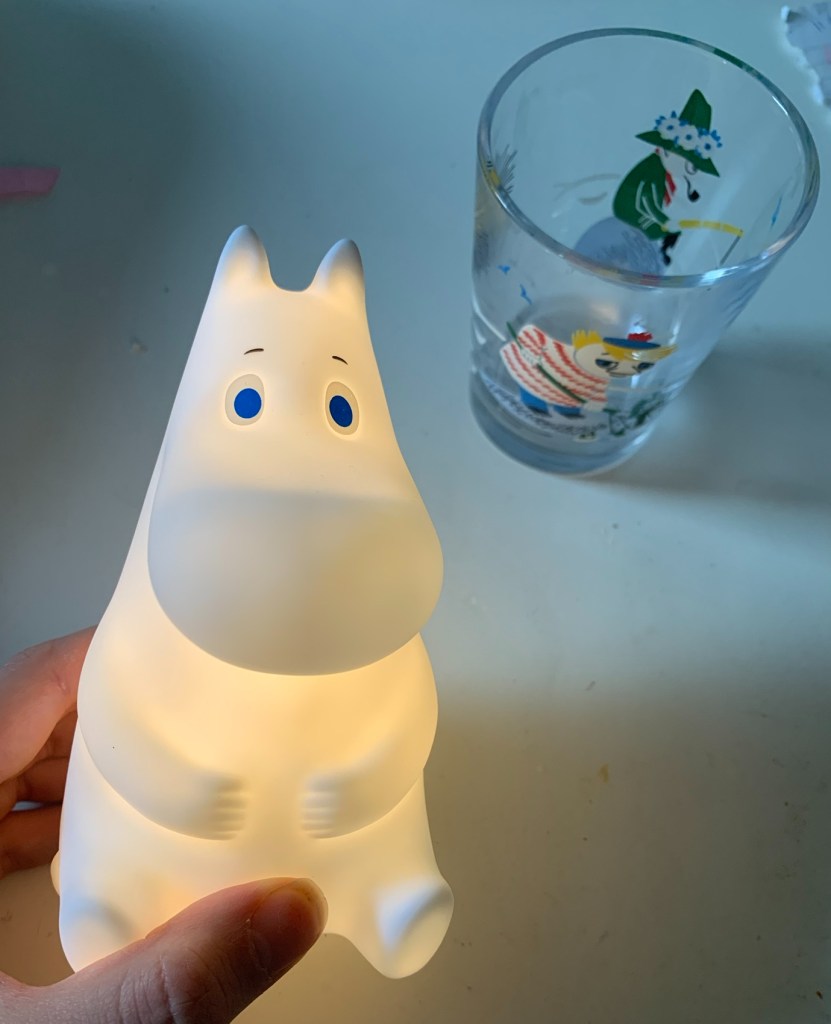
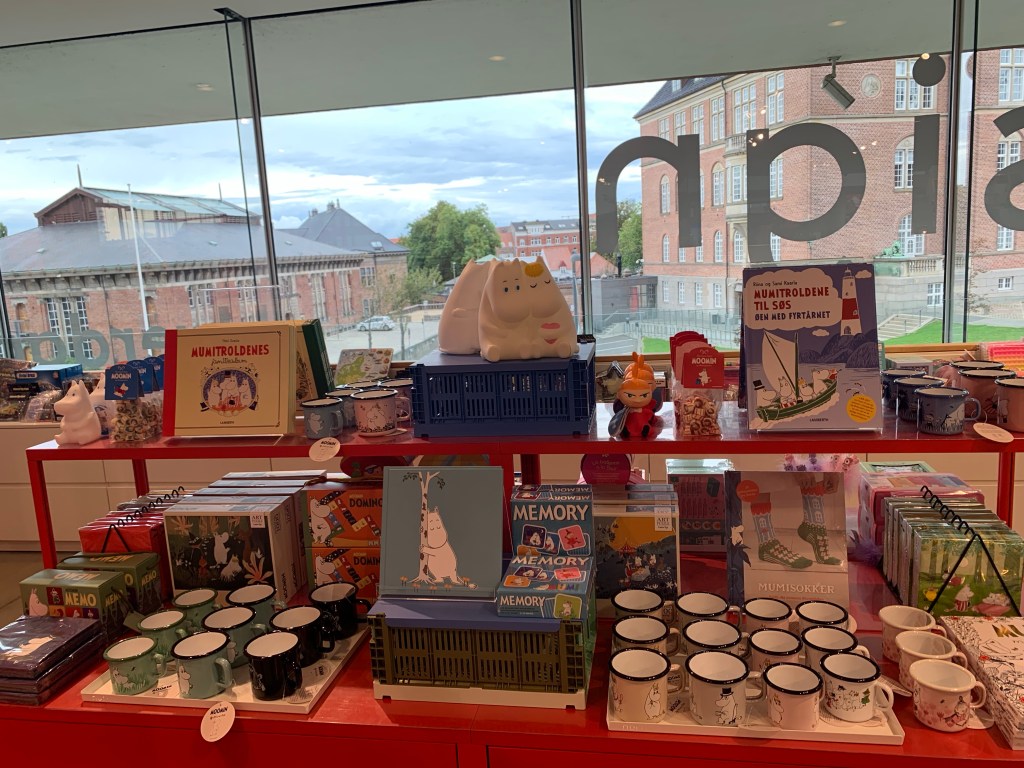
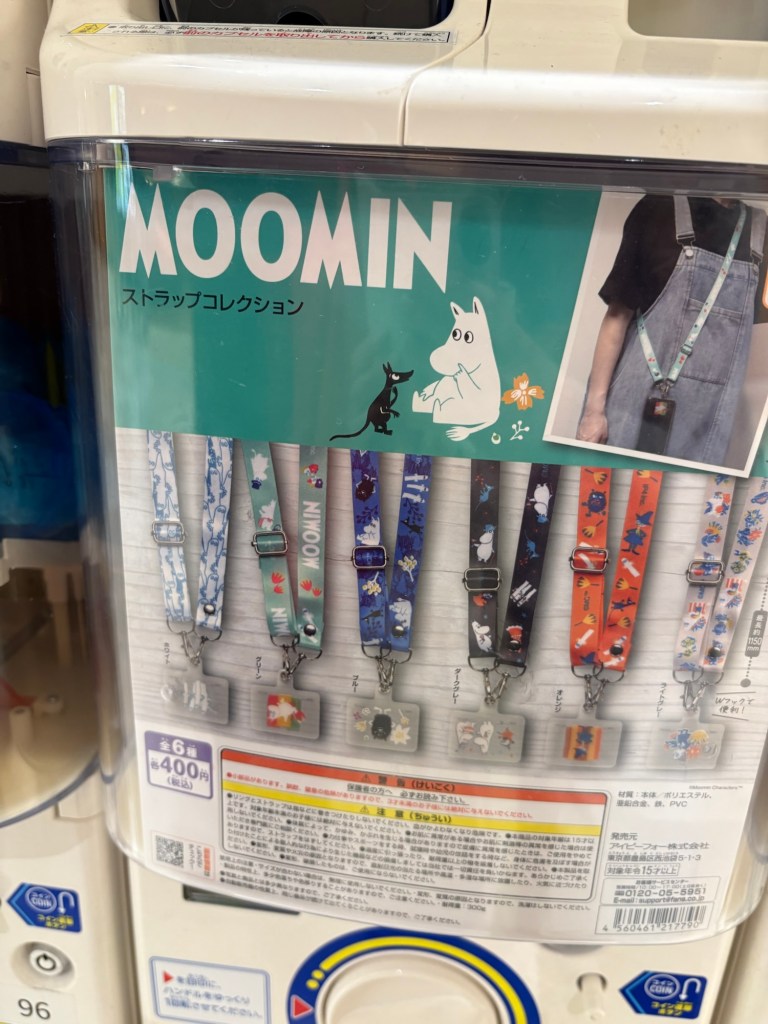
lamp and glass bought in Gothenburg, SwedenMoomin corner of ArOS art museum in Aarhus, Denmark. Japanese gacha-gacha moomin!
Moomin themed-cafes are very popular in East Asian countries: other than in Finlandvarious pop-up cafes have appeared now and then in Japan, Hong Kong, Thailand, South Korea and Taiwan. You could eat a moomin shaped meal in front of a giant moomin character plush there! Moomin Cafes.


 a Polyglot illustrating Scandinavia