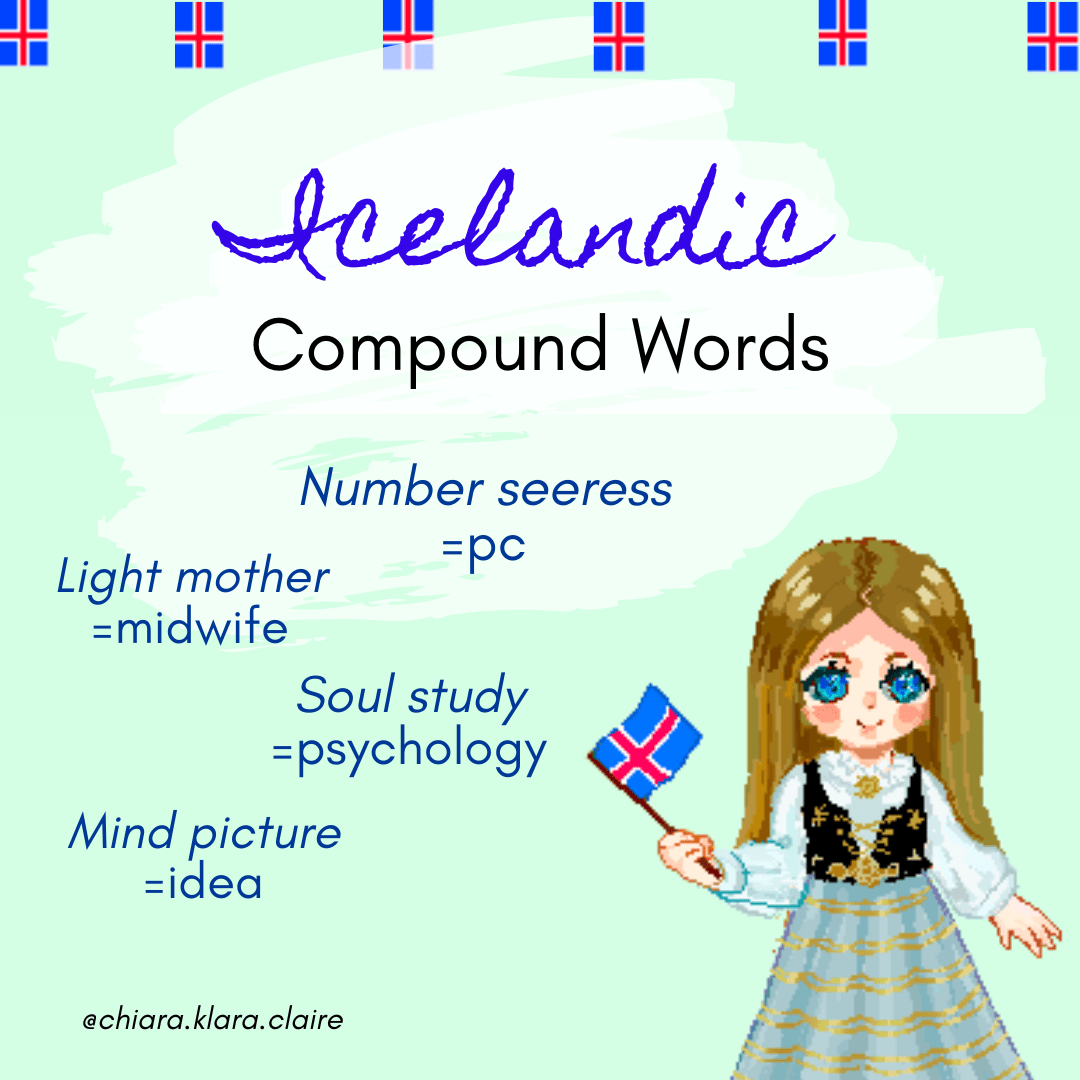
Icelandic, like other languages, has a lot of compound words, expressing a concept with multiple other words.
For new concepts, for example technology-related vocabulary, Iceland has a committee inventing new words for new concepts, by assembling existing Icelandic words. This is to follow the language purism policy, and avoid just adapting foreign words or using loanwords.
Here are some Icelandic compound words I like. Can you guess the meaning by looking at the literal translation?
words unique to Icelandic:
| Icelandic | literal meaning | meaning |
| tölva | Number-Prophetess (tala+völva) | computer |
| ljósmóðir | light-mother | midwife |
| bergmál | rocks-language | echo |
| tónlist | sound-art | music |
| hugmynd | mind-picture | idea |
| ástfanginn | Love-captured | be in love |
| hugfanginn | mind-captured | fascinated |
| sálfræði | soul-study | psychology |
| málfræði | language-study | grammar |
| Viðskiptavinur | business-friend | customer |
| Hunangsfluga | Honey–Fly | bee |
| Mörgæs | Fat-Goose | penguin |
| spékoppar | naughty cups | cheek dimples |
| smokkfiskur | condom-fish* | squid |
| leigubíl | rent-car | taxi |
Compound words that also exist in other languages
Icelandic also took words that are jut adaptions of the original Greek words, literally translating into Icelandic, and shares quite a few with other (Germanic) languages, which are still curious if you are not a speaker of any of them.
| Icelandic word | literal meaning | English/most European languages from Greek/Latin |
| ljósmynd | light-picture | photography (phos+graphe: light+writing) |
| Reikistjarna | wandering-star | planet (planḗtēs, “wanderer”, ellipsis of astéres planêtai, “wandering stars”) |
| rafmagn | amber-power | electricity (ēlektron: amber) |
| flóðhestur* | river-horse | hippo (hippopotamos) |
| Nashyrningur* | nose-horn | rhino (rhinocerus) |
| Legkaka* | Womb-Cake | placenta (literally “flat cake”, ellipsis of placenta uterī “womb cake”) |
| Innblástur | In-Breeze | inspiration…(yes, you’re welcome) |
*As in Scandinavian languages flodhest/häst or ‘Nile-horse’ in German and Dutch Nipferd/nijlpaard; similarly Noshörning, neshorn, Nashorn, Neushoorn ‘nose horn’.
*Scandinavian mo(de)rkake, ‘mother cake’.
Some curious combination are present in other languages as well:
| Icelandic word | literal meaning | same as | English |
| eldfjall | fire-mountain | 火山 (Japanese) | volcano |
| Gæsalappir | Goose-Feet | Gänsefüßchen (German, besides Anführungszeichen) | Quotation Marks |
| Ljósapera | Light-Pear | Glühbirne (German), lyspære (Norwegian) | lightbulb |
| vínber | wine-berry | viinamarjad (Estonian) | grapes |
sources:
Article by Silvia Cosimini on Passenger Islanda, Iperborea.
Reddit thread: /r/linguisticshumor/comments/17k5ivl/whats_the_most_ridiculous_example_of_semantic/
guidetoiceland.is ‘s Icelandic Language iverview
Boredpanda.com
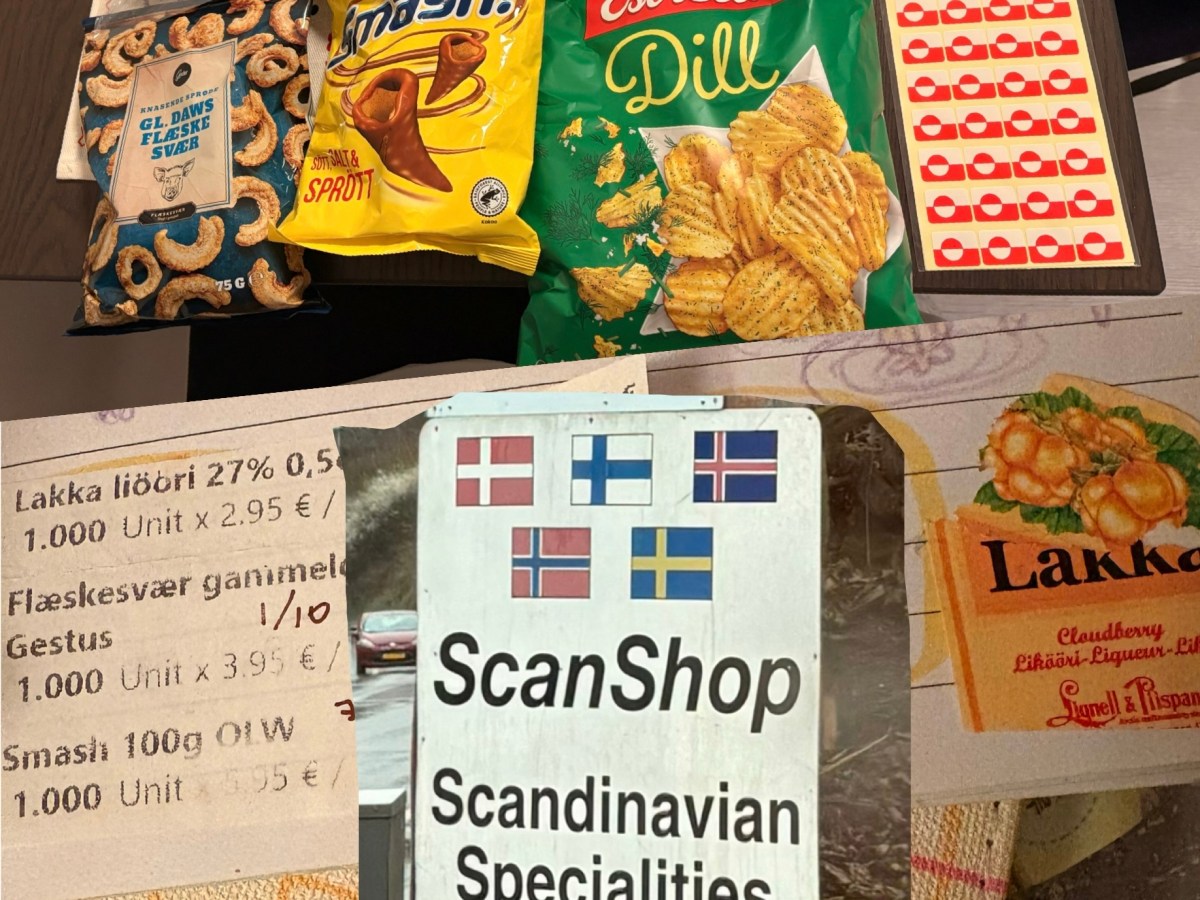
ScanShop: Nordic supermarket in Luxemburg
I visited Scanshop, a supermarket for Nordic expats in Luxembourg and Belgium. It offers a wide range of Scandinavian food products, including rye bread, fish, and sweets, alongside flags and tableware.

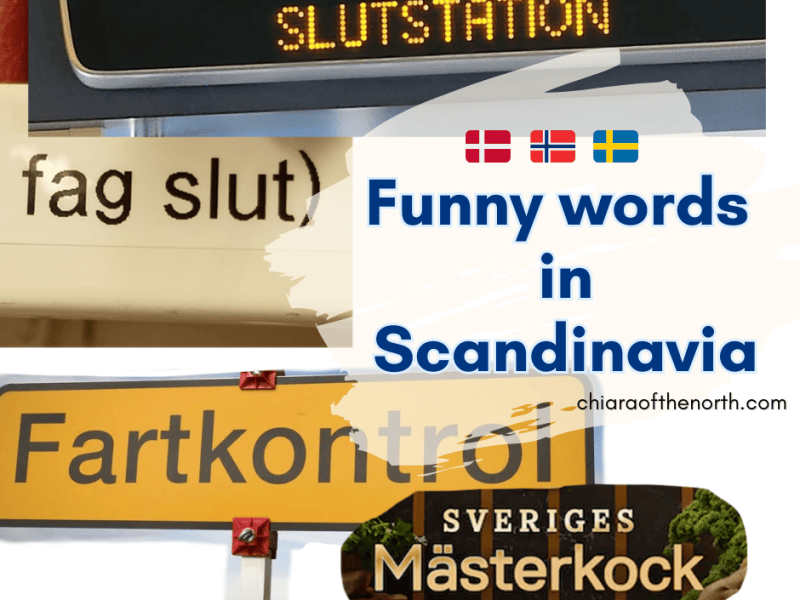
A collection of (unintentionally) Hilarious False Friends in Nordic languages
Take a train in Scandinavia to reach a “slutstation” or see”fartkontrol” signs while driving. Kiss and killing also mean something you were not expecting!
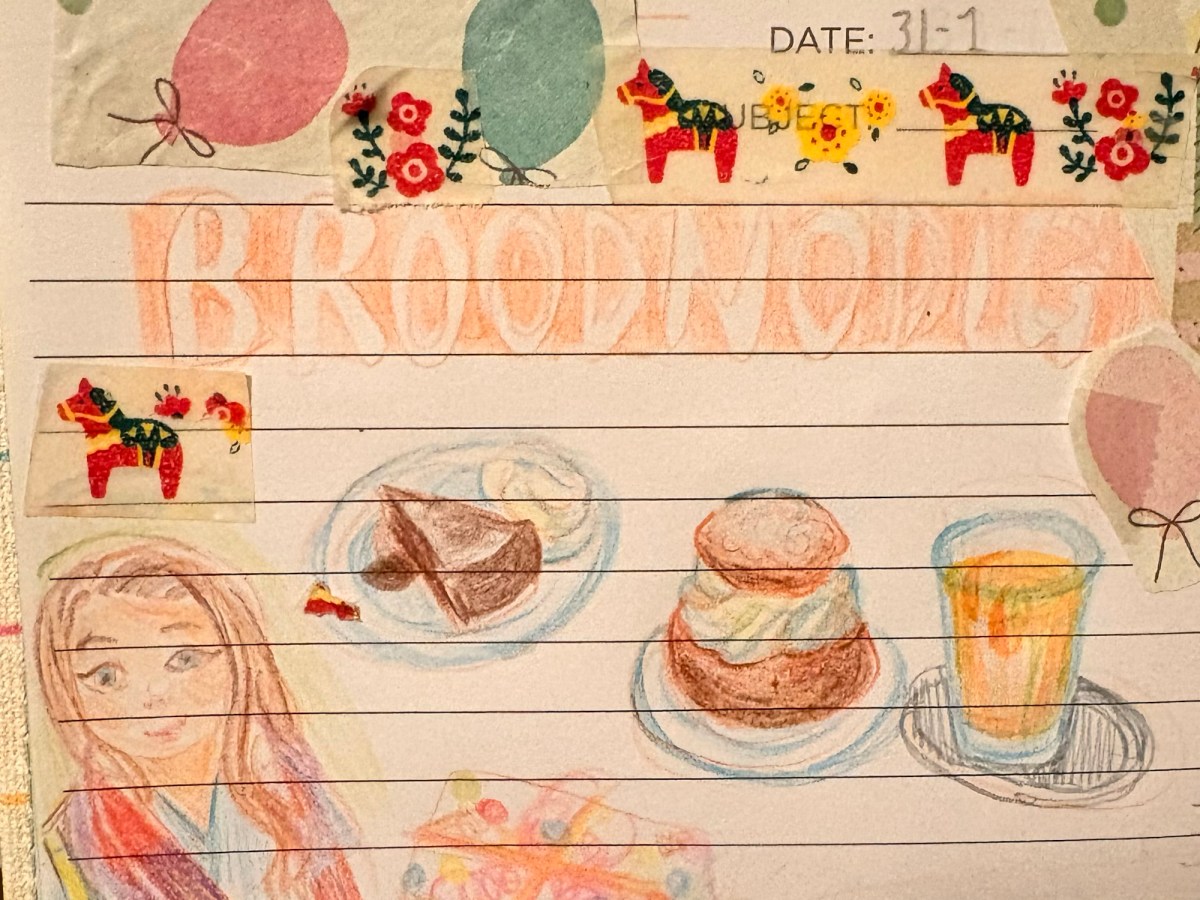
Swedish Café in Utrecht: Broodnodig
In Utrecht, the cafe Broodnodig serves Swedish pastries and cakes as cinnamon and cardamom buns, kladdkaka, smulpaj and Scandinavian seasonal treats as semlor and saffron buns.

