17. Mai in Norway

17th May is Norway’s national day, in which parades are the central event

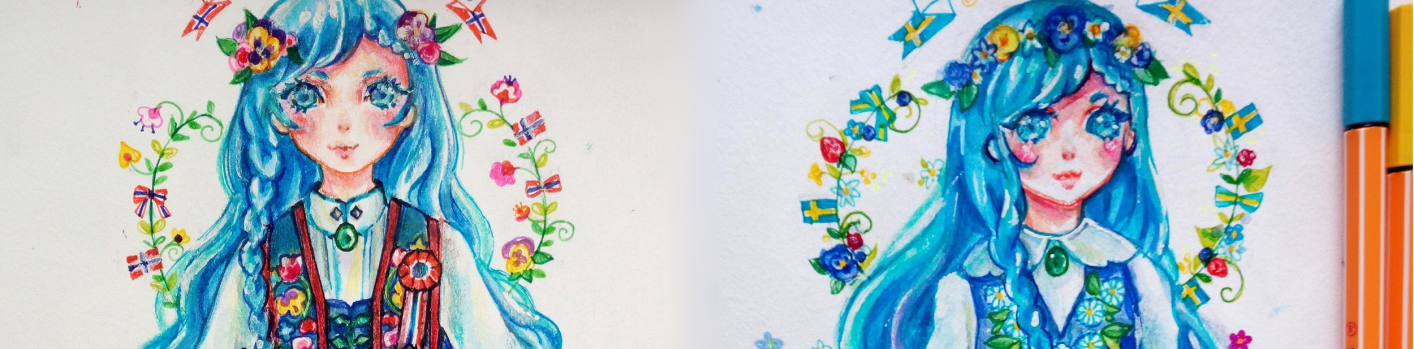
Known as Syttende Mai (17th May) is Norway’s Constitution Day, Grunnlovsdagen, the most important day in Norway, characterized by parades, a sea of flags everywhere and people wearing the Norwegian folk costume, the Bunad. It is commonly called Norway’s birthday!

On this day the Constitution was signed at Eidsvoll in 1814, declaring Norway as an independent kingdom after being continuosly handed over from and to Sweden and Denmark. Celebrations began among students despite Norway still being in an union with Sweden. WW2 ended in Norway nine days before that year’s Constitution Day, and this strengthened the meaning of 17. mai!

Parades (17. mai-tog)

Norway’s national day is also called “Barnas dag” (children’s day). Each elementary school district arranges its own parade with marching bands. In 1864 the first children’s parade was launched in Oslo, but only with boys until 1899. The parades are, in order:

  • senior school children carrying the school’s official banner
  • others carrying full-size Norwegian flags;
  • the school’s marching band;
  • the rest of the children follow with hand-sized flags, and often self-made banners for each class.

The parade often stops at homes of senior citizens and war memorials. Kindergartens and bystanders often join in behind the parade as it passes.

songs about the celebration of the National Dayare sung, and the parade is concluded with the national anthem Ja, vi elsker dette landet, and the royal anthem Kongesangen. At the end, The children shout “Hurra!”. All parades begin or end with speeches. Both grown-ups and older children are invited to speak. After the parades, there are games for the children: sekkeløp (sack race) and potetløp (egg & spoon race) are two classics.

Norway’s birthday is the day on which children are allowed to eat as much ice cream as they please! Popular snacks are pølser (hotdogs), barbecue, waffles. Food with colors of the Norwegian flags is of course a must.

Other parades

Parades for the public, Borgertog, where everybody is welcome to join in. They are led by marching bands and often local boy scouts, local choirs, NGOs, sport associations and firefighters. The borgertog take place in the early morning or in the afternoon, before or after the school’s parade.

The Russ, graduating class of the videregående (high school),celebrate 17 May with their own parades in Norwegian streets later in the day, usually around 4 or 5 pm, on a Russebuss, a party bus, highlight of Norwegian graduation traditions…

Celebrations in Norwegian cities

The longest parade is in Oslo, broadcasted on tv. It includes around 100 schools, marching bands, and passes the royal palace where the royal family greet the people from the main balcony. In the municipality of Asker, near Oslo, the children gather outside the residence of the Crown Prince in the morning.

Bergen has its own traditions for the parade, including comic troupes, various local organisations, a children’s parade, and the buekorps

In Stavanger international schools arrange parades with flags from many countries and an international parties. the British school started it in the 1970s, followed up by the Dutch school and the American school.

Kristiansand, is known for the conclusion of the National Day with running through the city centre (“Tapto”) and spectacular fireworks. A trad jazz band plays until midnight in front of the Christiansholm Fortress.

17 MAI IN THE WORLD

Norwegian seamen churches (sjømannskirken) and Norwegian heritage associations organise 17 mai parades, Norwegian church service, and celebrate the day in parks, with typical Norwegian food and music.

AMERICA

In the United States and Canada, the local lodges of the Sons of Norway often play a central part in organizing the festivities, attended by people with Norwegian ancestry, common in the mid-western USA.

  • Chicago – holds a three-day 17 mai celebration
  • New York City – has had a 17 mai parade since 1952.
  • Petersburg, Alaska a.k.a. “Little Norway”: has a festival the weekend around 17 May, including Vikings and Valkyries.
  • Since 1969, the city of Westby, western Wisconsin has a four-day festival
  • Seattle and Salt Lake City, Utah also have 17 mai celebrations with parades, folk dancing and luncheons.

EUROPE

  • Stockholm has the biggest 17 mai parade outside Norway – ending at Skansen, where you can get waffles, coffee and hot dogs!
  • 17 May in London is celebrated every year in Southwark Park. Games, live music, and a parade from the Norwegian church to the park are in the programme
  • In Orkney/Shetland (Scotland) 17 May is celebrated as the islands used to be part of the Norwegian kingdom. Orkney holds a parade, and children are invited to bring their Norway and Orkney flags.

GRATULERER MED DAGEN! Happy birthday Norway!

Who are the Sámi? – The indigenous people of Scandinavia and their history

The indigenous people of North Scandinavia & 6th February

February 6th is, other than my birthday, Sámi people’s National Day.

The Sámi – also spelled Saami – are an indigenous people inhabiting Sápmi, which today encompasses large northern parts of Norway, Sweden, Finland and Russia. The Sámi have historically been known as Lapps or Laplanders, but these terms are usually regarded as offensive. There are about 100,000 Sámi people, divided by the borders of 4 states: Norway (ca. 60.000), Sweden (30.000), Finland (8.000) and Russia (2.000).

The Sami are well known for their traditional occupation of reindeer herding: around 10% of Sámi practice reindeer herding nowadays, which in some parts of the Nordic countries can be practiced only by Sámis.

Sami people mantain a strong cultural identity while being citizens of their countries, from languages – which are related to Finnish – to traditional clothing and a Sami flag.

Sami people of Norway, Sweden, and Finland also reunite in Sami parliaments of each country since the late 20th century, and have a joint Saami Council. The first meeting of Sami across borders in 1917 became Sami national Day, on 6th February.

After religious missions and colonisation of Northern Scandinavia, Sami people were subject to discriminization and forced assimilation – from prohibiting them to enter territories to the south in Sweden or buying land in Norway, to the Systematic Norwegianization in the 1860s.

The majority of the Sámi now speak the majority languages of the countries they live in and all Sámi languages are at some degree of endangerment.

Sámi languages had been illegal for centuries in Sweden and Norway, with assimilation policies and special residential schools (similarly to what happened in North America with indigenous people). This left many with traumas, not speaking Sámi languages to children as a way to protect them.

This started to change with laws, the funding of Sami parliaments, and recognization of Sami as indigenous people of Scandinavia, giving them the right to education in their language. Despite this, most Sami languages are endangered

Recommendations

  • the movie Sameblod, or Same Blood in English (2016), directed my Amanda Kernell. It is set in Sweden in the 1930s and concerns a 14-year-old girl who experiences prejudice at a nomad school for Sami children, and decides to escape her town and disavow her Sami heritage. Parts of the story are inspired by Kernell’s own grandmother.
  • books by Ann-Elen Laestadius: Stöld (stolen is the English title- with a Netflix adaption from 2021 as well), Straff (punished in English)
  • Sami singers: Jarnna (their Nilas jojk was my favourite song to calm down in an incredibl stressing period), Jon Henrik, Elin Oskal

Sources :

  • Samiskeveivisere.no – Samer og nordmenn i Norge – Samiske Veivisere
  • Store Norske Leksikon – snl.no/samer
  • sametinget.no
  • samer.se
  • YLE’s Say it in Saami quick guide to Saami culture

Scandinavian Christmas: symbols, sweets and gift bringers

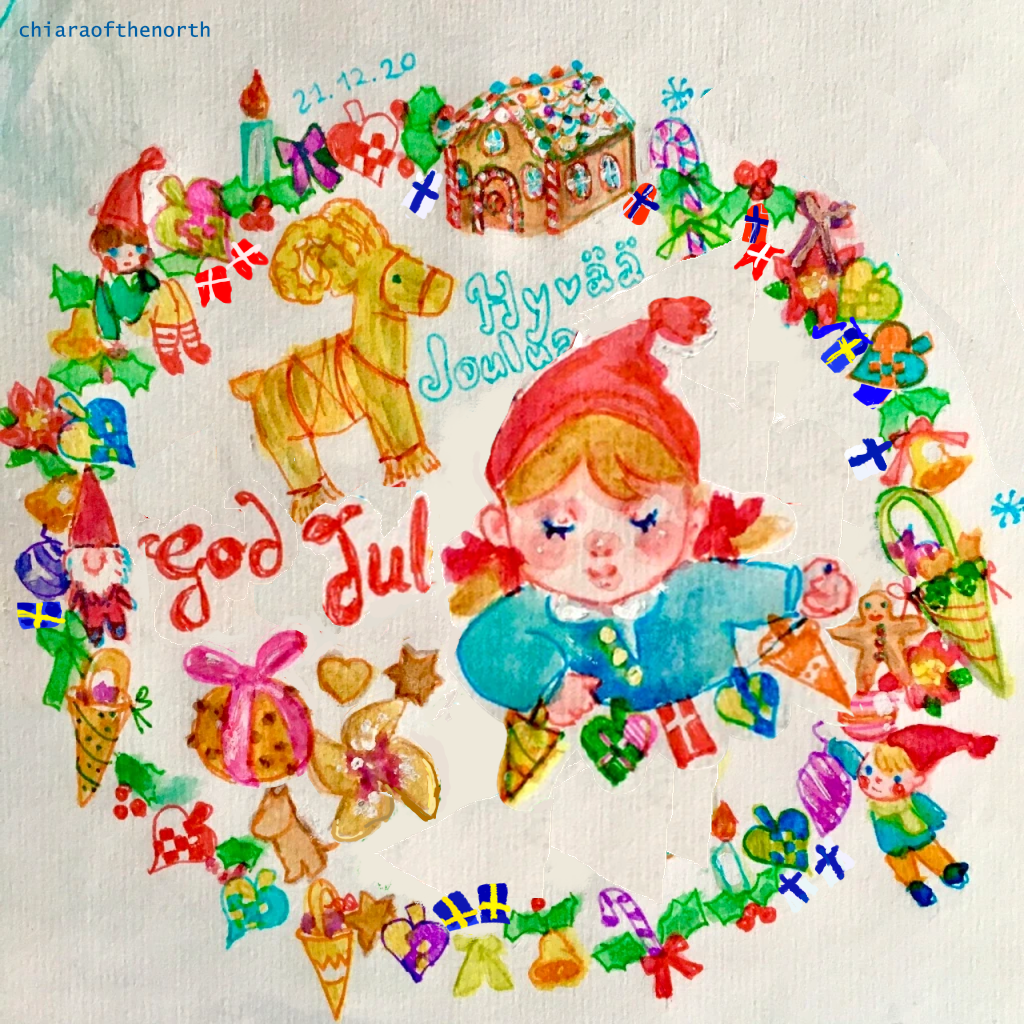
Nordic Christmas, or Yule, means among others flag tree decorations, a pinwheel-shaped pastry, and gnomes.

Nordic countries share quite a lot Christmas customs and symbols, whether it is Christmas tree decorations, gnomes and elves instead of Santa Claus, and of course spiced cookies. Let’s see what a Scandinavian Christmas looks like!

1. Scandinavian Santa Claus: Gnomes and pixies
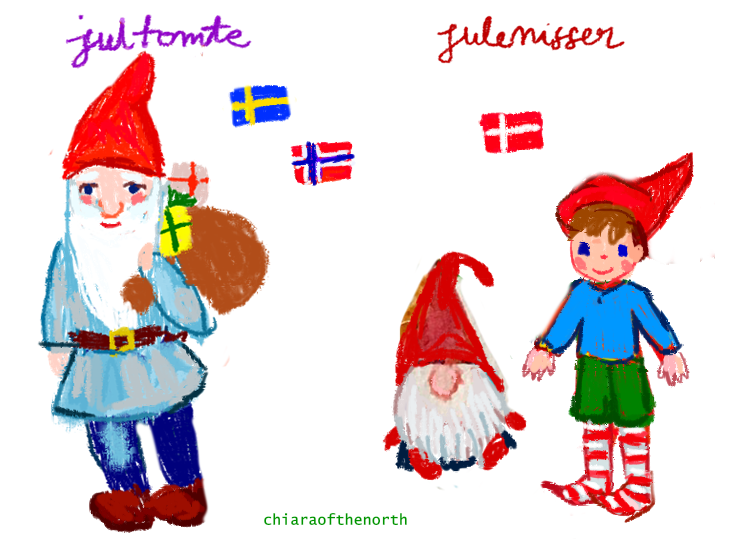
In Sweden and Norway it is a Santa Claus-like gnome bringing presents: Jultomte in Sweden and Julenisse. According to the tradition it lives in farms and takes care of the household while the family is sleeping, Bringing presents if the family treated him and the farm animals well. In Norway, an adult disguises himself as Julenisse and gives out presents to children, often greeting them by saying Er det noen snille barn her? (“is there any good child here?”).

In Denmark Julemanden (literally Christmas man) arrives on a sleigh with reindeers and has elves as helpers, Julenisser or just Nisser, who are believed to live in barns and attics. Children leave rice pudding for the Nisser, who find it delicious accoring to popular belief. In the Faroe islands it is called Jólamaðurin.

Initially the gift bringer was the Julbocken/Julebukk goat mentioned above, so in Finnish Santa Claus is called Joulupukki

2. Christmas Decorations: straw goats, pleated hearts and flags

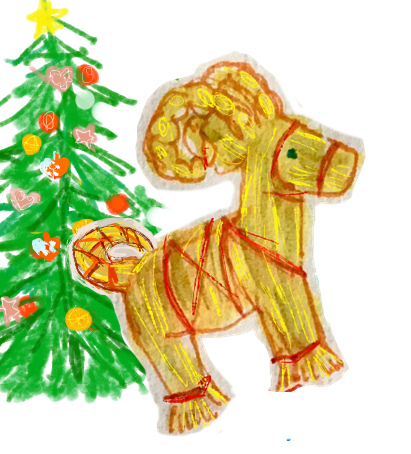
Yule Goat: A common Christmas symbol and decoration is a straw goat, Julbocken/Julebukk, often put under the Christmas tree. It goes back to the Viking times and it was a household protector, representing Thor’s magical goats, who lead him in the night sky. Bigger versions can be found in town centres – this tradition started in the Swedish town of Gävle in the 60s, and every year this traditions is repeated with a Julbock as tall as around 10 metres.

Things to hang on the tree

Julehjerter are pleated hearts, very common and in Denmark and Norway (Norwegians call them Juletrekurv “Christmas tree baskets”), but also present in other Nordic countries as a typical Christmas symbol. Children make them with their family with paper of different colours, although they are often red and white.
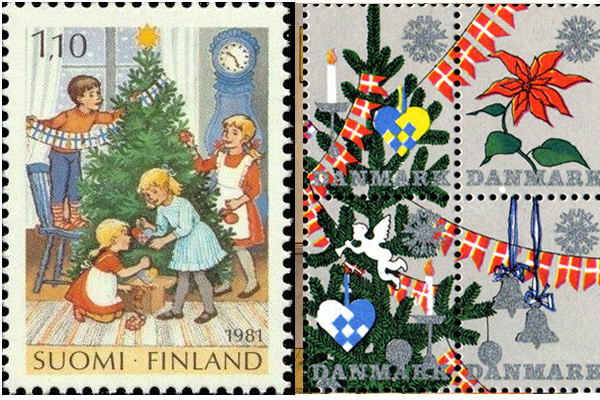
Flag garlands: Decorating Christmas trees with flags originated in Denmark and it can be seen in all Nordic countries, although it was more common in the mid-20th Century. A survey showed that one in three Norwegians thinks flag garlands are suitable Christmas tree decorations, while only 3 % and 5 % is of the same opinion in Sweden and Finland. Nonetheless, I bought a Christmas tree flag ornament in Sweden…

3. Christmas treats: spiced cookies to rice porridge

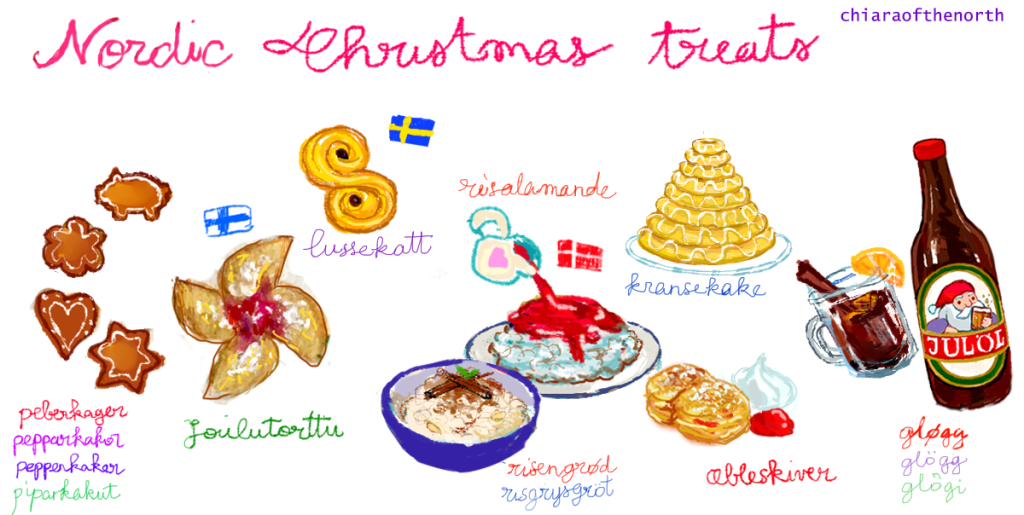
  • Baking gingerbread cookies is a typical Christmas time family activity: Pepparkakor in Swedish, Pepperkaker in Norwegian and Peberkager in Danish, piparkakut in Finnish.
  • Hiding an almond in rice porridge with a prize for who finds it is a common things in Nordic countries. in Sweden the rice pudding is called risgrysgröt. In Denmark you have the Risalamande (from French ris à l’amande, just because French sounded fancy), It is served cold with a warm cherry sauce, kirsebærsovs. The lucky person who finds the entire almond in it wins a marzipan pig!
  • Lussekatter are Swedish saffron pastries, typically eaten for Lucia.
  • Joulutorttu, a Finnish pastry filled with plum or apple jam.
  • Æbleskiver are Danish fried snacks, round and often served with jam and powder sugar. The name literally means “apple slices”, although apples are usually not an ingredient!
  • Kransekake, Norwegian and Danish almond cookie rings, commonly eaten on festive occasions.

Mulled wine, glögg, is a classic, with spices as cinnamon, cardamom and ginger, but you can also drink Chistmas beer! It is darker and spicier than the usual ones.
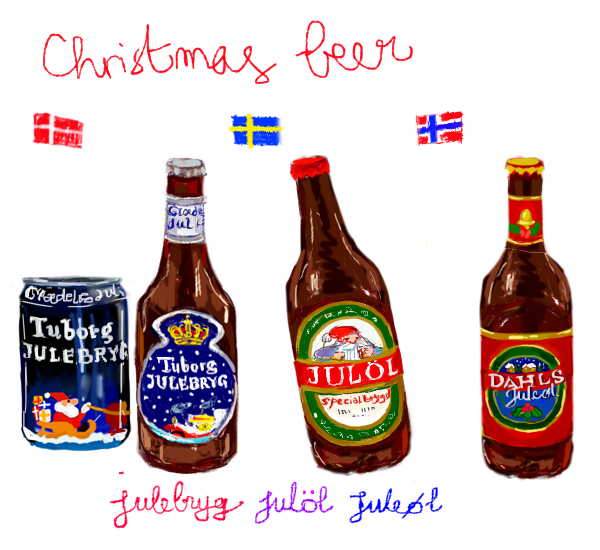
God Jul!

more articles
Scandinavian Embassy‘s bakery and cafe in Amsterdam zuid

On a trip to Amsterdam, I decided to test Scandinavian Embassy and both of its two locations, starting with the bakery in europaplein. The two locations are in Amsterdam zuid: Saphatipark and Europaplein: in the former, a more central location, you can sit but it has fewer items than the bakery in Europaplein. The bakery,…