idioms in Swedish, Finnish, Norwegian and Danish with berries
Berries are a big thing in Nordic countries, and you can hear that in their languages as well! So I have collected a few sayings and idioms involving them in Swedish, Norwegian Finnish and Danish.
Swedish
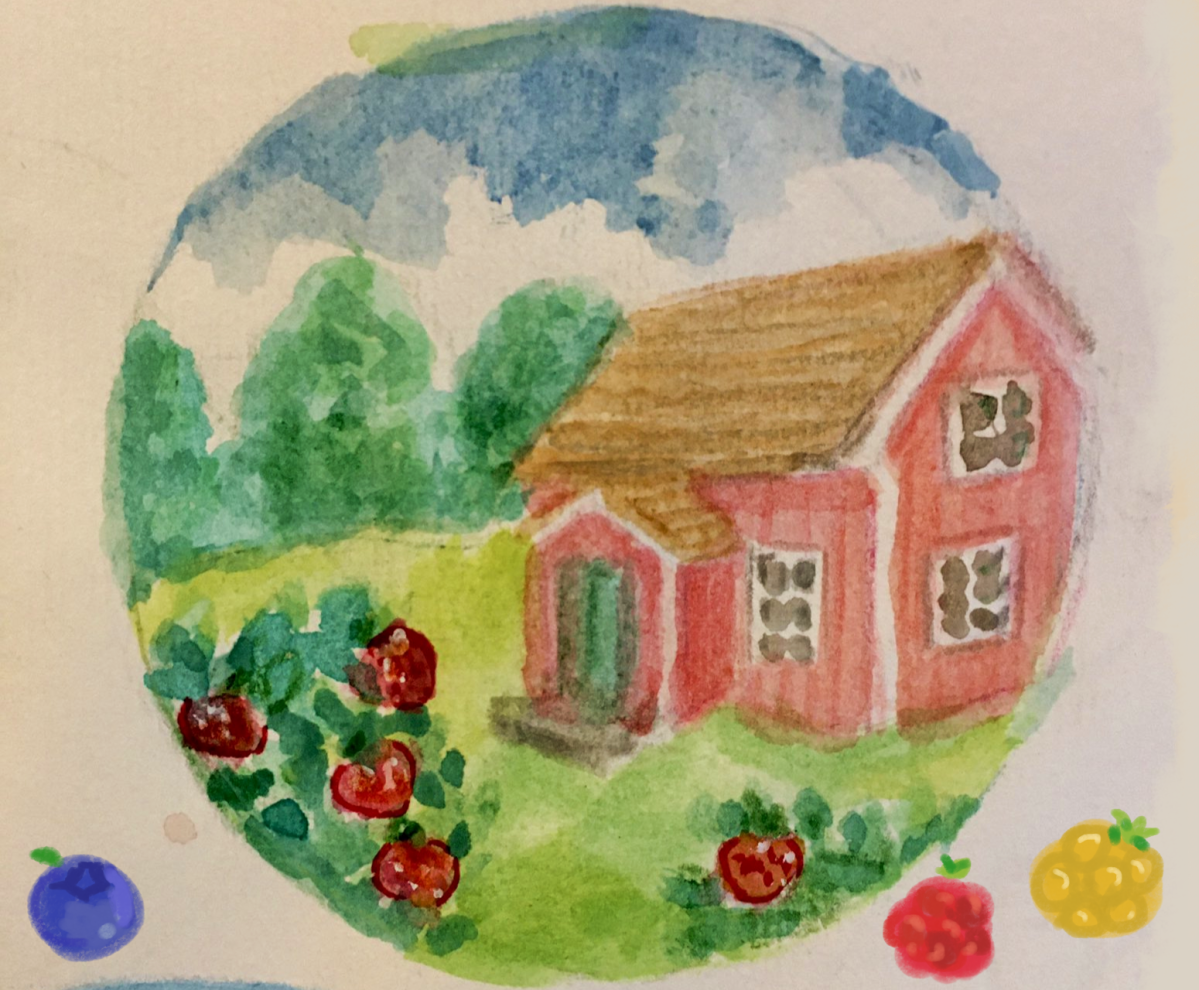
Smultronstället – Place of wild strawberries – a special place discovered, treasured, returned to for solace and relaxation; a personal idyll free from stress or sadness
Blott Sverige svenska krusbär har – Only Sweden has Swedish gooseberries – There’s no place like home… Originally a quote by writer Carl Jonas Love Almqvist (1793-1866)
Hej hopp i blåbärsskogen! / Hej svejs i lingonskogen tjosan hoppsan hej! – hey hey in the blueberry/lingonberry wood hey hey: a funny surprised expression Swedes may use in a joking way
Norwegian
Det er bare blåbær – It’s just blueberries: it’s not a big deal/it’s a piece of cake
Være på bærtur – To be picking berries: being completely lost/wrong.
Finnish
Oma maa mansikka, muu maa mustikka – our land strawberry, other land blueberry: No place like home, here too 🙂
he ovat kuin kaksi marjaa – they are like two berries: they look very much alike
se maksaa mansikoita – it costs strawberries: very expensive
and last but not least paskanmarjat – sh*t berries: bullsh*t
Danish
stikkelsbærben – gooseberry legs: pale, skinny, and hairy legs
et surt ribs – a sour redcurrant: a grumpy person
at give (eller få) en på bærret: to give (or get) one on the berry: to hit or get hit on the face
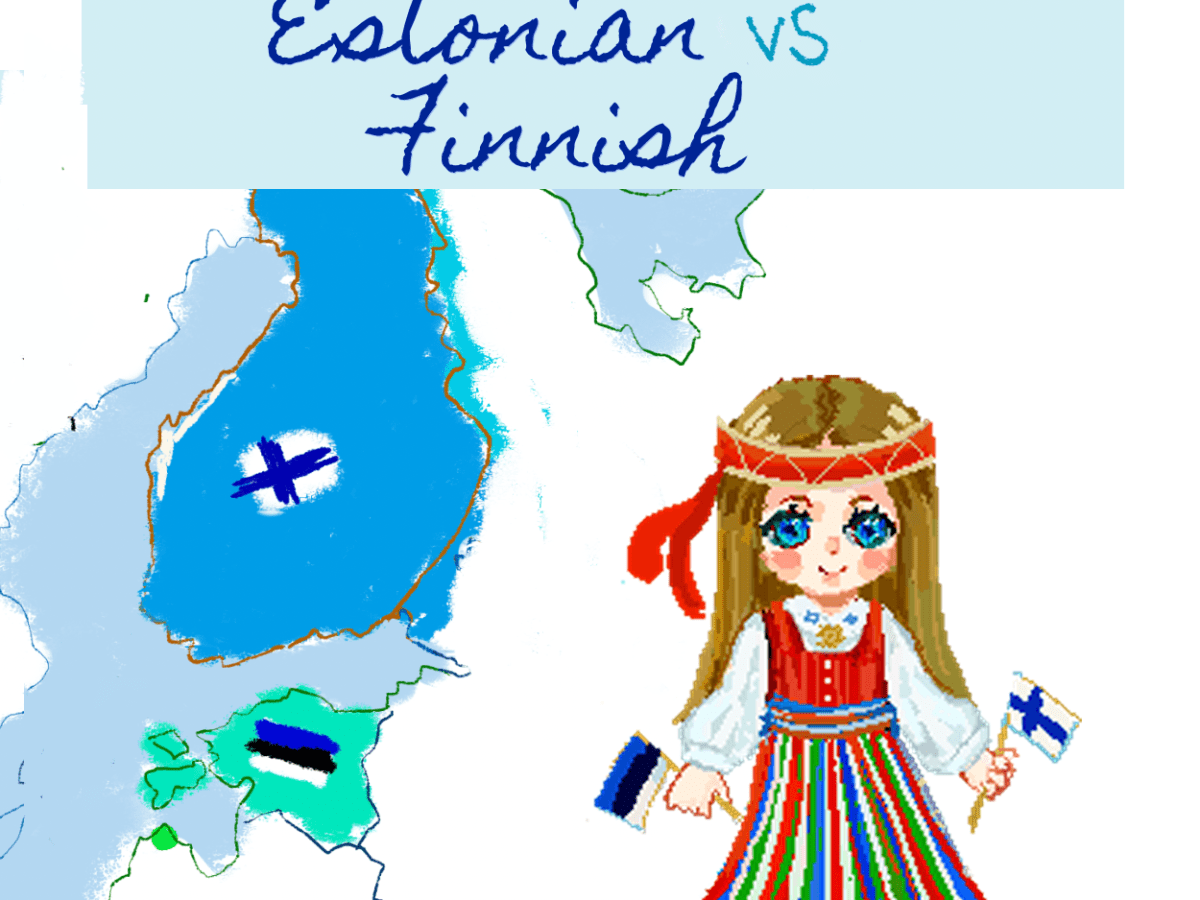
Estonian is a Finnic language, sharing many similarities with its ‘bigger’ sister Finnish, while being unrelated to all their bigger language neighbours
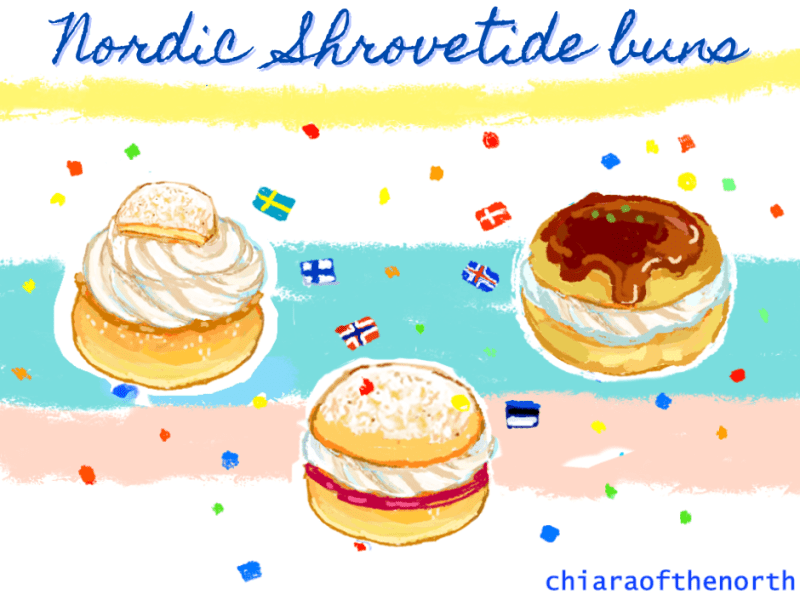
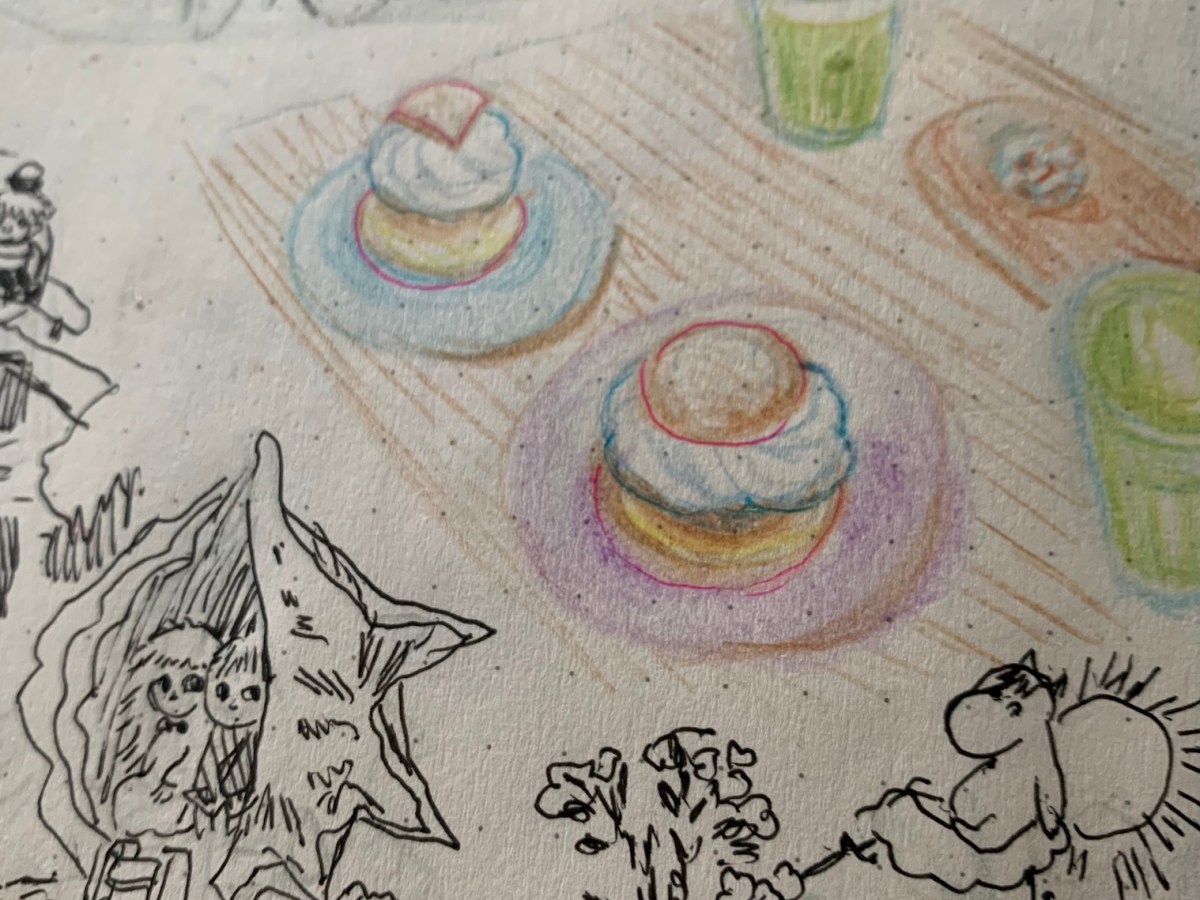
Cream buns are enjoyed in Nordic and Baltic countries during shrovetide, between January and February. Sweden’s classic semla has almond paste, while other countries variations include jam, vanilla cream, and chocolate icing top.
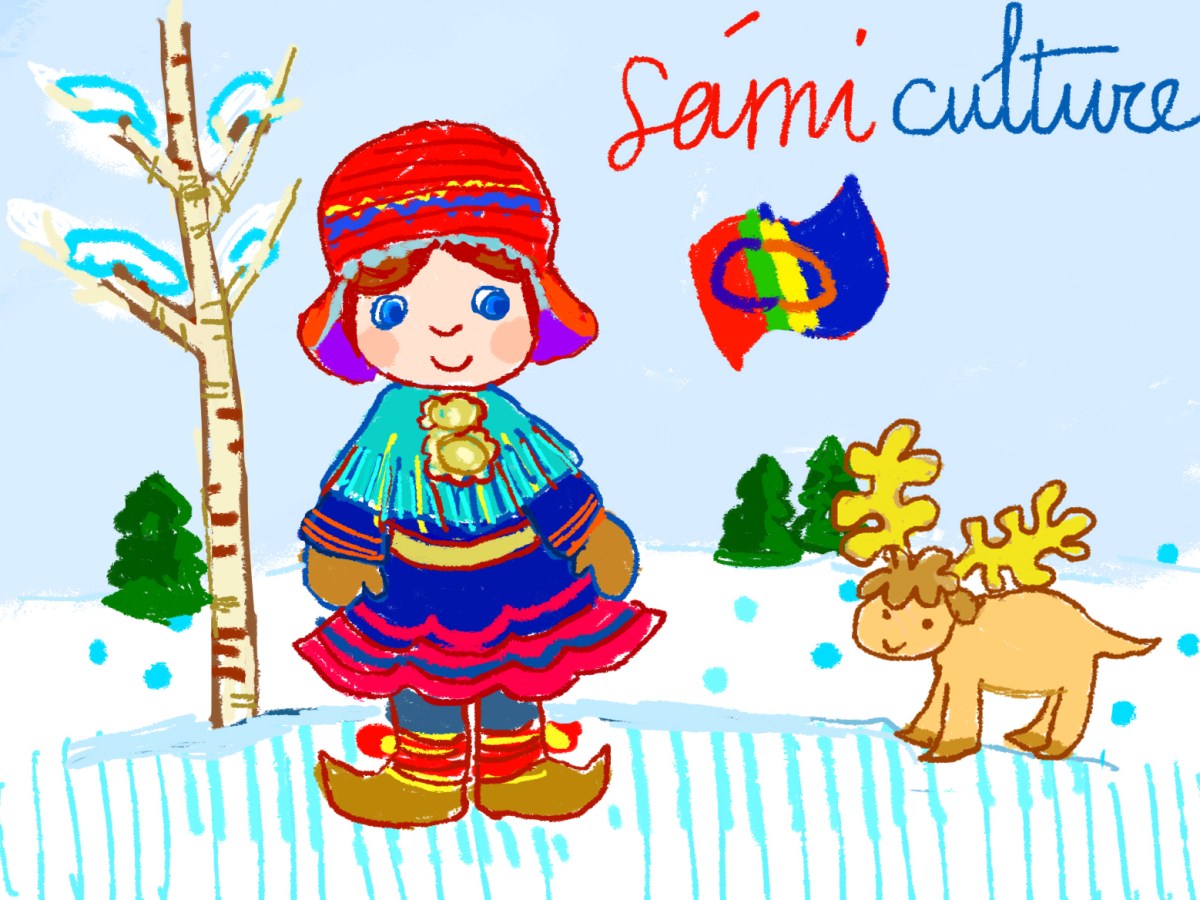
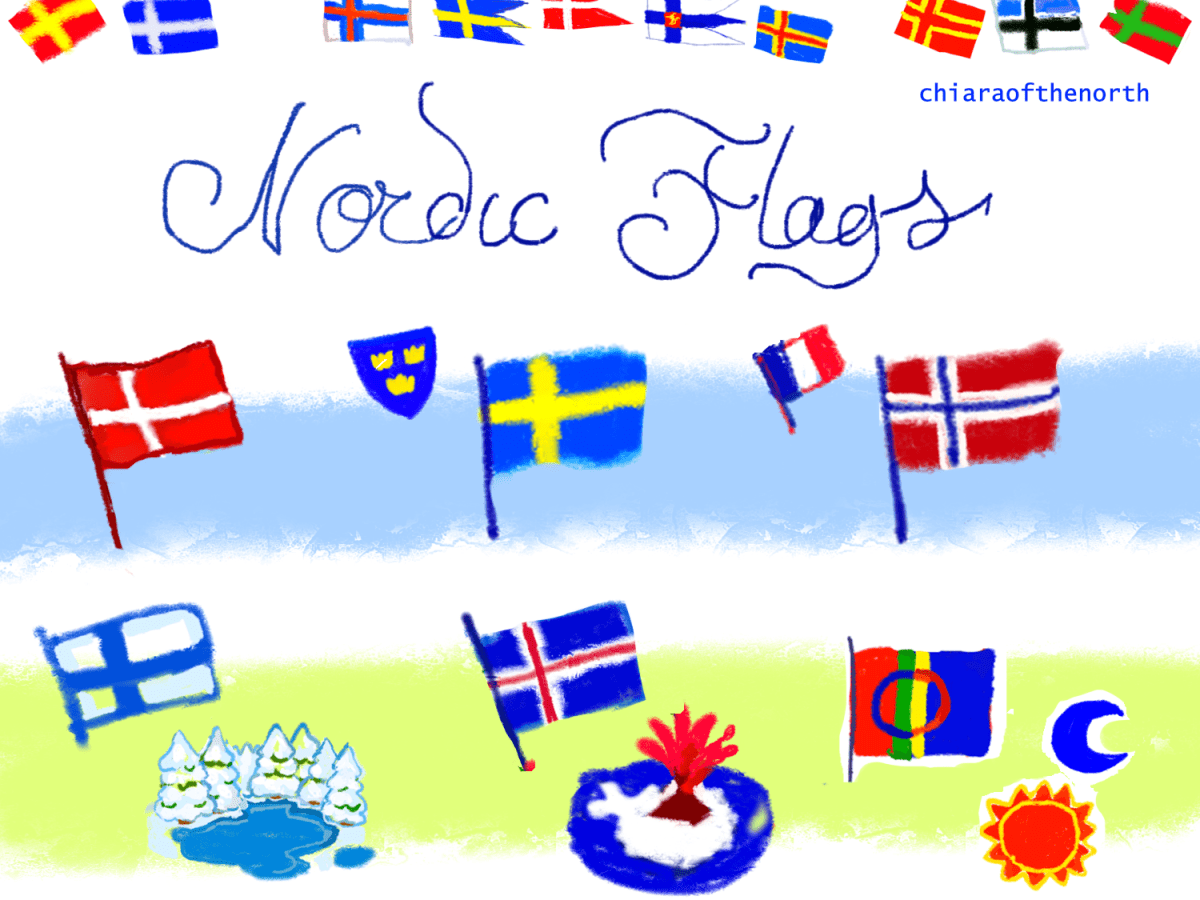
Sámi people, indigenous people of North Scandinavia, have a distinct culture, symbolised by its unique flag and traditional clothing, and part of it are Duodji handicrafts and unique musical expression through yoik.
I joined the polyglot gathering in Prague, an event for language lovers with lectures and activities
First of all, to be updated about language events you can follow me on instagram at @ chiaraspeaksnordic
In May 2024 i went to the Polyglot Gathering – an event I had been dreaming about for a while, but did not know if I would never manage to join. However, after stumbling upon its existence not too long before it would take place, In the course of a few days I figured out I could actually make it! Here is my experience at it.
Sign-up, info Pre-gathering and visiting Prague
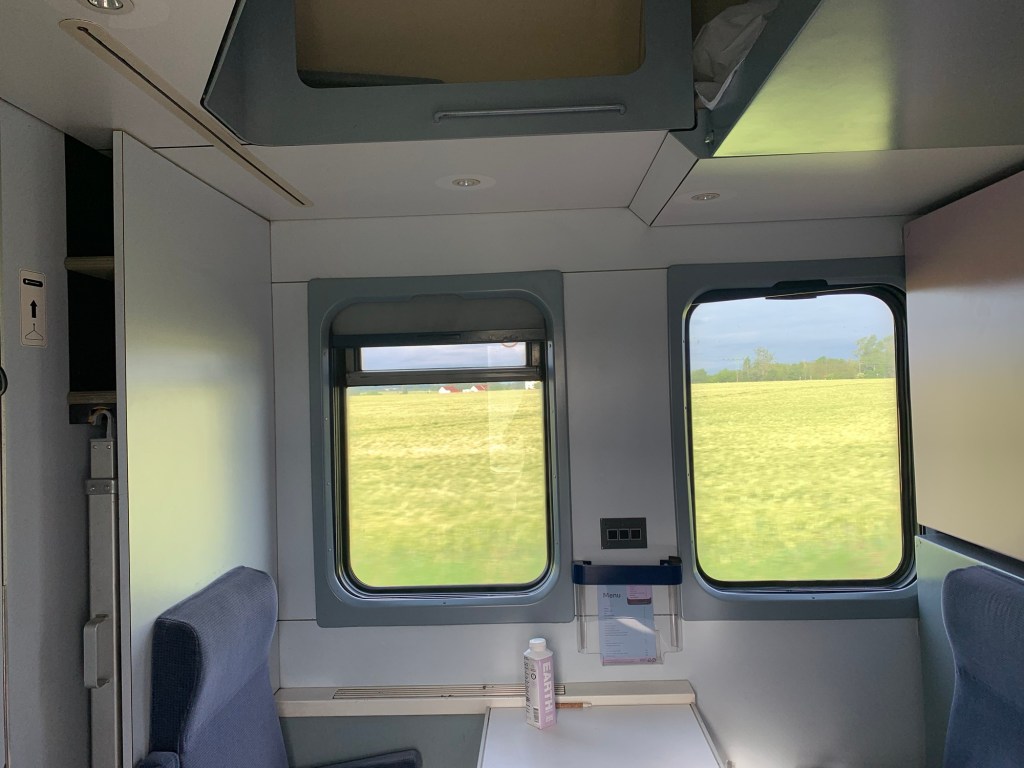
After checking out programs of past editions, info and such on the Polyglot Gathering website, I signed up a couple weeks before the event would take place. By signing up early on you would get discounts, so next time I’ll try to do this asap. The main thing to be sure about was getting there, and turns out there is a European Sleeper train to Prague.
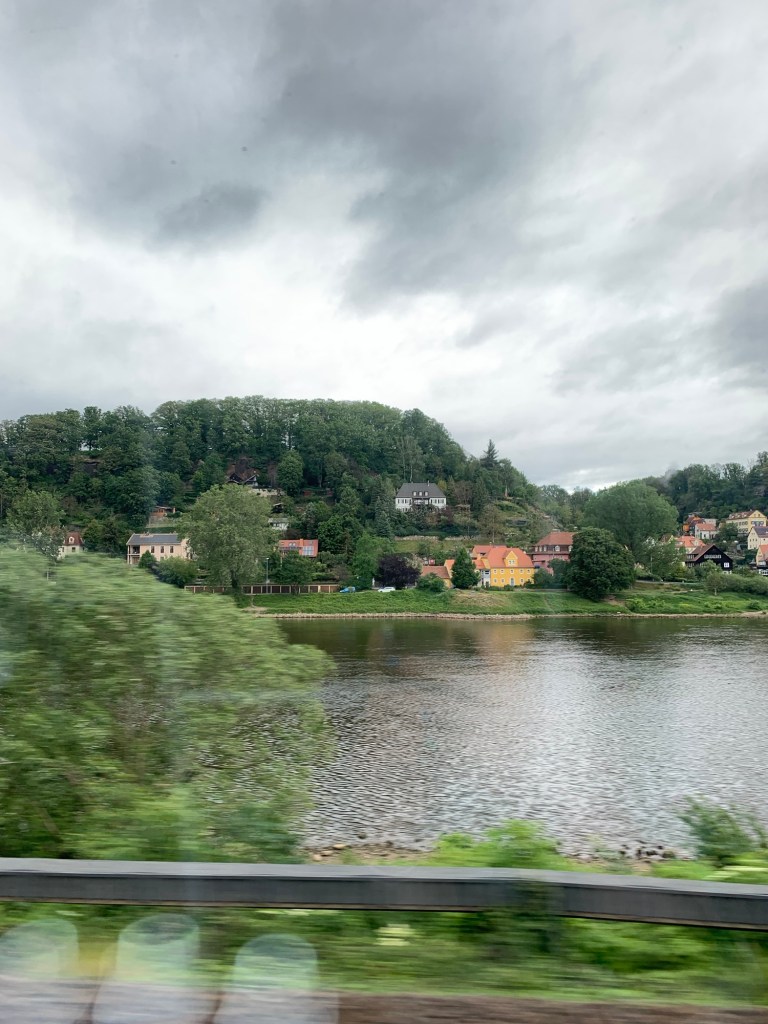
I attempted at studying Czech before leaving..Saxonian Switzerland from the train
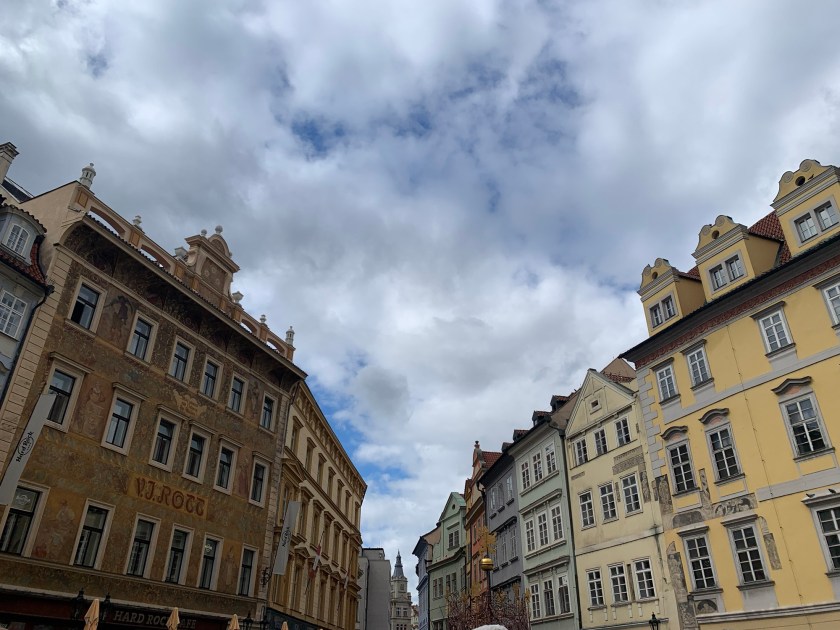
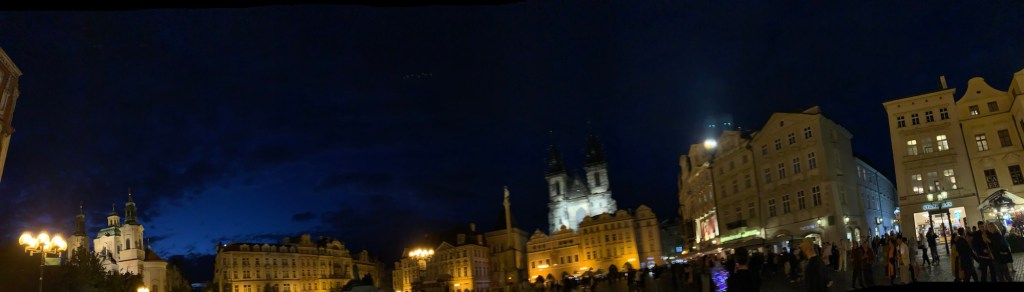
I arrived there around 11am and had planned to just walk around on Saturday as it would have been a pity to just stay inside a building (and pay for an entire day of activities) while I had a brand new city and country to explore. I also tried the most touristy street food, the Trdelník (chimney). BUT of course, without ice cream, unlike everybody. I had lunch at the Havelska Koruna, budget authentic Czech food restaurant.
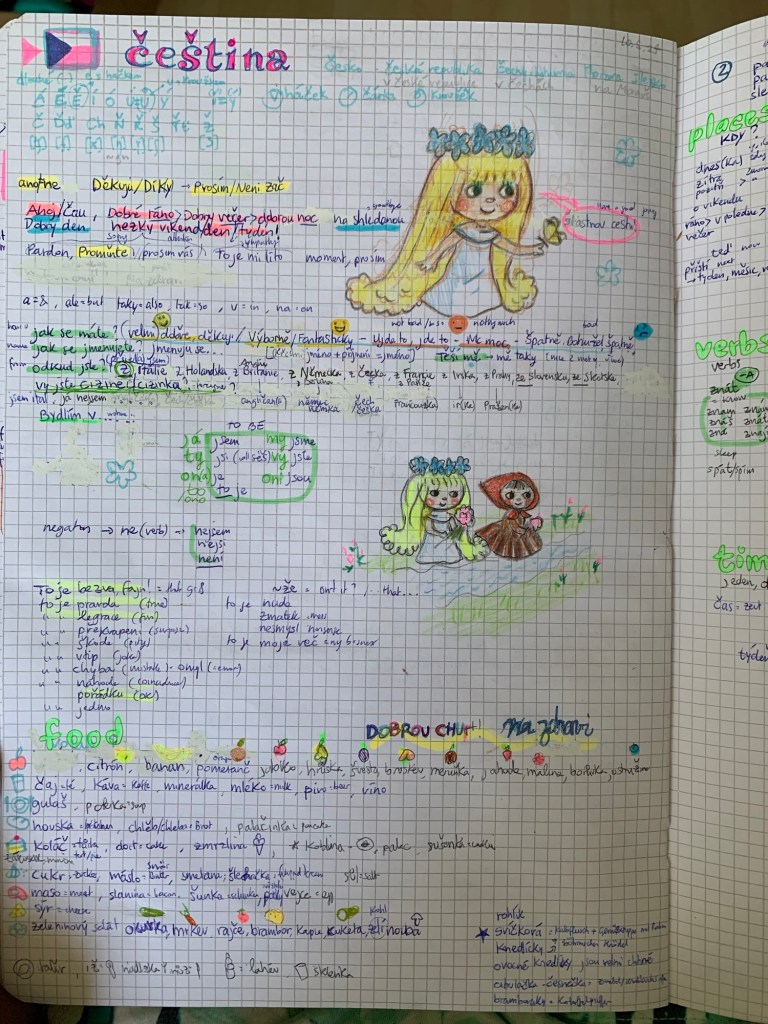
A challenge related to the Gathering was learning Czech. Having to start from scratch, I tried to focus on practical stuff as food vocabulary in the little time I had, and didn’t manage to go much further than memorizing words for apples and potatoes.
having to look up stuff slowed down my deciding process… That was frustrating! This was my first time in a country with a language I do not understand at all, last time I was 13… One thing I really look forward to if next year’s gathering will still be in Czechia, will be improving my Czech skills, if anything to navigate these things more efficiently.
Sunday: The Gathering
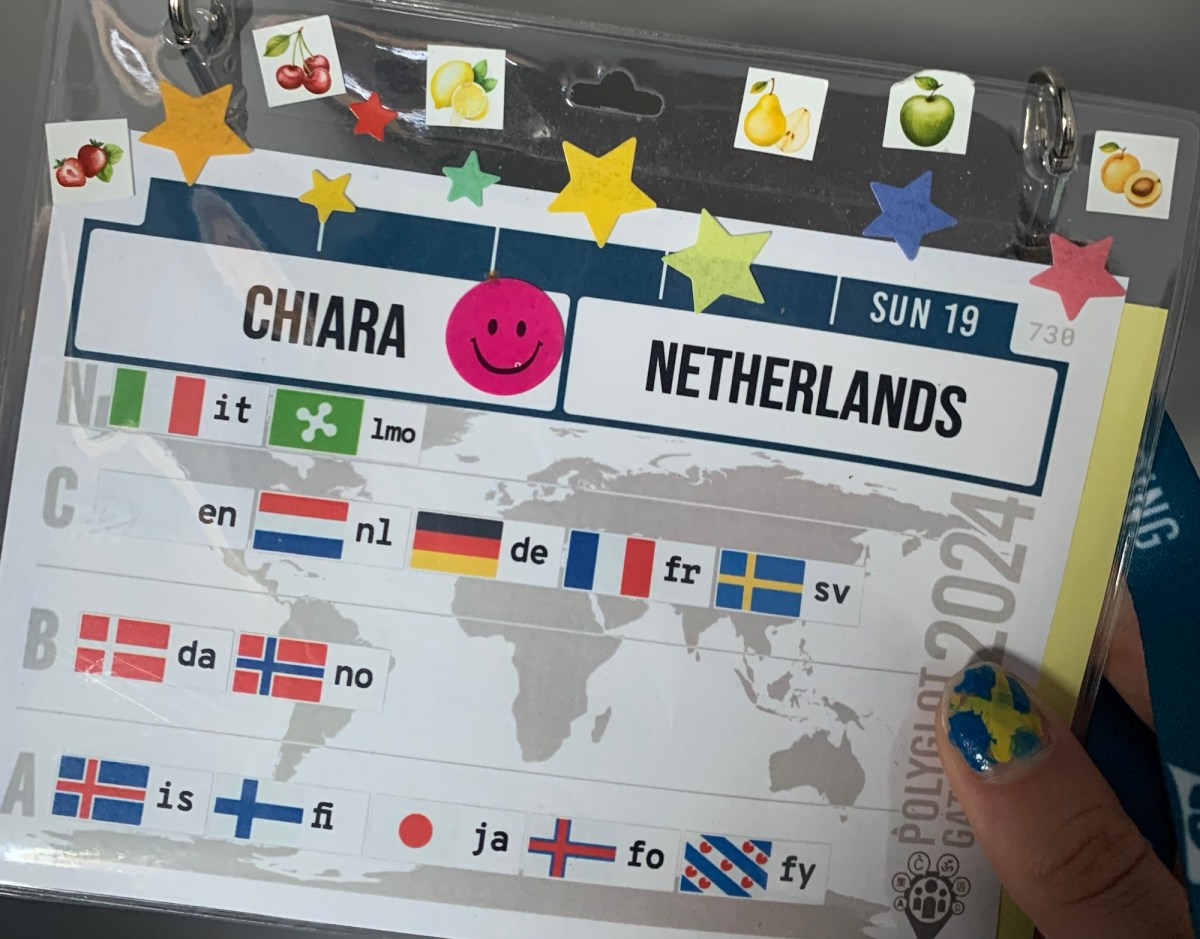
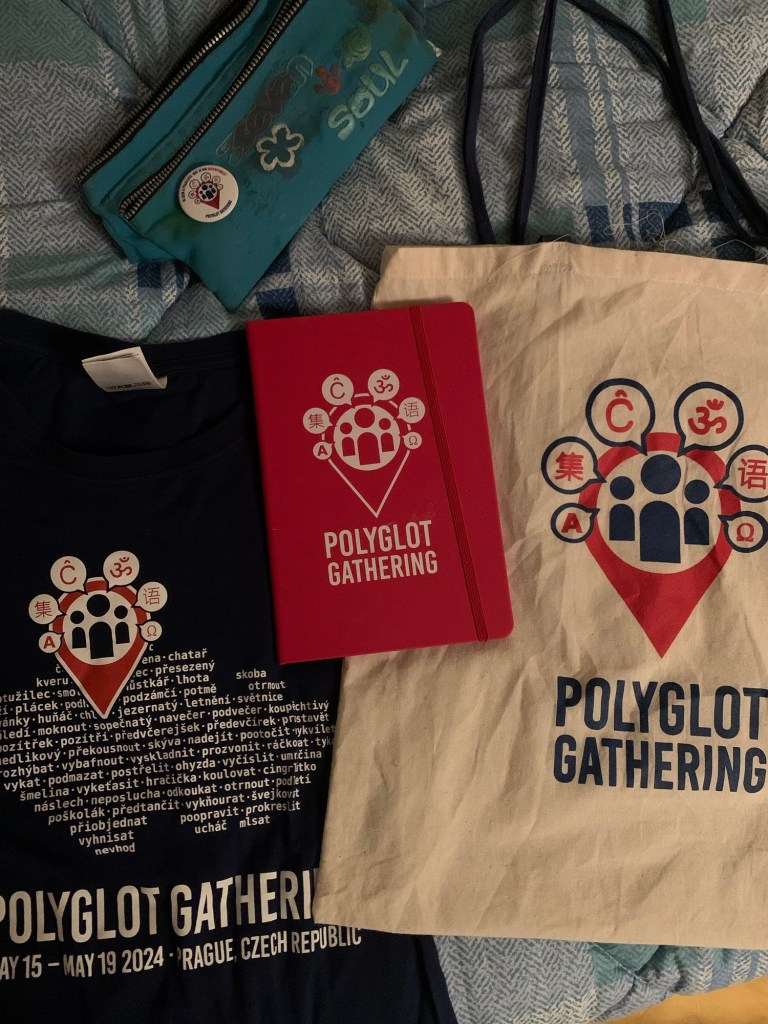
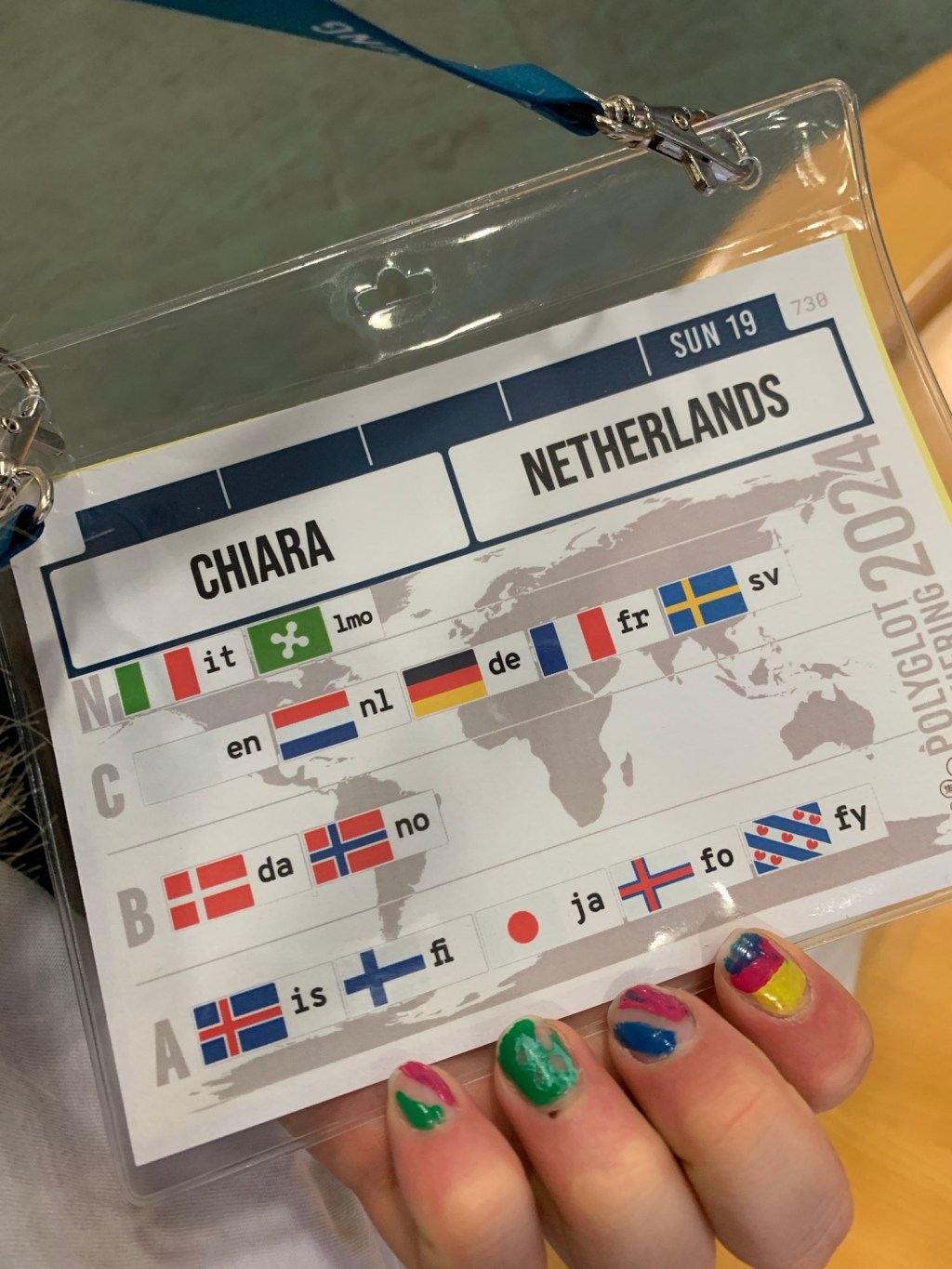
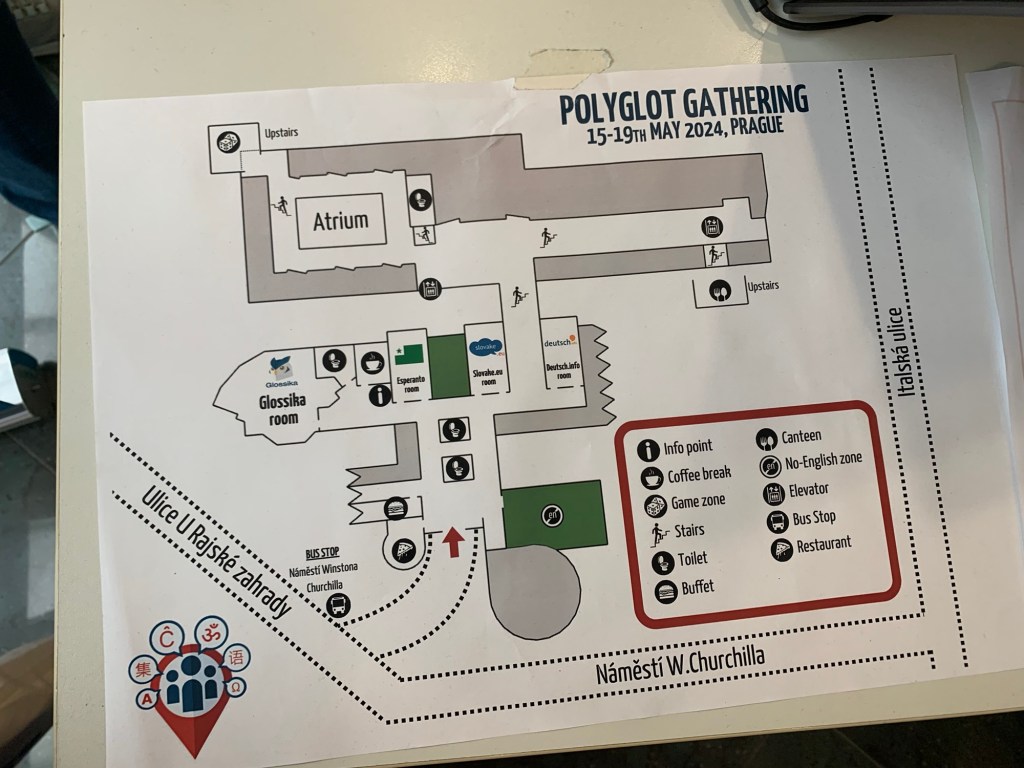
Anyway, I was ready to join the Gathering on Sunday, the last day of it. I met two Italian girls walking just outside the University building where the event took place, so I didn’t have to figure out myself how to exactly come in, as it was not super clear. As I registered I was given a tote bag with a notebook, a pen, few pins, a bottle of water and of course my language tag that I had filled in while signing up for the Polyglot Gathering! And, a t-shirt, that I had added to my registration.
tote bag, notebook, pin and tshirtA few people were actually curious about the Lombard and Frisian flags
I announced on social media I’d go, and found out a (Swedish-speaking) friend would be there. So I ended up speaking a lot of Swedish which on its turn attracted fellow Scandinavians hearing us..
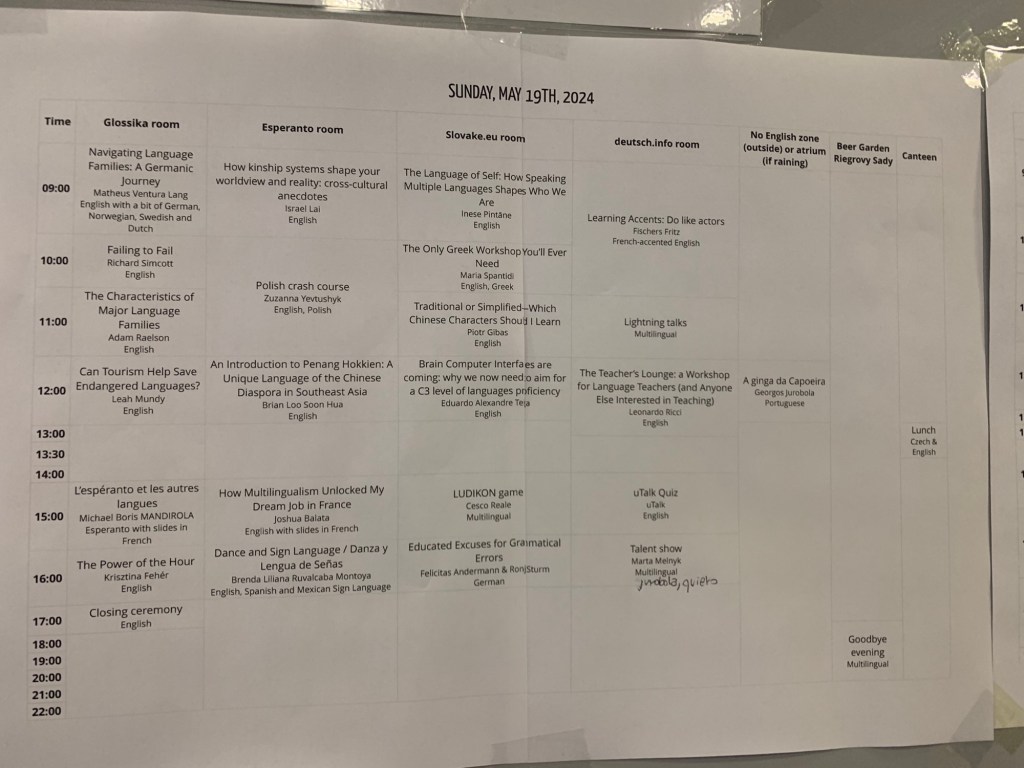
I could already see the program (see below for the last day) shortly before the Gathering started, so i knew more or less what lectures I wanted to join.
Besides lectures there were also activities as language practice rooms (and a “no English Zone”), talent shows, quizzes, workshops, tasting international snacks.. But that will be for another time …I eventually picked these lectures:
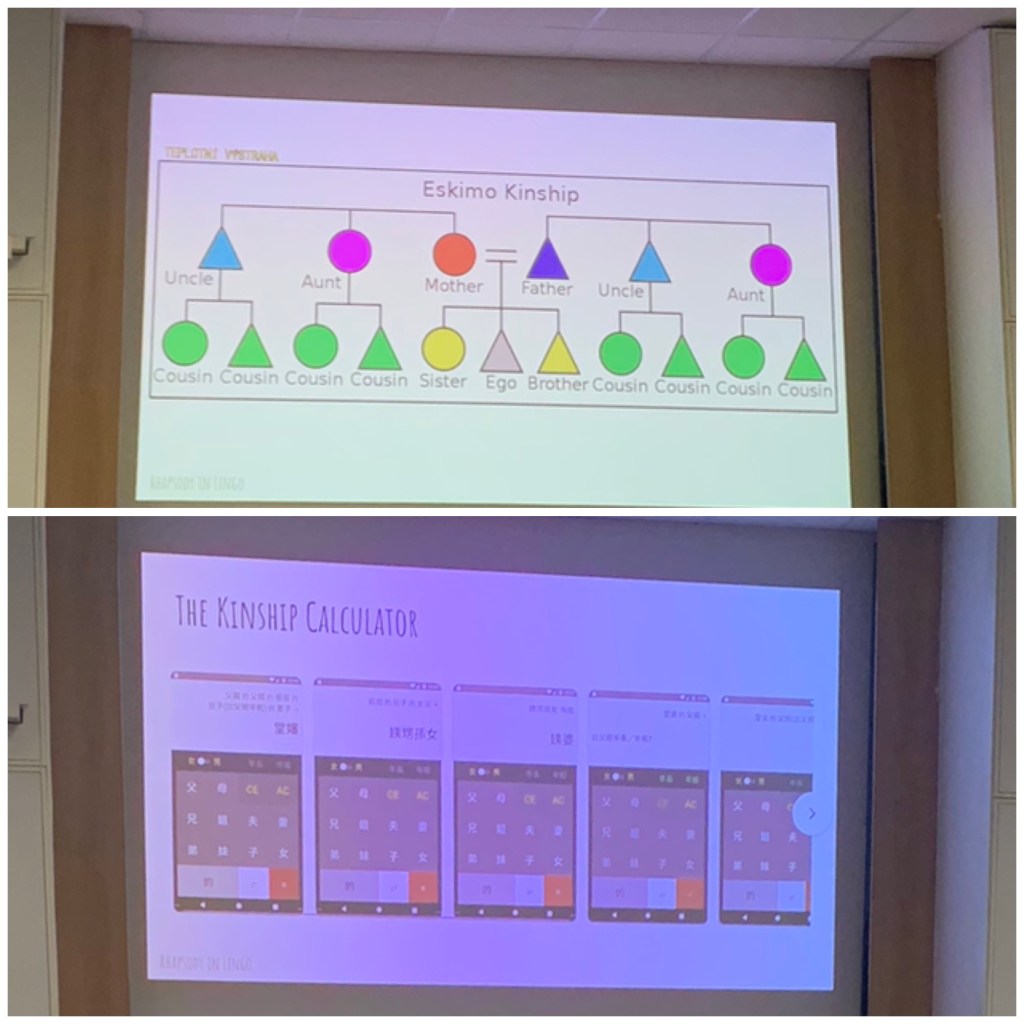
How Kinship systems shape your worldview and reality: cross-cultural anecdotes, by Israel Lai
Polish crash course (1/2 of it) by Zuzanna Yevtushyk
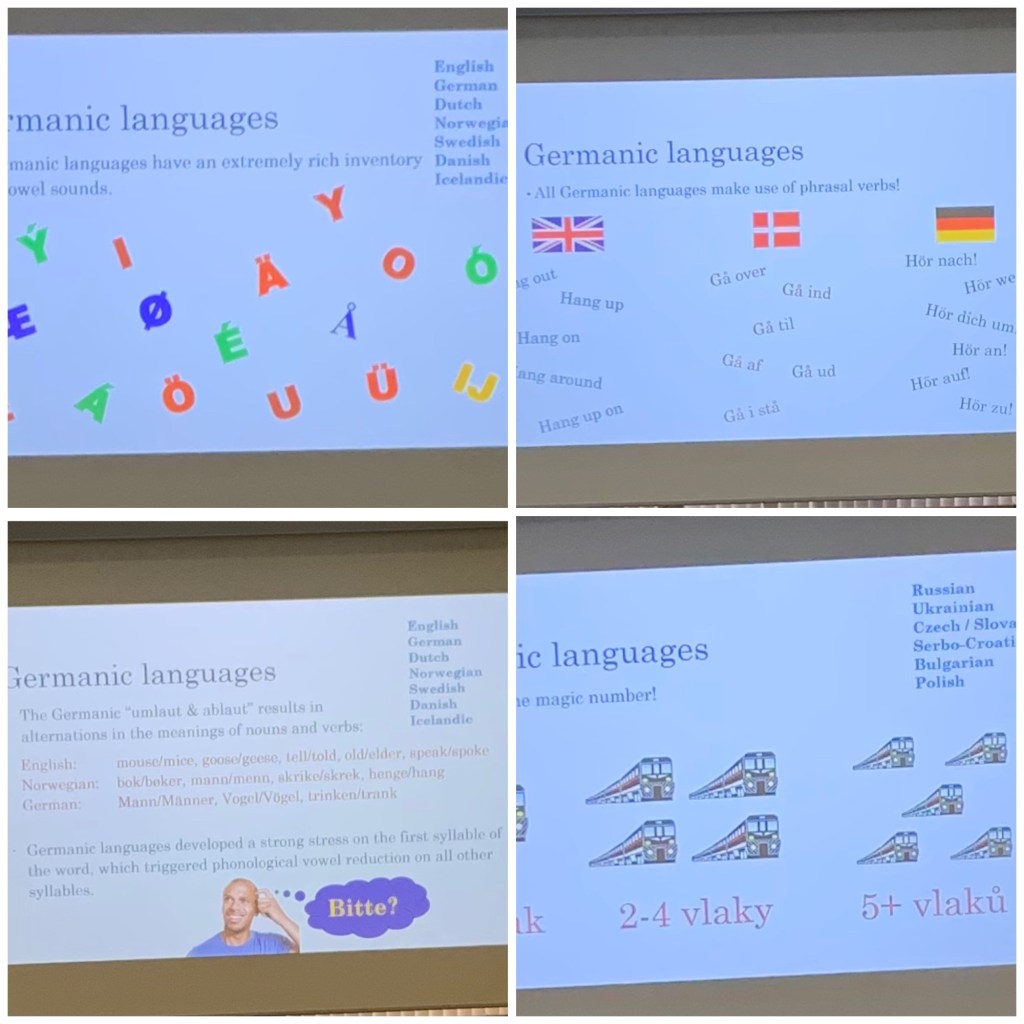
Characteristics of major language families (mainly Romance, Germanic, Slavic and facts about further ones), by Adam Raelson
Brain computer interfaces are coming- Why we now need to aim to C3 level
Esperanto and the other languages (slides in French and lecture in Esperanto)- by Michael Boris Mandirola
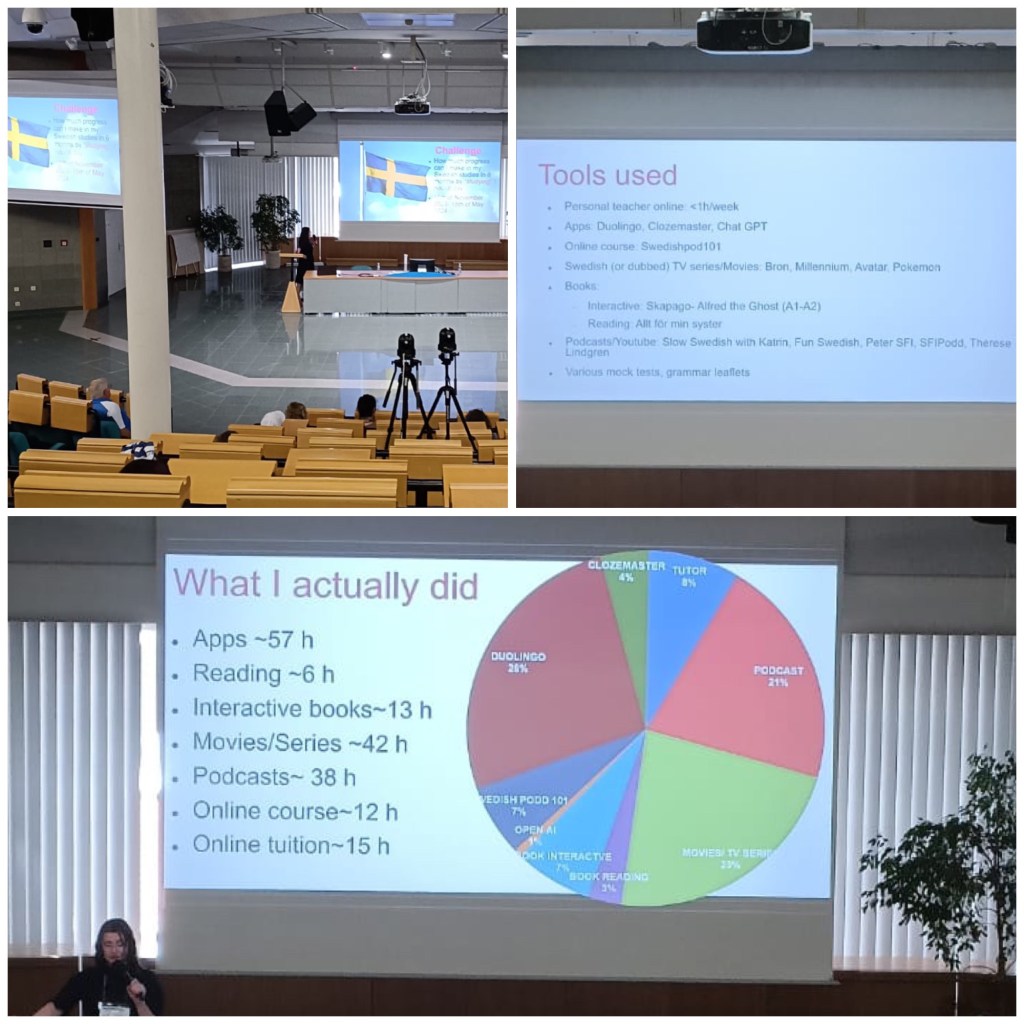
The Power of the Hour – Swedish in 6 months by Krisztina Féher
one time slot had multiple interesting courses, others not as much, but most lectures were definitely interesting! I would have gone to a Chinese lecture instead of another one about competing with AI intelligence if I had to do this again, but for the rest I was satisfied with my choices. It was also a pity I had to leave the Polish Crash Course halfway through to go to the Languages Families lecture. Although I must say my brain cells were getting tired, the Czech I had learned wasn’t helpful beyond the first three sentences.
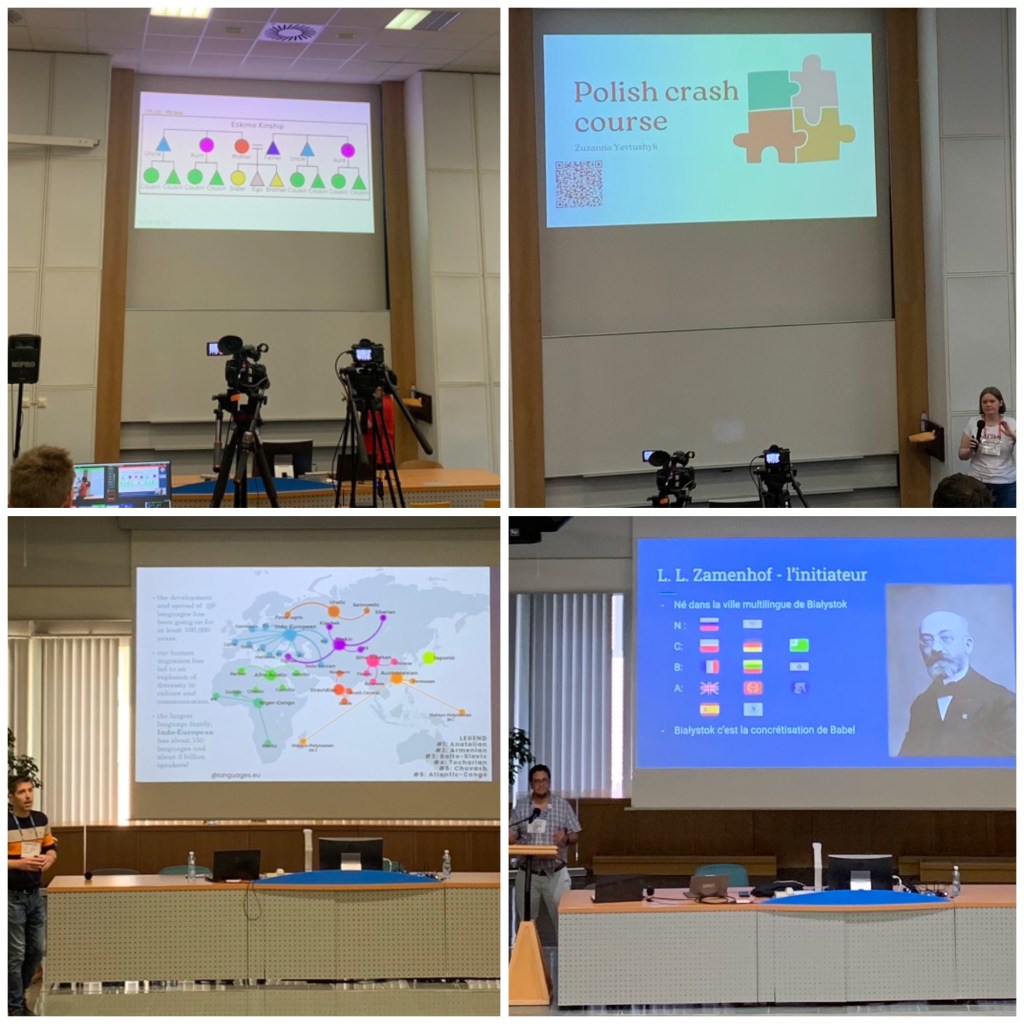
I’d say my favourites were the one about language families and hearing about the strategies used to learn Swedish one hour a day – the way she tracked it was quite inspiring and gave me good insights. Learning about different ways different languages name family members was also pretty cool! See some slides below.
Breaks
Between each lecture there was a break, and you could get coffee or tea. and there were stands selling books, gadgets and stuff.
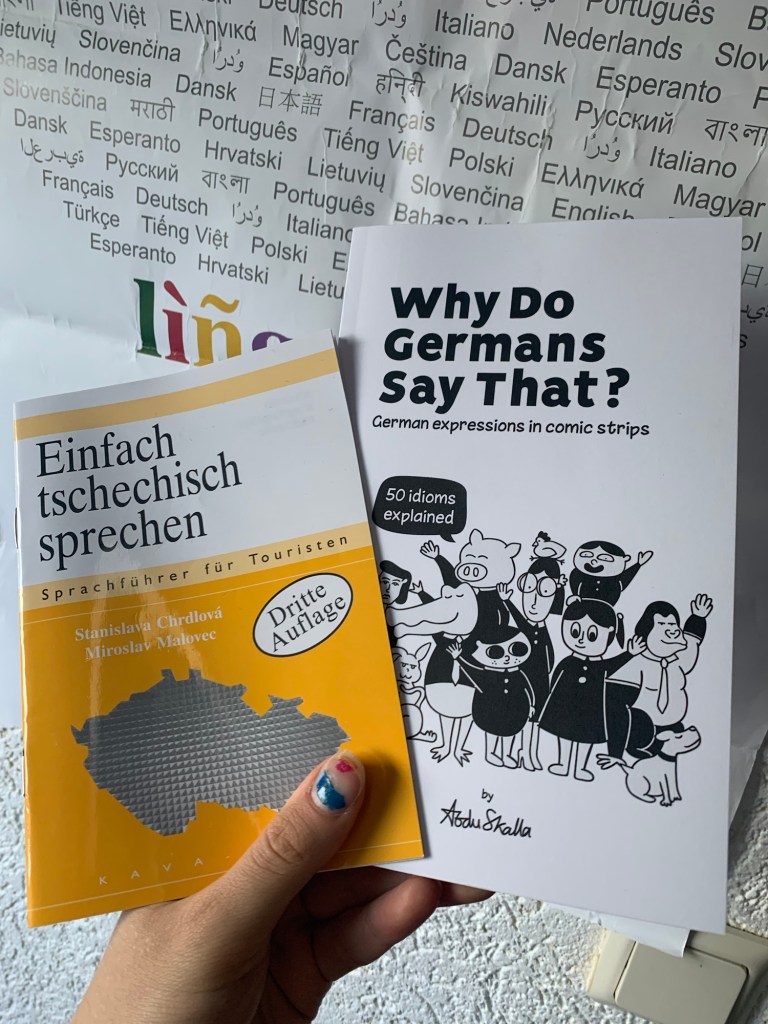
One was mostly just about Esperanto though – seems to be pretty big at language nerds events. I got a book explaining German idioms, and a tiny tourist phrasebook for Czech. Might be handy for another time!
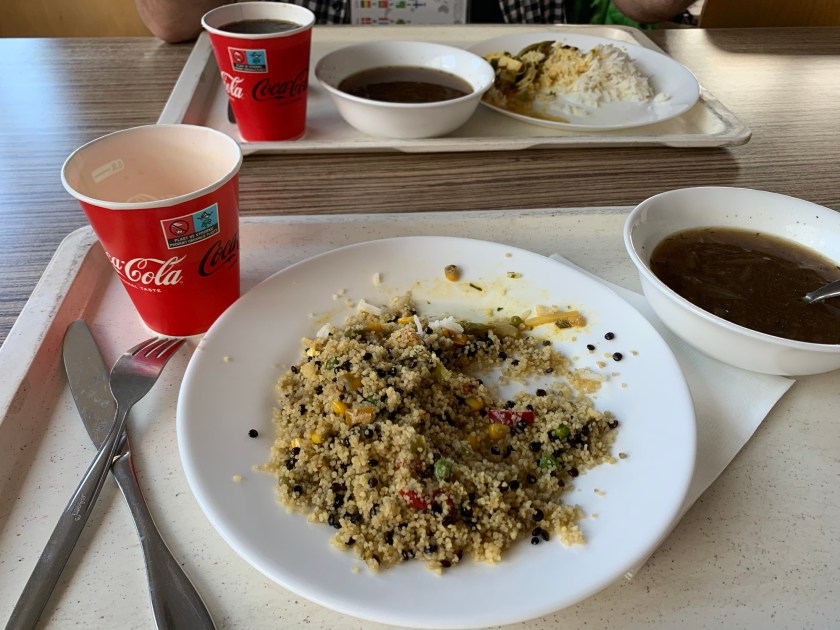
The main break was of course lunch, a couple hours. You had the option to get lunch either everyday or not at all at the canteen, and it was available in 3 versions: meaty, vegetarian and vegan. Here too, you had to choose one and stick to it for all the days you’d stay there.
The best thing would be having the menu to begin with and freely deciding which version to pick, but I understand that’s for organisational reasons.
I was there only one day so I did not have to stick to only meat or only vegan dishes for 5 days. And I knew I would eat typical Czech food with meat outside anyway, so it was okay. On Sunday the vegetarian version was curry rice, the vegan couscous, the meaty schnitzel. And of course I got soup as side dish, typical Czech.
Closing ceremony & Final Evening
As it was the last day, the final ceremony took place at the end of the lectures, and it was a sum up of the event, organisational effort of the team behind it, Slovakian Edukácia@Internet as main party, thanking all partners and sponsors. and insights about where the Gathering will be next here. Which might be Prague again. Or somewhere in central Europe. Sorry, non-Europeans…
Once the Gathering was over, we still had the possibility to meetup with other polyglots at the beer garden in the evening. As I had only been there that day, I had not had the chance to really chat a lot with others yet. It was quite fun and got to talk to quite a few people – notably a person I am a mutual follower of on tiktok, it was quite amazing to see her in real life – unexpectedly!! I also got Polish chocolates :). Afterwards some people went to pubs – I had a bit trouble switching from Swedish to norwegian after a drink, I must say.
Though English stayed in most contexts as the lingua franca, I still got to speak quite a few languages. I look forward to the next time I will be able to join it, hopefully for longer than just one day!
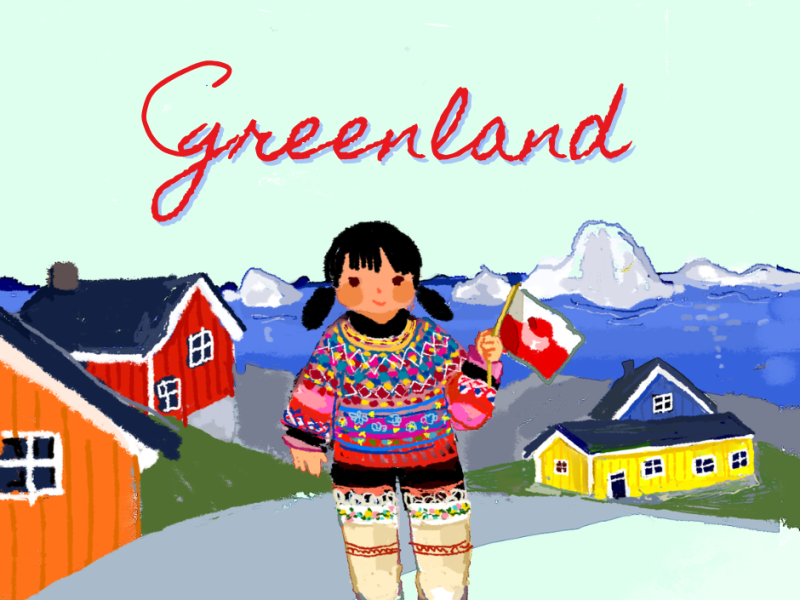
Discover Greenland, home to the Inuit Kalaallit, and its most iconic aspects as its flag, language and folk costumes. The biggest island of the world has a rich history of indigenous culture intertwined with Norse colonization and later Danish rule.
Identical words with different meanings that Finnish, Japanese, Italian share.
Homonyms are words with the same sound (homophones) or spelling (homographs), but differ in meaning.
Finnish is totally unrelated to Japanese and Italian, but it has quite a few curious homonyms with them because of featured they share:
Consonant/vowel alternation
Words frequently ending in a vowel
A common trait is also double consonants (alternated by vowels)
This results in completely unrelated words being identical! What is a noun in one language, can be an adjective or a verb in another though. Other times it’s surprisigly words in the same domain (see me/te in Finnish and Italian!)
te: plural you (Finnish), you (complement pronoun, Italian), hand (Japanese)
Finnish and Japanese both use (or Japanese is transcripted with) a K for the esact same sound Italian uses C for:
kani/cani: bunny (Finnish), dogs (Italian), crab(s) (Japanese) – here surprisingly all animal names!
kasa/casa: pile (Finnish), house (Italian), umbrella (Japanese)
Sometimes the same word is actually very similar in other languages, but the way Finnish, Japanese and Italian adapt it is very similar or ends up looking identical to other words:
poro: reindeer (Finnish), pore (Italian), the polo game (Japanese)
shokki:shock (Finnish), tableware (Japanese)
kokki:cook (Finnish), national flag (Japanese)
Finnish – Japanese
ase: weapon (Finnish) – sweat (Japanese:汗)
haka: hook (Finnish) – grave (Japanese)
hana: tap/faucet (Finnish) – flower, nose (Japanese:花/鼻)
haku: search (Finnish), vomit (Japanese:吐く)
himo: lust (Finnish) – ribbon (Japanese:綬)
kanki: wood/metal bar +slang for bon..r – ventilation (Japanese:換気)
Is it easier to learn Icelandic if you speak a Scandinavian language? My experience of studying it while knowing Swedish, Danish, Nowegian and German
A while ago a follower of my langstagram asked: Hi Chiara, I was thinking about starting Icelandic, what are your thoughts on the difficulty of the language? I already know swedish on B1 level, is that helpful?
Generally speaking, good knowledge of Scandinavian languages will certainly help, but Icelandic is to be taken as a very distinct language, for which you’ll need to spend quite a lot of time for both grammar and vocabulary, even if many things will look familiar.
As follows my impressions and experience with my prior knowledge of Scandinavian languages:
Learning grammar
Needless to say now, the trickiest part is the grammar and the inflections, it’s something you have to practice with and get used to. For that aspect knowing some German might help you more than knowing Swedish honestly. Just like they told me Latin would help me understand how German works. And I think it did, even if it was just to understand what cases are at all. German and Icelandic belong however to the same language family, and as fellow Germanic languages there are still some endings they vaguely share. They also use the same 4 cases: Nominative, Accusative, Dative, Genitive. This is clear by looking at the personal pronouns: while you only have I-me in the rest of Germanic languages, from Swedish to Dutch, Icelandic and German have the dative version: ich-mich-mir and ég-mig-mér.
Icelandic
Scandinavian
German
English
case inflections
4 cases used in nouns, adjectives
– only personal pronouns (I-me, he-him.. forms)
4 cases used in articles, adjectives, personal pronouns
-only personal pronouns (2 forms)
verb conjugations (examples with present tense)
a couple conjugations with similar endings: -/a,-(u)r/-(s)t/ð, -(u)r/-; -um, -ið, -a/u
always same ending for all people (-a/er)
always same endings (with some irregularities in root vowels): -e,-st,-t;-en,-t, -en
no ending except for third person -s
word order
as in English +verb in 2nd position rule
as in English +verb in 2nd position rule
verb in 2nd position, conjugated verb at the end after given connectors
To put it simply, I could say Icelandic is like an overcomplicated version of something you might be familiar with. Of course there are unique features Icelandic shares with its cousin languages, like:
definite article at the end of the word: (a) boy, strákur, becomes strákurinn when you want to say the boy. the ending is -n for the feminine and ,-ið for the neuter, and gets a bit more complicated in the plural. But once you got how it works that’s it.
passive/reflexive verb form made with the Middle Voice, formed by the addition of the ending -st to the Active verb, in any tense: við sjáumst, vi ses = we see each other; Hann kallast – han kallas = he is called.
Learning vocabulary
Scandinavian languages might come in handy for vocabulary. There are a lot of cognates and things which will remind you of something you already know, although not used in the same way. However, generally speaking I would say knowing any other Germanic language is often as helpful, maybe just slightly less similar, but to a smaller extent for English, which has a significant higher share of romance vocabulary due to its history.
Icelandic
Scandinavian
English
German
Dutch
blóm
blomma/blomst
flower
Blume
bloem
maður, kona
man, kvinna/kvinde *kone in Danish=wife
man, woman
Mann, Frau
man, vrouw
jarðarber
jordgubbe, jordbær..
strawberry
Erdbeer
aardbei
höfuðborg
huvud/hovedstad
capital city
Hauptstadt
hoofdstad
eða
eller
or
oder
of
But still, quite often you will encounter obscure words, for which most other languages use the same word, for instance háskoli for university (literally ‘high school’, just higher than high school in Icelandic 😉 , or tölva for computer. You can check out many others in an article with a comparison between Icelandic and Finnish.
Sometimes you won’t recognize some related words instantly but once you’ve realized the connections with Swedish/Danish/Norwegian they will be much easier to remember (I had this some time ago with keyra (to drive), köra/køre in Swedish/Danish).
Icelandic
Scandinavian
English
German
hvað heitir þu?
(h)va(d) heter/hedder du?
What’s your name
wie heißt du?
ég tala ekki ensku
jag/jeg pratar/snakker inte/ikke engelsk(a)
I don’t speak English
ich spreche kein Englisch
hvað ert þú gamall?
hur/hvor gammal/el är/er du?
how old are you?
wie alt bist du?
English: All human beings are born free and equal in dignity and rights.
Scandinavian: Alla/e människor/mennesker är födda/født fria/e och lika/lige i värde och rättigheter/værdighed og rettigheder.
Icelandic: Hver maður er borinn frjáls og jafn öðrum að virðingu og réttindum.
German: Alle Menschen sind frei und gleich an Würde und Rechten geboren.
As follows the plot of the movie Nói Albinói. words in bold are similar in Scandinavian languages, underlined ones in other Germanic languages as well, meaning that knowing the given language(s) spared me from the pain of looking them up. Words in italic are unique to Icelandic, and I had to copy-paste them somewhere…:
Myndingerist um vetur í smábæ úti á landi. Nói er ungur strákurí menntaskóla. Hann býr hjá ömmu sinni. Pabbi Nóa býr einn, hann er þunglyndur og drekkur mikið. Nói er sérstök persóna, hann er gáfaður en hann er ekki duglegur í skóla. Hann er oft einn og hann er ekki félagslyndur. En ung stúlka, Íris, flytur í bæinn. Hún er úr Reykjavík. Nói kynnisthenni og þau verðavinir. (text from IcelandicOnline)
Is it useful to learn a Scandinavian language before starting Icelandic?
Of course speaking a Scandinavian language will make your journey with icelandic a bit easier, but definitely not as much as Norwegian/Swedish/Danish with each other. So learn a Scandinavian language before or after Icelandic to have fun, but do not think Icelandic will be easy after it. On the other hand, Learning them simultaneously might confuse you a little bit but in my opinion they are different enough to not mess up too much.
Learning Icelanding before a Scandinavian language will make the latter feel a lot easier. Similarly to what it is like to first learn German and then Dutch, when finding yourself with a simplified version of a known grammar, instead of the opposite.
Icelanders learn Danish in school but the chances that that will make it any more convenient to speak Danish in Iceland are probably very low.
Some dialects of Norwegian have more in common with Icelandic though, mostly in the pronounciation, with hva being pronounced as ka, similarly to Icelandic hv-words. But that’s more a language geek thing than something actually helping you learn Icelandic I guess?
My experience
Although learning it not too consistently and keeping it as an “extra”, I started picking it up a couple years ago. I already spoke Swedish and more casually learned Danish and Norwegian, and Icelandic was my missing puzzle, the living ancestor of these three, with its unique þ and ð and the obscure grammar. I was first mainly interested in just understanding its grammar, the same I had with Finnish, and my current goal is becoming conversional. In the meantime, I gained a good insight on how the language works and challenges it gives.
I am currently using Icelandic Online and reading Short Stories to keep up with Icelandic (not consistently enough, unfortunately), and I do often find cognates which help me recognizing words, but that’s mostly due to having studied all the main Germanic languages than just Scandinavian ones. Probably also because of this my experience learning Icelandic goes more smoothly than Finnish, which belongs to a separate language family.
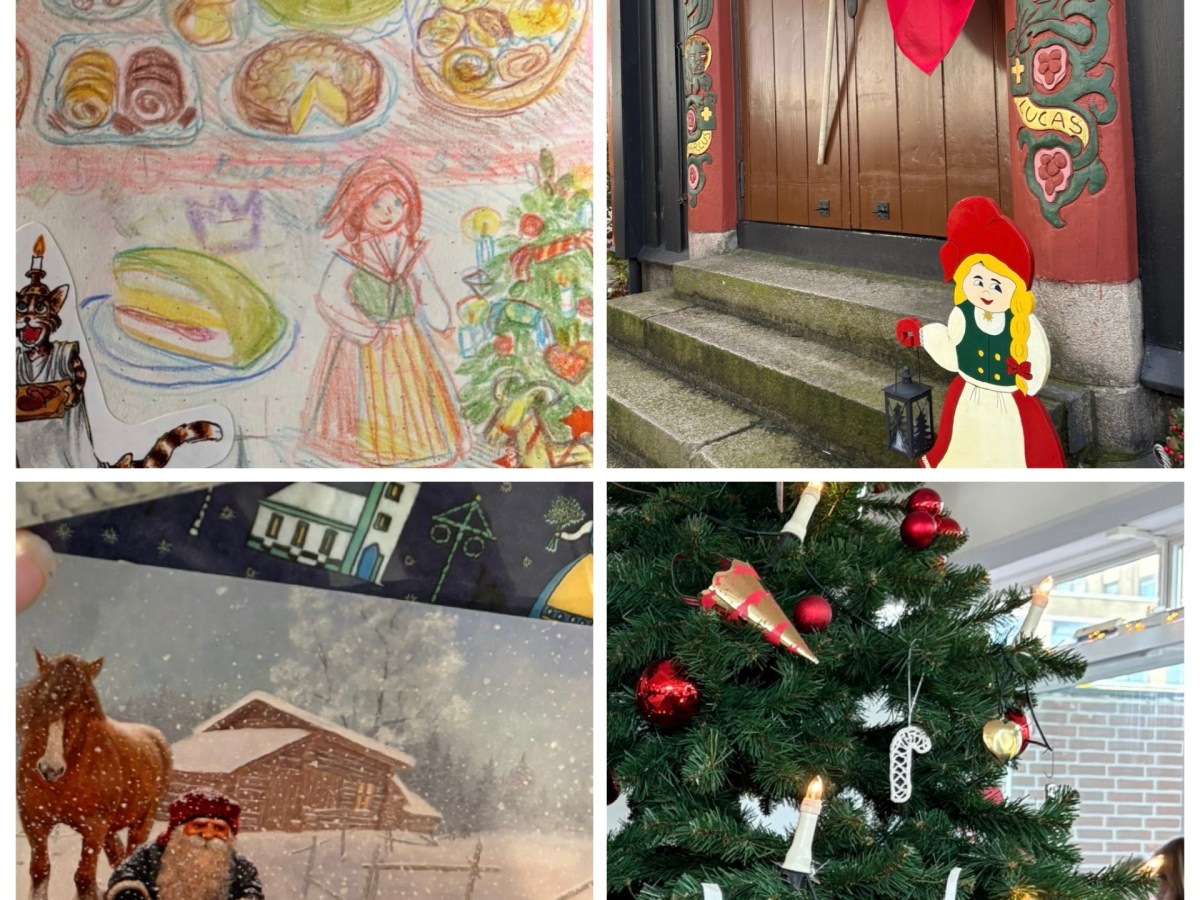
Norwegian, Danish, Finnish and Swedish Christmas markets in Rotterdam. Christmas decorations, imported typical Nordic products for sale, a cafe with lunch and cakes in each of them!
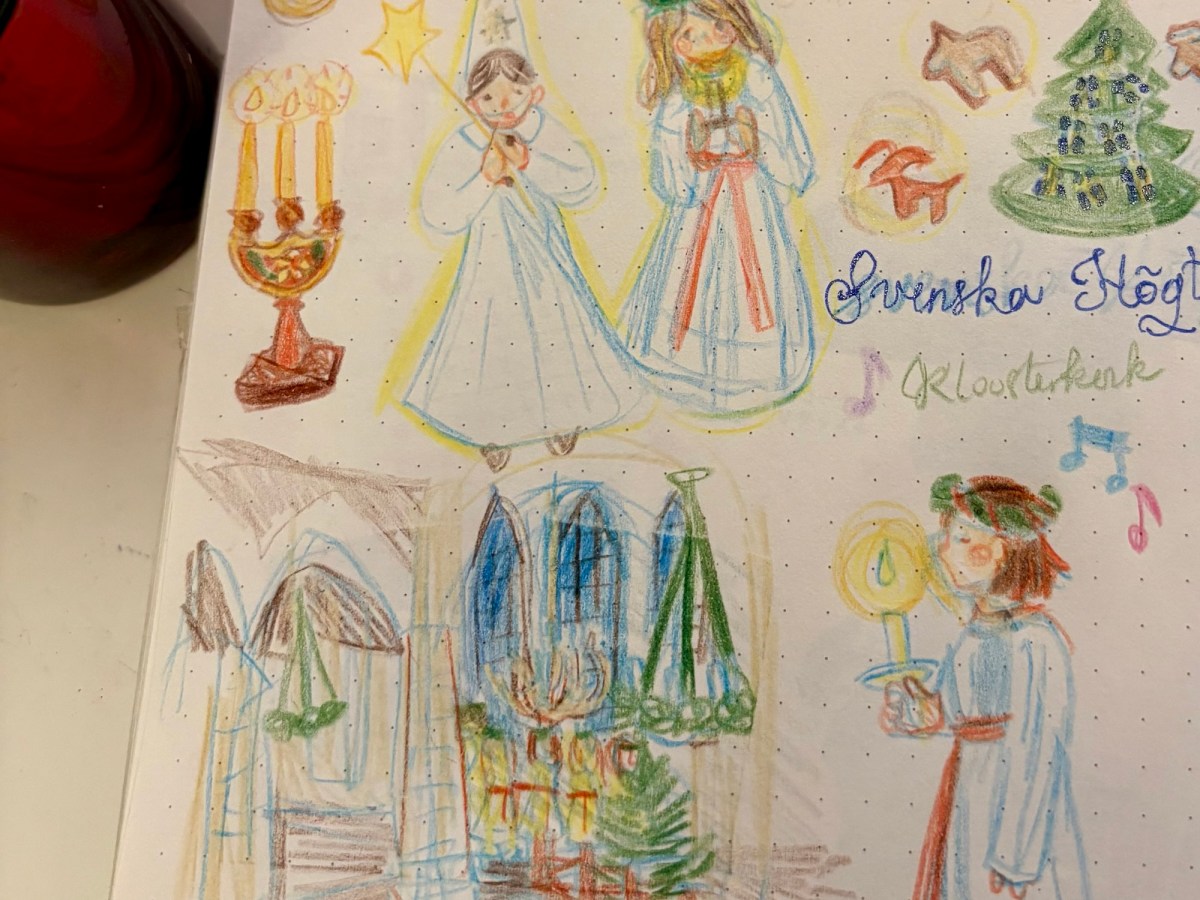
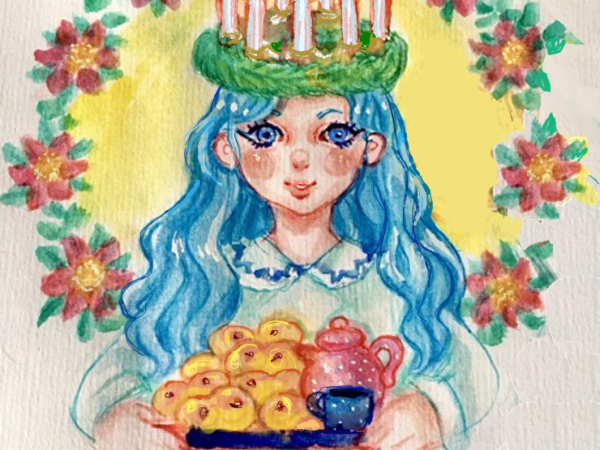
Lucia brings light in the darkest night of the year and is a mix of pagan and christian traditions. It is celebrated in Scandinavia with processions, saffron buns and church concerts.
What I’ve learned through my language learning journey trying to master many Germanic languages, from German to Faroese through Dutch and Swedish among others.
This article is derived from my Instagram post on my language learning profile inspired by @haluska.langs with her slavic version. I had also made a post about learning multiple similar languages in the past!
I speak to different degrees most of the main Germanic languages, including being familiar with a few lesser known ones as West-Frisian and Faroese.
I gradually added more and more of them through the years, starting from English and then German at school, then self studying more since I was about to finish high school.
As English was heavily influenced by French and uses many words with latin roots, besides the fact that it just feels like a given-for-granted language everybody speaks, it sometimes feels weird to include it in the Germanic languages family, but it indeed helped understanding for example to instantly recognize är in Swedish as the verb are, and the fact that verbs have att – in the infinitive form makes sense as English has to –.
However, When i started Swedish and Dutch simultaneosly in the now distant April 2017, it was German that made a lot of things easier than it would have perhaps been without it.
MY JOURNEY
I started English in primary school, and was always quite excited about learning it, wishing to have more hours for it every year.
My second Germanic language arrived much later, I choose German over Spanish in high school, but it had been fascinating me for many years, trying to learn random words of it here and there, I did learn the first word on cornflake boxes: Zutaten (“ingredients”).
During my last year of high school, after 5 years of English, French and German, I started self-learning Swedish and Dutch simultaneosly, using exclusively Duolingo for months. I theorically dowloaded duolingo for Swedish, but I loved Dutch too so i immediately started the course and used duolingo basically every day for a good year. I had a strong knowledge of German to begin with, it heavily helped me and made a lot of grammar and vocabulary instantly clear/recognizable, but also meant having interferences (see below), for example it ruled the verb order making me place verbs where it made no sense in Swedish nor English nor my mother tongue…
Two years later I wanted to learn some Danish and Norwegian: exposure, writing “adjusting” my Swedish with the help of online translators, but the effort to learn grammar and vocabulary was 70% done. learning Danish and Norwegian together without knowing Swedish would have been bad, you wouldn’t know when you are learning one or the other, but with a good Swedish knowledge and some exposure for both it’s manageable. Needless to say, focusing on one will make you better at it than splitting time/energies for both.
During the first corona lockdown in spring 2020, I started learning Icelandic with textbooks and online resources. I had actually read about pronunciation in a mountain hut in summer 2018, but didn’t understand much or took the time to process it at haha.
In the last few years I’ve been also getting some exposure to Faroese and West Frisian (which i can understand to a given extent thanks to other languages as Dutch and Icelandic) and casually learning them.
MIXING THEM UP
When learning multiple related languages, it is easy to end up mixing them up in one way or another. The more fluent you are in one, the less it is likely that you let yourself get influenced by another, this is way reaching a good level in onee language before learning another one in the same family is important. Moreover, you will be very familiar with much of its grammar and vocabulary, and you might rely way too much on your first language of that family. Using Spanish words when speaking Italian might not be the best, but you’ll be much better off than only knowing more distant related languages locals hardly speak.
There are a lot of false friends and words which would “fit” in the other language used without even realizing it. Some examples are short words existing in multiple languages but with different usage/meaning:
en means “and” in Dutch, “a(n)” in Scandinavian languages, and “but” in Icelandic!
ommeans “about” something in Scandinavian languages, while it’s usually “(in order) to” in Dutch
A false friend example is Icelandic að kenna meaning teach; while kennen/känna/kjenne/kende all mean “know (usually someone)”!
a funny fact about interferences is that I once used mensen talking in Swedish, “people” in Dutch, but “the menstruation” in Swedish!
Verb order is very vulnerable to interferences when learning multiple Germanic languages, at least at first: with subordinate clauses in German you have “..that I something done have“, in Dutch “..that I something have done“, in North Germanic languages ” ..that I have done something” as it is in English.
At first I would instantly use the German verb order with Swedish (for no apparent reason since the order in Swedish is supposed to be the most natural for me..), that doesn’t happen anymore, however, I still mess up it with Dutch and German since they only have the very last part switched! I hate it, but that’s what you pay for speaking both I guess…
To avoid interferences one of the most useful things is getting corrected or being aware of them, detecting the mistake is the first step to stop making it.
BONUS POINTS
Easy to learn vocabulary
Knowing languages related to each other can cause interferences but can also come very handy at times! Besides all words sharing a common root, You will understand and easily remember cognates and words which are everyday vocabulary in one language and seldom used ones in another one.
In Danish jeg spiser is “I eat”, you might easily remember this word as Speisekarte means “menu” in German. In the closely related Swedish you say “jag äter”, which however resembles eat, eten etc.
Despite my Swedish being more advanced, Danish and Norwegian helped me with understanding right away obsolete words in Swedish while reading an old book: Danish pige and Norwegian jente are the word for “girl”, while piga/jänta are “maid” in Swedish, not a word you’d learn in an everyday context.
Easy to guess the gender
Germanic languages, except for English, have different genders, whether masculine, feminine, neuter as German, Icelandic, and partially Norwegian, or general + neutral as Swedish, Danish and Dutch*. Being from the same family in many cases genders are usually the same for words with the same root:
House is neutral: das Haus/het huis/ett hus/husið;
Earth is feminine, sky is masculine: die Erde, der Himmel (German) /jörðin, himinn (Icelandic) /jorda, himmelen (Norwegian)
The closer the language the safest the bet: Dutch and German are more likely to have words with the same gender than them and North Germanic languages: book is neutral in West Germanic languages but feminine/general in North Germanic – het boek, das Buch (n) / boka, bókin (f).
*Neutral exists in all but English, while In Dutch, Swedish and Danish masculine & feminine merged. However, they are sometimes still visible, for example in pronouns for objects: hij/zij as he/she in Dutch (knowing German can give you great advantage compared to natives!); to tell the time in Swedish you say “hon är..” (she is..) because klocka (clock) was feminine! Norwegian does have feminine, even though in some Norwegian dialects feminine (book: ei bok, boka) and masculine are not distinct and general en is used (having en bok, boken which would be masculine).
Easy to learn Irregular verbs
All Germanic languages have irregular verbs, which mean learning lists of paradigms present-past perfect-past participle. Once you have learned them for one, it’s all downhill to learn the others, as not only you already know how the verb system works but many are very similar across different languages (and the set of verbs being irregular is more or less the same), or follow similar patterns:
Don’t learn more than 2 similar languages at once, if very similar and from scratch keep that at one. You might be dying for the other for a while, but the path will be downhill and you’ll be less confused.
I learned Norwegian and Danish more or less simultaneously but it wad 95% just exposure, as I already spoke Swedish. That means I knew well what I was dealing with and most importantly I didn’t have to learn a grammar system from zero, but mostly only how to adapt it to Danish and Norwegian, same for how spelling behaves in both. The proficiency you acquire then depends on how much time you spend on each. My Danish is better and I don’t have to check words as much as in Norwegian because I happened to use Danish more because of friends and such, but I used to write letters in Danish/Norwegian and basically check every other word on google, while the grammar structure was as good as done with some exposure on top of speaking Swedish.
Getting a little exposure is always fine, you will just get to know the other languages a bit more, preparing yourself for a more serious approach when you are ready. With some effort you’ll then split from the “rely on X language” phase and speak it independently.
Dutch and German are maybe almost as similar as Scandinavian languages to each other, but not as much, and if you learned Dutch first you’ll have to deal with cases and an additional gender, not quite the same as just adapting it and only learning from immersion.
Nevertheless, give love to all your target languages through frequent immersion, scheduling study sessions for those which require help.
A little fact in conclusion: in Germanic languages “moon” is masculine and “sun” is feminine, while in romance languages it is the opposite! I can see why if you look at the weather and daytime in North vs South Europe 🙂
You’d expect 50, 60, etc. till 90 to be fem-, seks-something, as it is in Swedish, Norwegian and Icelandic (femtio, sextio; femti, seksti; fimmtíu sextíu…); but Danes use another… method, based on a vigesimal system: a numeral system based on twenty, making them harder to remember for Danish learners. You can’t guess what halvfems is without having learned it first, I suppose.
How I remember Danish numbers
Let’s start by remembering the easier ones, that is to say the ones that are just called “x times 20”
3 x 20 = 60: tres (three times twenty)
4 x 20 = 80: firs (four times twenty)
to remember them, I just think of half of the target number: 60 is 30×2 and 80 is 40×2 so the number will sound like 3(s), 4(s)
50, 70 and 90 are however not perfectly divided by 20, and start with halv. It might help you to think that each halv-is smaller than the similar version without halv by 10:
60 is tres, and 50 is halvtreds is 50
80 is firs, and 70 ishalvfjerds
90 is before 100, which is 50x2, so 90 is halvfems
In addition to all this, remember that from 20 units go before tens, just like in German and Dutch, separated by og (“and”), so 21 is enogtyve
The fractional system used in these numbers names is as follow: first half is ½ [0.5], second half is 1½ [1.5], third half is 2½ [2.5] (halvtreds=50), and so on as follows:
50 is halvtreds, which stands for halvtredje-sinds-tyve, meaning “third half times twenty”, or “two scores plus half of the third score” [2½ * 20].
60 is tres, short for tre-sinds-tyve, which means “three times twenty” [3*20].
70, halvfjerds, is short for halvfjerd-sinds-tyve, meaning “fourth half times twenty”, or “three scores plus half of the fourth score” [3½ * 20].
80 is firs, which long form firsindstyve, or fire-sind-styve, meaning “four times twenty” [4*20].
90, halvfems, short for halvfemsindstyve or halv-fem-sinds-tyve, means “fifth half times twenty”, or “four scores plus half of the fifth score” [4½ * 20].
Don’t ask me how this makes sense because I have no idea, I barely survived maths in school.
Ordinals
The vigesimal form leads to very long expressions of the numbers, which have been shortened phonetically, dropping -sindstyve (“times twenty”). Ordinal numbers may however still include that ending: 52 is usually rendered as tooghalvtreds (from the now obsolete tooghalvtredsindstyve), whereas 52nd is either tooghalvtredsende or tooghalvtredsindstyvende.
Even the Danes don’t know what they are doing
If you feel bad about not getting this whole thing, be aware that few Danish people know what the numbers actually mean, they just deal with those words all the time.
In addition, the decimal style is also commonly used in banking and when relating to other Scandinavian people. The numbers from 20 to 90 are: toti (literally “two tens”), treti, firti, femti, seksti, syvti, otti, niti.
Was this any helpful? Let me know 🙂 Held og Lykke! (good luck)
Main features in grammar, vocabulary, pronunciation and my experience with studying Íslenska (Icelandic) and Suomi (Finnish)
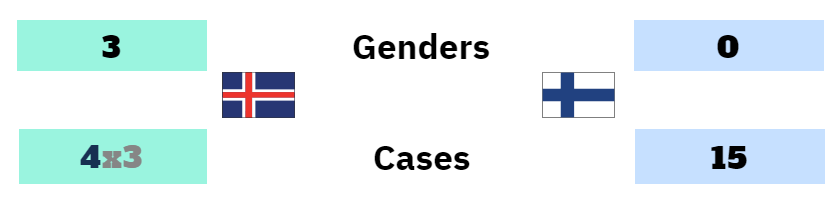
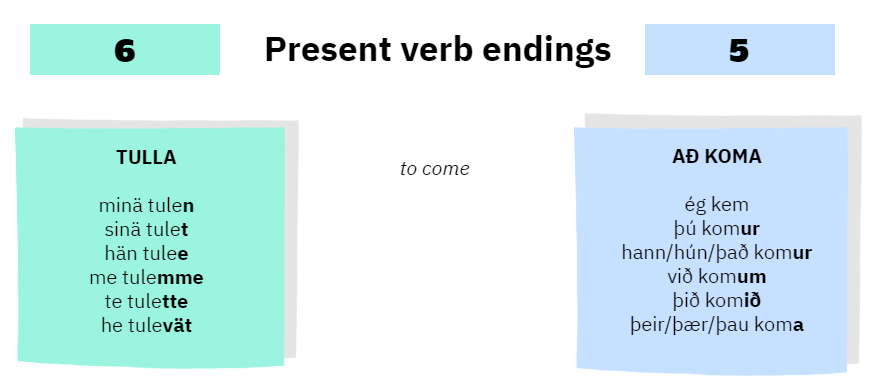
Some time ago I made an Instagram post comparing these two languages, which I started simultaneously during the hard lockdown in spring 2020 (you can see it on @chiara.klara.claire, as a summary of this article). With this article I’ll dig in deeper and talk about more aspects.
A short overview of Icelandic and Finnish main characteristics:
Icelandic belongs to North Germanic languages, as Swedish, Norwegian and Danish and Faroese, the closest of all to it (learn how totell them all apart) . It is still very close to what Old Norse was and retained a highly inflected grammar and ð/þ.
Finnish is an Uralic language, sister language of Estonian and related to Sámi languages but completely unrelated to its Scandinavian Neighbors. Its grammar is as complex as Icelandic but as an agglutinative language, lacking however genders.
In a language difficulty ranking 1-5 with 5 being the hardest, Icelandic was category 4 and Finnish between 4 and 5.
You can find useful language resources at the end of this article!
Alphabets & ortography
Icelandic Ðð (eth) is as “th” in the, Þþ (thorn) as in think. the former is also present in Faroese, its closest language
a, á, e, é, i, í, o, ó, u, ú, y, ý, æ, ö are all the vowels, each is a distinct letter of the Icelandic alphabet
c, q, w are not present in Icelandic. Z was removed in 1973 and replaced with S in words which had it. It is still present in some historic names as the Verzló school in Reykjavík.
Finnish actually uses only 21 of the 29 letters in its alphabet, which derives from Swedish: b, c, f, g, q, w, x, z, å are not present in native Finnish words. For example, the Swedish name of Turku, city with a significant number of Swedish speakers, is Åbo.
Finnish is the only language in which the frequency of vowels exceeds that of consonants, and both are often doubled: suosittelette. vaapukka, terveellistä, laatikko, karjalanpiirakka. With its relatively small inventory of letters being often doubled, many words change meaning with one letter: muta “mud”, mutta “but”, muuta “other”, muuttaa “to move”
Both languages use a lot of long compound words (common in most Germanic languages) as a way to construct new words. Those long stretches of letters might look obscure, but if you break them into smaller words they are quite normal: Icelandic volcano Eyjafjallajökull is just “island-mountain glacier”. An example in Finnish could be lumipallosotatantere = “snowball fight field”, English would be no different if it removed spaces after all!
Grammar
This is what Finnish and Icelanidc are most (in)famous for, both have an arguably complicated grammar, but more or less hard depending on the aspects.
In Icelandic and Finnish words change depending on their role in a sentence, with the so-called cases. Although to a much smaller extent cases existin English too, in personal pronouns: she becomes her when it’s an object. In the following table you can see how cases change words in these two languages:
(a) beatiful country
in (a) beautiful country
to (a) beautiful country
from (a) beautiful country
Icelandic
fallegt land
í fallegu landi
til fallegs lands
frá fallegu landi
Finnish
kaunis maa
kauniissa maassa
kauniiseen maan
kaunista maasta
Icelandic has 4 cases: nominative, accusative, dative, genitive (nefnifall, þolfall, þágufall, eignarfall) – familiar if you know German or Latin – in which nouns, pronouns and adjectives are declined differently depending on gender: (masculine, feminine, neuter), with weak or strong nouns, and number. Icelandic has no articles but it does have definite forms, which as in Scandinavian languages is marked in the end of the nouns: maður= (a) man, maðurinn= the man). More detailed info here
function
M*
pl.
F*
pl. *
N*
pl. *
nom.
subject
-i; -ur, ll..
-ar
-a; –
-ur; -ir
-a; –
-u; –
acc.
object
-a; -, -l..f
-a
-u; –
-ur; -ir
-a; –
-u; –
dat.
indirect object
-a; -um, -i
-um
-u; –
-um
-a; -i
-um
gen.
possession
-a; -s
-a
-u; -ar
-a
-a; -s
-a
definite form noun declension: *weak; strong.
Finnish uses many suffixes instead of prepositions, with a total of 15 cases, in which nouns, pronouns, adjectives, numerals are declined. The good news is that Finnish has no genders nor articles: even the personal pronoun hän means both he and she.
Verbs are divided in both languages into groups, 3 in Icelandic and 6 in Finnish, depending on which conjugations slightly change, but are not (in my opinion) much harder than in Romance languages as Italian and French. They have different endings for each person, and the infinitive form is sometimes not immediately recognisable knowing a conjugated form.
Vocabulary
As you might have already figured out, Icelandic is more accessible with knowledge of (North) Germanic languages, while Finnish will look completely unfamiliar unless you speak an Uralic language:
Icelandic
Scandinavian (se/dk/no)
German
Dutch
Finnish
apple
epli
äpple/æble/eple
Apfel
appel
omena
book
bók
bok
Buch
boek
kirja
hair
hár
hår
Haar
haar
hiukset
house
hús
hus
Haus
huis
talo
mother
móðir
mor
Mutter
moeder
äiti
night
nótt/nátt
natt
Nacht
nacht
yö
stone
steinn
sten
Stein
steen
kivi
that
það
det
das
dat
se
word
orð
ord
Wort
woord
sana
However, due to its history under Swedish rule -other than having the Scandinavian country as neighbour- Finnish adopted many loanwords from and through Swedish, adapting them to its spelling and pronounciation:
katu – gata (street)
koulu – skola (school)
sokeri – soker (sugar)
tuoli – stol (chair)
suklaa – choklad (chocolate)
pankki – bank
kahvi – kaffe (coffee)
During the 19th century, Icelandic started avoiding borrowing neologisms found in most European languages with its Linguistic purism policy, creating new vocabulary with Old Norse roots for new concepts: Theatre is Leikhús, “acting house”; AIDS is alnæmi, from al “all/complete” and næmi “sensitive”, which is what the disease really is about.
Finnish also has a good number of neologisms with native words when most European languages use a common Latin/Greek or English form:
Icelandic
Finnish
grammar
málfræði “language science”
kielioppi “language study”
electricity
rafmagn “amber power” calquing the Greek root
sähkö based on sähähtää “to sizzle (briefly)” + säkenöidä “to sparkle”
phone
sími originally “cord”
puhelin “I chatter”
computer
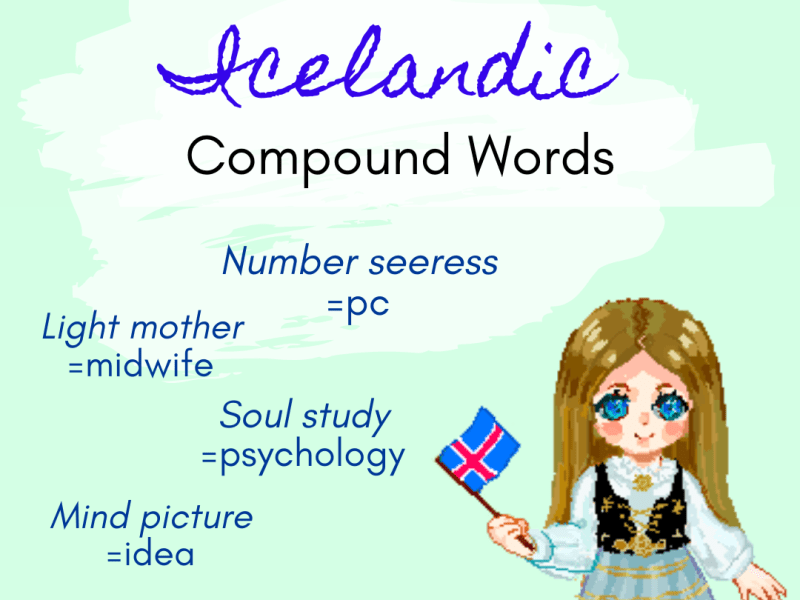
tölva (computer)=tala+völva “number seeress”
tietokone “knowledge/data machine”
film
kvikmynd “alive/moving picture”
elokuva “life picture”
As mentioned before Finnish did anyway adopt many words common in European languages, while Icelandic has words of its own, probably also thanks to its geographical isolation:
Icelandic
Scandinavian
Finnish
idea
hugmynd “mind picture”
idé
idea
comet
halastjarna “tail star”
komet
komeetta
psychology
sálfræði “soul study”
psykologi
psykologia
history
sagnfræði
historia/historie
historia
philosophy
heimspeki
filosofi
filosofia
bus
strætó
buss
bussi
helicopter
þyrla
helikopter
helikopteri
president
forseti
president/præsident
presidentti
normal
eðlilegt
normal
normaali
immune
ónæmur
immun
immuuni
alcohol
áfengi
alkohol
alkoholi
notice how Finnish often adds -i!
Pronunciation
Icelandic: Although not as inconsistent as English, in Icelandic different positions in the words or letter combinations make the same consonants sound differently, with many variations which at least for me took long to grasp and I am often in doubt about the pronounciation of Icelandic words. Here is a list of tricky features from wikibooks
HV is pronounced as KV, (or as Scots WH in some areas)
LL is often pronounced something liketl.MM and NN as pmand tn.
KK, PP, and TT are pronounced with an h sound to their left. Pre-aspirated tt is analogous etymologically and phonetically to German and Dutch cht (Night-Icelandic nótt, German/Dutch Nacht.
If a K is followed by a t, it is pronounced similarly to a Spanish j (e.g. lukt – lantern). Likewise, a P followed by a t changes into an f sound (e.g. Að skipta – to shift). F in the middle of a word is often pronounced as a v (e.g. Að skafa – to shave), FF is pronounced as English F.
Word-final voiced consonants are devoiced pre-pausally, so that dag (‘day (acc.)’) is pronounced as [ˈta:x] and dagur (‘day (nom.)’) is pronounced [ˈta:ɣʏr̥
I and Y share the same pronunciation, as do Í and Ý.
Finnish: Extremely consistent and read just like it is written: Each grapheme (independent letter), represents almost exactly one phoneme (sound).
Double consonants can be challenging for English speakers among others, and failing to pronounce them correctly can result in confusion with other words.
Some vowel combinations can be tricky for your tongue: yö,pyöreä (with y pronounced as ü in German).
With little exposure I was confident in pronouncing Finnish, while Icelandic requires much more effort & time, this might be influenced by the fact that Italian phonology is more similar to Finnish, and double consonants are not problematic to me as an Italian native speaker.
Language variations
Icelandic has very small dialect variations, presumably due to its strong writing culture throughout history. However, some local pronunciation variants exist.
Finnish has dialects divided into two distinct groups, Western and Eastern.Finnish dialects are largely mutually intelligible and operate on the same phonology and grammar, not going too far from standard Finnish. What Finnish is mostly known for is however the distinction between the two registers: the formal, written form Kirjakieli “book language” and Puhekieli “spoken language”. The former is used in written texts and formal situations like political speeches and newscasts, the latter is the main variety of Finnish used in everyday speech, popular TV, radio shows and at workplaces. In Puhekieli words are often shortened: minä olen “I am” becomes mä oon, anteeksi “excuse me” drops the last i and so on.
Conclusions
Both languages can be pretty challenging, with a significant amount of grammar one can hardly just absorb by practicing as in my experience it was with languages as Dutch and Swedish. What I do think is that practicing and paying attention to certain features can be more helpful than only focusing on repeating declensions without context, and I try to mix both. That being said, Icelandic and Finnish are my “slow” languages with Japanese, and at the moment I’m trying to proceed with textbooks once a month, trying to practice with little things as apps and learning/translating things I see here and there on social media.
I personally find Finnish a bit easier per se, since it has no arbitrary gender and different declensions connected to it, a rather easy pronounciation and so on. However, since I speak Germanic languages, I study (& understand!) Icelandic with much more ease and find myself more easily lost in Finnish, for now at least.
Have you tried studying these languages? If both, which one did you think was harder?
p.s. Perse means “ass” in Finnish and Estonian so maybe don’t say per se too often when talking to Finns.
Learning resources
You find many free, online resources for Finnish and Icelandic on my Language Resources page, other than all for mant other languages.
Sources
Sanders, Ruth H. The languages of Scandinavia (2017) The University of Chicago Press, p. 99-100: Finnish sound structure
The ‘anchor’ language concept allowed me to learn Swedish, Dutch, Danish, Norwegian easily starting from studying properly only one language. This approach helps prevent confusion and builds a solid foundational understanding of language structures.
The languages of the Sámi, indigenous people of Scandinavia
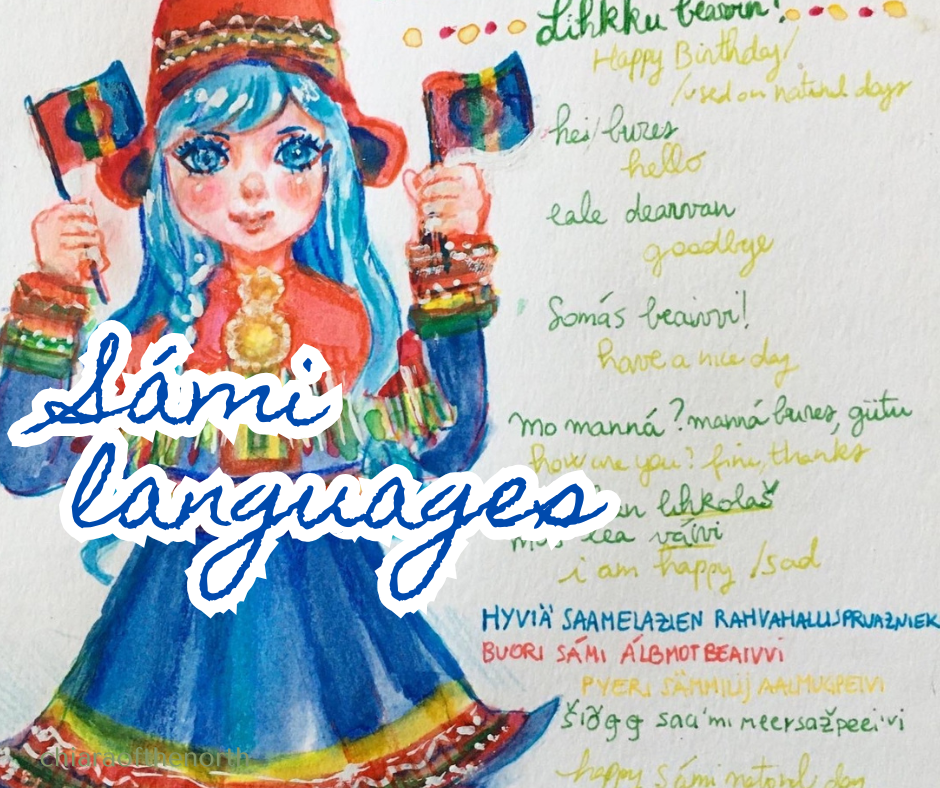
The Sámi people (Sámit/Sápmelaš in sami languages) are Northern Scandinavia’s indigenous people. I have talked about Sámi people and their National Day last year. This year I will focus on their languages.
Sámi languages speakers are approximately 30,000-40,000, out of around 100,000 people identifying as Sámi.
Sámi languages belong to the Uralic language family and are most closely related to the Baltic-Finnic languages (as Estonian, Finnish, and Karelian).
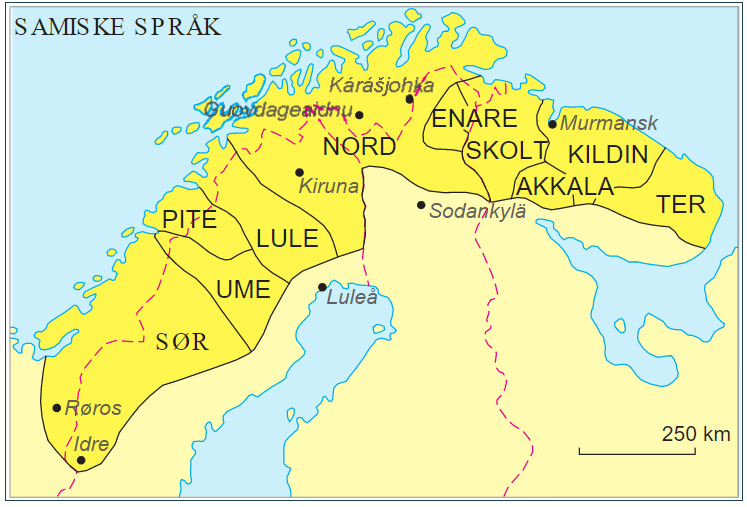
There are 10 distinct variations (of which 6 have standard written forms). They are not mutually intelligible to each other, although there is intelligibility among neighbor variants, which makes the Sámi languages a dialect continuum. According to the Store Norske Leksikon South and North Sami are as far as Norwegian and Icelandic.
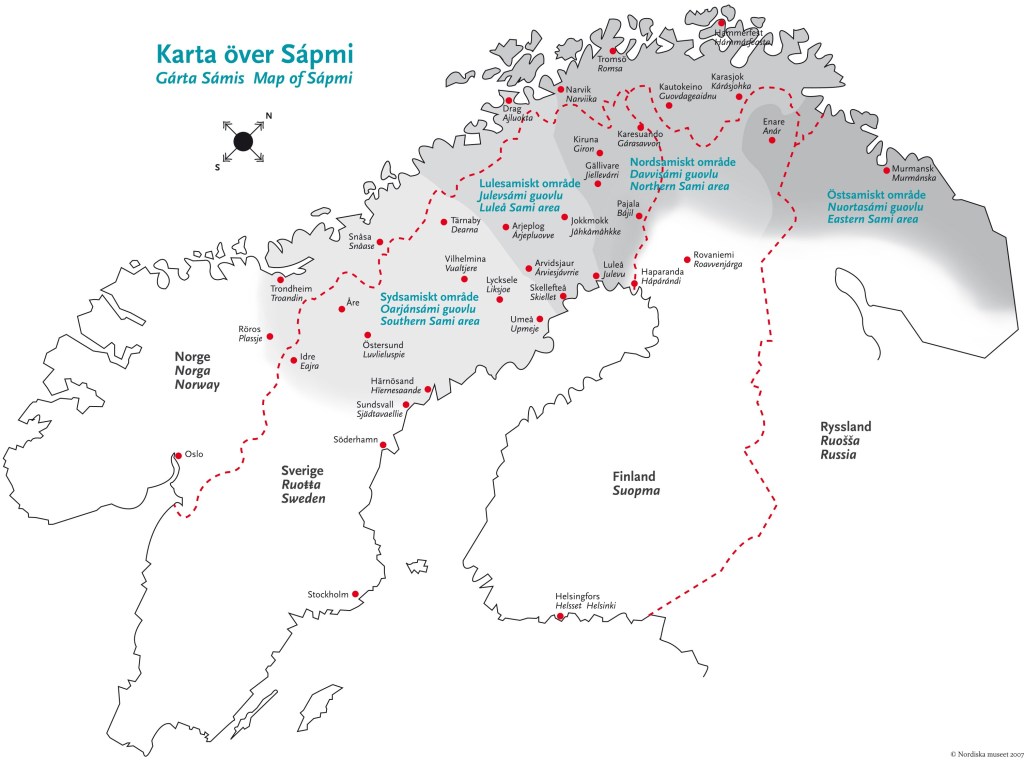
Sámi language areas, picture from Store norske leksikon.
They can be divided into Eastern and Western language groups:
Western Sámi languages
North-Davvisámegiella: 15,000 speakers in Norway, Sweden, Finland, about 75% of all Sámi native speakers
Lule–Julevsámegiella: 2000 speakers in Norway and Sweden
South-Åarjelsaemien gïele: 500 speakers in Norway and Sweden
Pite–Bidumsámegiella: 20 speakers in Sweden
Ume–Ubmejensámien giella: 20 speakers in Sweden
Eastern Sámi languages
Inari-Anarâškielâ: 400 speakers in Finland
Skolt-Sää’mǩiõll/nuõrttsää’m: 400 speakers in Finland and Russia
Kildin–кӣллт са̄мь кӣлл: about 787 speakers in the Kola peninsula of Russia
Ter-Saa’mekiill: fewer than 10 speakers in Russia
Akkala-Ákkil sámegiella: considered extinct. Not standardized, but translations of the New Testament into it in 1755 and the bible in 1811 were major influences in the written language.
Sámi language features
Note: what follows refers mainly to North Sámi
like Finnish Sámi languages are agglutinative and highly inflected, nouns and adjectives change form according to their grammatical roles. Northern Sámi has 7 noun cases.
Sámi verbs have dual forms: other than three singular and plural persons the verb conjugations can indicate an action by two people (plural is more than two).
Sámi originally had no words beginning with two or more consonants (unlike in English: green, strong, bridge..): Spasibo (спасибо) became pass’bo in Kildin Sámi. Word-initial clusters were however taken into Sámi through Scandinavian lownwoards: Kraevies (gray) from protonorse *grawaR, grár in Protonorse, modern Scandinavian grå.
Sámi languages have a kind of vowel harmony, which for example makes the given name Knut become Knavhta, adding a third vowel.
Scandinavian varieties of Sámi languages use the Latin alphabets, with additional characters: The unique letter “Ŧ/ŧ”, similar to English th in “thin” and Thorn þ still used in Icelandic. “Đ/đ” is equivalent to Icelandic ð. Other letters occurring in Sámi languages are Áá Čč Ŋŋ Šš Žž.
Language Comparison
Similar words North Sámi – Finnish – Estonian
Nature: luondu – luonto – loodus
Forest: meahcci – metsä – mets
Shaman/witch: noaidi – noita – nõid
Brother: viellja – veli – vend
Day: beivi – päivä – päev
life: eallin – elämä – elu
love: ráhkisvuohta – rakkaus – armastus
mother: eadni – äiti – ema
Reindeer:boazu – poro – põhjapõdrad
As you might notice, historically related words in Finnish with p, t, k have b, d, g in Sámi.
N =North; L=Lule; S=South; U=Ume; P=Pite; I=Inari; SK=Skolt
All the Sámi languages are considered endangered, this is due in part to historic laws prohibiting the use of Sámi languages in schools and at home in Sweden and Norway. Sámi languages were illegal in Norway from 1773 until 1958. Special residential schools that would assimilate the Sámi into the dominant culture were established, and access to Sámi instruction as part of schooling was not available until 1988.
Samer.se underlines that in the 60s and 70s many Sámi parents did not speak Sámi to their children. This was a reaction to the negative experiences and the discrimination faced in Swedish schools, which however resulted in depriving children of their mother tongue, and many suffered from that as adults.
In the last decades of the past century this attitude started to change, granting the rights to have education in Sámi languages and esthablishing funds for the promotion of Sámi culture and languages.
In Norway Sámi languages have official status in 9 municipalities in the counties of Finnmark and Troms.
Since 2002 Sámi languages have been recognised as minority languages in Sweden and have official status in 4 municipalities. In these areas they can be used in government agencies, courts, pre-schools and nursing homes.
North Sami, Skolt Sami and Inari Saami are offically recognised in Finland and have official status in 4 municipalities, Sámi people have the right to use Sámi languages for all government services.
In Russia Sámi people are recognised as an indigenous people but their languages have no official status.
Municipalities where Saami is an official language, picture from Nordiskamuseet.se
Art and media in Sámi languages
The first two recorded Sámi poems are by Sámi priest and poet Olaus Sirma (1655-1719), included by Johannes Schefferus of Uppsala in his book Lapponia in 1673.
A boy’s will is the wind’s will, the thoughts of youth are long, long thoughts.
refrain ofMoarsi favrrot/The Beloved One, translated in “a Lapland song” by Henry Wadsworth Longfellow (1807-1882) and included in the long poem “My Lost Youth”
The oldest Sámi language newspaper is Nuorttanaste (Eastern Star), a religious paper began in 1898 and still published in Norway. The Sámi-Swedish bilingual Newspaper Samefolket began in 1918, and Sapmelas, founded in 1934 and renamed in in 1993 Odda Sapmelas (The New Sámi) is published in Finland.
The 1970s saw a blossoming of Sámi language literature that has continued to the present, with Sámi artists focusing their work on Sámi language and Sámi traditional themes. Prominent figures include Nils-Aslak Velkeapää (writer, singer, multimedia artist); Paulus Utsi (poet); Vuokko Arvonen (feminist writer); Nils Gaup (filmmaker); Mari Boine and Sofia Jannok (singers). In Norway, the yearly Riddu Riđđu festival in Olmmáivaggi/Manndalen features music, art, theater from Sápmi, including Sámi rap music, yoik rock and dramas from Beaivváš Sámi Našunálateáhter, the Sámi national theatre.
Swedish and Dutch languages compared: speakers, grammar, vocabulary, history
Both Swedish and Dutch belong to the Germanic language family: Dutch is a West Germanic language, as German and English; while Swedish is North Germanic, learn to tell it apart from all the other Nordic languages. They are therefore closely related, but of course not as close as Scandinavian languages to each other.
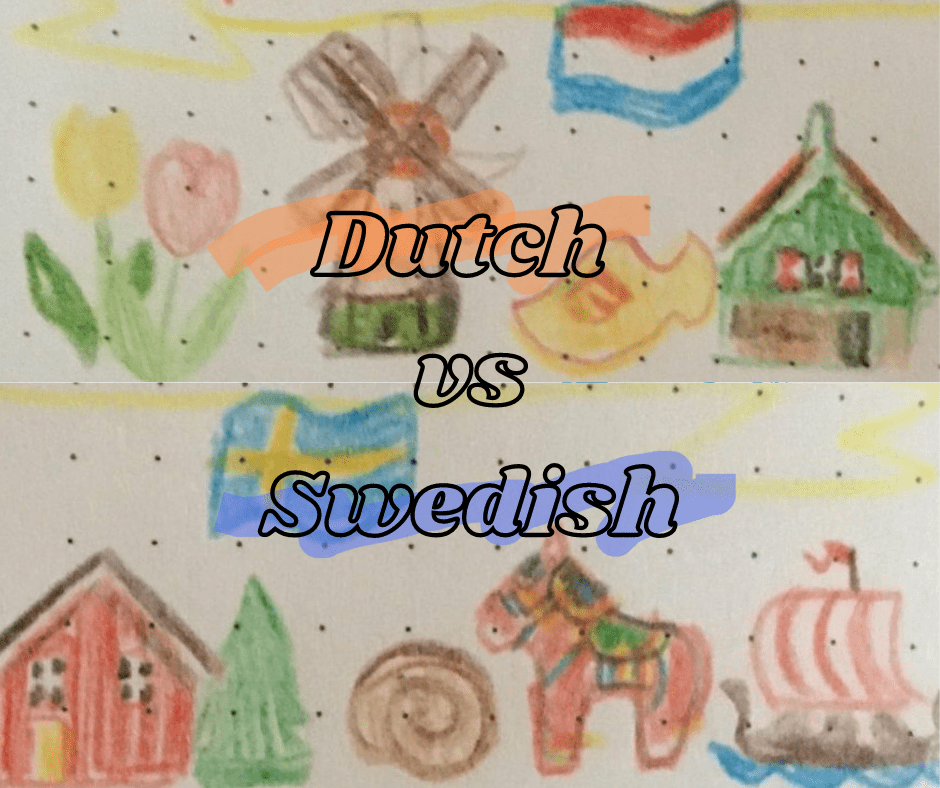
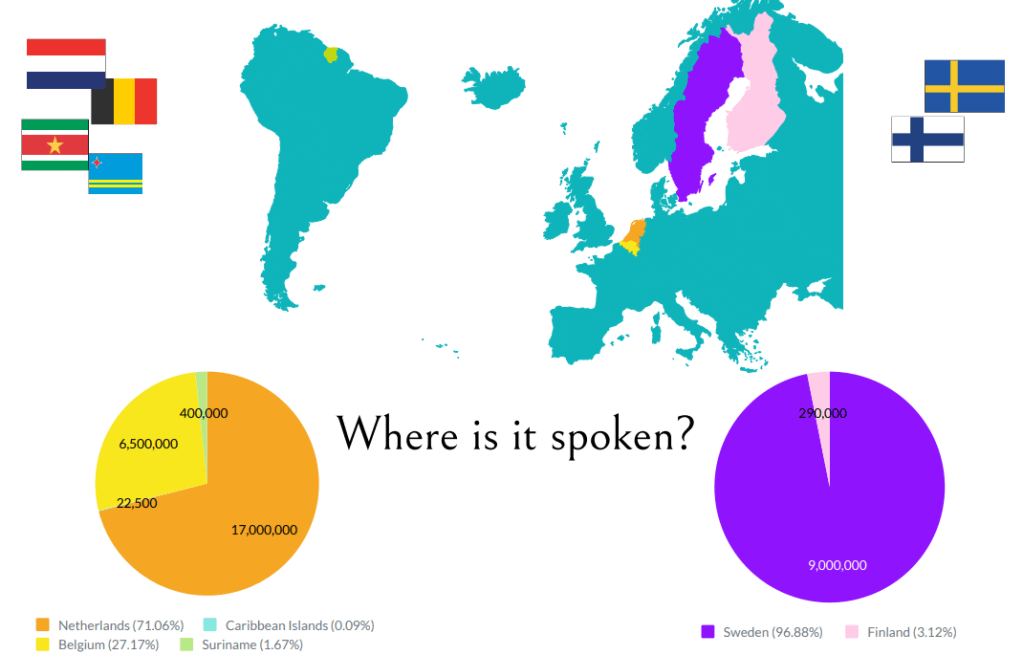
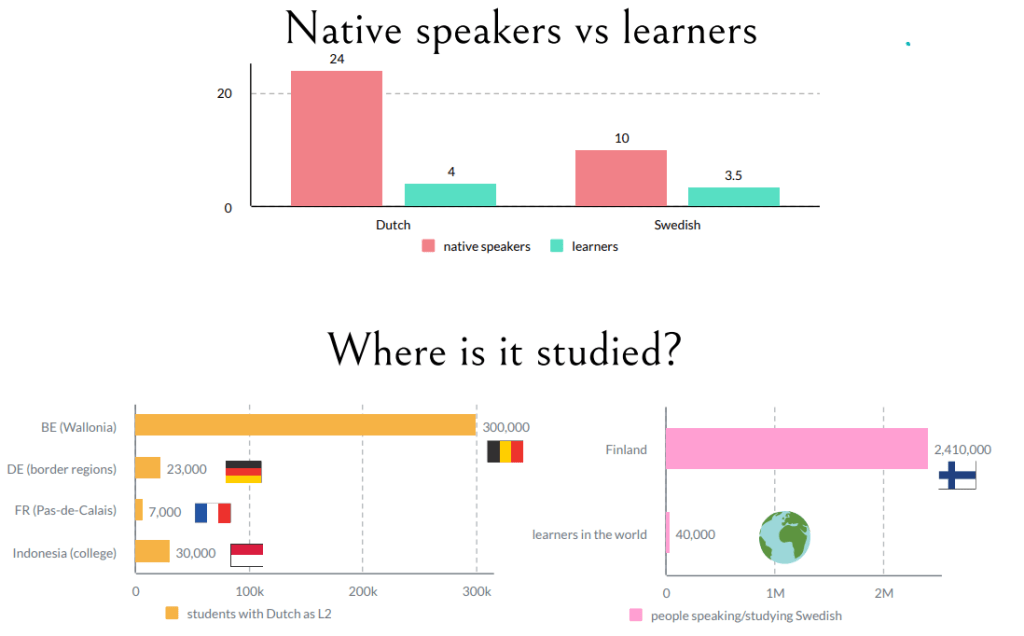
They are not well known languages worldwide and for this reason i decided to use them in a infographic comparison assignment! You can see it better here.
Countries and number of speakers
Dutch is mainly spoken in the Netherlands, with 17 millions of speakers.
In Belgium, it is spoken by 54% of the population, in Flanders. That makes up for 6,5 millions of speakers.
You might be surprised to see South America on the map, that’s because Dutch is also an official language in Suriname, a former colony, and on small Caribbean islands: Curaçao, Aruba, Sint Maarten, which are constituent countries of the Kingdom of the Netherlands.
It used to be spoken or is on the verge of extinction in the area around Duinkerk, northern France; and Indonesia.
Afrikaans is considered a daughter language of Dutch and is spoken by 17 million people in South Africa in Namibia, of which 7 millions speak it as their mother tongue.
Swedish is spoken in Sweden (9 million speakers) and by Swedish minorities in Finland, mostly concentrated in the south and west coastal regions and the autonomous Swedish-speaking archipelago Åland. Swedish Finns are around 290,000. 3 municipalities in mainland Finland have Swedish as the sole official language.
There used to be a Swedish-speaking minority in Estonia From the 13th to 20th century, particularly on the islands; but almost all Swedish Estonians fled to Sweden during World War II. Only around 300 of them remain.
In the early 18th century Estonia was ceded to the Russian Empire and around 1,000 Swedish Estonians were forced to move to Ukraine, to a village now called Gammalsvenskby, (“Old Swedish Village”). A few elderly people in the village still speak a Swedish dialect, most likely facing extinction.
Finding precise and correct data about the learners of these languages was quite hard, not considering people who self-study the language (I would fall under this category).
I tried to find data about students enrolled in language courses, finding numbers of those who study Dutch as a school subject: In Belgium, not surprising considering it is a national language, it is studied in Wallonia (French-speaking area) by about 300,000 people. Dutch can be found in German schools in areas sharing a border with the Netherlands: Niedersachsen, Nordrhein-Westfalen. A small portion of France in the very north of the country, Pas-de-Calais used to be Dutch-speaking, the language is still taught to some 20,000 pupils.
Unfortunately I couldn’t find data about Universities offering Dutch courses and the number of students over the world, but i thought it was relevant to add that in Indonesia around 30,000 students take Dutch courses in college. Because of its colonial past as part of the Dutch Indies, Dutch still plays a role in Indonesian history and its law, making it important for the students to have some knowledge of the language and its vocabulary in some fields.
Swedish is not really a school subject anywhere but in Finland, where it is a compulsory subject for everybody. This is because of the significant Swedish influence on Finland and the fact that Finland used to be part of the Swedish Empire. According to the sources I found, people reported to be able to speak Swedish are around 2 millions in Finland. I found that there are about 40,000 people being enrolled in Swedish language courses worldwide.
What are the languages like?
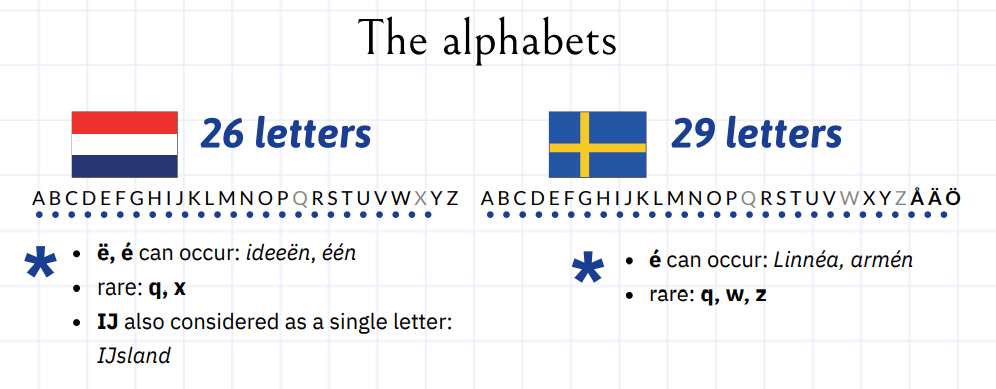
Swedish has three extra letters: Å, Ä, Ö, placed at the end of its alphabet, longer than the Dutch alphabet which includes 26 letters and not any more than in the English one. Despite this, Dutch does consider IJ as a single letter producing a single sound and you can find it written as Y in old texts and it still is in Afrikaans, Dutch daughter language. (Try writing I and J in italic and you’ll see they look like Y together!). I and J are written in capital letters when IJ is at the beginning of a word: IJsland is Iceland.
Both Dutch and Swedish alphabets include letters that are only used in foreign words: Q can be found in some Swedish surnames as -quist, written in a fancy way when latinising names was fashionable. W and Z appear only in foreign words in Swedish, but it is a very common letter in Dutch. X is not present in Dutch, and not much more in Swedish, but it is still found in a few words as exempel.
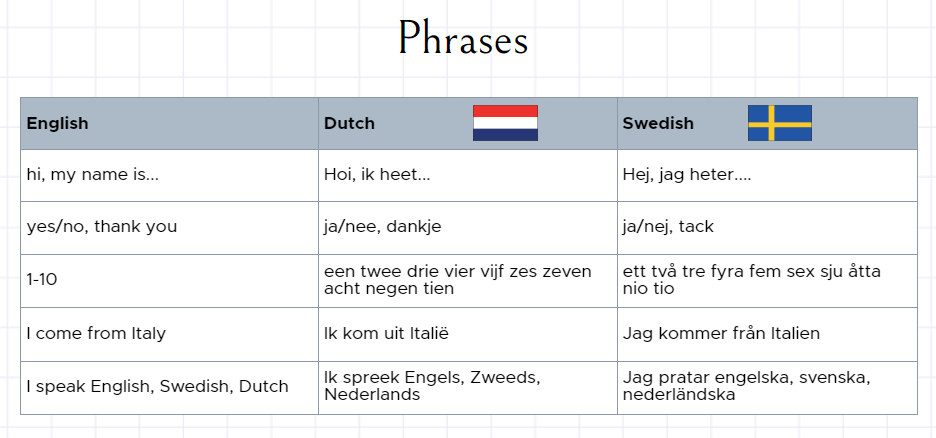
Since they both belong to the Germanic language family, Swedish and Dutch have many similarities in vocabulary, often shared with English as well. You can notice them in the table I made.
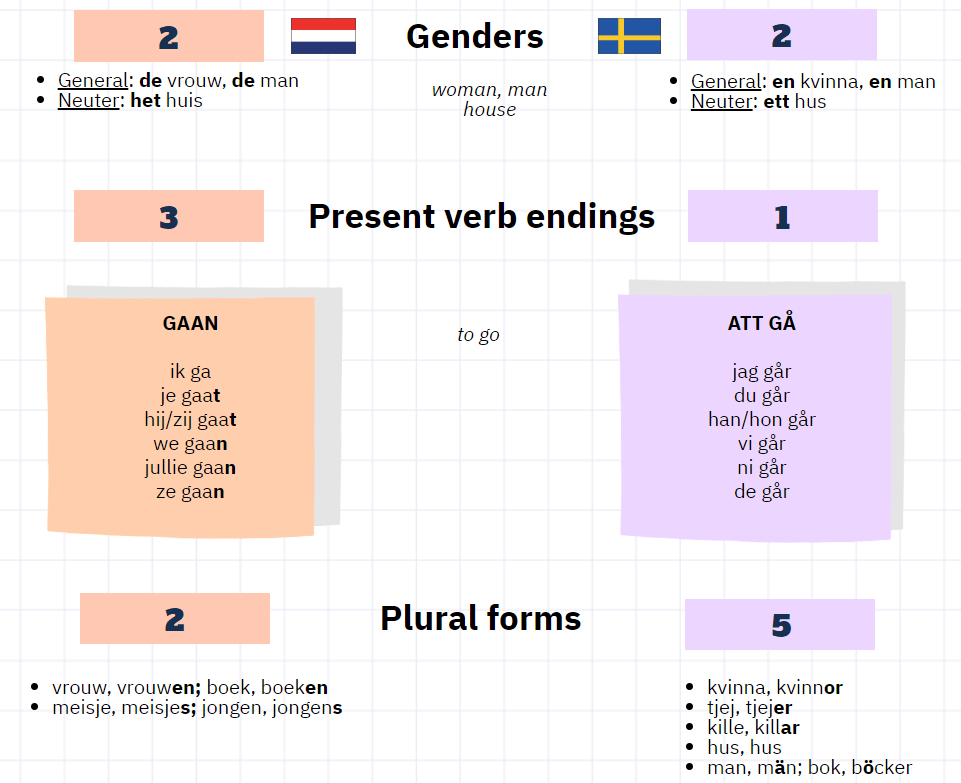
Both Swedish and Dutch have two genders: old masculine and feminine ended up being merged in a single, general gender; which exists with a neutrum gender:
in Dutch de is the generalarticle het “the” is the neutrum article, both take een “a(n)” in the indefinite form though. En kvinna, ett hus become kvinnan, huset if you want to say “the woman, the house”.
In swedish en and ett are respectively the general and the neutrum indefinite articles. In the Scandinavian definite forms the article goes to the end of the word:
This unfortunately does not mean that all living things take the general article and objects the neutrum article: there are some rules for endings and categories of words but you cannot guess the gender in a nature-logical way. Child is neutrum in both languages: het kind, ett barn; and girl is paradoxically netrum in Dutch: het meisje (as weird as it might sound, there are reasons for this I will explain if anyone wishes me to).
Swedish verbs always take the same conjugation in allpersons: -(a/e)r for present tense. Dutch verb declension is slightly more complicated, but not as much as other languages. You might say it is a simplified version of German (which is honestly what the Dutch language is as a whole..).
Dutch plurals are either -en or -s, while Swedish tends to often take -r but with different vowels preceding it: words ending in -a take -or, in -e take -ar and if it doesn’t have a vowel ending in the singular form it can take -er but not necessarily. There are also words that change their root vowel and/or add up -er: as man/men in English we have en man/män in Swedish, or en bok/böcker (books). While many neutrum words usually stay the same in the plural form, there are cases as ett land/länder (countries).
Loanwords to and from Dutch and Swedish
loanwords from other languages in Swedish and Dutch
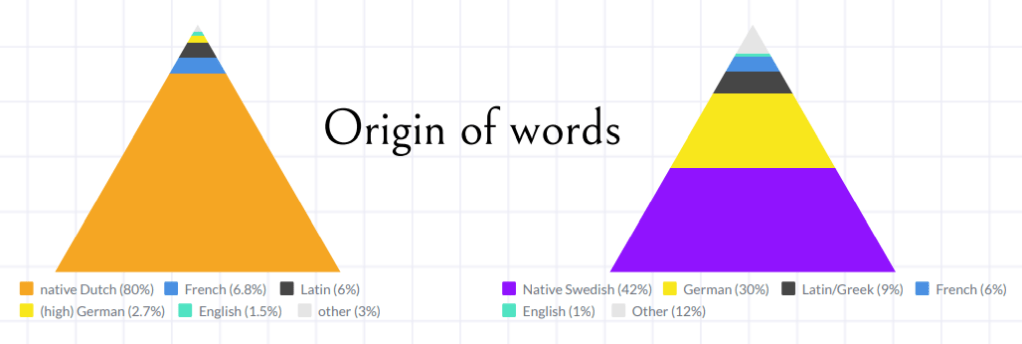
Swedish has a visibly large amount of words with their origin in German, due to the time of the rise of the Hanseatic League in the 13th and 14th century, providing Swedish Commerce and administration with a large number of Low German-speaking immigrants. Many loanwords are about trade and town life, such as stad (from Stadt, city), köpman (from Kaufmann, businessman), borgmästare (from Borgermester, mayor) och betala (from betalen , to pay).
Latin and Greek have a significant number of loanwords in Swedish and Dutch just like in most European languages. This goes for many science-related terms, although some terms were substituted with pure-Dutch terms in some fields: Physics and Mathematics are called Natuurkunde and Wiskunde (“nature-science”, “knowledge-science”, verb and vowel are werkwoord and klinker (“work-word”, “sounder”). Swedish has adopted fysik, matematik, verb, vokal; similarly to German, Italian and many others.
More loanwords came from French: paraplu, bureau and so on. Swedish adapted most french loanwords to its spelling: paraply, byrå; while Dutch often maintained the original French spelling: bureau, paraplu, crèche, other times also adapting it as in kostuum (from costume). A large amount of the most recent loanwords comes as you might think from English.
Loanwords from Dutch and Swedish
Some Loanwords from Dutch are Waffle from wafel; Cookie from koekje/koekie, Skate from schaats, but it also had a significant influence on naval terms: Yacht from jacht, short for jachtschip, lit. “hunting ship”; Skipper from Middle Dutch scipper (now schipper), lit. “shipper”; Cruise from Dutch kruisen, “to cross, sail to”. Iceberg probably comes from ijsberg “ice mountain”. Landscape, geek, decoy, pickle, frolic among others also came through Dutch.
The presence of the Dutch during the time of colonization in North America in the 1600s had its effects: Santa Claus comes from Middle Dutch Sinterklaas “Saint Nicholas”, bishop of Minor Asia who became a patron saint for children, celebrated on the 5th and 6th December in the Netherlands and Belgium. Yankee probably comes from Jan-Kees, a person name. Some places around what was called New Amsterdam, a.k.a New York City, have names with Dutch origin: Coney Island from Conyne Eylandt lit. “Rabbit Island” (in modern Dutch konijn and eiland); Harlem and Brooklyn were named after the Dutch towns Haarlem and Breukelen;
Without going back to the influence Old Norse had on shaping English, There aren’t that many loanwords from modern Swedish in it. Some are lingonberry; aquavit (the spirit); ombudsman, a person responsible for investigating complaints against the state.
Many are scientific terms and were constructed with Greek or Latin roots by Swedish scientists: Dynamite from dynamit, coined in 1867 by Swedish chemist and inventor of dynamit, Alfred Nobel; Nickel, coined in 1754 by Swedish mineralogist Axel von Cronstedt, a shortening of kopparnickel, meaning ‘copper-colored ore’. Moped, a complicated abbreviation of (trampcykel med) mo(tor och) ped(aler), “(pedal cycle with) mo(tor and) ped(als)”, coined in 1956. You can find more here.
Language History
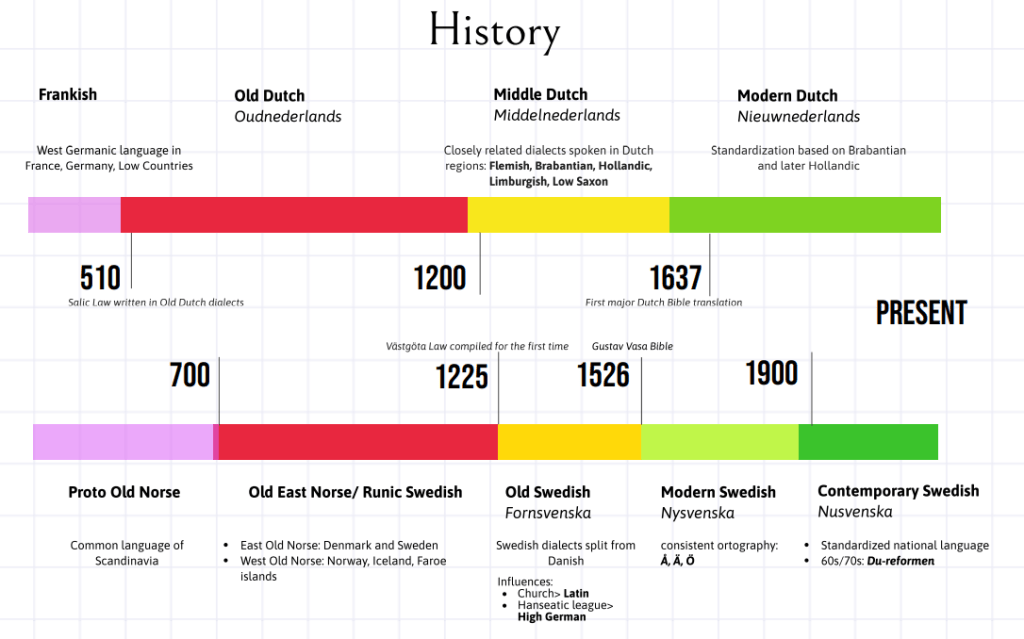
Both Swedish and Dutch have their origin in Proto-Germanic. Dutch evolved then from Frankish, spoken by Germanic tribes in the continent; and Swedish from Old Norse, the common language of people living in Scandinavia during the Viking Era.
Medieval Swedish and Dutch
Old Norse underwent more changes which resulted in the appearance of two similar dialects: Old West Norse (Norway, the Faroe Islands and Iceland) and Old East Norse (Denmark and Sweden). with the usage of runic alphabet. From 1200 onwards, the dialects in Denmark began to diverge from those of Sweden. In 1225 the Västgöta Law is believed to have been compiled, among the most important documents of the period and oldest Swedish law codes in the latin alphabet.
The early form of Dutch was a set of Franconian dialects: Flemish , Brabantian and Limburgish in the South; Hollandic and Low Saxon in the North of today’s Dutch speaking area.
Modern language &standardization
the advent of the printing press and the European Reformation had great influence in the standardization of languages, The Bible played a significant role, with major translations into Swedish and Dutch between the 16th and 17th century.
The Swedish translation of the Bible ordered by the monarch Gustav Vasa introduced the letters Å Ä Ö (previously spelt as æ/a’, ao, oe) and the spelling “ck” in place of “kk”, distinguishing it clearly from the Danish Bible. All three translators came from central Sweden which is generally seen as adding specific Central Swedish features
Dutch had Brabandic and dialects of Flanders as the most influential varieties in its standardisation, later replaced by Hollandic once Antwerp fell under the Spanish army and Holland became the Dutch-speaking area’s powerhouse. the Statenvertaling (“state translation”), the first major Bible translation into Dutch, was created so that people from all over the new republic could understand. It used elements from various dialects but was predominantly based on the urban dialects of Holland of post 16th century.
The du-reformen
A very significant change in Swedish occurred in the late 1960s, with the so-called du-reformen, “the you-reform”. Previously, the proper way to address people of the same or higher social status had been by title and surname, with the use of herr (“Mr” or “Sir”), fru (“Mrs” or “Ma’am”) or fröken (“Miss”). With the liberalization and radicalization of Swedish society these class distinctions became less important, and du became the standard in any context.
I might write a similar article with infographics differentiating the 3 Scandinavian languages or the other Nordic languages in the future, give me feedback!
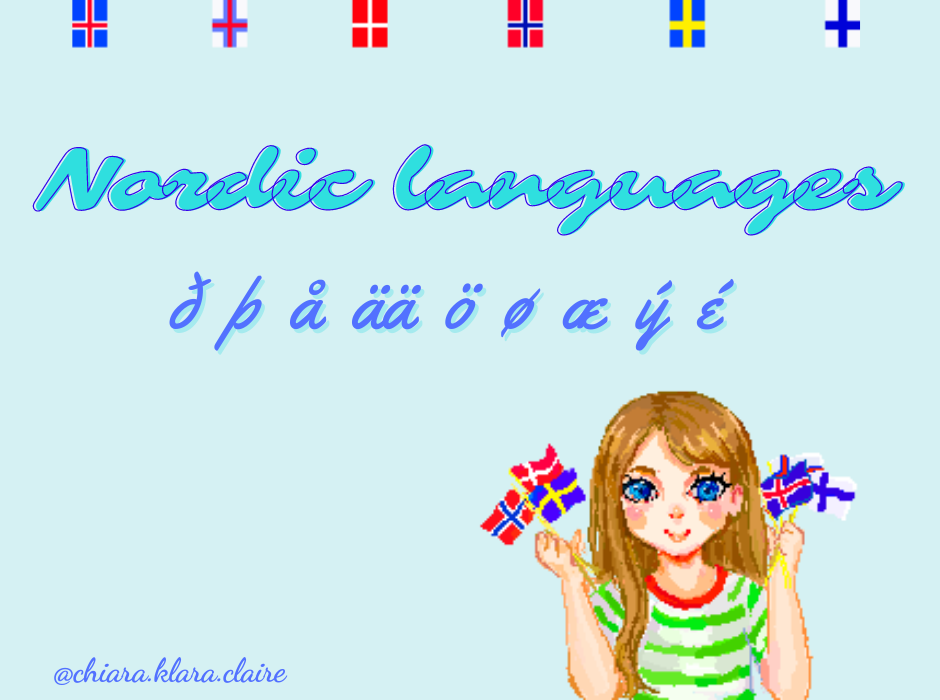
Learn quickly how to distinguish and identify all Nordic languages!
As a language lover I tend to take for granted that certain languages are clearly different from others or recognizable from certain features. Some time ago my sister asked what was the language I was reading in, and I was expecting her to know that with ð’s it has to be Icelandic. But if language learning is not your hobby, Dutch and Swedish might as well be the same thing, purely because you never get to see them. I still remember reading about differences between Danish and Norwegian and finding it really useful, so I decided to make a summary of features and differences that can come in handy as a guide for those who would enjoy being able to distinguish all Nordic languages without actually studying or knowing much.
Please note that I’m mostly writing about the written form, as nuances of the spoken language can be much harder to describe. For what concerns the oral form, you just have to listen to them a lot, and as a Swedish friend once told me:
Swedish is up ‘n downs, Norwegians is all ups, Danish is all downs.
And well, it makes sense.
How similar are Nordic languages to each other?
Swedish, Norwegian, Danish, Icelandic and Faroese belong to the North Germanic language family. Their cousins are German, Dutch and English. If you speak two of these three a big amount of vocabulary and grammar will be familiar to you.
Swedish, Svenska; Norwegian, Norsk; and Danish, Dansk, are the languages of Scandinavia, (yes, the Scandinavian paeninsula is made up of only these three countries) could be considered siblings (or twins?) because they are mutually intelligible, a Swede and a Norwegian will likely converse in their own language without recurring to English, the same goes with a Dane although Danish can be more problematic…But you can read about that later. Theirunique letter is Å, which is roughly pronounced as O. So yeah, remember that when you talk about songs by Måneskin…
Icelandic,Íslenska, is essentially old Norse – the ancestor of all North Germanic languagages – that got crystallized in the middle of the North Atlantic. Because of this Icelanders find it pretty easy to read old viking sagas than the Scandinavians, who don’t really understand Icelandic. Faroese, Føroyskt, spoken in the Faroe islands – between Iceland, Norway and Scotland – is similar to Icelandic in the written form, but the spoken language is quite different. They are classified as Insular languages of the North Germanic family, its distinguishing letter is ð (called eð in Icelandic and edd in Faroese, capitalÐ), pronounced as th in this. Both have æ, á í ó úin their alphabets.
Swedish and Danish would be classified as East-North Germanic, while Norwegian and Icelandic West-North Germanic, the bound between Icelandic and Norwegian is is noticeable in some Norwegian dialects, but the geographical distance made Norwegian become more intelligible with the eastern branch instead.
However, there’s an odd one out of the Nordic languages. Not only Finnish, Suomi, does not belong to the North Germanic family, but it is not even indo-european. That means Hindi is potentially closer than its neighbour Swedish. Finnish belongs to the Finno-ugric family and is completely different grammar-wise, but has quite a lot of loanwords and cultural influence from Swedish. You can recognize it by very frequent double letters with combinations as yy and ää, double consonants after another consonant: tsemppiä, pankki. Finnish does not have B, G, D in its alphabet.
The Sámi, indigenous people of north Scandinavia, have their own languages, which are related to Finnish as they belong to the Uralic language family, this article i wrote focuses on them.
And now let’s go into detail!
Swedish vs Danish & Norwegian
Norwegian and Danish look very much alike in the written form, but if you hear them you will be more likely to think Swedish and Norwegian sound similar while Danish stands out for its “weirdness”, It is said that Danes speak as if they had potatoes in their mouths, if you want to know more look up the stød linguisti phenomenon.
Swedish: Ö, Ä / Norwegian & Danish: Ø, Æ: The first and easiest difference
CK/KK: ck is found in Swedish, usually K or KK in the other two: lycka/lykke (luck); tack/takk, tak (thanks).
-A/-E: Swedish tends to have a lot of -a endings, while you have E’s in Norwegian and Danish. See the example above of lycka/lykke, also in plural adjectives: mina/mine (my) goda/gode (good).
HV/V is not found in Swedish, which got rid of the H: vad, vem/hvad, hvem; (what, who)
X an Q sometimes occur in Swedish, only in foreign names in the other two: exempel/eksempel (example).
Modern written Norwegian was based off Danish so it can be extremely similar and if you have a very short text it might even be all spelt the same way, but a few features will signal which of the two you are reading:
ØJ/ØY: øj in Danish while øy in Norwegian: tøj/tøy (clothes)
MIG/MEG: Norwegian Bokmål uses E in deg/meg/seg, while Danish has mig as in Swedish
K/KJ: kj an b found frequently in Norwegian while Danish has directly a vowel after K: kære/kjære (dear); at kende/ å kjenne (to know)
TION/SJON: Norwegian’s spelling in words of foreign origin is more “tamed” to the language, for instance words ending in-tion, where Danish keeps the -tion ending and Norwegian has -sjon: international/internasjonal; chokolade/sjokolade (chocolate).
Tendencies:
D, G, B/ T, K, P: Danish tends to have much more D, G, and B’s (it could be compared to Spanish vs Italian I think?). bog/bok (book); nouns in -hed/het; at vide/å vite (to know); peberkager/pepperkaker (gingerbread). Swedish and Norwegian are usually more similar for what concerns this.
Norwegian got rid of many “unnecessary” letters (often D’s, G’s) to its pronounciation: at sige/å si (to say); vidste/visste (knew), sagde/sa, -ld, -nd endings trold/troll (troll); end/enn (than)
Æ frequence: Danish tends to have a lot more Æ, where Norwegian has a ‘simple’ E: næsten/nesten (almost); at tænke/å tenke (think). at hjælpe/ å hjelpe (help). Swedish usually has an Ä here: att hjälpa, nästan, att tänka.
Norwegian could be further divided into Bokmål and Nynorsk, which are just two different ways to spell it. Bokmål “book language”, is fundamentally Danish with adjustments to the Norwegian language and the most widespread one, while Nynorsk “New Norwegian” was an attempt to create a more Norwegian-Norwegian, and it is more frequent in the west part of the country, used by about 12% of Norwegians. I won’t go into detail with Nynorsk, but ein, eit indicates Nynorsk, while en, et are Bokmål.
Icelandic vs Faroese
Faroese and Icelandic pronounciations contrast with their similar spelling, that is because Faroese was given an ethymological ortography to resemble its ancestor Old Norse. On top of that, Faroese adopted some words of Danish origin because of its history.
Þ/T: Only Icelandic has Þþ (þorn in Icelandic) which corresponds to English th in mouth, Icelandic words with Þ have T in Faroese: þú/tú (you); það/tað (it).
Ö/Ø: Icelandic uses ö while Faroese adopted ø.
Icelandic has accented E’s, É, not present in the Faroese alphabet: ég/eg (I).
Finnish: the outsider
As previously mentioned, Finnish is completely unrelated to the North Germanic family, it belongs to the Ugro-Finnic family and its closest language is Estonian.
TO HELP: att hjälpa-at hjælpe-å hjelpe ; að hjálpa ; autaa
SOMEONE: någon-nogen-noen ; einhver-onkur ; joku
TO SAY: att säga-at sige-å si ; að segja-at siga ; sanoa
APPLE: äpple-æble-eple ; epli; omena
WHAT: vad-hvad-hva ; hvað-hvat; mikä
Article 1 from the Universal Declaration of Human Rights :
Swedish: Alla människor är födda fria och lika i värde och rättigheter.
Danish: Alle mennesker er født frie og lige i værdighed og rettigheder.
Norwegian bokmål: Alle mennesker er født frie og med samme menneskeverd og menneskerettigheter; Nynorsk: Alle menneske er fødde til fridom og med same menneskeverd og menneskerettar.
Faroese: Øll menniskju eru fødd fræls og jøvn til virðingar og mannarættindi.
Icelandic: Hver maður er borinn frjáls og jafn öðrum að virðingu og réttindum.
Finnish: Kaikki ihmiset syntyvät vapaina ja tasavertaisina arvoltaan ja oikeuksiltaan.
If you want to go even more in detail, you can check out this on mylanguagebreak.com, but my advice is to just expose yourself to the languages, and experience all the differences yourself. 🙂 Here you can briefly read about even more languages used in the Nordic countries.
if you want to see an even more succint summary of all this, you can check out my post on instagram.




 a Polyglot illustrating Scandinavia