Fika in Nijmegen, lunch with smørrebrød

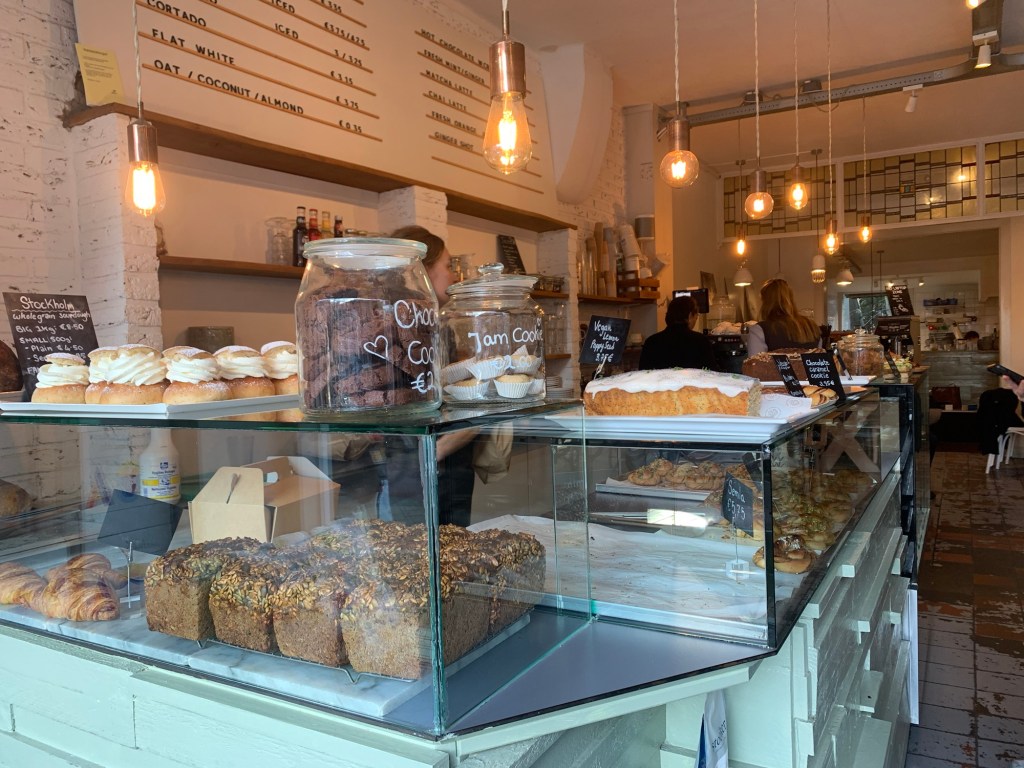
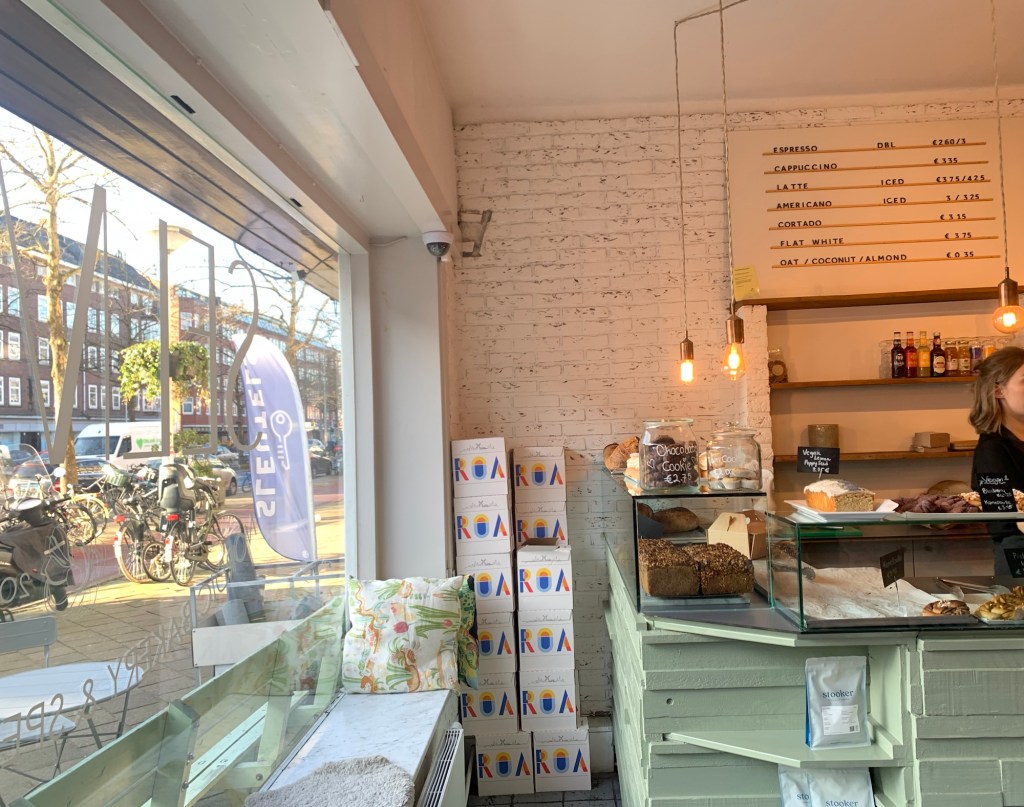
Fika in Nijmegen is a cafe/lunchroom with Scandinavian vibes: smørrebrød, knäckebröd, buns, cakes and books!

Some time ago I went to Fika in Nijmegen, a Scandinavian inspired Café / Lunchroom, focused on open-face sandwiches. high fika with friends. It is also possible to use your laptop at certain times for remote working! Next to the café you have the Fika Kiøsk for a treat and drink on the go.

NL: Een tijdje geleden ben ik bij Fika geweest in Nijmegen. Daar kun je lunchen met skandinavische boterhammen, een lekkere koffiepauze hebben met kardemombollen of cakejes, en zelfs een gezellige ‘high fika’ met vrienden boeken. Andere Zweedse broden als Knäckebröd en polar brood kan je hier ook eten.
Fika heeft een ruime ‘smørrebrød’ selectie: boterhammen van meergranen desembrood met vis, vlees en vega opties. Borrelsnacks met wat skandinavisch gevoel zijn er ook.
Je mag hier ook je laptop gebruiken, aparte flexwerk-ruimte.
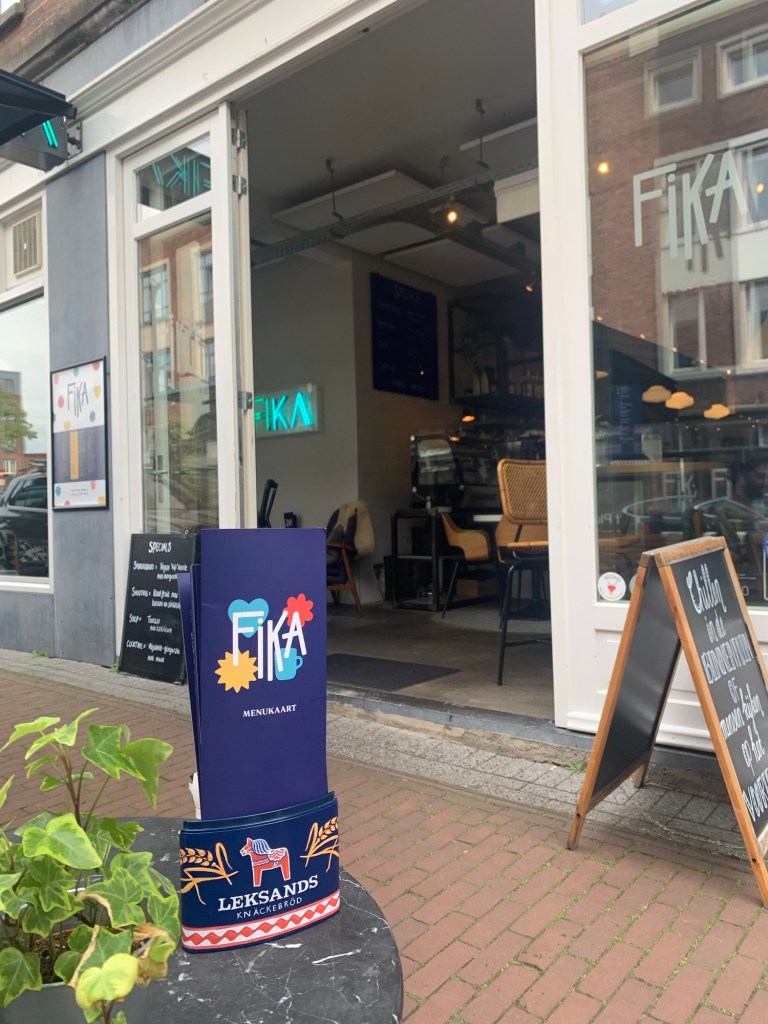
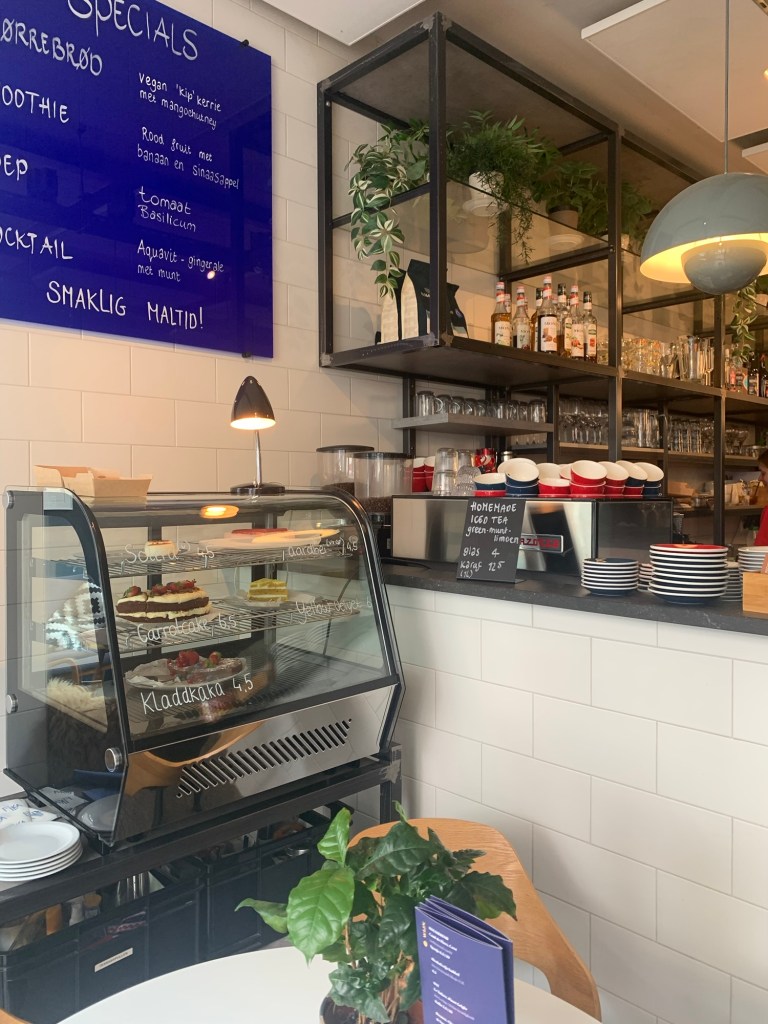
Here is what you can eat at Fika:

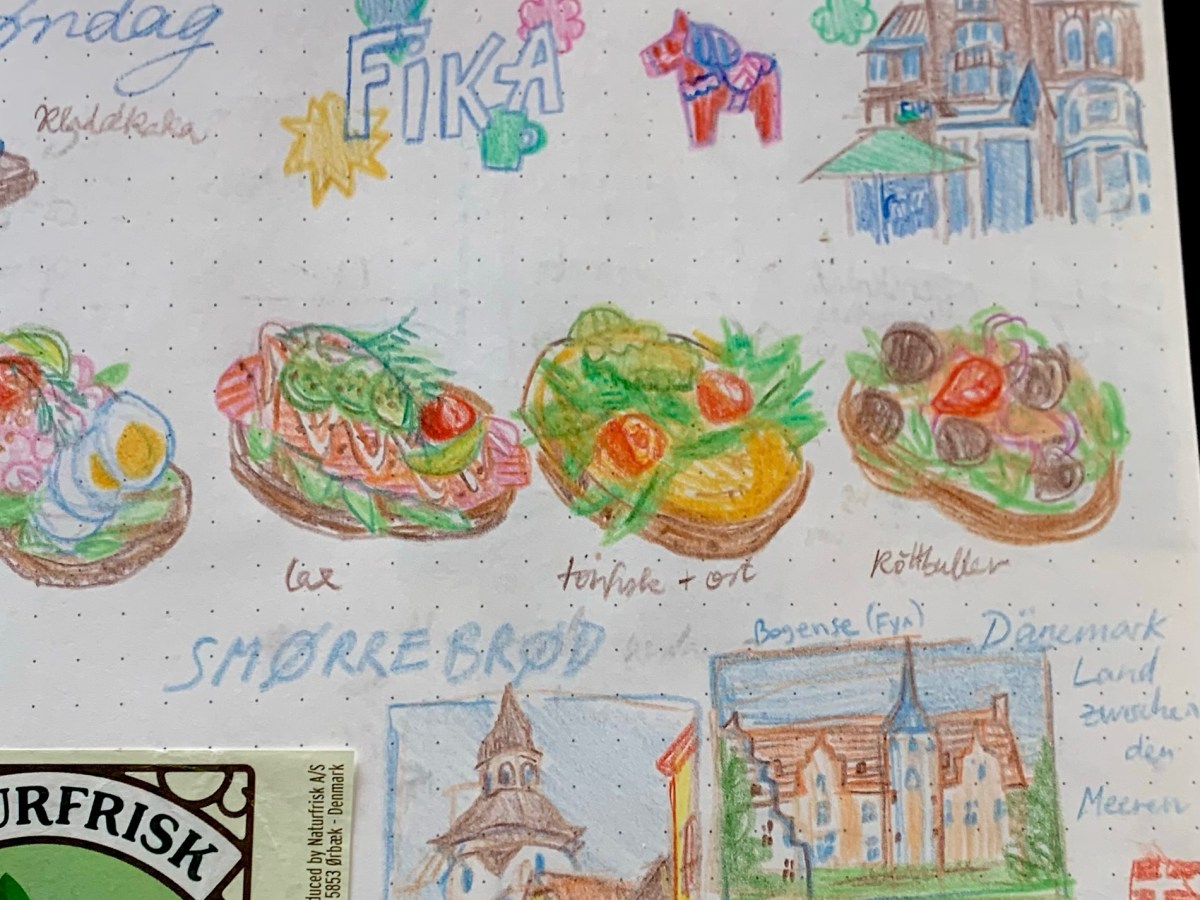
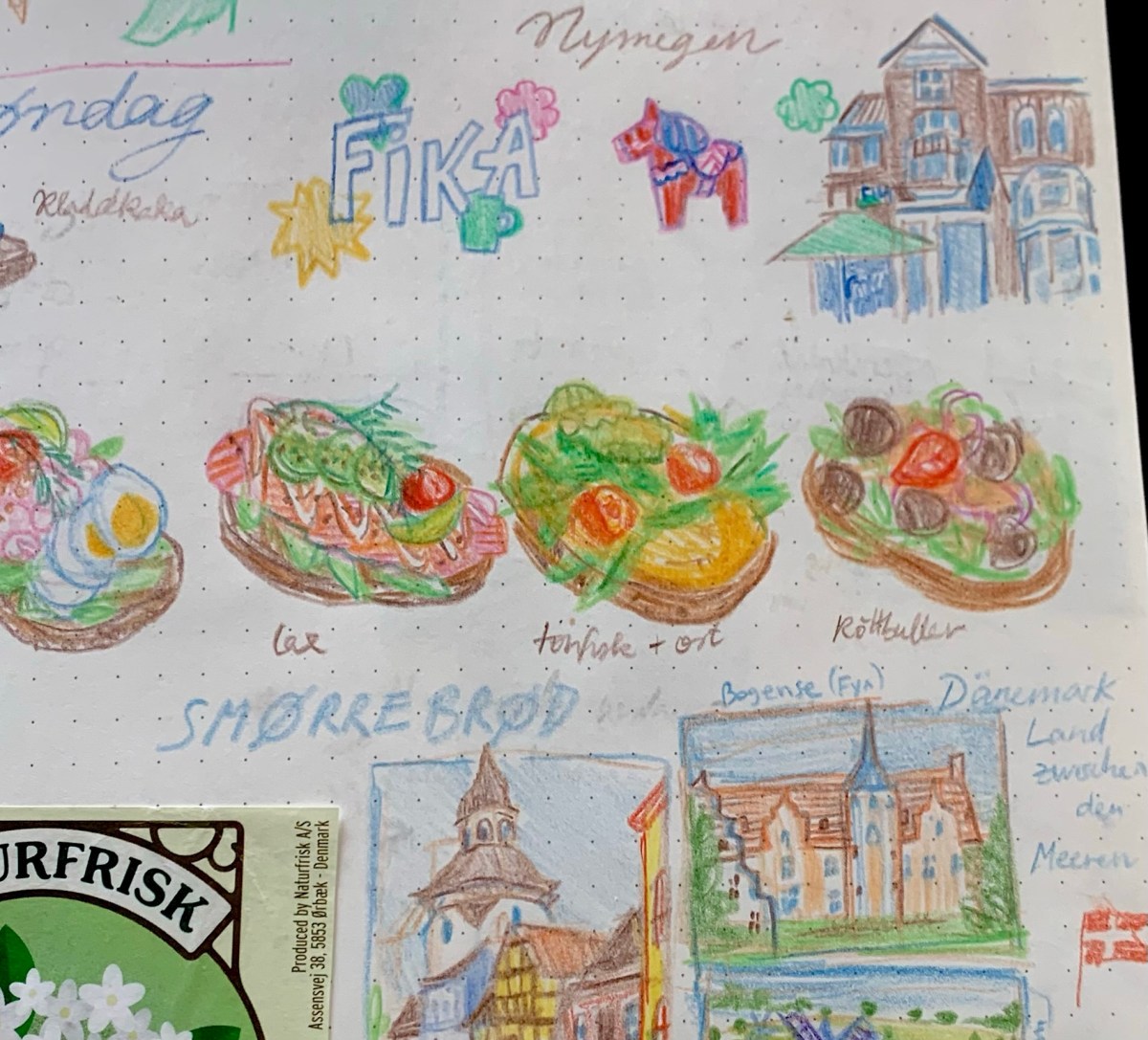
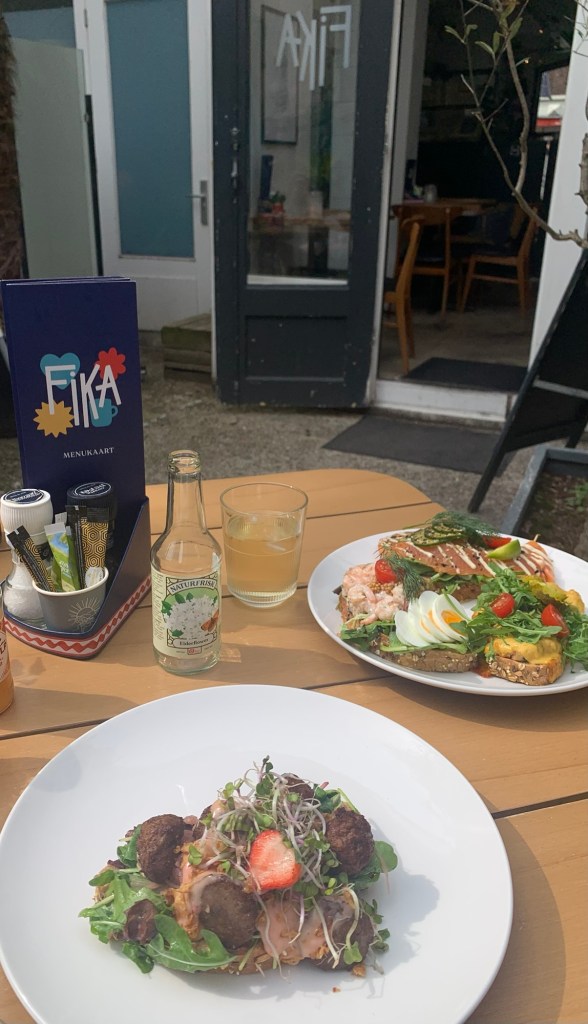
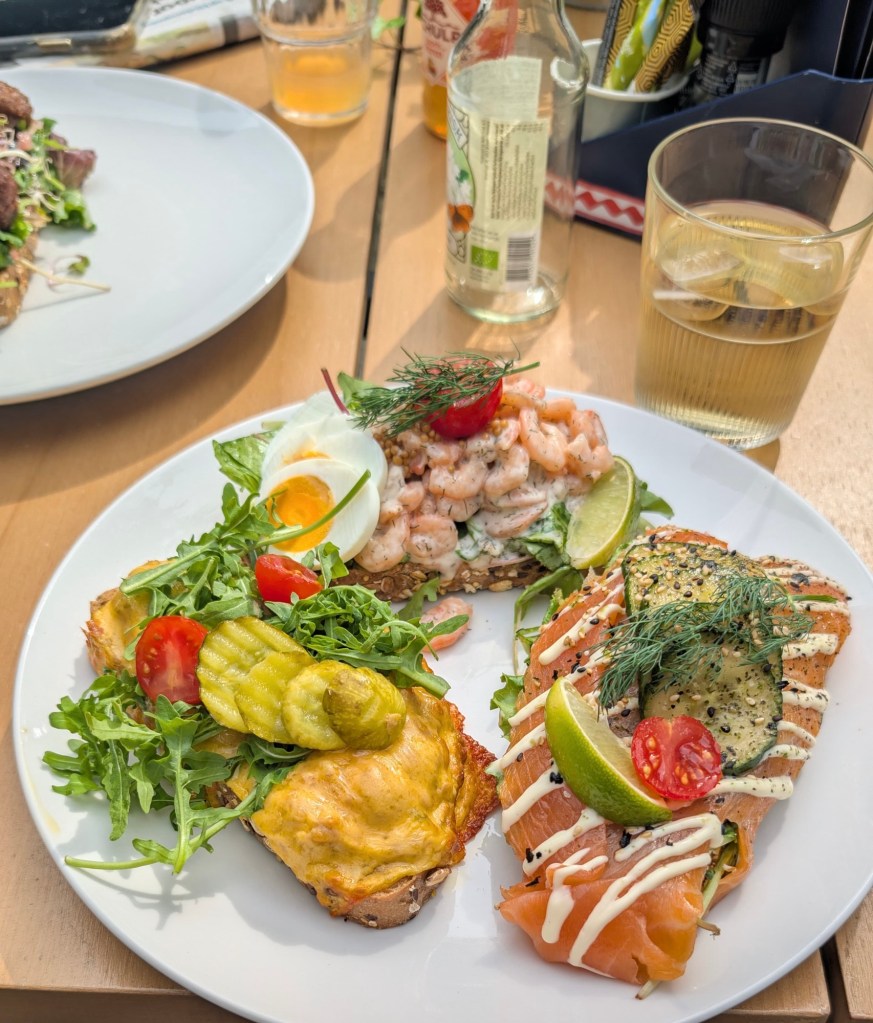
A highlight of the café is the wide ‘smørrebrød’ selection: multigrain sourdough open-face sandwiches with fish, meat and vegan options. Shrimp salad and köttbullar (meat- or vegan balls) among others.

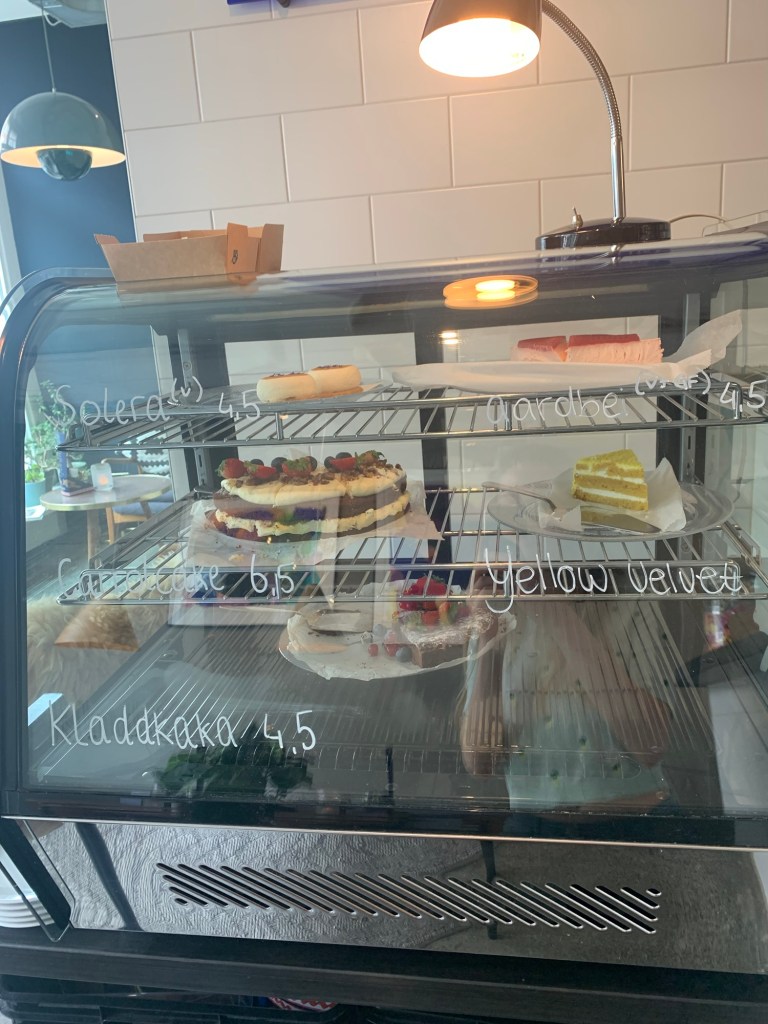
For a sweet break, of course you can have a fika at Fika – some classic Scandinavian treats to choose from are buns, cardamom or almond; and Kladdkaka (Swedish chocolate cake with gooey filling).

Other snacks to share I noticed on the menu are cheese and meat/vegaballs with a cranberry sauce; knäckebröd with goat cheese and veggies; mini Polar pizza – polar bread with mushroom or salmon; and dill potato chips!
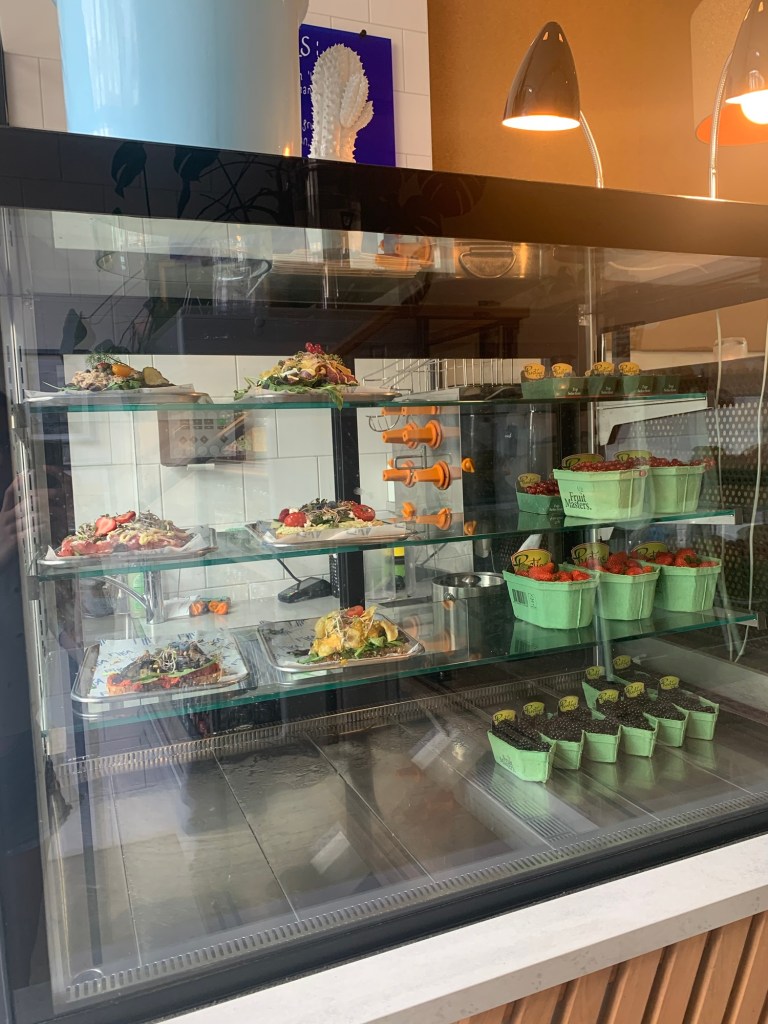
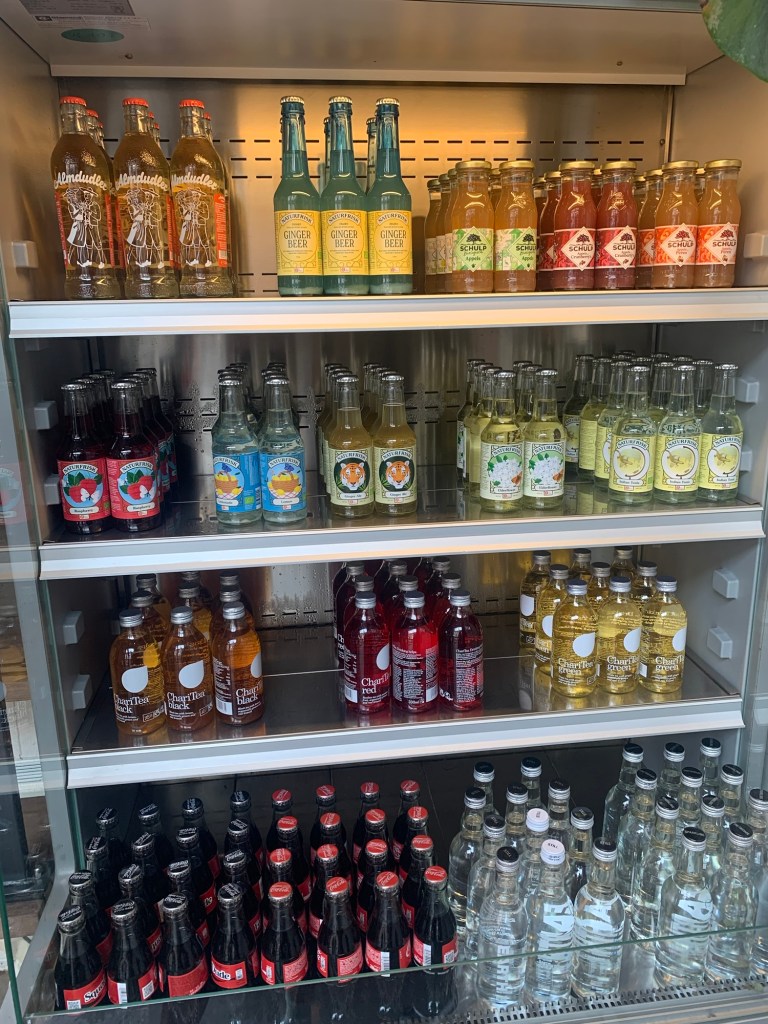
Something I like was the good assortment of Naturfrisk Danish drinks they have!

If you are with friends, it is also possible to book a ‘high fika’, what they call a High Tea elsewhere here. For 26,- euros per person you will get warm drinks and:

  • a soup
  • small open face sandwiches
  • polarbread pizza with mushrooms
  • small cakes
  • skyr
  • fresh fruit

Being with someone else, I managed to try quite a few Smørrebrød, the fish versions- tuna-cheese, salmon, shrimp – and one with mixed vegan- and meatballs. They might not be on the ‘proper’ Danish rye bread, but they did look and taste good! I advised my friend to try the Elderflower Naturfrisk drink.
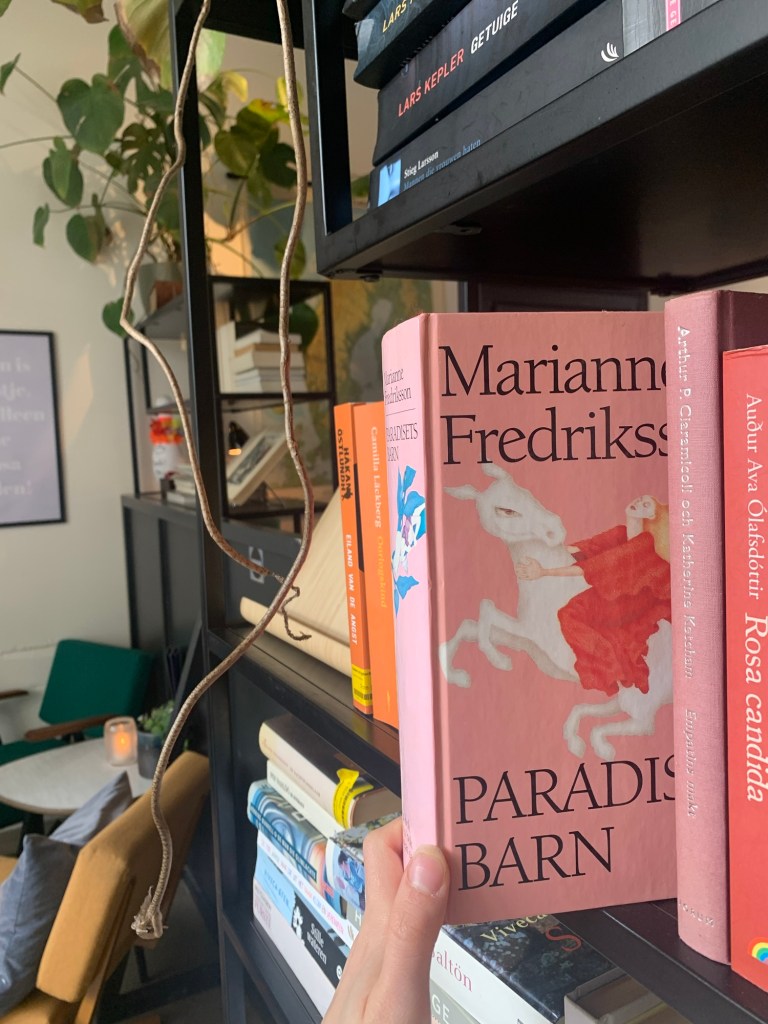
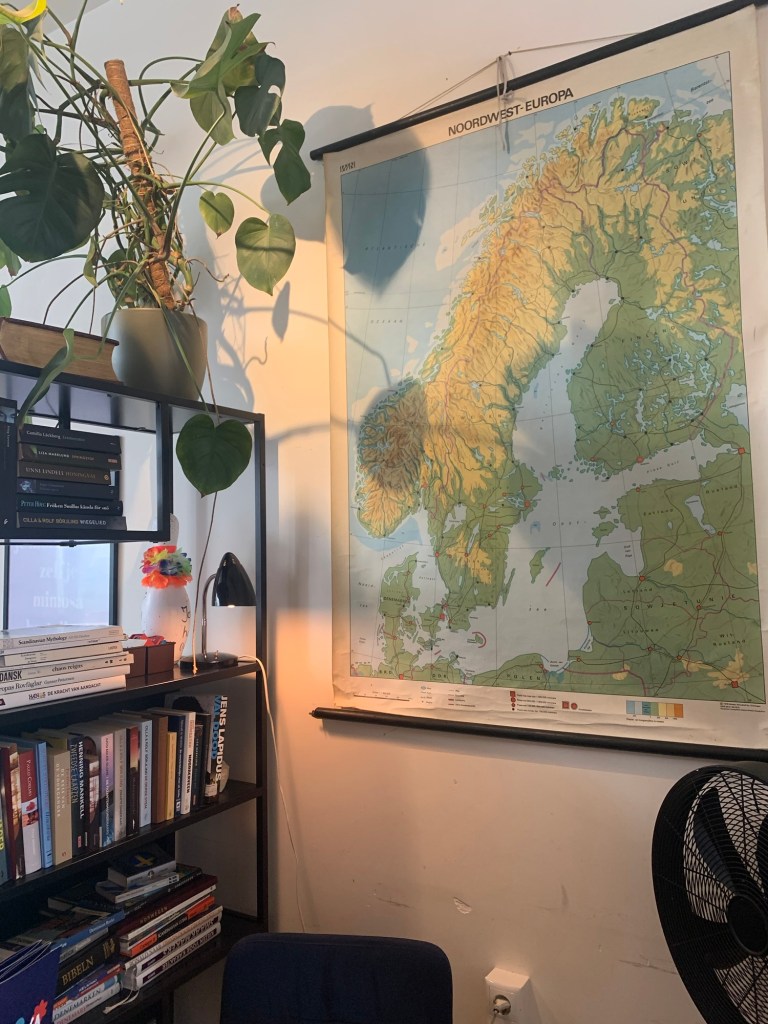
Before entering the backyard to sit outside, I saw a nice collection of Scandinavia-related books: novels by Nordic authors (translated or in the original version, travel guides, and more.
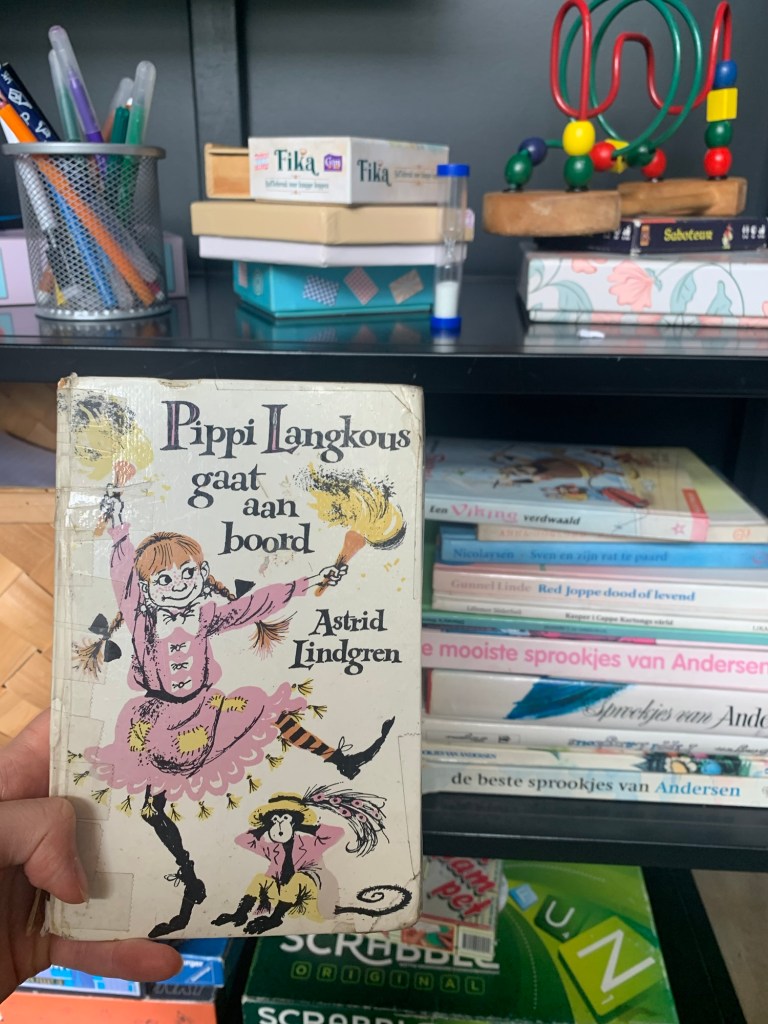
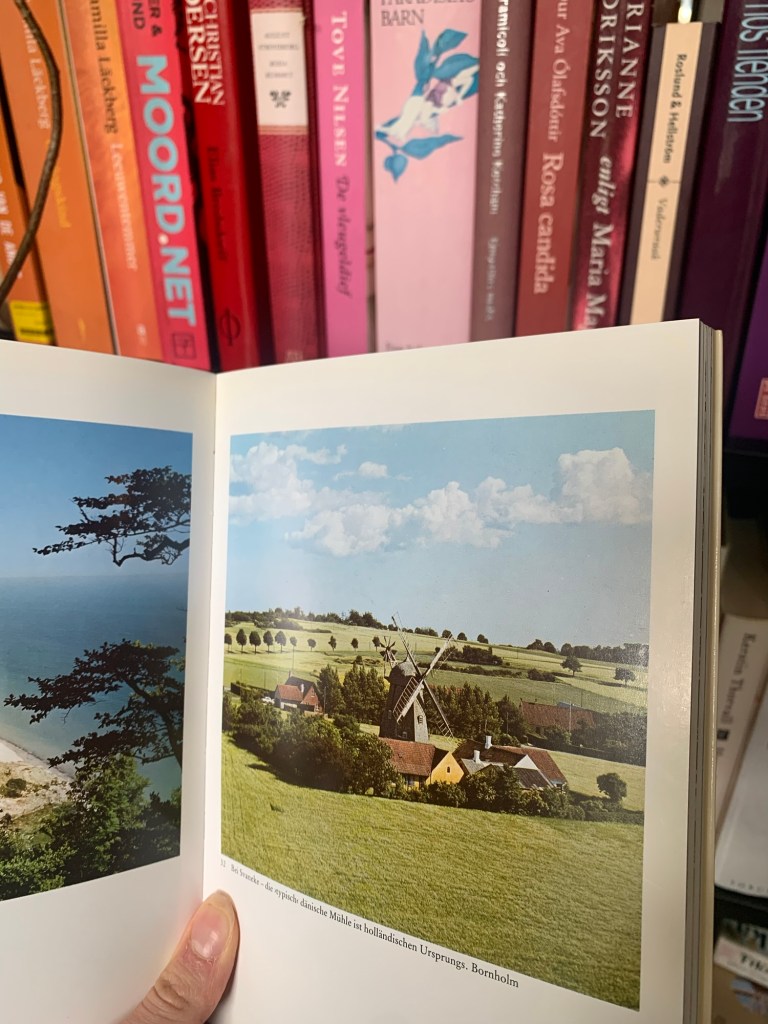
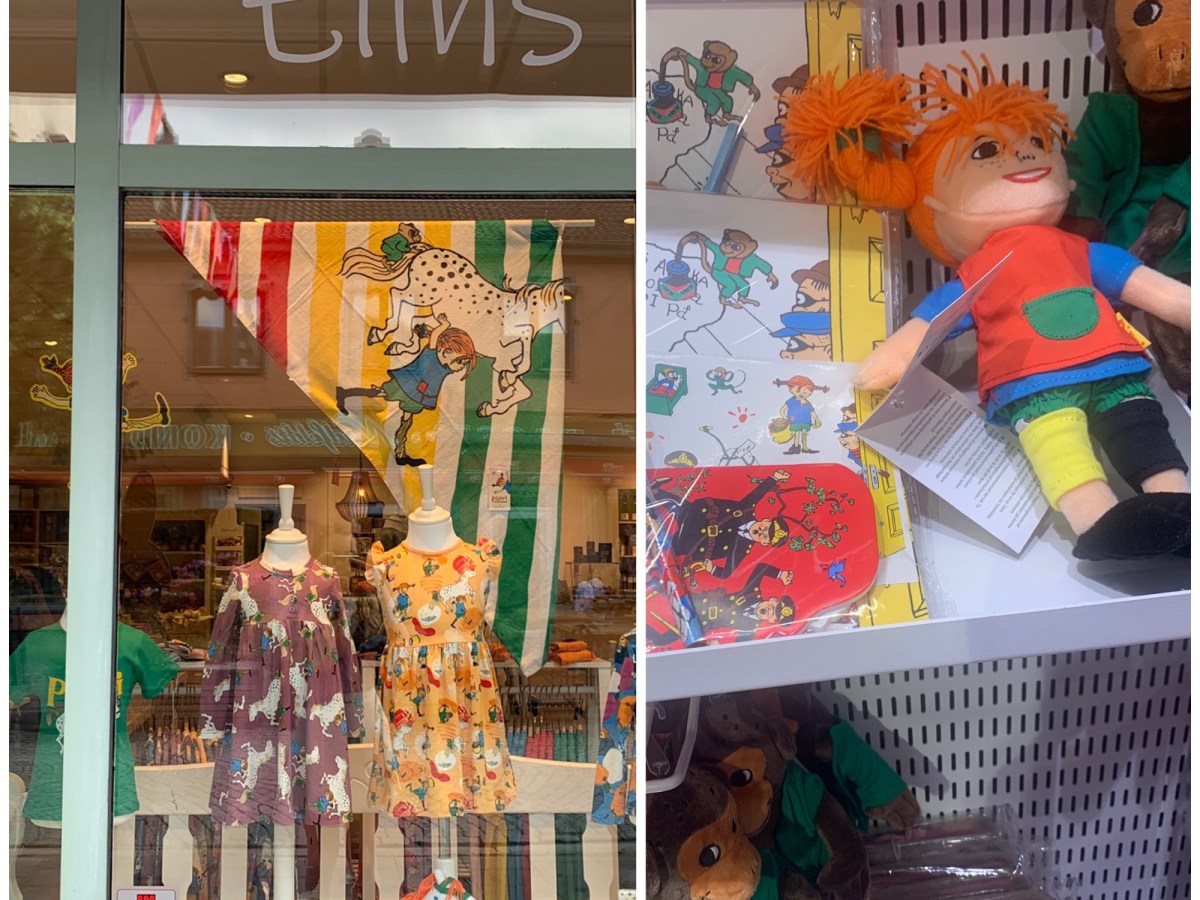
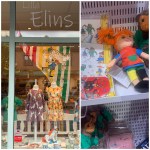
Underneath there were some toys, and I found one featuring a dammsugare, I am a sucker for this small details.
After checking out the books, it was time for dessert. I really wanted to mke my friend try cardamom buns and try an almond bun myself (Swedes would call it a Tosca), but unfortunately there were not any left, so we went for another Dessert lemon velvet, and a Matcha-mango latte. Not particularly Nordic but good.
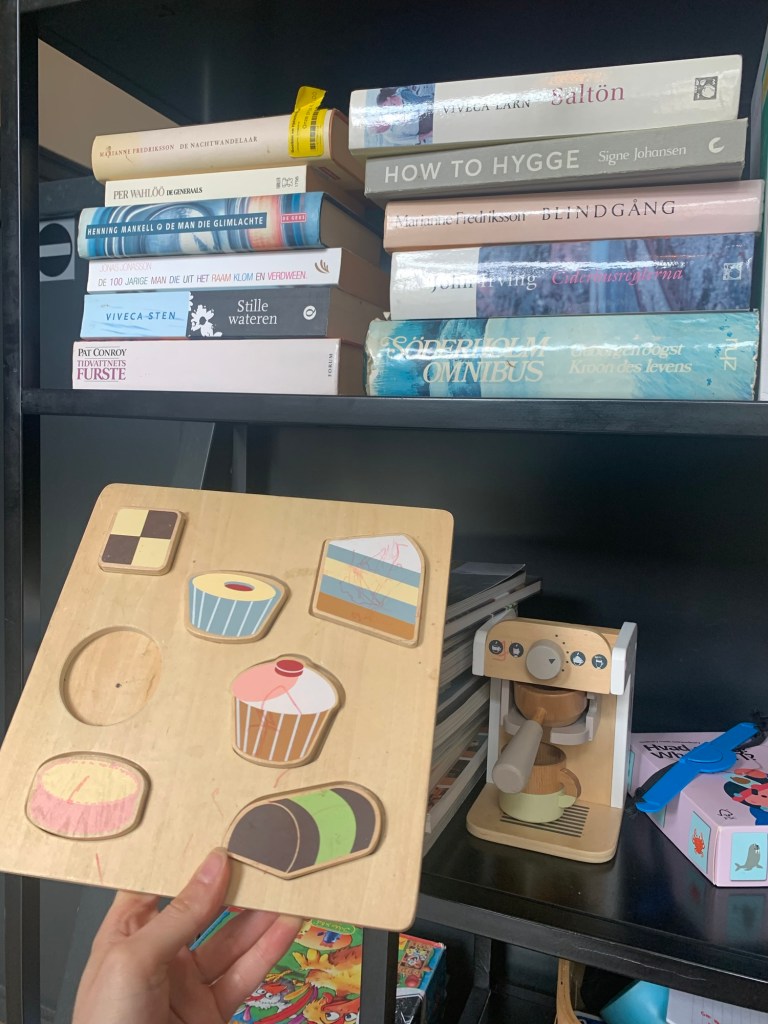
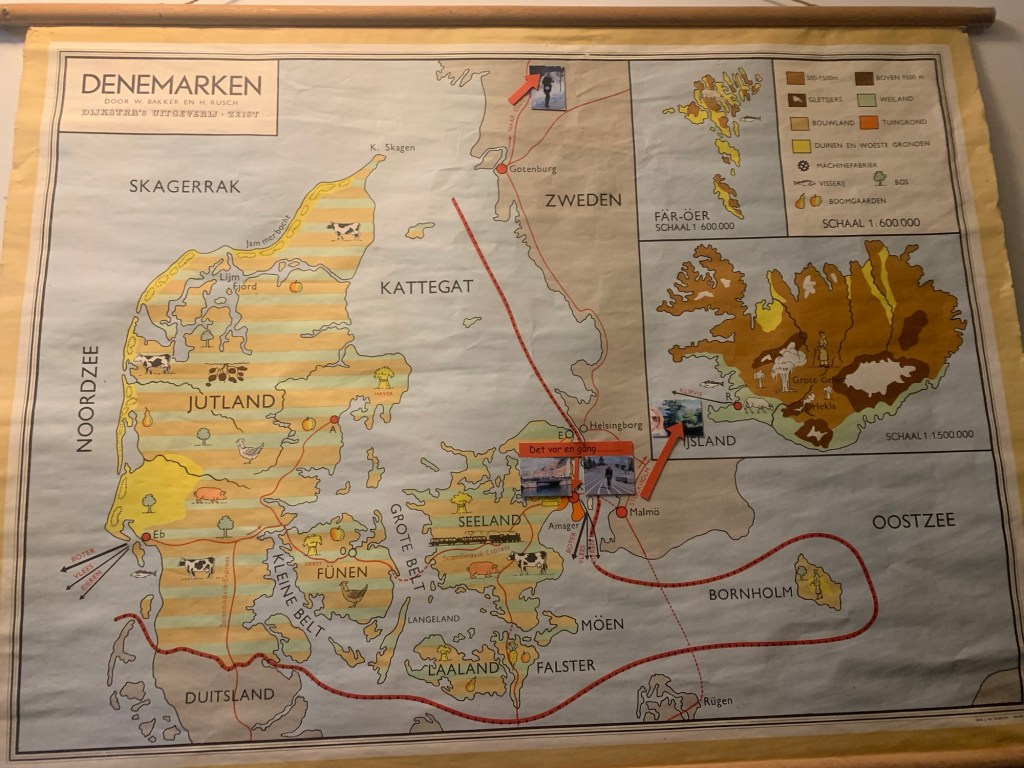
I loved how the café has a lot of maps of Scandinavia hanging here and there as well!
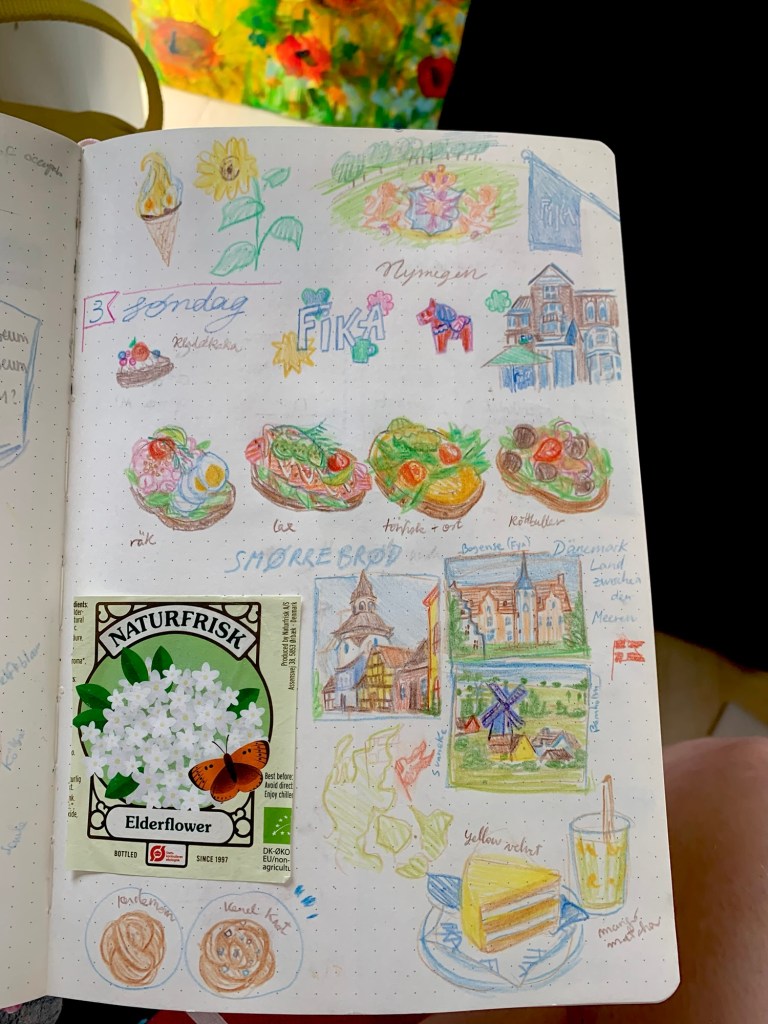
And here is the journal spread for this smørrebrød fika experience in Nijmegen!
We left, with me being kind of disappointed the buns were already finished when we were there, and because of that I had and even bigger craving for a kardemummabulle…

Since you never know, we went to the Albert Heijn to Go to see if they had the more Swedish-looking cinnamon knot. They did not only have that, but CARDAMOM knot too!! Sometimes life surprises you. Not sure if this is only a temporary promotion for Wereldse Smaken – international treats together with miso cookies and pandan muffins.
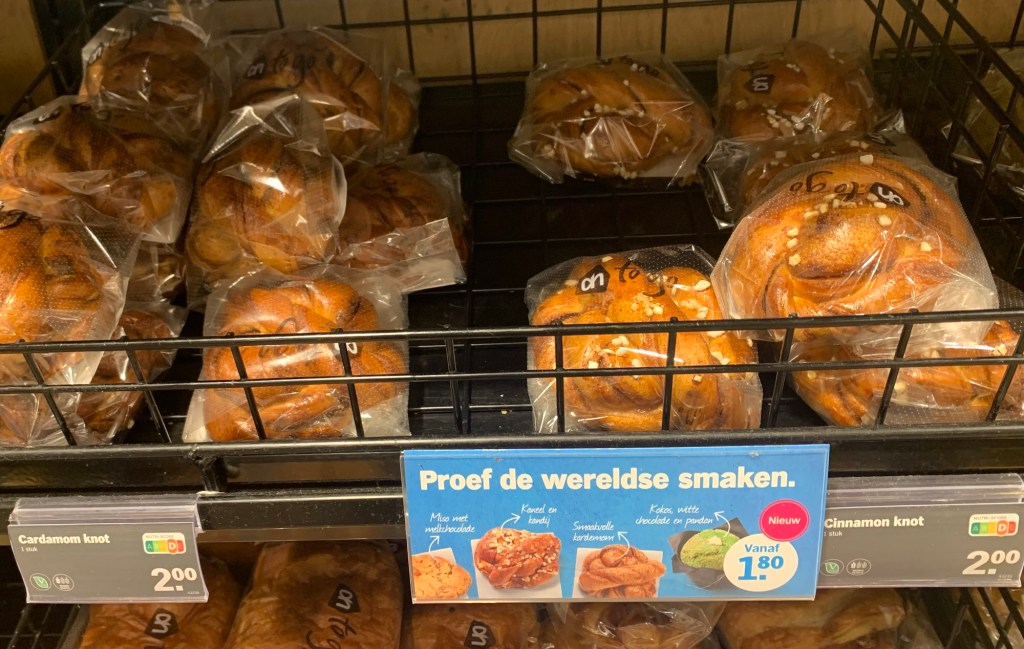
Volg de blog voor meer Skandinavisch eten aanraders in Nederland:
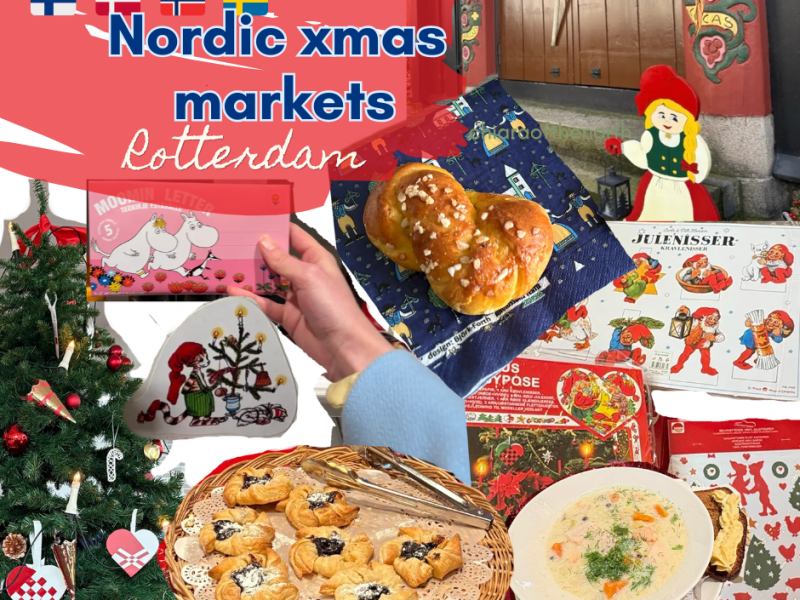
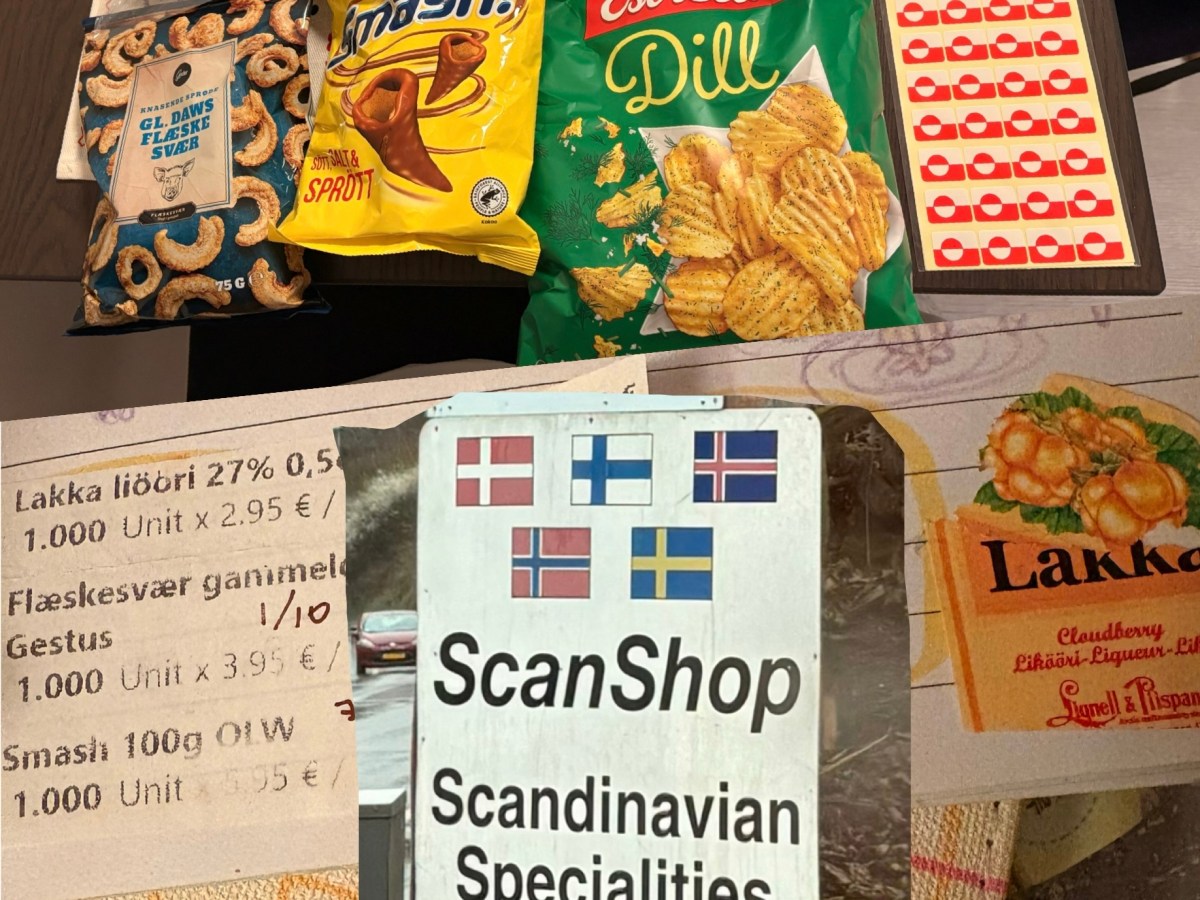
ScanShop: Nordic supermarket in Luxemburg

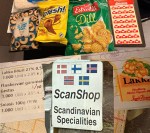
I visited Scanshop, a supermarket for Nordic expats in Luxembourg and Belgium. It offers a wide range of Scandinavian food products, including rye bread, fish, and sweets, alongside flags and tableware.
False Friends within Scandinavian languages

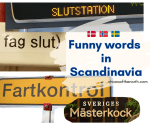
False friends in Danish, Norwegian, Swedish and Icelandic that can lead to misunderstandings and funny situations between Scandinavians.

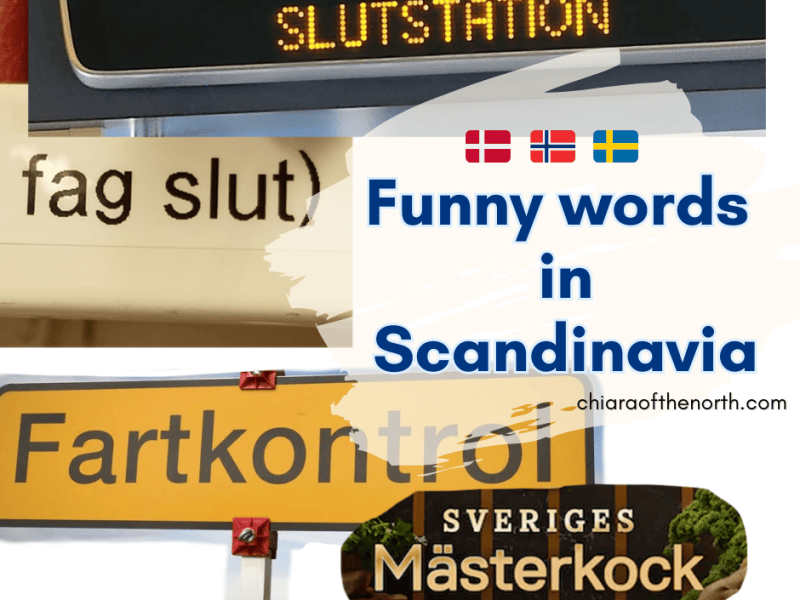
False friends are a very common thing in similar languages, and they can cause funny or weird situations, from calling someone calm instead of fun and pastries becoming headaches. Or insulting a girl by calling her girl.

So here is a list to find out curious false friends and keep yourself safe from incoveniences. As you will notice, Danish and Norwegian often have the same meaning opposed to Swedish, but not always.

(se-dk-no) wordSwedish meaningDanish meaningNorwegian meaning
roligfun (calm=lugn)calmcalm
artigpolitefunnyfunny
frukost/frokostbreakfast (lunch=lunch)lunch (breakfast=morgenmad)breakfast (lunch=lunsj)
blomma/eflower (plum=plommon)plum (flower=blomster)plomme=plum (flower=blomster)
varelse/værelse(living) being (room=rum)room room
bytown/village (city=stad)city (town=landsby)city (town=landsby)
stad/stedcity placeplace
semesterholiday (semester=termin)semester (holiday=ferie)semester (holiday=ferie)
lovsummer break , promise (law=lag)law (a promise=et løfte, but to promise=at love) law (a promise=et løfte, but to promise=at love)
rarweird (nice=snäll)nice, friendlyweird (nice=snill)
konstig/kunstigweirdartificial (weird=mærkelig, underlig)artificial (weird=rar, merkelig)
snålstingy–weird, odd
lesmile (laugh=skratta)laugh (smile=smile, read smeeleh)laugh (smile=smile)
grina/eweep, cry, also gråtalaugh (cry=græde)cry (laugh=le, also gråte)
glassice cream (glass=glas)glass (ice cream=is)glass (ice cream=is)
kjol/kjoleskirt (dress=klänning)dress (skirt=nederdel)dress (skirt=skjørt)
killingyoung goatkitten*geitekilling=young goat
bumsimmediately, at oncepimple–
kryddsill/krydsildspiced herringcrossfire (spiced herring=kryddersild)-, spiced herring=kryddersild)
tallrik/talrigplatenumeous (plate=tallerken)-, plate=tallerken
hurtigcheekyfastfast
anledningreasonreasonopportunity
bedriftachievementcompanycompany
styggnaughtyugly
flyescapeairplaneflight
tillbud/tilbudincidentofferoffer
tullcustoms– (customs=told)joke/nonsense (customs=toll)
snortsnotlace, cord
driva/e medjoking with/kiddingdoing
måste/må jeg…do I have to?may I?do i have to?

and here special section with Naughty words…. Pay attention

Swedish meaningDanish meaningNorwegian meaning
skedephasevag**a
tös/tøsgirlgirlsl*t
bolla/eplay boll (to f8&k=knulla)to f*cken bolle=bun pastry, å bolle seg=chill, have fun (to f8&k=knulle)
kneppe–to f**k (button=knappebutton (fuck=pul3)
måsseagullbutt (seagull=måge)– (seagull=måke)
svanstailfag**t–
källing/kællingkitten*b**ch–
kukd1ckcuckoo , mess (d*ck=p1k)d1ck
bärs/bæ,sjslang for a beerpoop

icelandic also has a few interesting cases:

SwedishIcelandic
huggachopconsole
bakverkpastrybackache

That’s all for now, I will keep this updated in the future!


more:

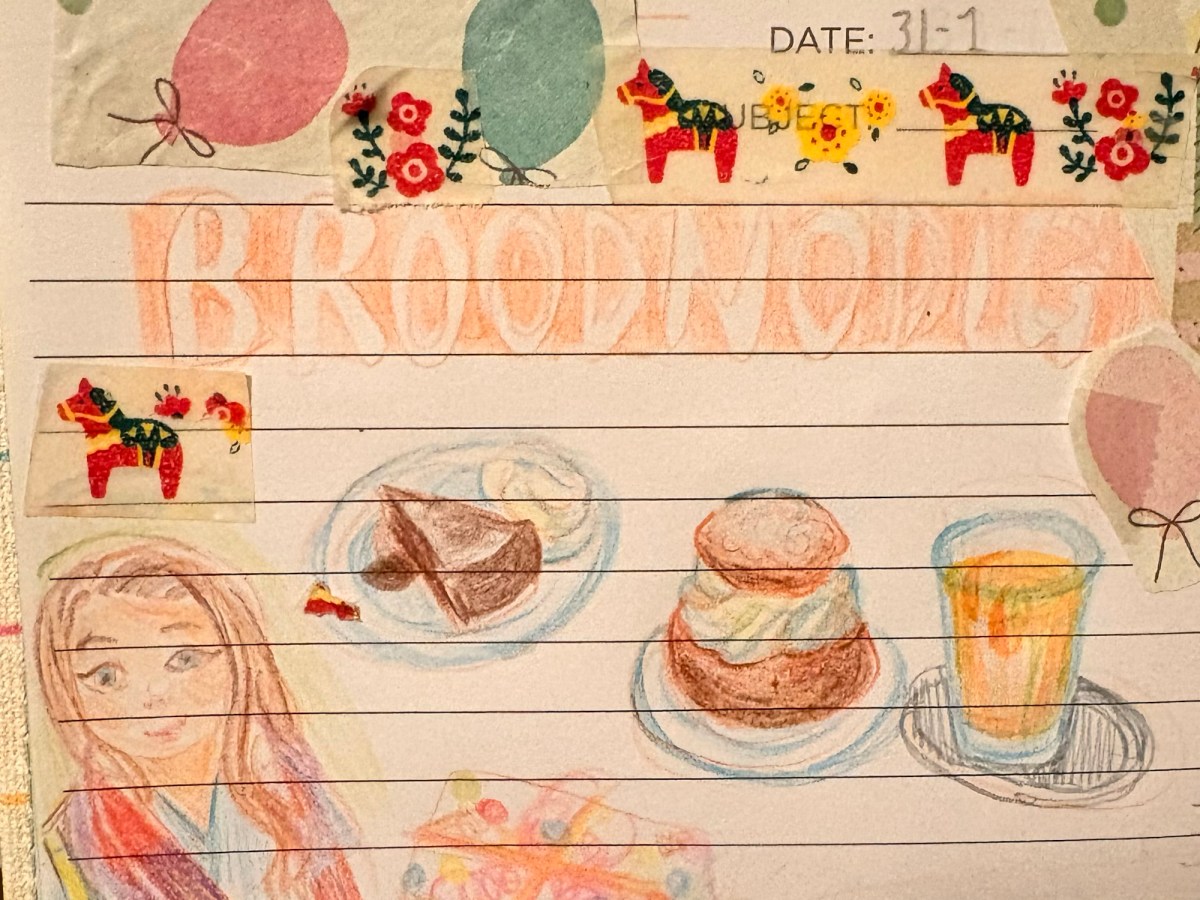
Swedish Café in Utrecht: Broodnodig

In Utrecht, the cafe Broodnodig serves Swedish pastries and cakes as cinnamon and cardamom buns, kladdkaka, smulpaj and Scandinavian seasonal treats as semlor and saffron buns.

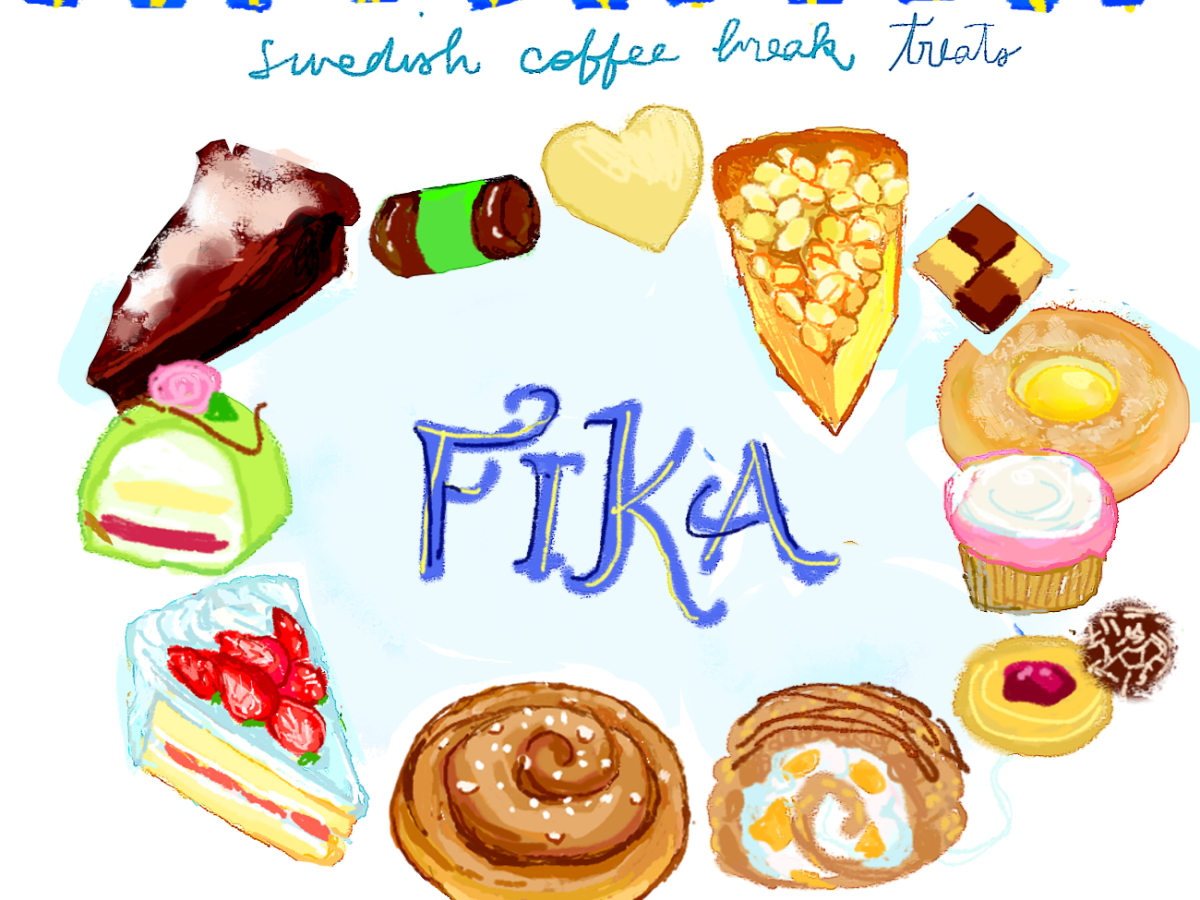
Illustrated Guide to Swedish Fika

Fika is a cherished Swedish tradition involving a coffee and cake break. Discover various Fika treats, from classic kanelbullar (cinnamon buns), cakes and cookies to savory options.

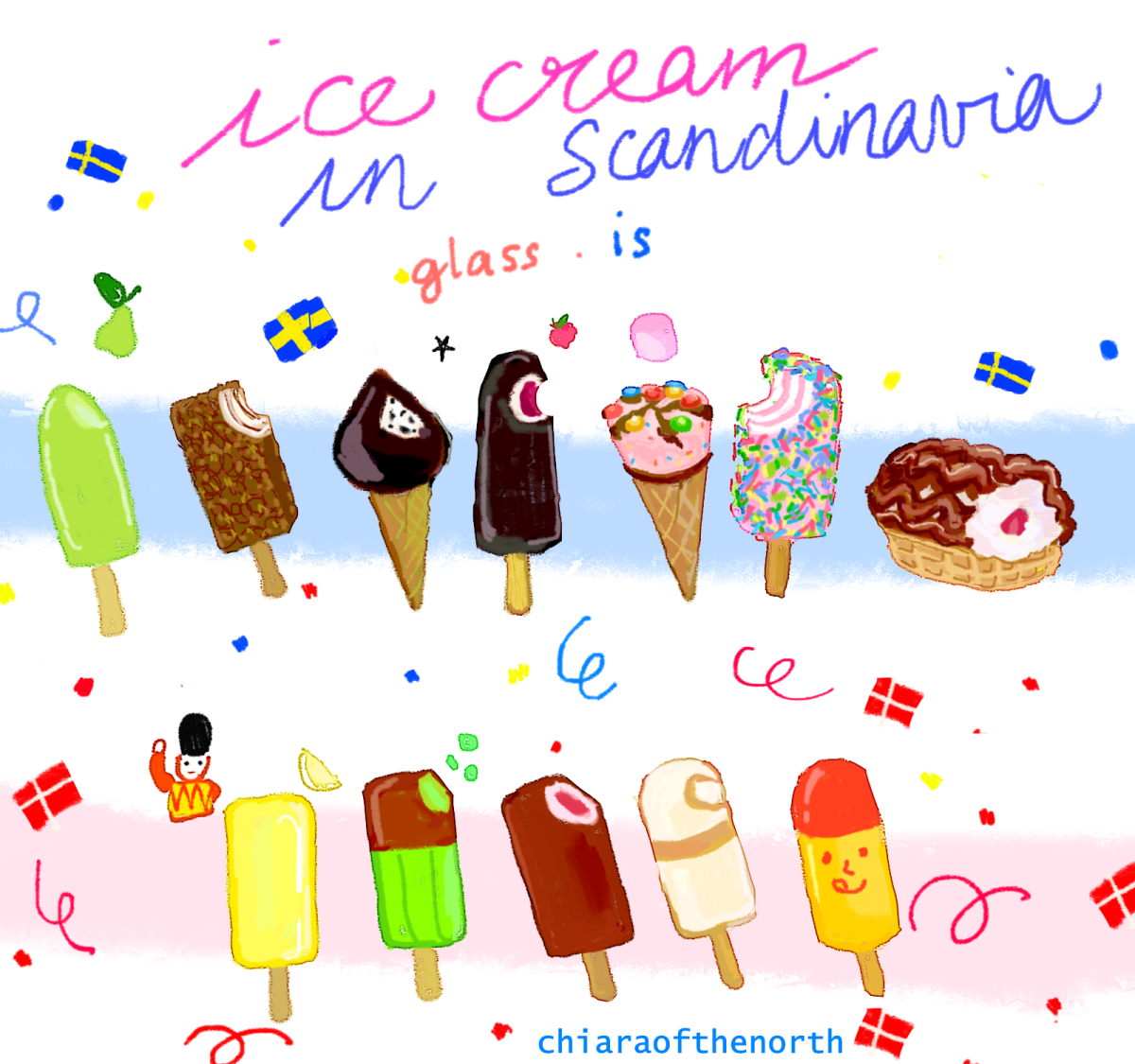
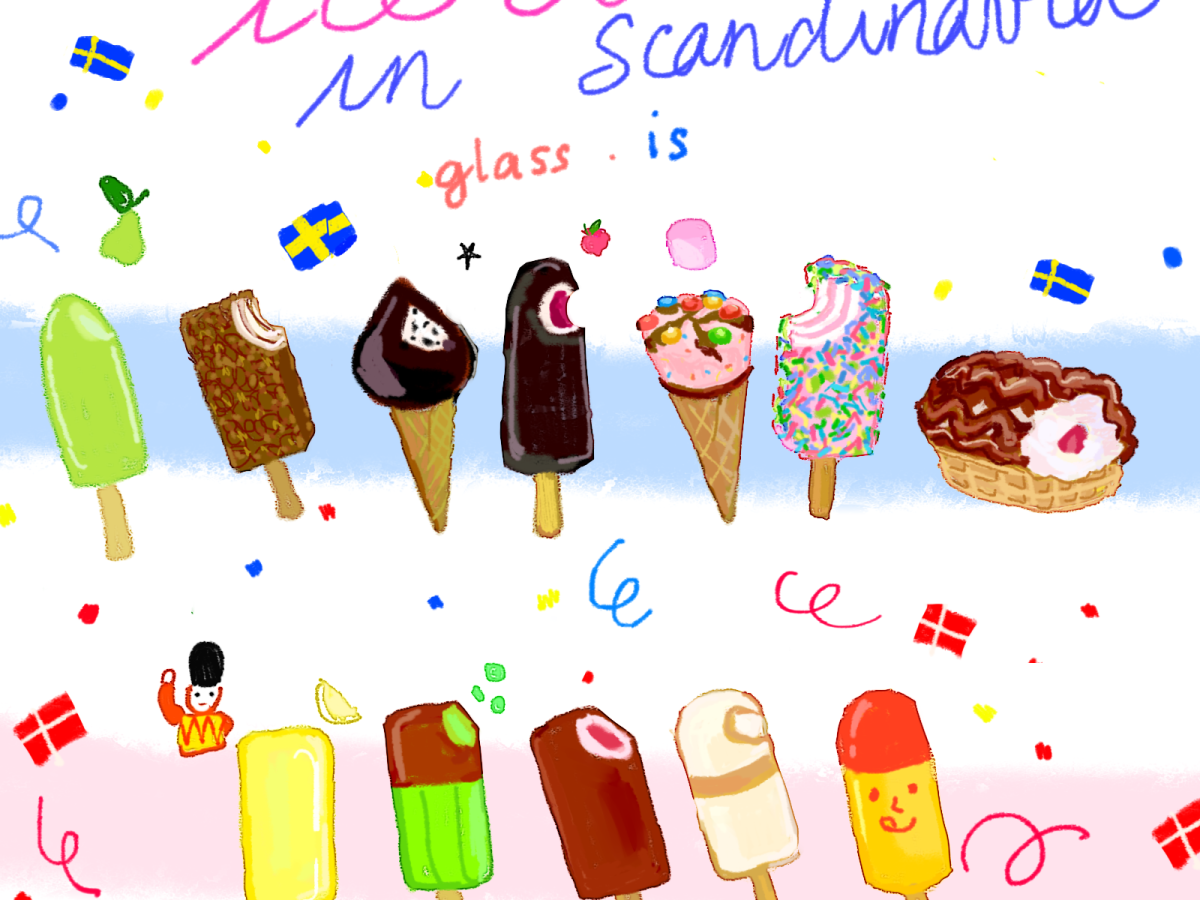
Guide to Ice Creams in Scandinavia

Discover Ice creams to try in Denmark, Sweden, and Norway: all-time classics,
Popular flavors, and curious novelties.

Since travelling to Scandinavia for the first time, i got quite acquainted with ice lollies available there, they have of course the magnum ice creams you see everywhre, but also quite a few interesting national classics, which vary. Here is a guide, so you are prepared..

Typical nordic flavours – Liquorice, pear and berries

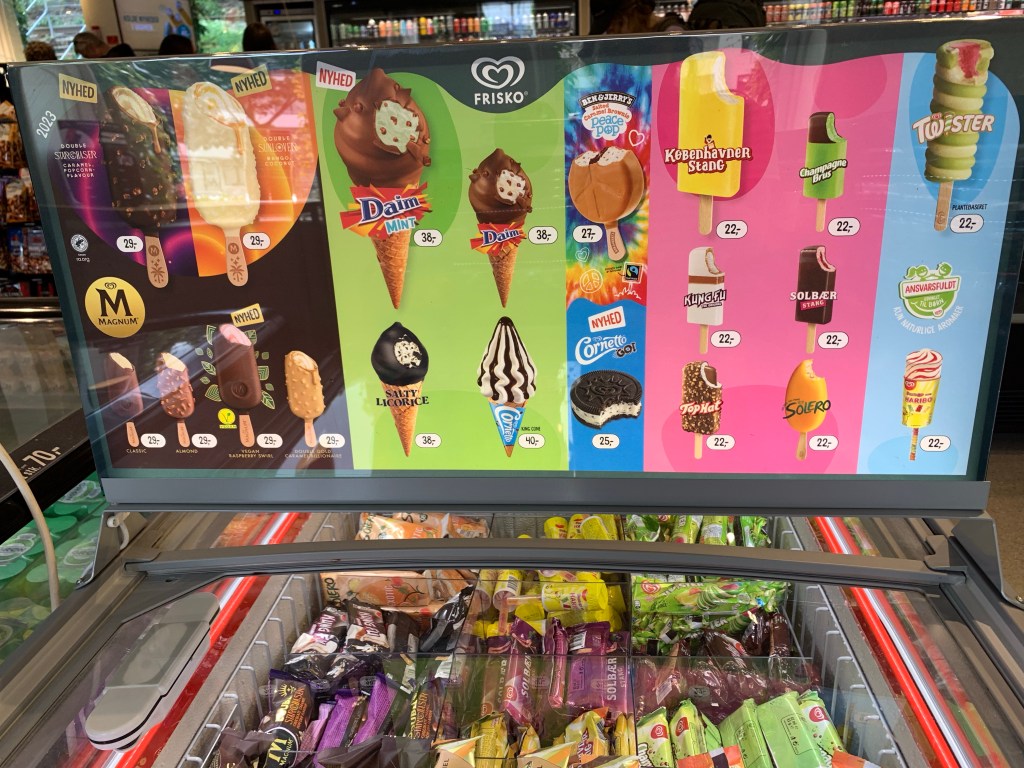
  • One thing you see everywhere in Nordic countries that is not as common elsewhere is liquorice as ice cream flavour: lakrits/lakrids. In Scandinavia you find a round DAIM chocolate covered cream cone with a few variations, which also come in a salt liquorice version! During a Denmark-Sweden holiday I tried a berry-liquorice lolly in Sweden.
  • Pear flavour very common in Sweden (Piggelin is GB pear ice lolly). A friend told me it probably is because you cannot grow many other fruit..
  • Solbær – blackcurrant- is a berry I’ve seen quite a lot in Denmark

The Danish Classic ice creams

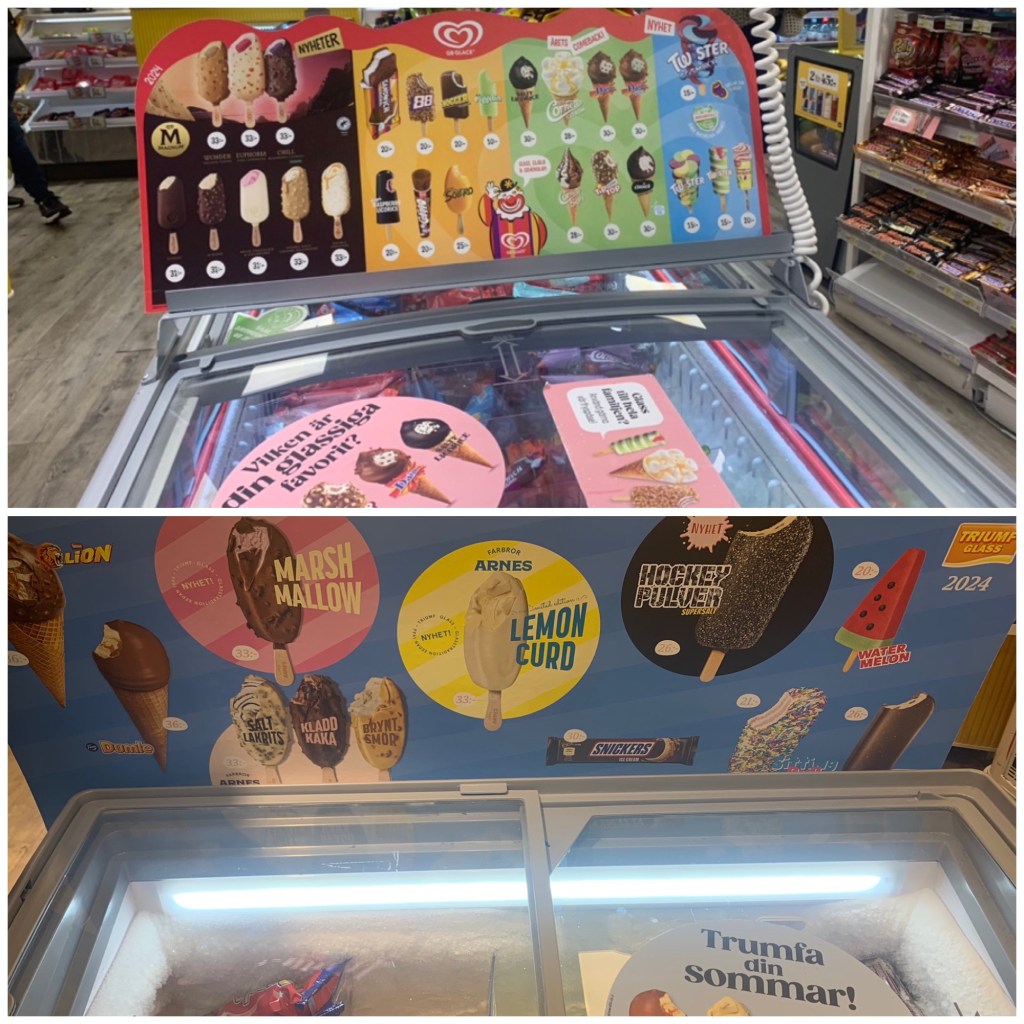
Frisko in Denmark, GB Glace in Sweden is the ice cream brand with the heart symbol present everywhere with different names, and many Ice creams I will mention are sold by it. Denmark has a set of all-time favourites, some have been around since the 50s!


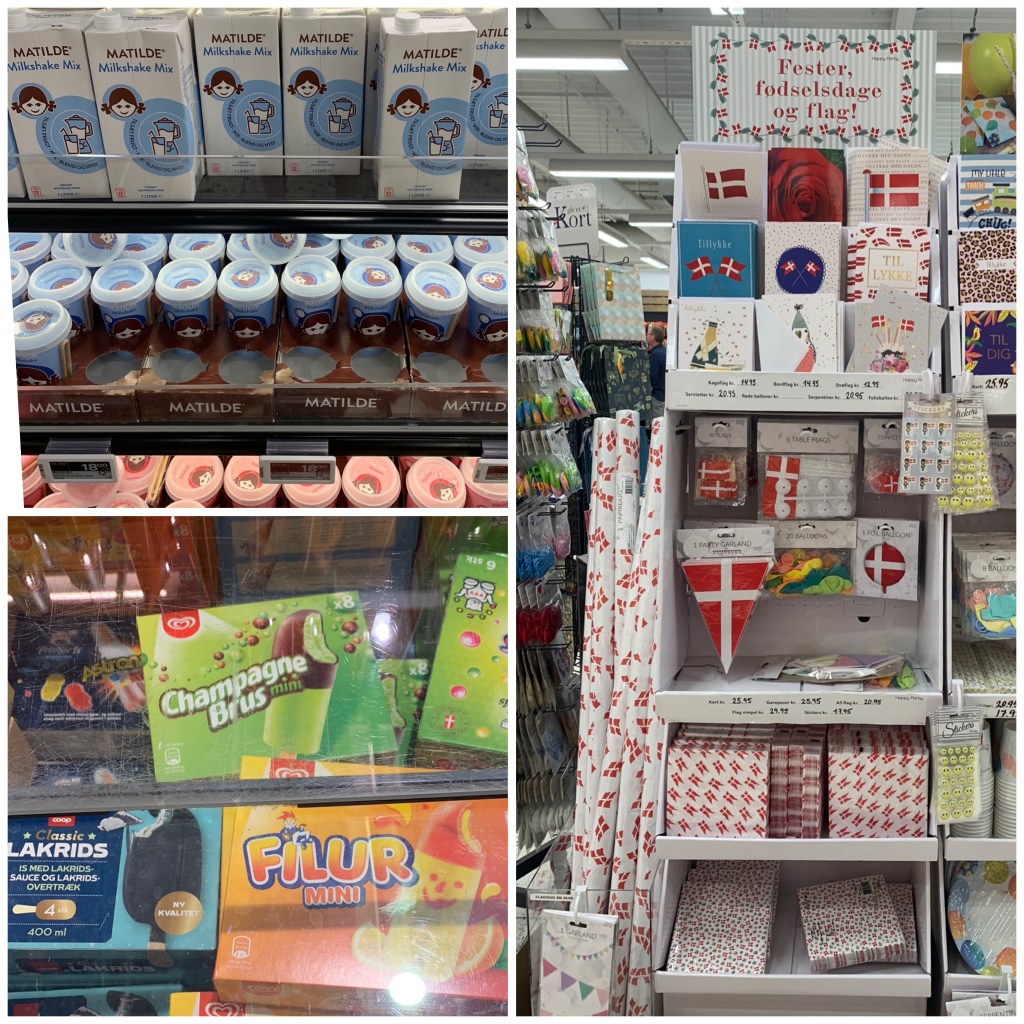
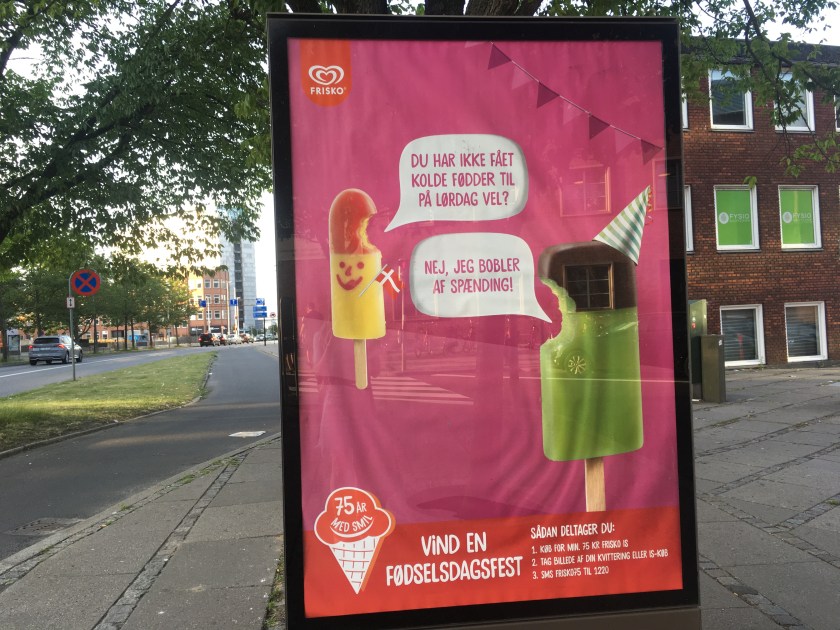
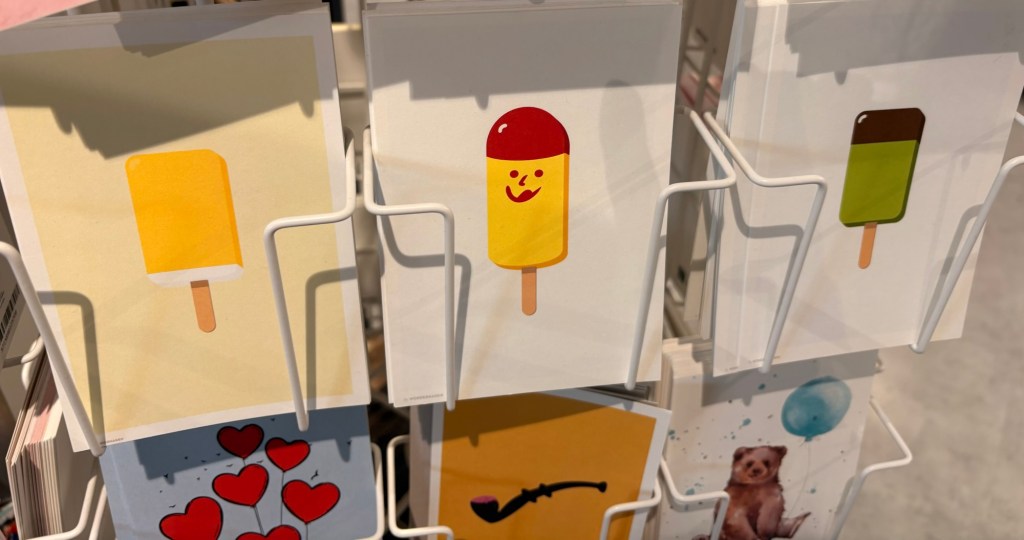
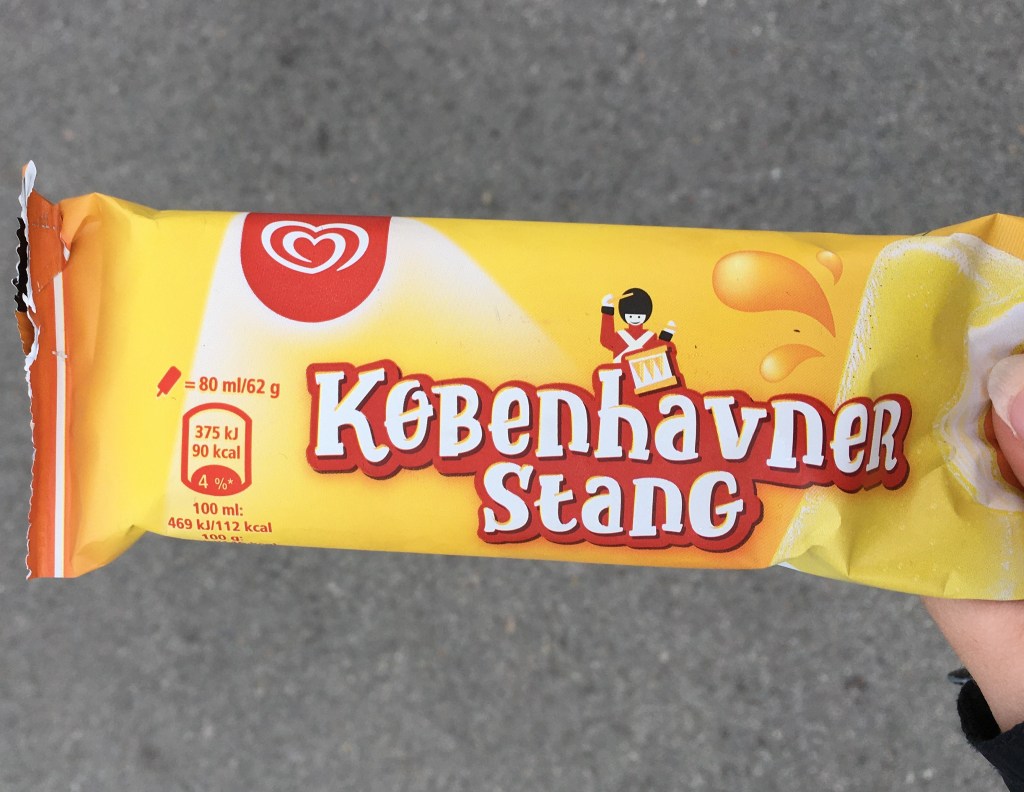
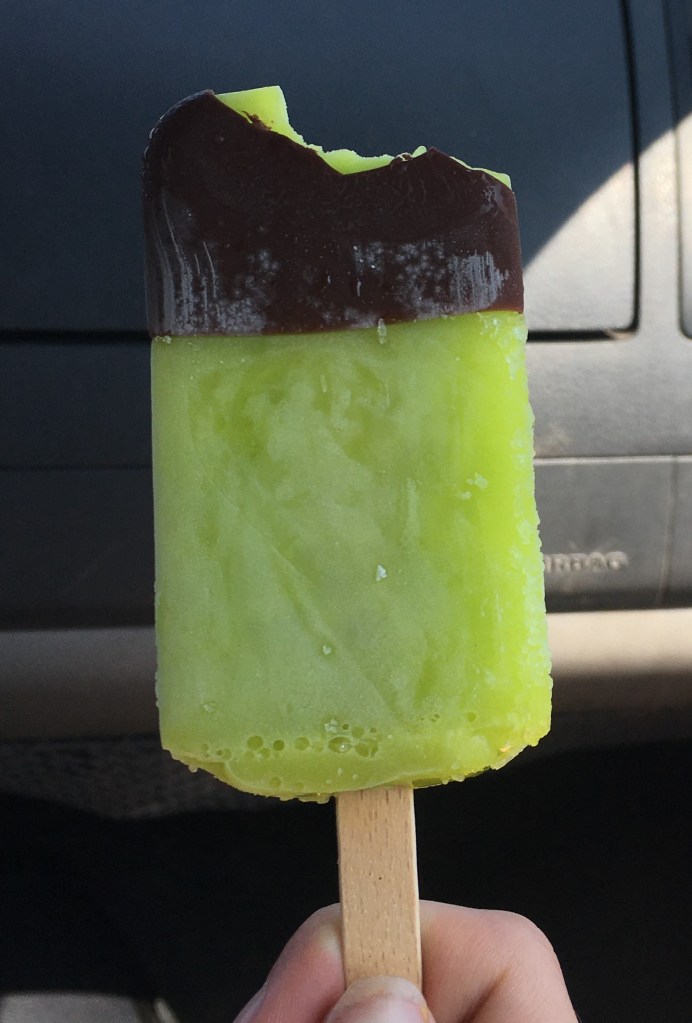
Københavner stang is just a plain lemon flavor but with the cute royal guard logo; Champagne Brus – I love the contrast of fizzy, acid green lemonade flavour and chocolate on top; Solbær – which changed name from Kæmpe Eskimo for political correctness – is cream and blackcurrant under chocolate. Kung Fu is lime and liquorice, Filur is the cute smiley orange-raspberry water ice cream.

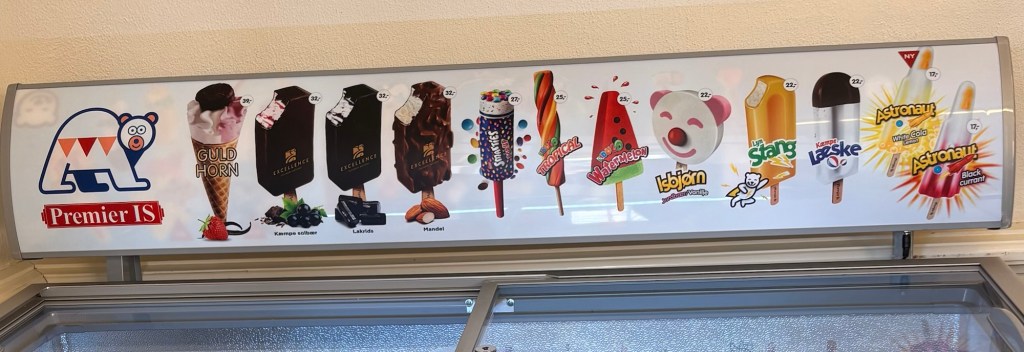
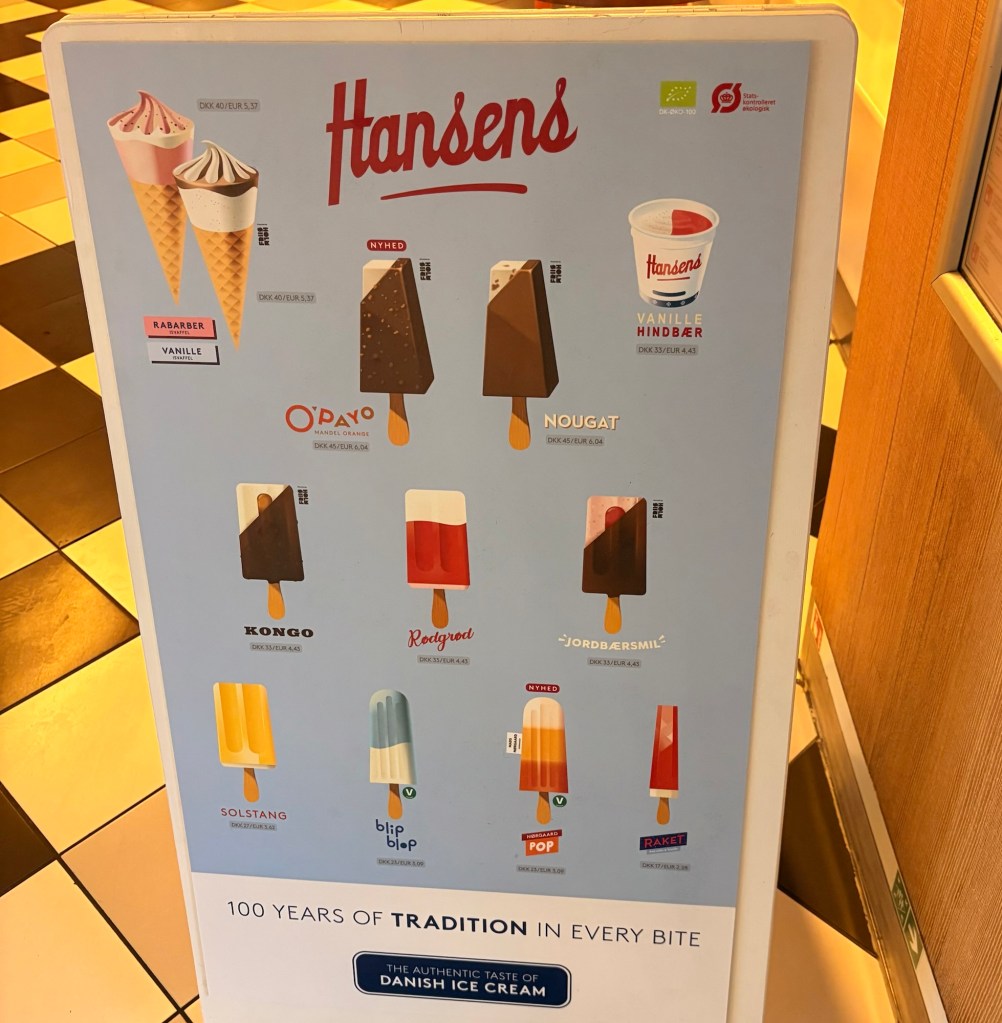
Premier IS is a brand which also features ice creams with black currant, liquorice, and the stang. On the ship between Germany and Denmark I saw Hansens ice creams as well – special mention for the rhabarber ice cream!

Sweden: the most creative ice creams?

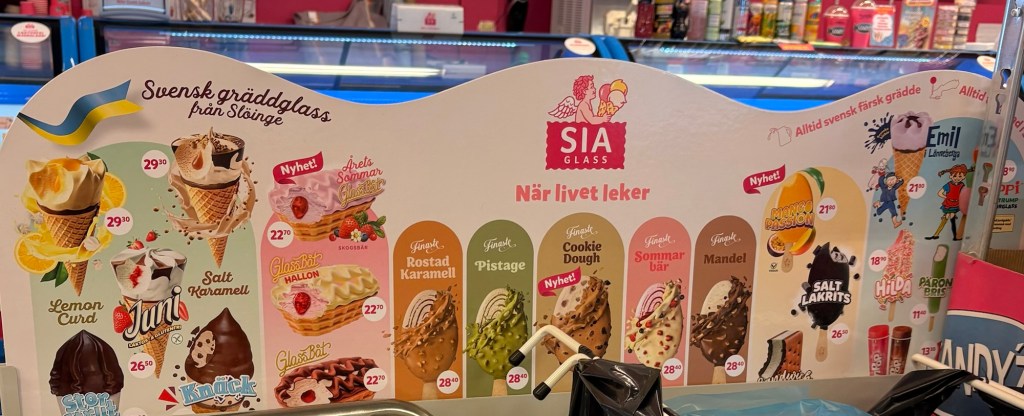
SIA is the main competitor of GB in Sweden I guess, based in Halland. notable ice creams are Emil and Pippi ice creams, the Glassbåt (‘ice cream boat’), and of course there is a pear and a liquorice ice lolly.

SIA ice creams for summer 2026

I would have also tried a Hilda, marshmallow/strawberry-ish? ice cream covered in rainbow sprinkles, or Godisregn (‘candy rain’), basically the same concept but in a cone.

pictures (c) SIA Glass

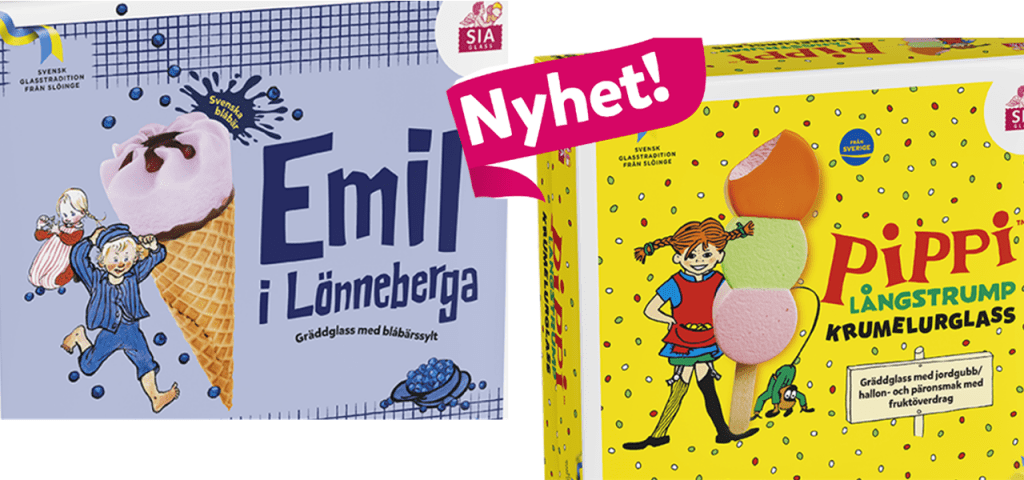
Emil and Pippi ice creams were 2025 novelties!! The former is Krumelurglass, made of 3 fruity ice cream flavours (which i got in the original candy form last year, krumelurpiller), while Emil is a blueberry and cream cone.

More interesting and very Swedish ice creams I have seen around are:

  • Konfetti gul & blå (blue-yellow as the Swedish flag) from Hemglass, lemon and blueberry ice creams with sprinkles on them.
  • Punschrulleglass, inspired by the green and chocolate dammsugare pastry. Hence it looks like a Danish Champagne Brus.
  • a Kanelbulle and a kladdkaka flavour one
  • Geisha ice cream- ice cream version of the famous chocolate candy by not Japanese, but Finnish Fazer.

The usual GB ice creams are a thing also in Sweden of corse – but a Swedish all-time favourites are the 88, read åttioåtta. Shoutout to my friend Linda & her husband who made me try it.

Norway’s 17 mai ice creams

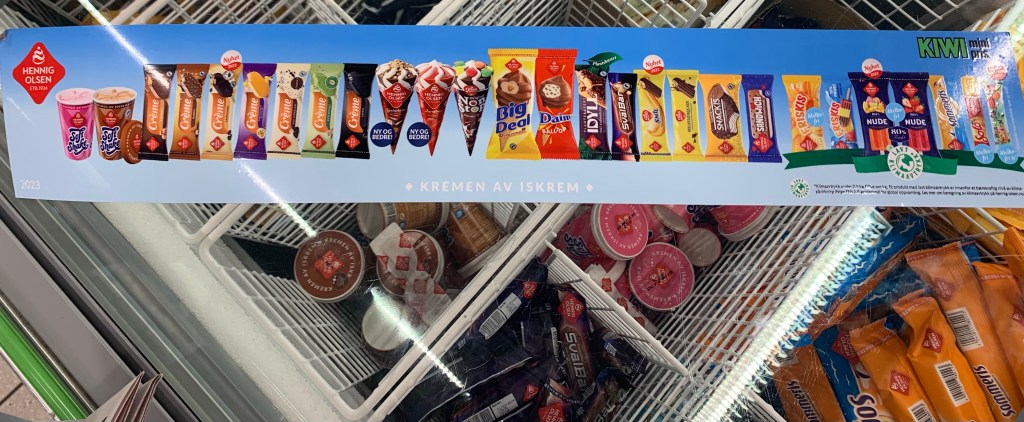
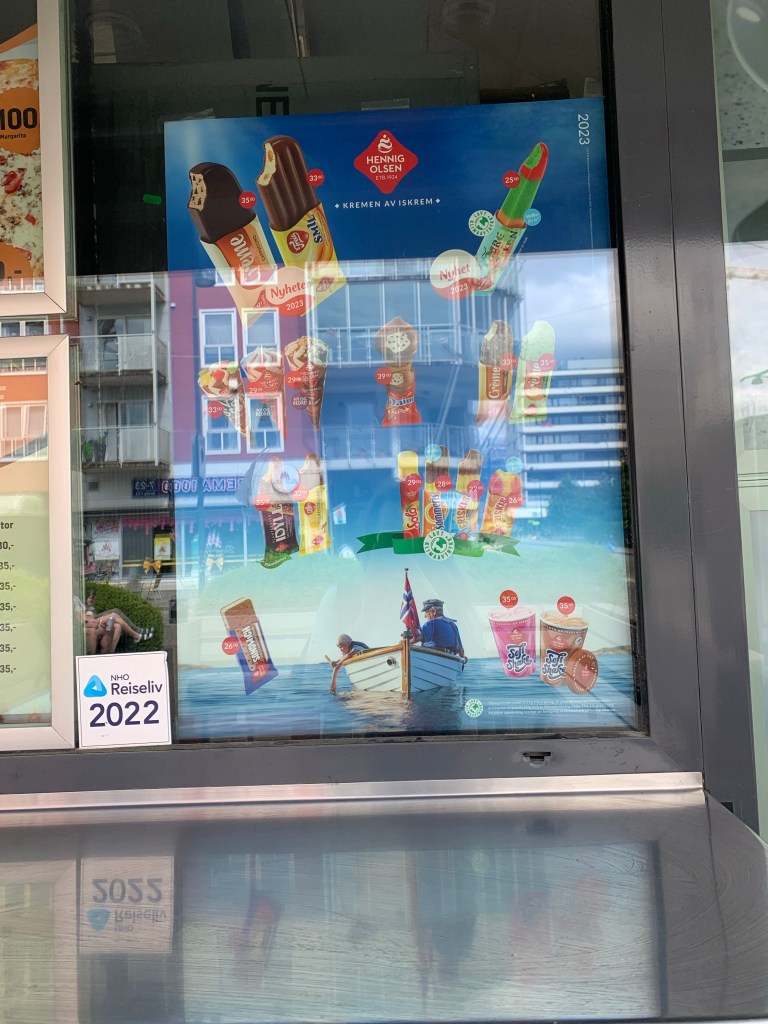
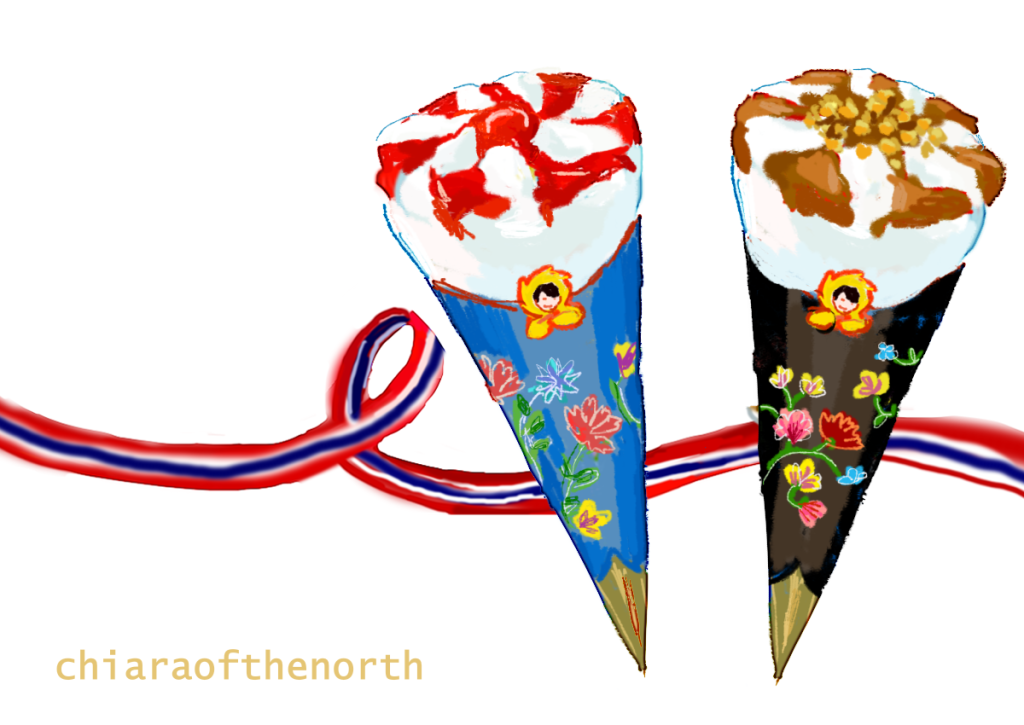
In Norway you see Diplom-Is or Hennig Olsen instead, not sure if Unilever is still behind them – Whatever. There are ‘regular’ strawberry or chocolate and cream cones, which around May get fancier for the National Day, 17 Mai, with bunad-like patterns.

I have not eaten any ice creams in Norway, but I have to say I saw nothing that stood out compared to the other countries! Please invite me to Norway to prove me wrong, haha.

Ice creams in the Baltics

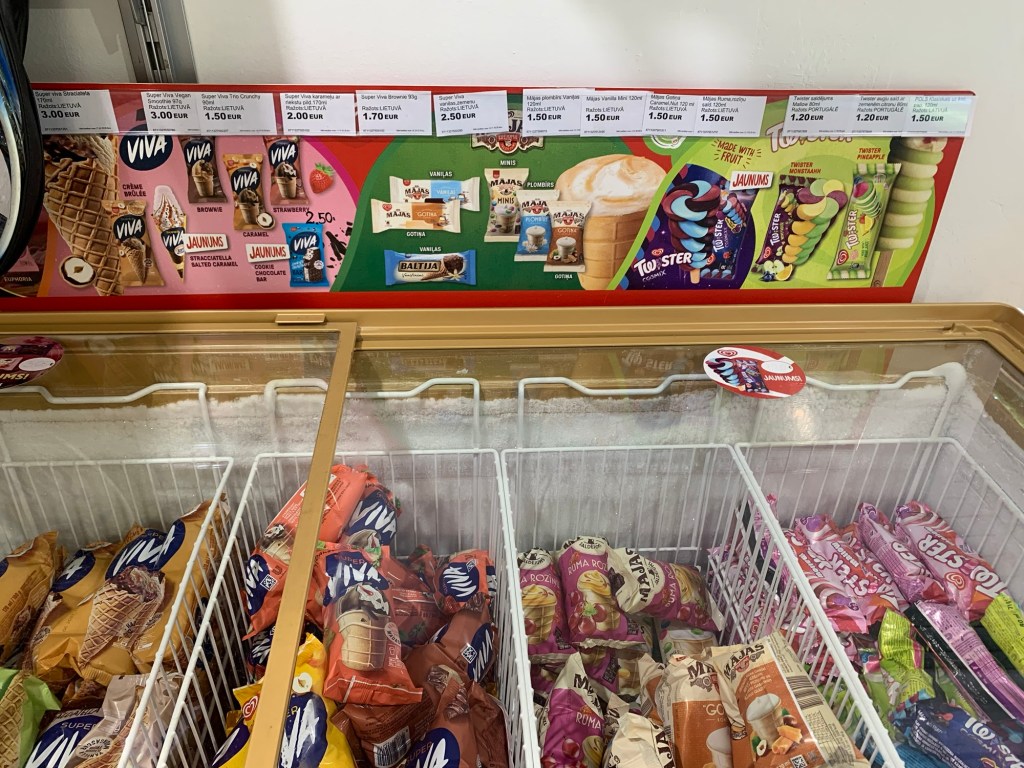
I have noticed noticed particular similarities with the Nordics and the Baltics in ice creams, I did just notice they have a brand called VIVA making chunky ice creams

That was all for now, I will update this post in the future summers…Or add it for Finland and Iceland and hopefully try out their ice creams!!

So subscribe to stay update on Scandinavian Ice creams:

Read more:

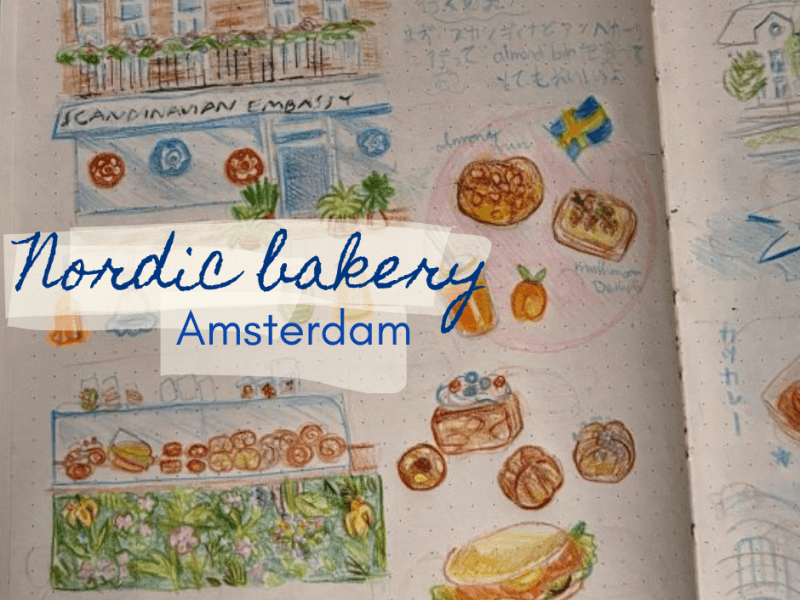
Scandinavian Embassy bakery and cafe in Amsterdam zuid

On a trip to Amsterdam, I decided to test Scandinavian Embassy and both of its two locations, starting with the bakery in europaplein. The two locations are in Amsterdam zuid: Saphatipark and Europaplein: in the former, a more central location, you can sit but it has fewer items than the bakery in Europaplein. The bakery,…

How I learned all Scandinavian languages (and more)- Anchor language method

The ‘anchor’ language concept allowed me to learn Swedish, Dutch, Danish, Norwegian easily starting from studying properly only one language. This approach helps prevent confusion and builds a solid foundational understanding of language structures.

At the Polyglot Gathering 2025 – an event to connect with fellow language lovers and attend talks on language-related topics – Richard Simcott mentioned an interesting concept during his talk Language Bubble. Replying to a question about learning many closely related languages (and avoid confusion) he talked about relying on an ‘anchor’ language. And I realized i actually used that method without being fully aware of it.

As I mentioned while talking about learning all Germanic languages simultaneously, I did not start 5 languages at once. It was a gradual journey. And I relied on different languages at different stages. First on German, then on Swedish, and that is how I gradually studied/learned all Scandinavian languages. My experience as follows.

How I learned Scandinavian languages together

My first Scandinavian language was Swedish, which I picked out of feeling. Sweden was probably just slightly better represented in my head than Denmark and Norway. I started it after having studied English and German for years, and that helped me significantly, vocabulary and grammar wise. The same goes for Dutch, which I started at the same time as Swedish – they are related, but not that closely.
When I started, I could make a lot of assumptions and give things for granted thanks to my German knowledge: verb position, past verb paradigm, vocabulary I could understand etc. Back then, German could be loosely defined as my Anchor language for both.

Then, after having focused myself only on Swedish for 2 years, I started trying to write in Danish. I could not express myself but all i needed was figuring out how to modify my Swedish. The grammar works In the exact same way for most things, vocabulary is often very similar and has recurring spelling differences. After a while just google translating you see the patterns, and learn fast because of how similar they are.
Similarly, as I happened to chat with more Danes than Norwegians, I expanded a lot my Danish skills, making it more ‘independent’ from my Swedish. For Norwegian I have been relying on both, being aware of typical Norwegian features. I believe the key when attempting to speak is learning well filler words. The listener will be impressed about it before you recycle a word in another language – fake it until you make it they say.

Knowing Scandinavian languages surely did not have the same role as an anchor language when learning Icelandic, but I guess I could/can still use them as a ”reference”. German similarly when it came to Icelandic grammar in the beginning.

Anchor language concept In a nutshell

This concept consists in one language being on a higher level than the rest, To know something also means to know what distinct it from the rest, and for that you need a solid base you can rely on and use as reference. At some point, you will rely less and less on the anchor language.

  1. Pick a language and focus only on it and no new closely related ones for a while. You do not need to become fluent, but you need to know the language structure well: how grammar works, general vocabulary etc. So you are sure of what is Swedish, and do not mix it with what isn’t when learning.
  2. Get exposure in other related languages: start getting to know the other members of the family. Just like in a real family you do not remember the names of everybody after first introductions with many new people, so you have to have contact with them again here and there to actually be acquainted.
  3. Start using the other languages. As the passive language skills are already there due to language intellegibility, and you can use what you naturally absorb after a while, also by searching words you do not know and grammar concepts that might be different in your anchor language.

you can also see it as writing two essays: it works better to first write and finish one with a defined structure, then take that structure for a different topic and slightly modify it, than starting two different essays simultaneously, adding bits to both now and then, ending up with two randomly written texts.

The same can be applied for Romance languages, though my Anchor language is my native language, which I obviously have a strong base of to begin with…

I do plan to focus on Finnish to be able to make it my anchor language in order to easily learn/understand Estonian. It already helps with absorbing grammar features and some words I have randomly encountered, but to be a proper anchor there is work to do!

Find more language tips & facts on Nordic languages learning on this blog, or check out my free language resources list.

5 symbols of Sami culture

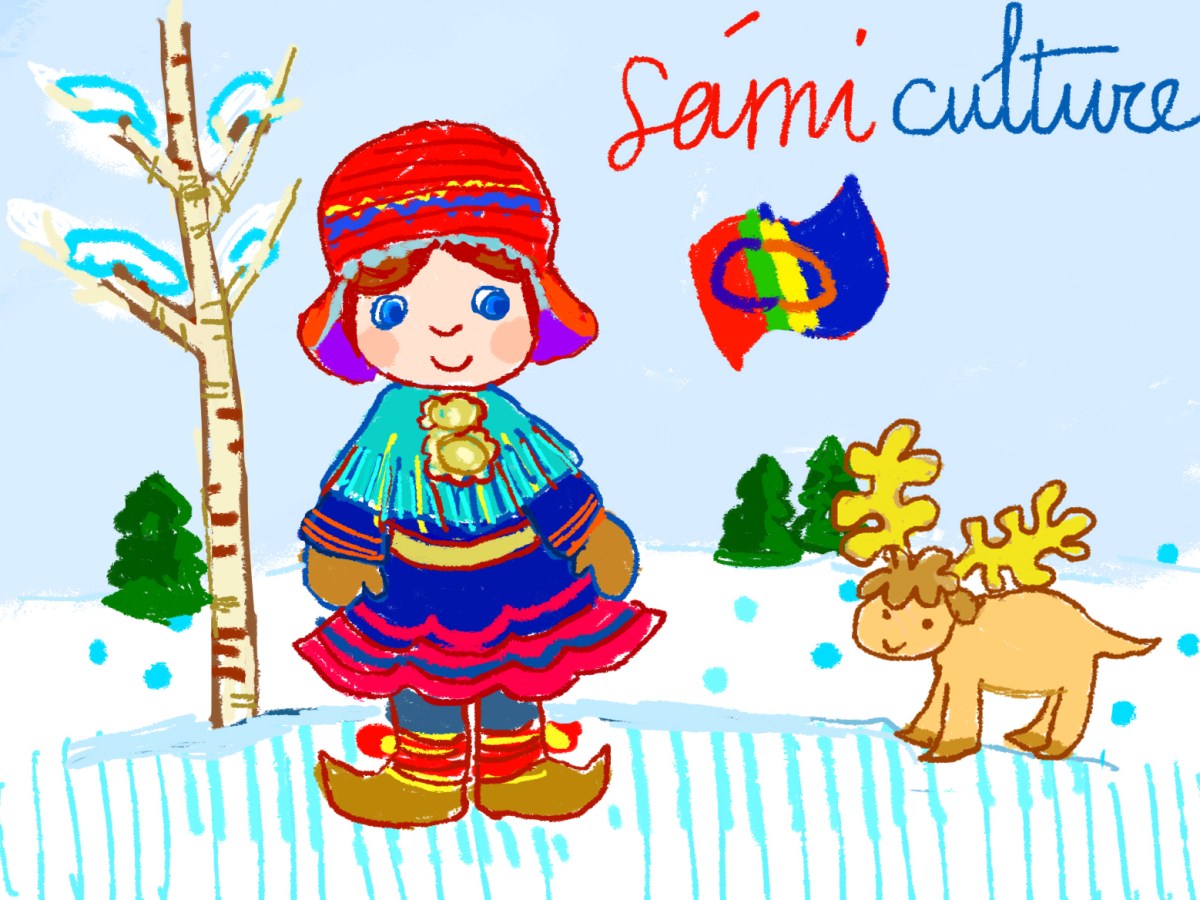
Sámi people, indigenous people of North Scandinavia, have a distinct culture, symbolised by its unique flag and traditional clothing, and part of it are Duodji handicrafts and unique musical expression through yoik.

20+ Mindblowing Icelandic Composed Words

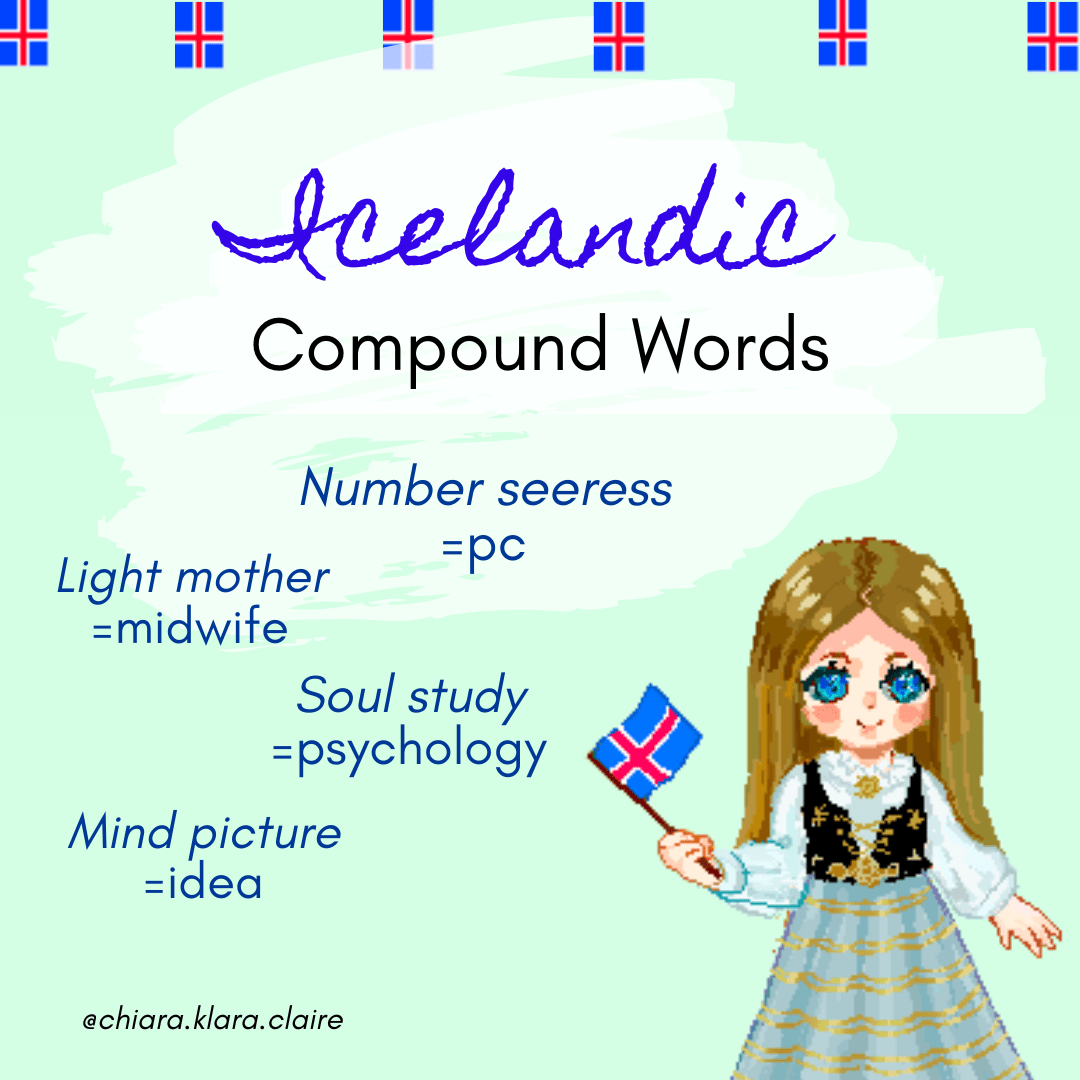
curious Icelandic compound words, from unique Icelandic words as ‘number prophetess’ for computer to ‘light pear’ for lightbulb.

Icelandic, like other languages, has a lot of compound words, expressing a concept with multiple other words.
For new concepts, for example technology-related vocabulary, Iceland has a committee inventing new words for new concepts, by assembling existing Icelandic words. This is to follow the language purism policy, and avoid just adapting foreign words or using loanwords.

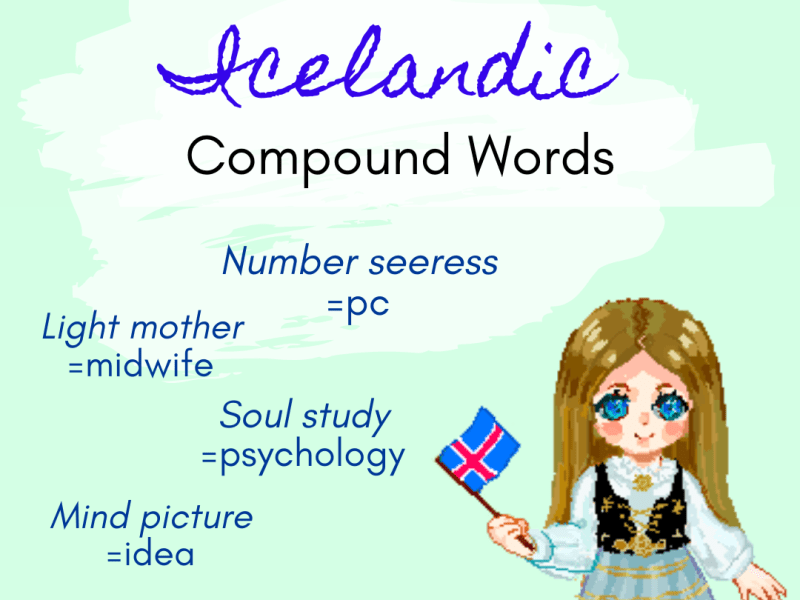
Here are some Icelandic compound words I like. Can you guess the meaning by looking at the literal translation?

words unique to Icelandic:

Icelandicliteral meaningmeaning
tölvaNumber-Prophetess (tala+völva)computer
ljósmóðirlight-mothermidwife
bergmálrocks-languageecho
tónlistsound-artmusic
hugmyndmind-pictureidea
ástfanginnLove-capturedbe in love
hugfanginnmind-capturedfascinated
sálfræðisoul-studypsychology
málfræðilanguage-studygrammar
Viðskiptavinurbusiness-friendcustomer
HunangsflugaHoney–Flybee
Mörgæs Fat-Goosepenguin
spékoppar
naughty cupscheek dimples
smokkfiskurcondom-fish*squid
leigubílrent-cartaxi

Compound words that also exist in other languages

Icelandic also took words that are jut adaptions of the original Greek words, literally translating into Icelandic, and shares quite a few with other (Germanic) languages, which are still curious if you are not a speaker of any of them.

Icelandic wordliteral meaningEnglish/most European languages from Greek/Latin
ljósmyndlight-picturephotography (phos+graphe: light+writing)
Reikistjarnawandering-starplanet (planḗtēs, “wanderer”, ellipsis of astéres planêtai, “wandering stars”)
rafmagnamber-powerelectricity (ēlektron: amber)
flóðhestur* river-horsehippo (hippopotamos)
Nashyrningur*nose-hornrhino (rhinocerus)
Legkaka*Womb-Cakeplacenta (literally “flat cake”, ellipsis of placenta uterī “womb cake”)
InnblásturIn-Breezeinspiration…(yes, you’re welcome)

*As in Scandinavian languages flodhest/häst or ‘Nile-horse’ in German and Dutch Nipferd/nijlpaard; similarly Noshörning, neshorn, Nashorn, Neushoorn ‘nose horn’.
*Scandinavian mo(de)rkake, ‘mother cake’.

Some curious combination are present in other languages as well:

Icelandic wordliteral meaningsame asEnglish
eldfjallfire-mountain火山 (Japanese)volcano
Gæsalappir Goose-FeetGänsefüßchen (German, besides Anführungszeichen)Quotation Marks
LjósaperaLight-PearGlühbirne (German), lyspære (Norwegian)lightbulb
vínberwine-berryviinamarjad (Estonian)grapes

sources:

Article by Silvia Cosimini on Passenger Islanda, Iperborea.
Reddit thread: /r/linguisticshumor/comments/17k5ivl/whats_the_most_ridiculous_example_of_semantic/
guidetoiceland.is ‘s Icelandic Language iverview
Boredpanda.com

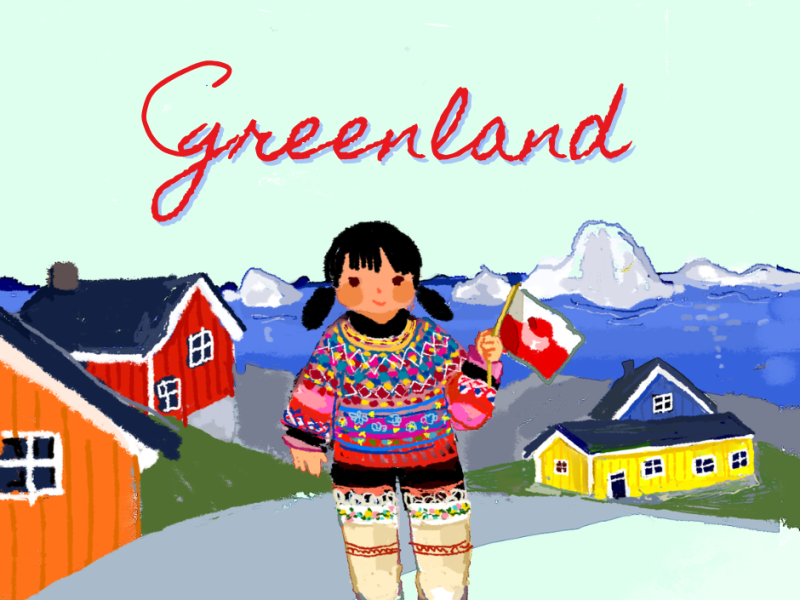
Who are Greenlanders? 3 symbols of Greenlandic culture

Discover Greenland, home to the Inuit Kalaallit, and its most iconic aspects as its flag, language and folk costumes. The biggest island of the world has a rich history of indigenous culture intertwined with Norse colonization and later Danish rule.

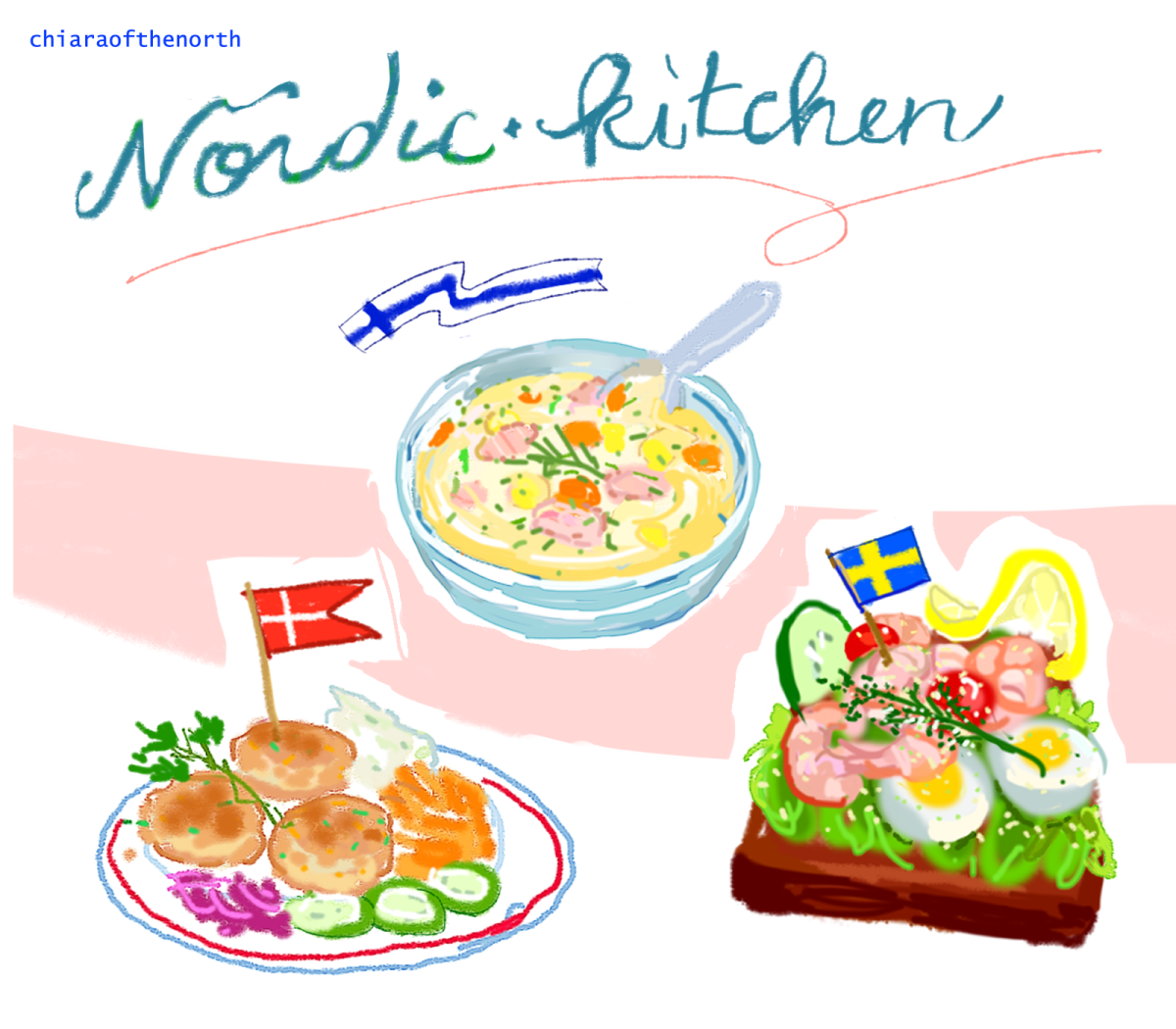
3 easy and fast iconic Nordic dishes

simple and iconic Scandinavian recipes to make yourself for a typical Nordic dinner

I have been testing Nordic dishes as someone with not-so-incredible cooking skills who likes to cook simple things, and these are three delicious and easy meal ideas I can present you, in time/complexity order from the easiest:

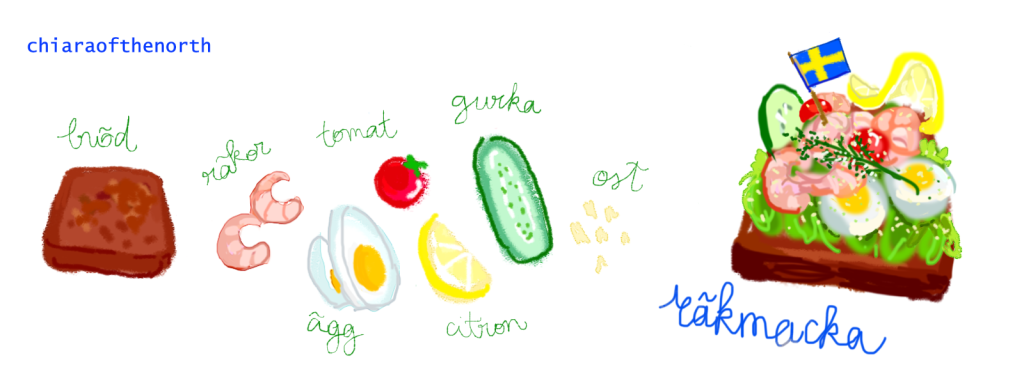
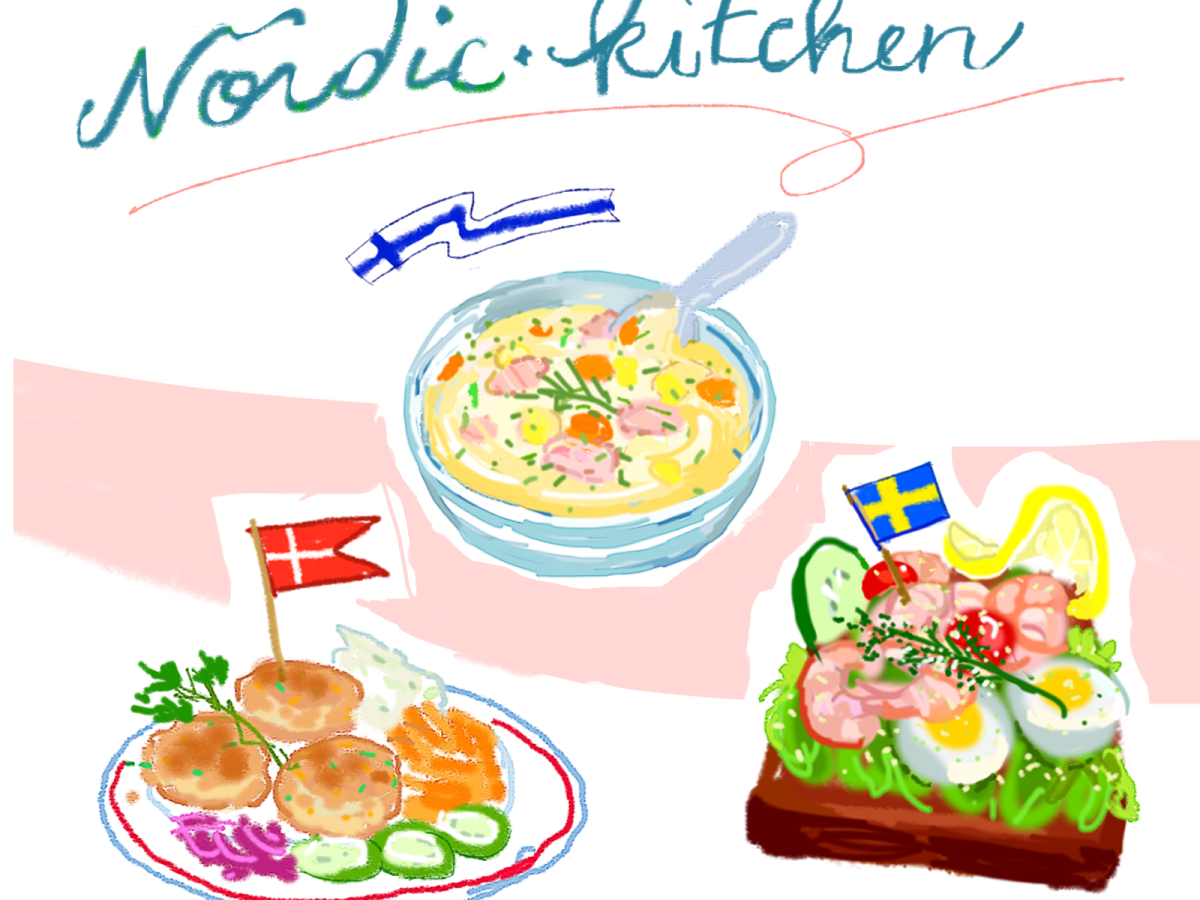
1. Räkmacka – Swedish Shrimp open sandwich

Typically found at cafés as savoury option for a fika, but you can easily make it yourself – (rye) bread with Shrimps, cucumbers and tomato slices on salad, often egg and lemon – add whatever you like and make it look fancy!

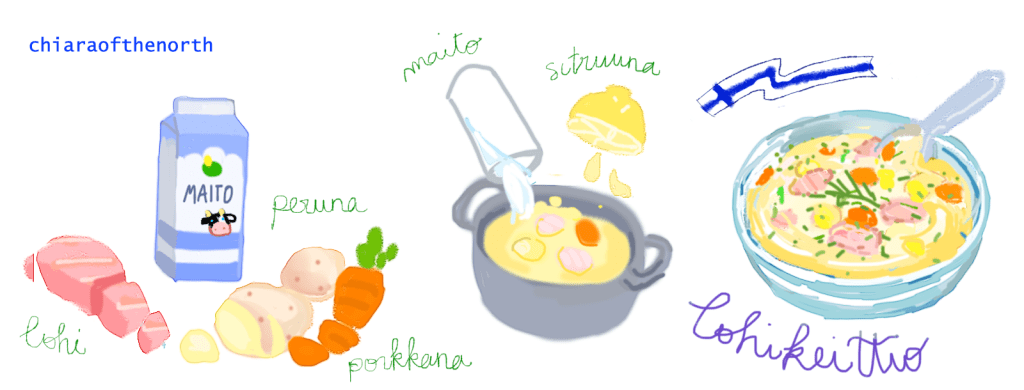
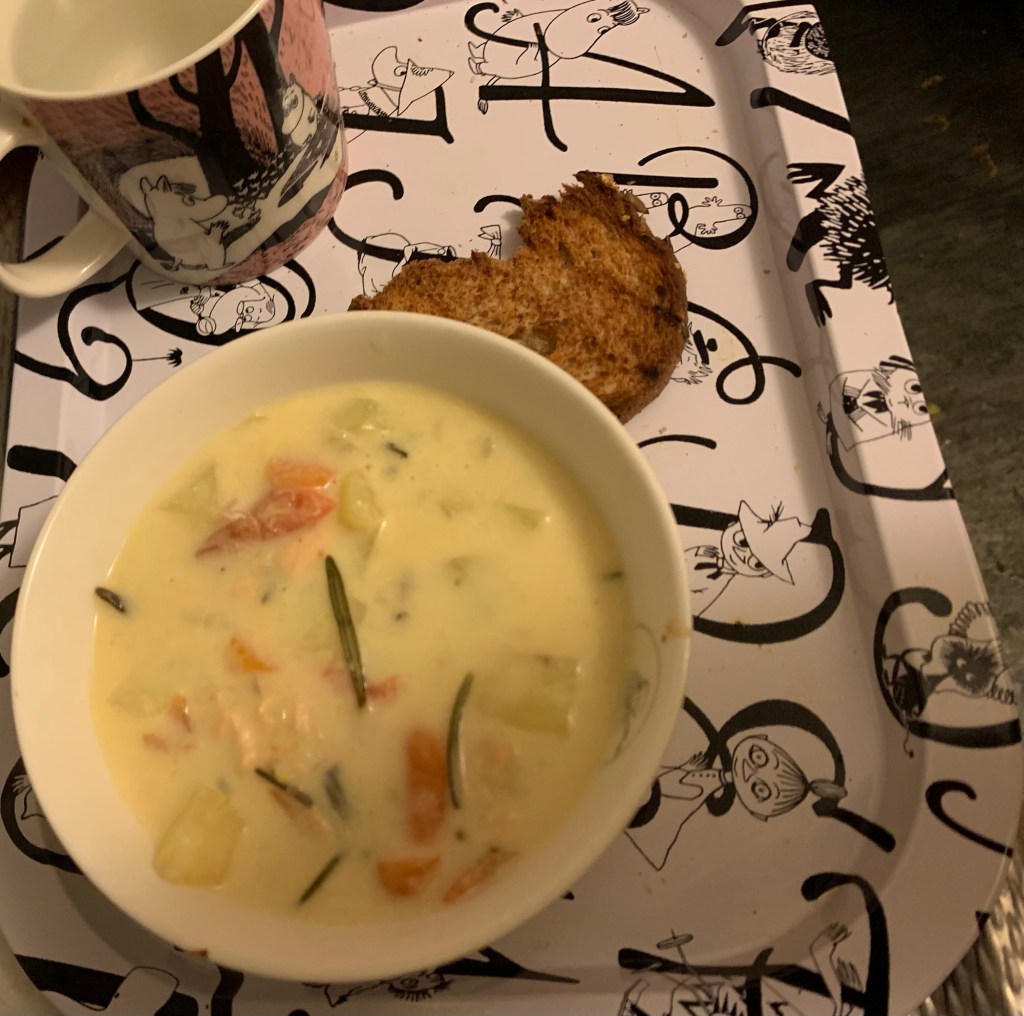
2. Lohikeitto – Finnish salmon soup

soup with chopped salmon, based off milk and lemon juice, and enriched by veggies as potatoes and carrots.

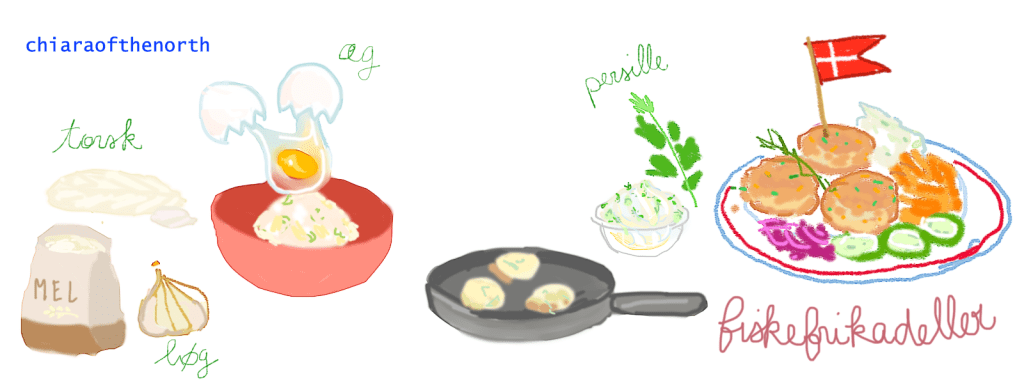
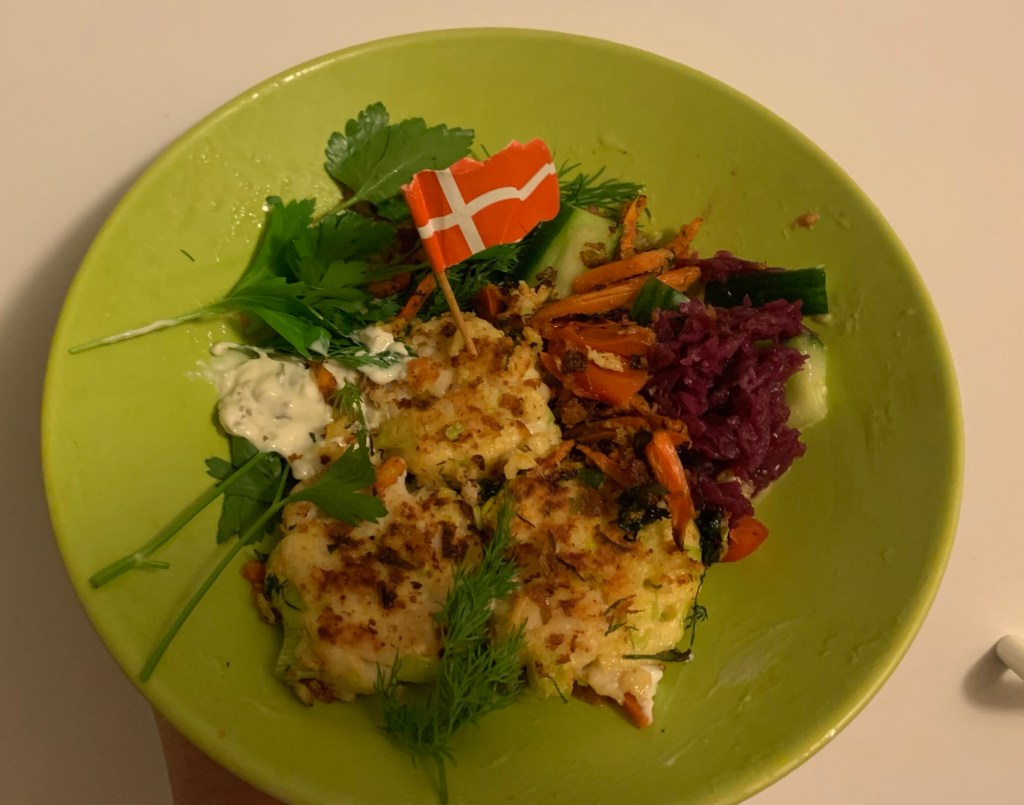
3. Fiskefrikadeller – Danish fishballs

Make balls after mixing fish chunks (I have used pangasius and cod) with egg, flour, spring onion – I also like to add carrot bits -, Fry them in a pan on both sides. Garnish with herbs as parsley. Complete the plate with some fresh veggies to the plate as cucumber and red cabbage. Enjoy the fishballs with remoulade sauce as the Danes do!

Here are pictures of my experiments:

Disclaimer: these are my creative versions, and I do not follow 1:1 classic recipes. You find plenty of other references online! You can still see more Scandinavian and Nordic food on this blog, from my trips in Scandinavia and to Nordic cafés elsewhere.
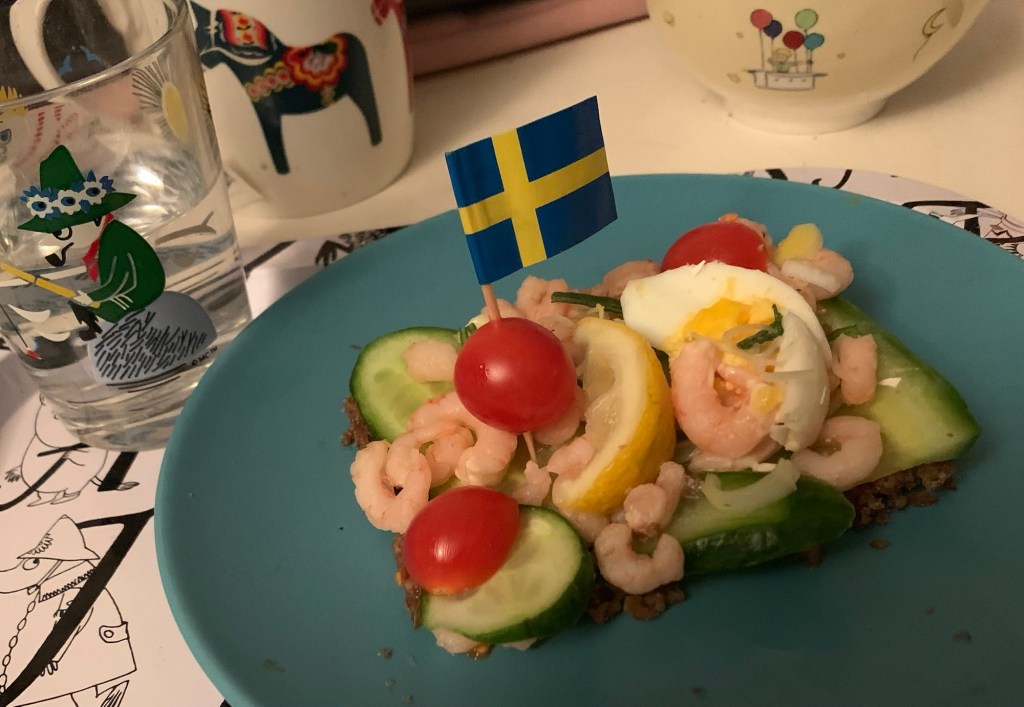
Please let me know if you will try making these!

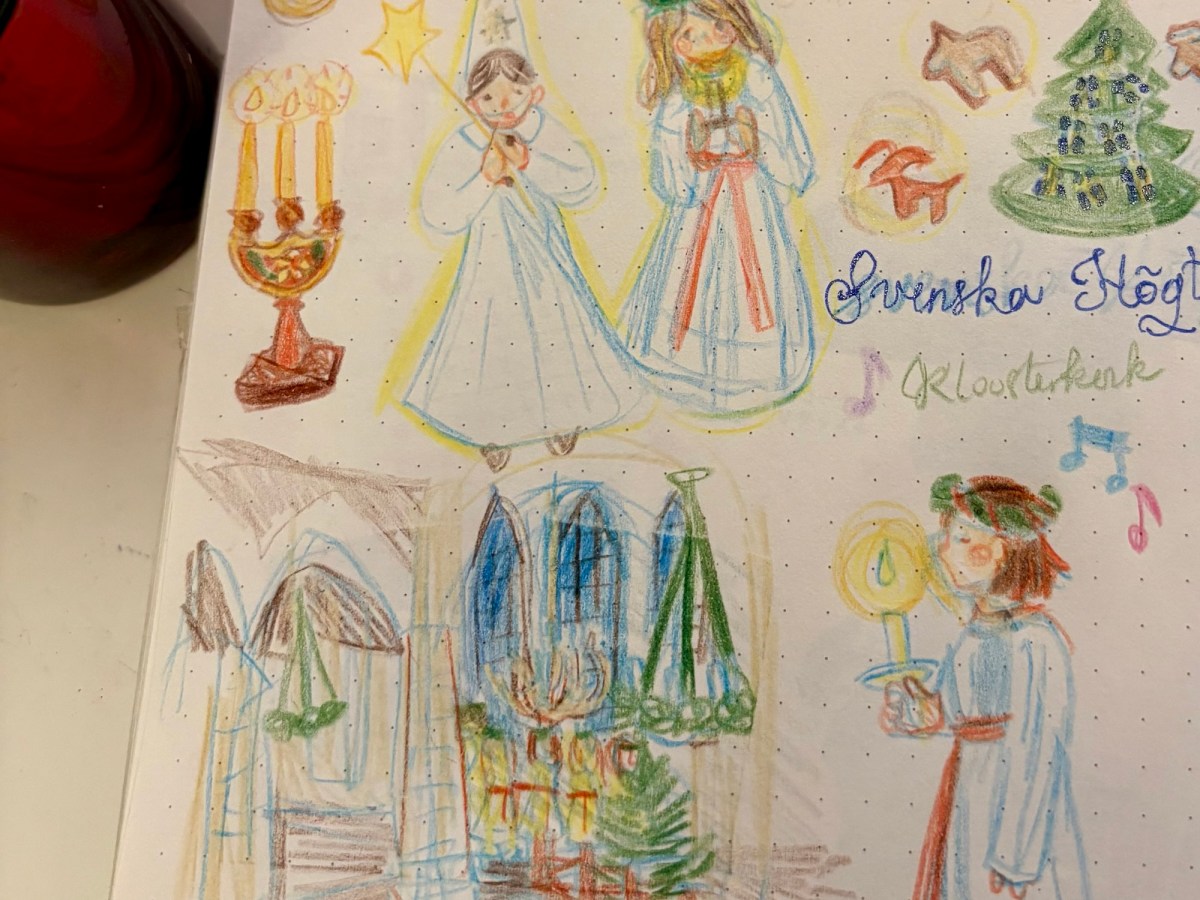
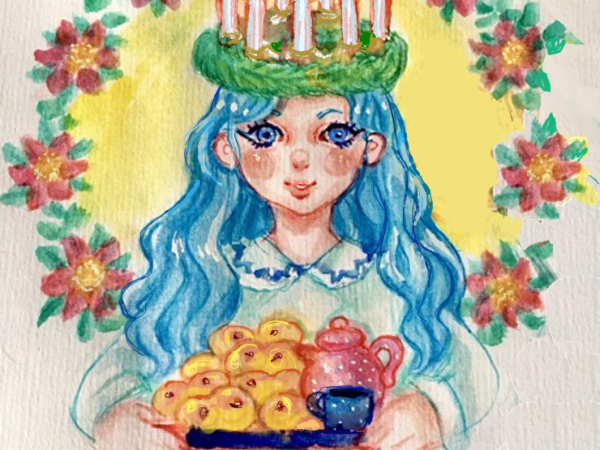
7 fun facts about Lucia, Sweden’s pagan saint

Lucia brings light in the darkest night of the year and is a mix of pagan and christian traditions. It is celebrated in Scandinavia with processions, saffron buns and church concerts.

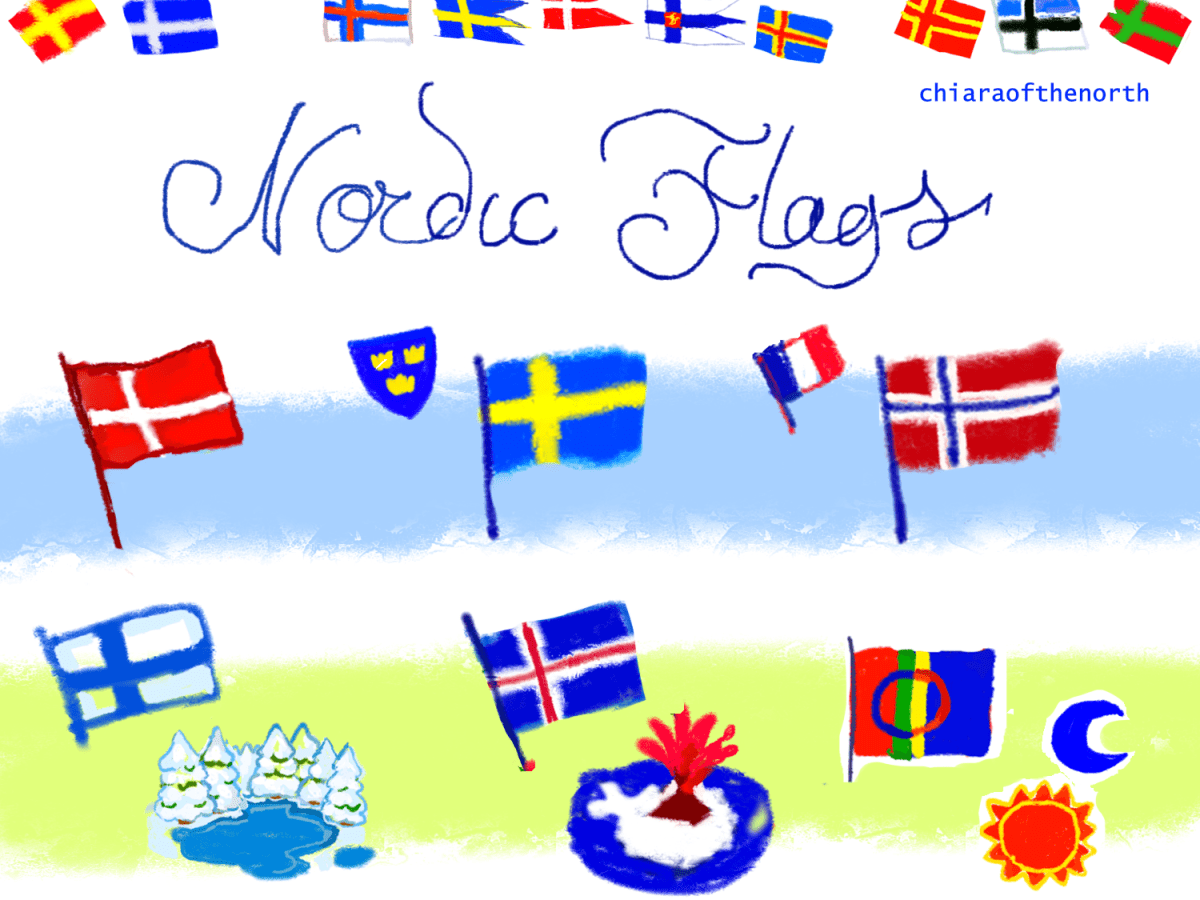
Nordic flags explained

Origin and meaning of Nordic flags and other Nordic cross flags explained

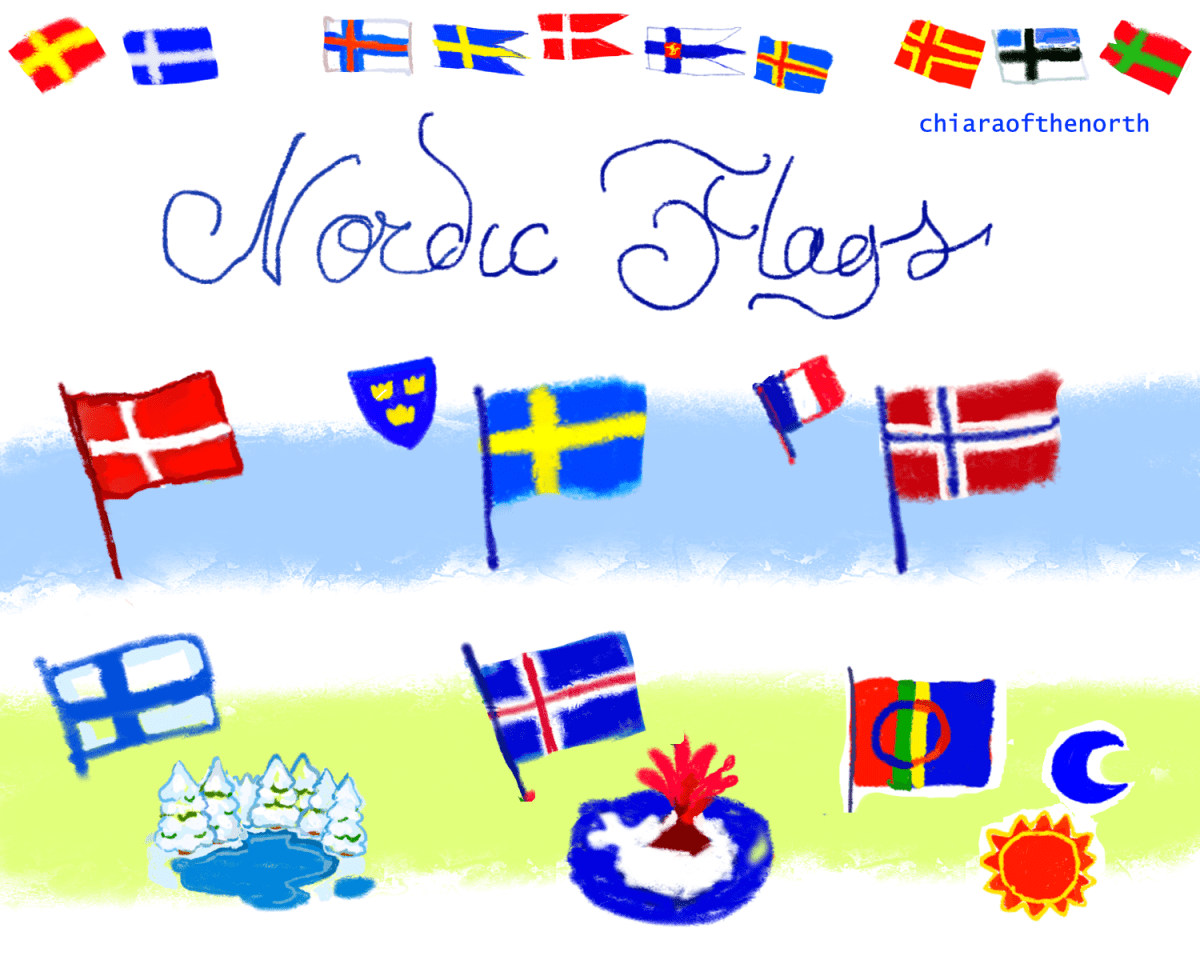
Tomorrow, 23 March, is Nordic day, on this day the Helsinki treaty, establishing the Nordic Council, was signed in 1962. Its member are all Nordic countries and autonomous regions – including Åland, the Faroe Islands and Greenland.

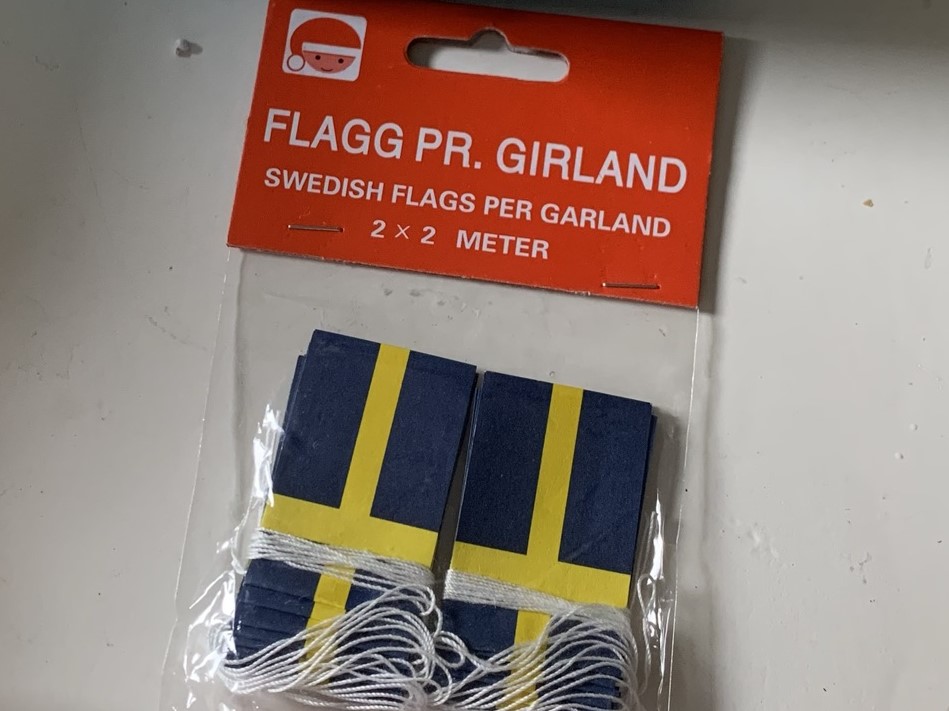
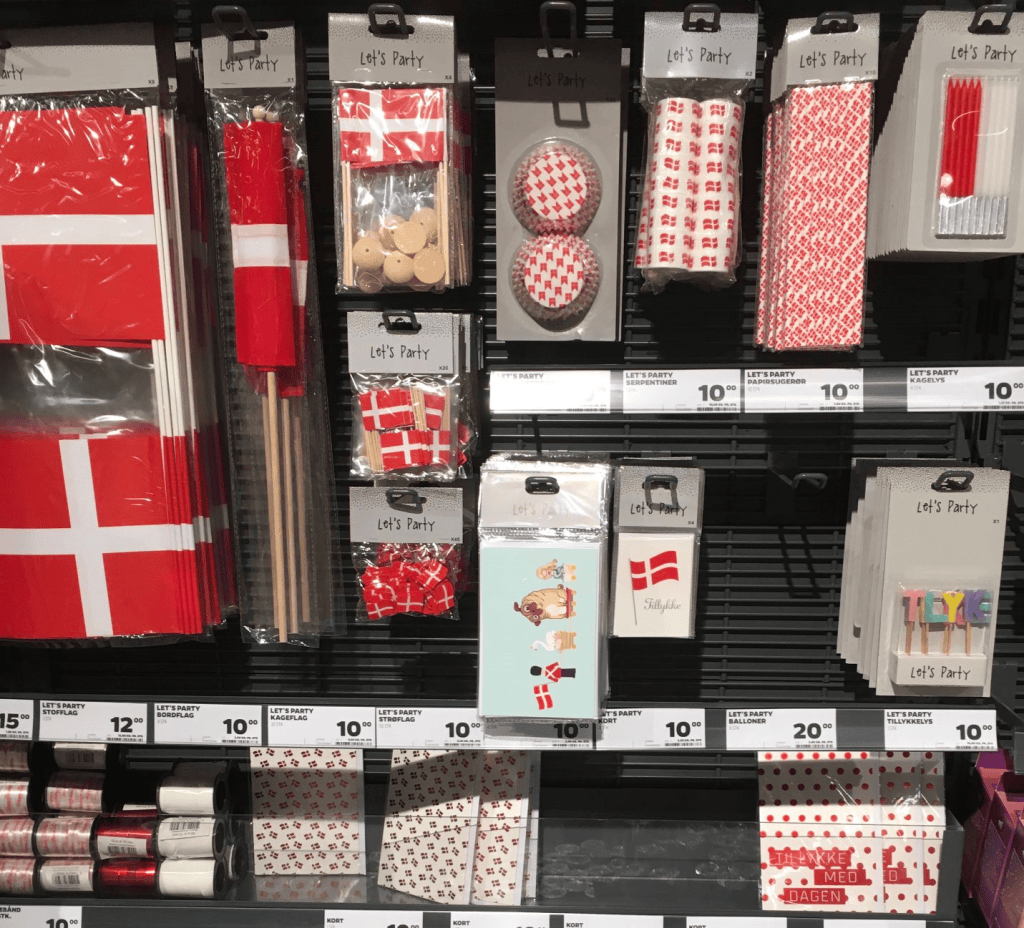
In honour of this occurence, I am writing this post explaining Nordic (cross) flags. Scandinavians and Nordic peoples in general really like to use their flag, which are common to see in various forms and occasions, from pennants to wooden table flags, as decoration for a birthday or on a Christmas tree. But let’s go back to history!
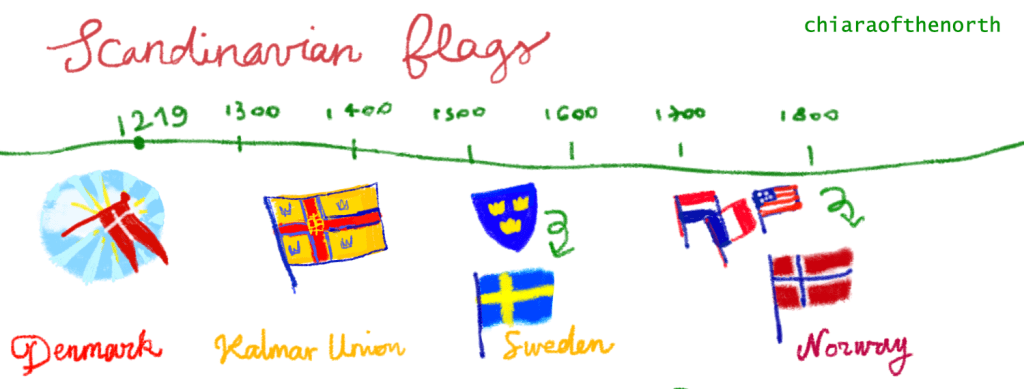
Where Nordic flags come from: Dannebrog, the oldest flag in the world

Danish flag

the Nordic cross flags originated from the Danish flag, the oldest flag in the world! Also called Dannebrog, according to the legend it fell from the sky during a battle in Lyndanisse (today’s Estonian capital Tallinn) in 1219, turning 800 years old few years ago! 15th June is celebrated as Valdemarsdag in Denmark, from Valdemar Sejr, the king who fought in that battle.
The flag of the Kalmar Union, union of Scandinavia (or Denmark and Sweden, with Denmark reigning over Norway) 1397-1523, also had a Nordic cross. The Danish flag then became the model for fellow Scandinavian countries:

Swedish flag

Sweden officially got its flag 300 years later, with a design from the 16th century, with the colors -yellow and blue – taken from the coat of arms dating back to 1275. The day on which the flag is celebrated is 6th June, Svenska flaggans dag.

Norwegian flag

Norway‘s current flag appeared in 1821 – picked among a few different flag design proposals. It was the first Nordic flag with 3 colors, maybe inspired by the French revolution wanting to get rid of the Danes…parliament member Fredrik Meltzer from Bergen said ‘it means freedom, as the French flag, and in the Flags of the Dutch and Americans, and the Union of the English’. You will see a sea of flags everywhere on 17th May, Norway’s constitution day

2oth century Nature-inspired Iceland and Finland, Faroe islands and Åland

Icelandic flag

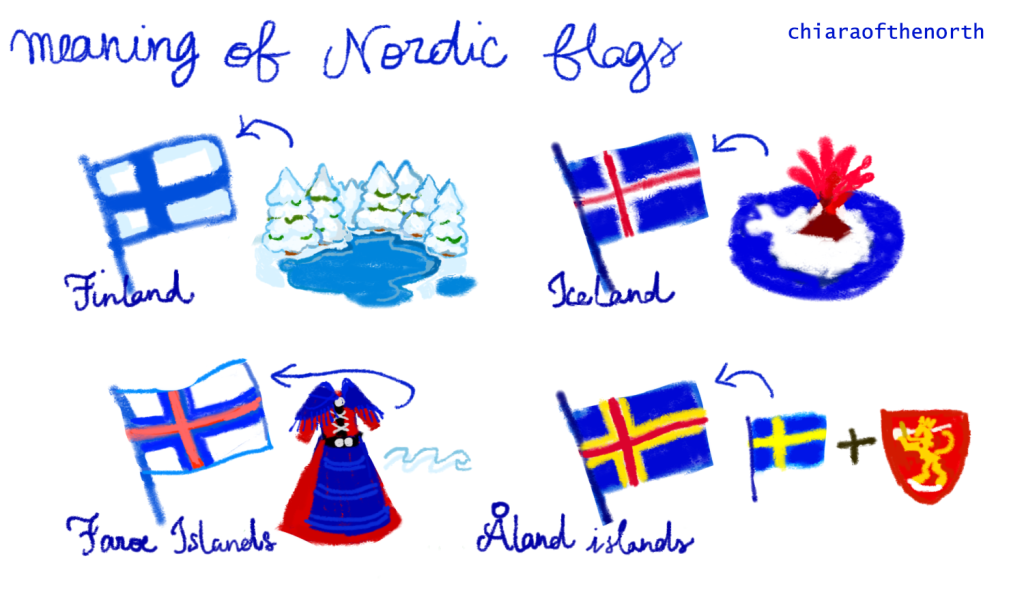
Iceland‘s official flag became official in 1915, based off its nature: according to the Flag Act the flag colours are “sky blue”, “fire red” and “snow white”. Iceland had previously an unofficial flag called Hvítbláinn, the ‘white-blue’, used by Icelandic nationalist activists from 1897 and after 1915 partly abandoned due to its similarity to other flags. Today it is still used by the Icelandic Youth Association among others.

Finnish flag

Finland‘s flag, called Siniristilippu “blue cross flag”, was adopted in 1917. The colors would represent the lakes Finland is rich of and snow. Finland has a Day of the Flag, Suomen lipun päivä, which also happens to be Midsummer (or Juhannus in Finnish), a very important day for the Nordics! On this day the Finnish flag is raised on Midsummer eve on 6pm, until 9pm of midsummer itsself.

Faroese flag

Faroe Islands flag is called Merkið “drape / mark”, with a white background symbolizing the foam of the sea and the pure, radiant sky of the Faroe Islands, while the old Faroese blue and red colours are reminiscent of other Scandinavian and Nordic flags, also reminding the colors of traditional Faroese clothing. Faroese students in Denmark strongly felt the need to have their own flag, and in 1919 their newly created flag was hoisted for the first time by a student in his home village. On 25 April 1940, the British Authorities officially recognised the Merkið as the Marine Flag of the Faroe Islands. This day became later the Faroese flag day, Flaggdagur.

Åland flag

Åland islands, the autonomous Swedish-speaking archipelago belonging to Finland, mixes Sweden and Finland in its flag, where the red cross represented Finland as the color of its coat of arms. The red cross used to be blue, with the colors taken from a song festival in the capital Mariehamn. Since 1954 it has been the official flag of Åland, April’s last Sunday is the flag day, Ålands flaggas dag.

Nordic official flags Overview

Nordic flagsadopted inInspired byalso known asday of the flag
Denmark1219flag fallen from the sky during a battleDannebrog ‘cloth of the Danes’16th June, Valdemarsdag
Sweden1500sSwedish coat of arms colors–6th June, Svenska Flaggans Dag
Norway1821colors of other ‘free’ countries flags –(widely used on Norway’s National Day 17th May)
Finland1917Finnish landscape (snow, lakes)Siniristilippu “blue cross flag”Midsummer is Finland’s flag Day, Suomen lipun päivä
Iceland1915Icelandic natural elements (sea, fire, snow)(widely used on Iceland’s National Day 17th June)
Faroe Islandscreated 1919, recognized 1940Sea and Faroese folk costumes’ colorsMerkið “drape, mark”25 April, Flaggdagur
Åland Islands1954Swedish flag+Finnish coat of armsApril’s last Sunday, Ålands flaggas dag

Nordic regional and minority flags

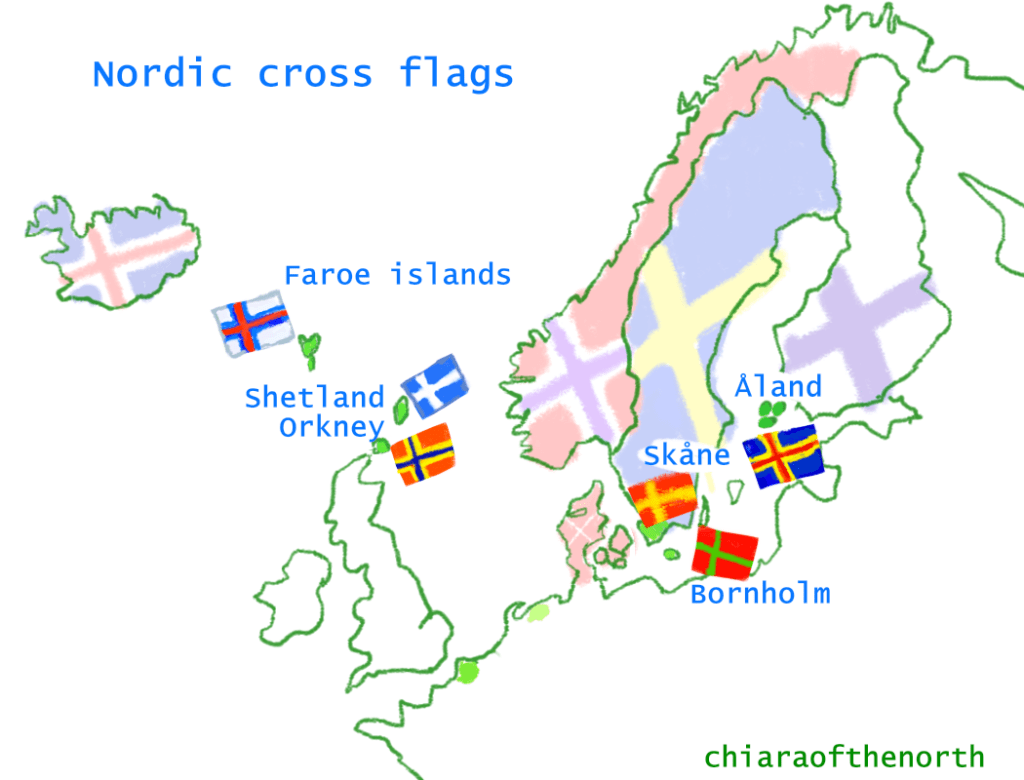
On this map I added official or widely used flags, not adding therefore Normandy and proposed flags

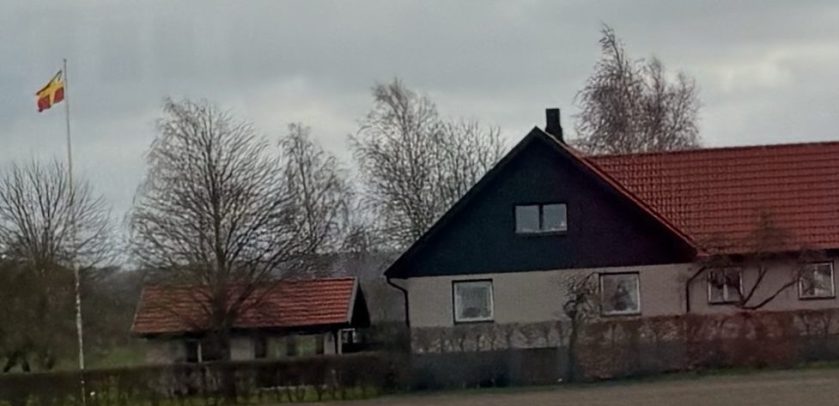
Skåne flag

The flag of Scania, Sweden’s southernmost county, is actually quite old, and has its origin in the historical coat of arms of Lund’s (Danish) archibishop of Lund, older than the Danish Dannebrog! The Nordic cross flag was made up in the 1800s though. The third Sunday of July is Skåne flag day.

skåne sweden landscape

Bornholm flag

Bornholm is a Danish island in the Baltic Sea, it has an unofficial flag from the 70s, designed by Bent Kaas. Green would represent the nature on the Danish island. It is mainly used in tourism and to mark local products.

Finnish Swedes and Swedish Finns flags

Finnish/Swedish minority: Flag mixes – Finland’s Swedes (looks actually the same as Skåne flag, red stands for Finland as above for Åland) and Swedish Finns, Finland’s flag with a yellow lining around the cross.

Flags of other Swedish regions: Norrland, Bohuslän, Småland, Öland, Gotland

Unofficial Nordic cross flags have been created for Swedish regions as Norrland, Bohuslän, Småland among others, and the Swedish Baltic Sea islands of Öland, and Gotland, although these are not really used.

Nordic cross flags of Nations with Nordic ties

Shetland and Orkney flags

for their Nordic heritage, historical and cultural ties of the Scottish islands with Scandinavia. Shetland‘s flag was created in the 60s for the 500 years since its transfer to Scotland from Norway (after belonging to Norway for as long). A Nordic cross with Scottish colors. Orkney‘s flag was chosen in 2007, after a public consultation (all proposed flags were a Nordic cross). Yellow and red from Scottish and Norwegian royal coats of arms, Blue representing Scotland and the Sea.  

Normandy flag

Normandy‘s Saint Olaf flag: mainly used by regionalists movements, its name comes from the Norwegian kind Olaf Haraldson, probably baptised in Rouen, remarking the region’s viking origin.

Estonian proposed flags

Nordic cross flags were also proposed for Estonia in 1919, to remark its Nordic (rather than Baltic) identity and historical ties.

Frisia proposed flag

A cool Nordic cross flag was also proposed for Frisia, probably due to the part of Scandinavian heritage Frisian people (scattered between the Netherlands, Germany and Denmark) have.

Nordic indigenous nations without Nordic cross: Greenland and Sami people

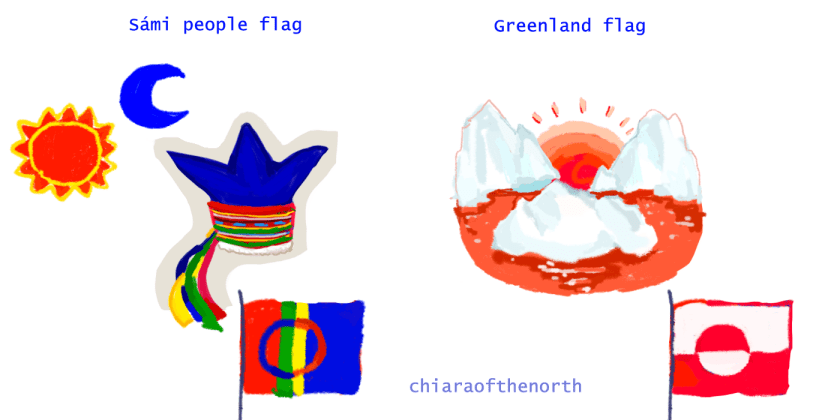
Greenlandic flag

Greenland and Sami people have a flag since 1985 and 1986, both Inuit and Sami people adopted a sun/moon symbol instead of a cross, more typical of indigenous people and their connection to nature. the sun symbol was kept however in the same left-aligned position as Nordic crosses.
Greenland has had a Nordic cross flag proposal – you might guess, green was in it- , but the Greenlandic iceberg landscape-inspired design by Tue Christiansen was eventually chosen instead. its name is Erfalasorput,”our flag”.

Sami flag


In the Sami flag sun and moon are represented as a circle. The first Sami flag, designed in 1977 by Synnøve Persens, was the simpler, red and blue with the yellow line, inspired by Sami traditional clothing. Astrid Båhl added the Green line (color more present in South sami clothing) and the circle.
Subscribe for more fun facts about Nordic cultures

sources

  • Norway: stortinget.no – Det Norske Flagg – et flagg i frihetens farger
  • Iceland: government.is
  • Faroe islands: faroeislands.fo
  • Åland: regeringen.ax
  • Greenland: dr.dk – video about the Greenlandic flag (Danish)
  • Sami flag: Store Norske Leksikon
  • more: britishcountyflags.com, skaneflaggan.nu, patrimoine-normand.com

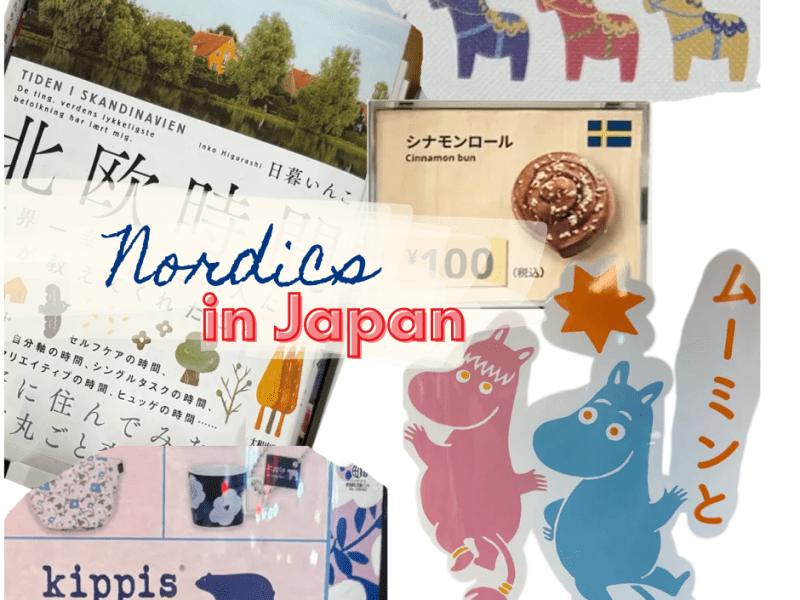
Nordic findings in japan

Nordic culture experienced in Japan: Moomins, Dala horse stationery, Nordic-inspired foods and books about Scandinavia seen by the Japanese.

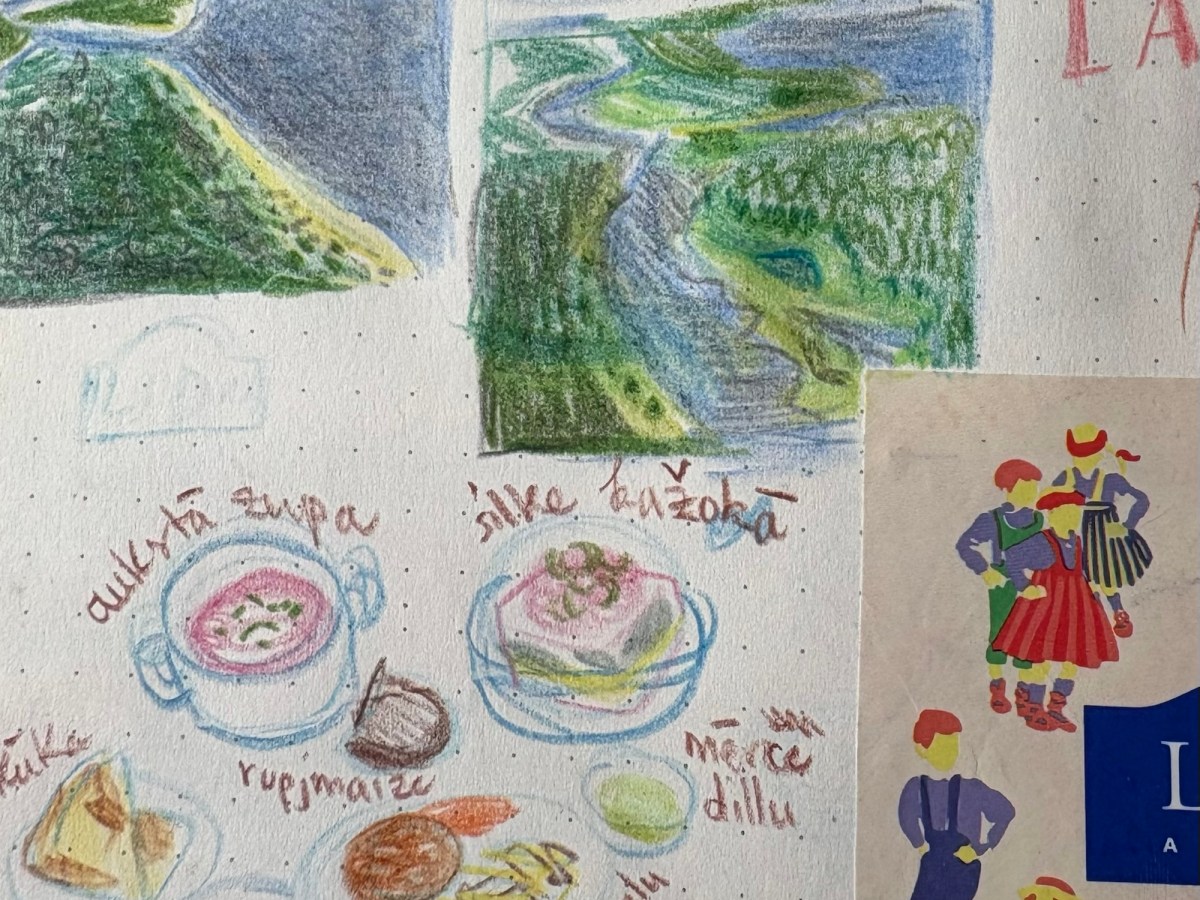
How Nordic are Baltic countries

Are Baltic countries Nordic at all? I explored Latvia and Estonia, noting their ties to Nordic culture, from languages to Rye bread and Midsummer.

Semlor at Selma’s and Danish pastries in Amsterdam

Trip to another Nordic bakery to enjoy a fika with a semla, and surprises on my way

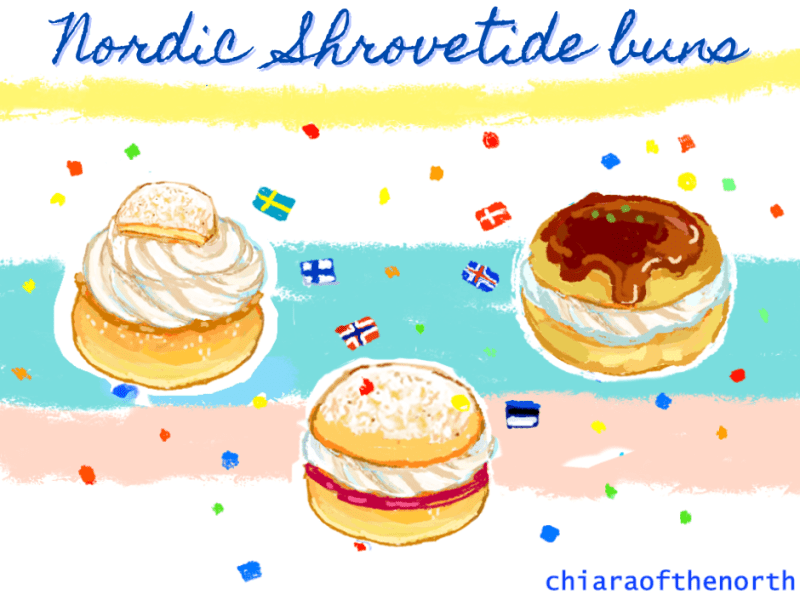
After getting a lussekatt during the Christmas season, I was really eager to also eat a semla, the whipped cream-filled bun which is eaten in the shrovetide season instead, culminating on Fettisdagen (fat Tuesday).

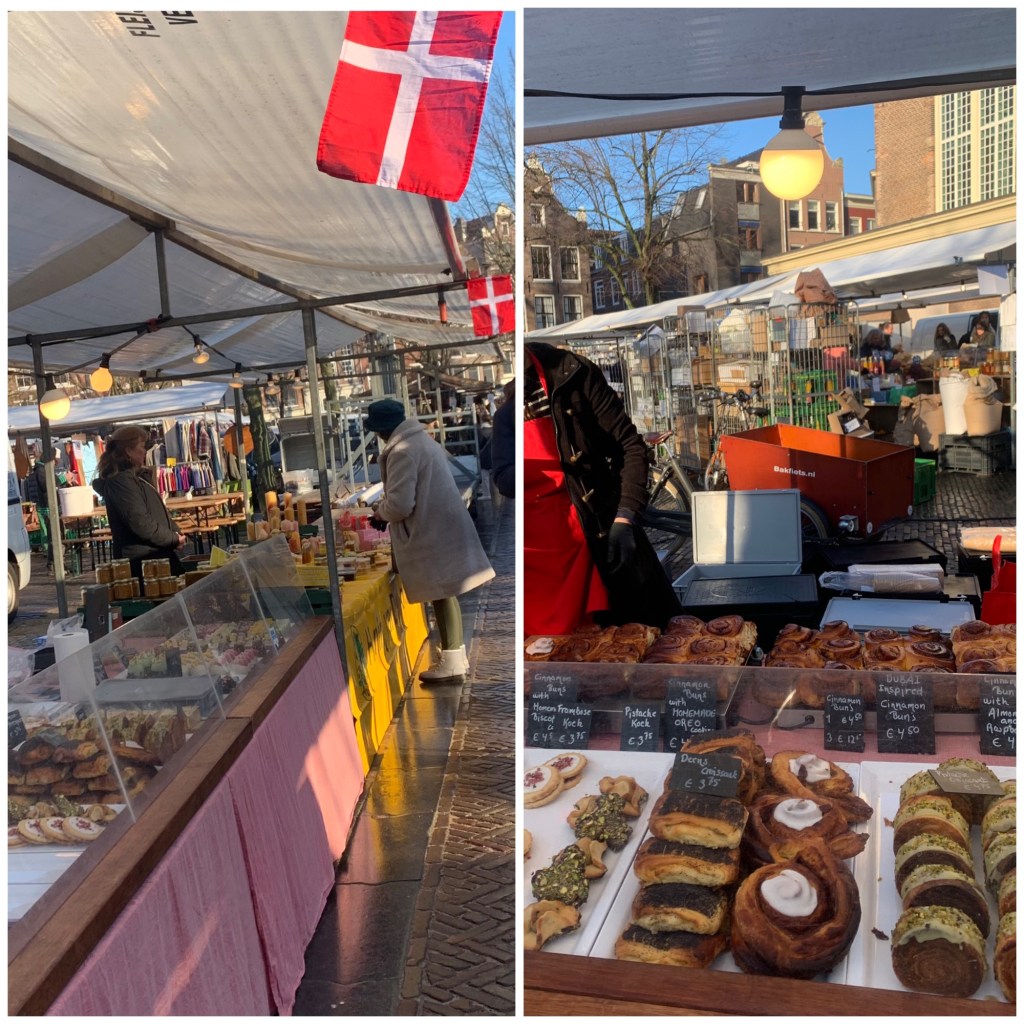
So I picked Selma’s Nordic Bakery in Amsterdam! On my way I randomly saw Danish flags at the Noordermarkt and happened to discover Raw Betty (Raw_betty42 on instagram), selling Danish delicious buns, cookies and cakes at Amsterdam markets. Read the article till the end to find out what I chose…

Raw Betty stand at Noordermarkt, Betty’s son also runs a hotdog stand, maybe I’ll get a pølse once!

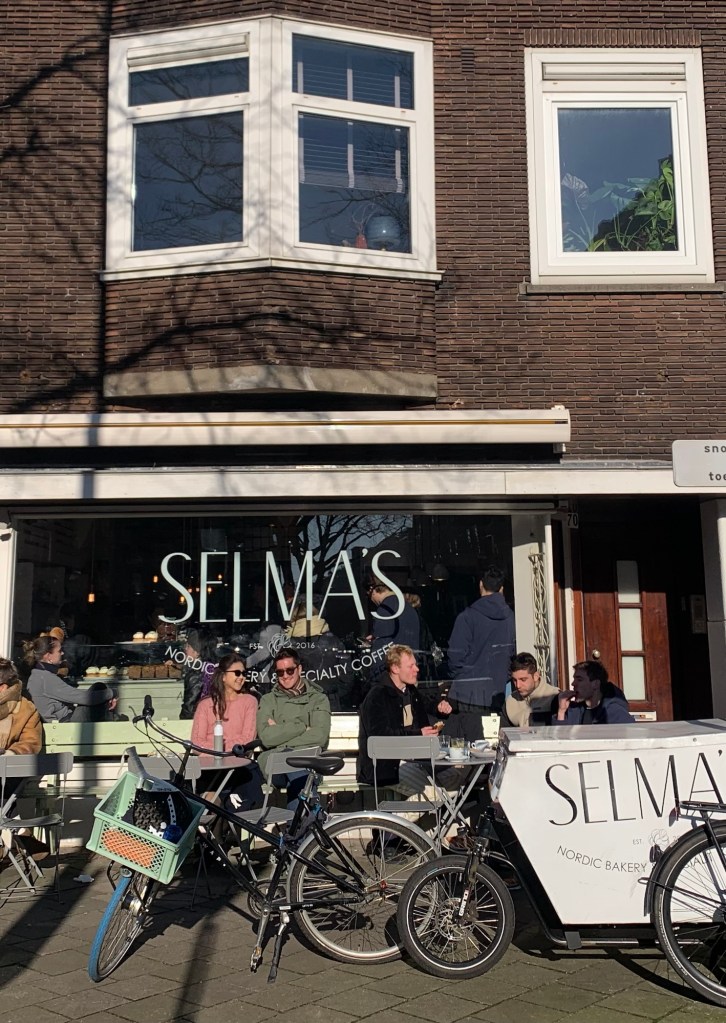
We then walked forward on our way to Selma’s, located in Amsterdam West, around 30 minutes walking from Amsterdam Centraal. Which I was not upset about at all, because it would mean a well-deserved fika.

Selma’s also has a to-go location closer to the station, in the Jordaan area, but this time we wanted to sit and enjoy it.

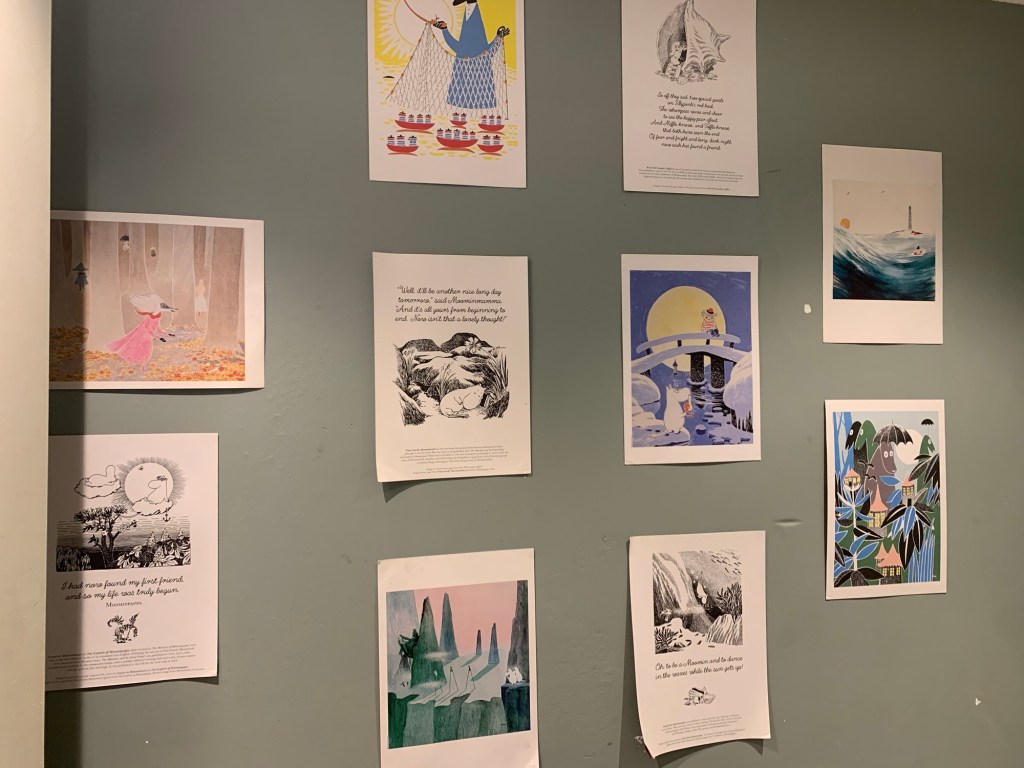
The interiors are also in a quite Nordic and pastellish style. The restroom even had moomin posters!

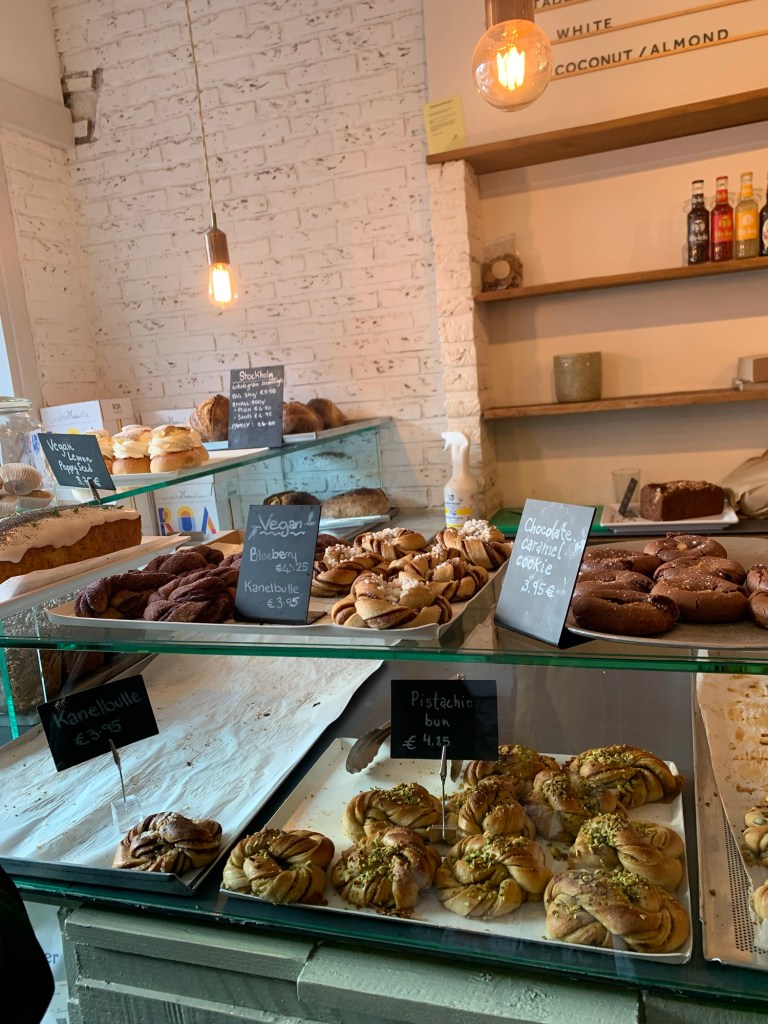
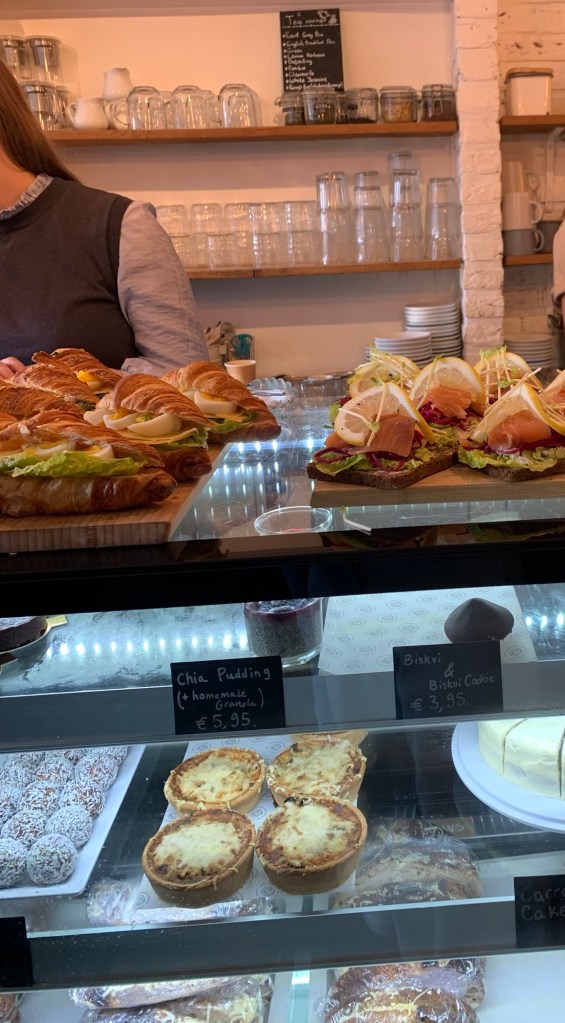
Rye bread loaves, cinnamon and pistachio buns and smørrebrød were among the sold products, among others classic fika treats as chokladbollar, biskvi and kladdkaka. Of course at this moment semlor had their own spotlight!

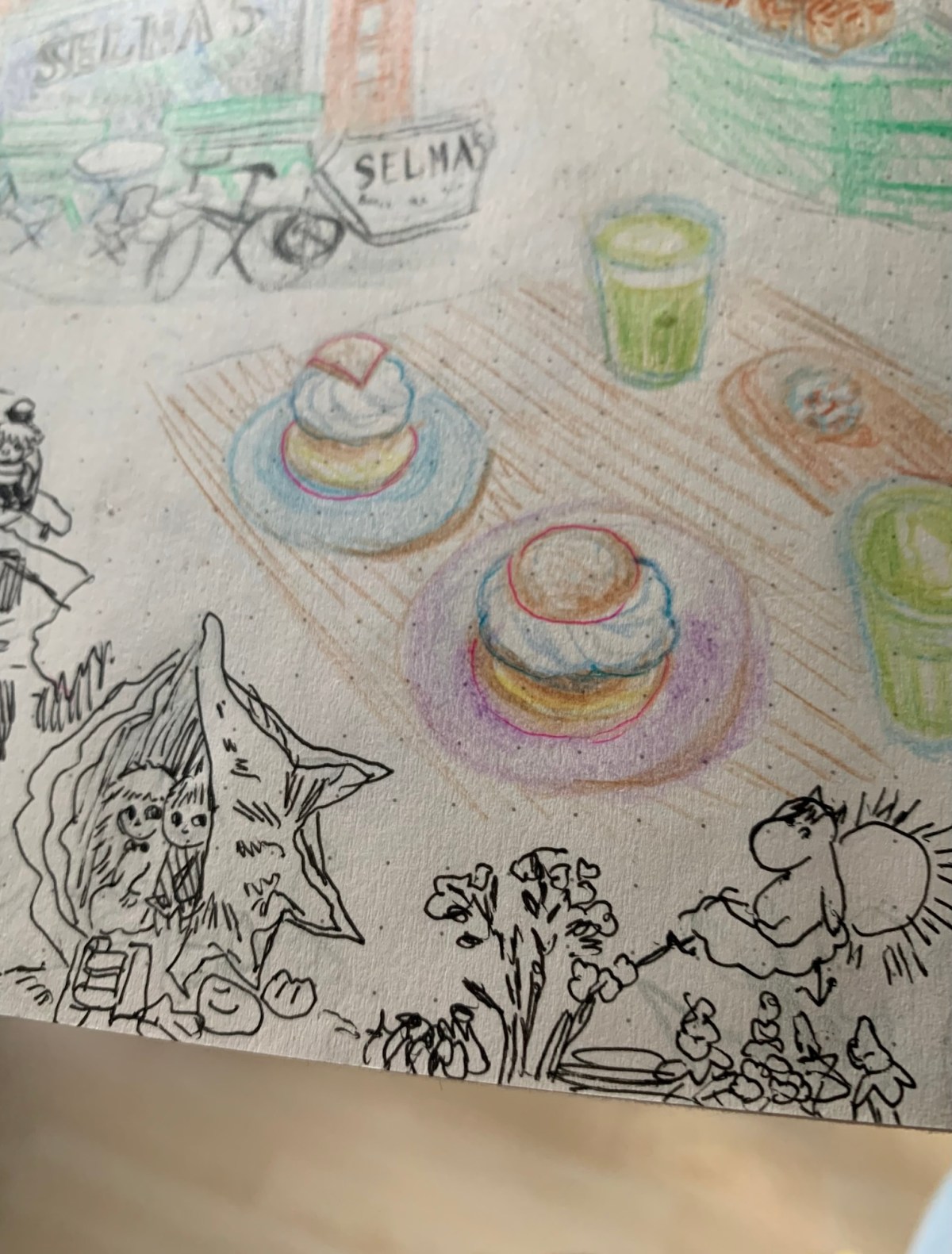
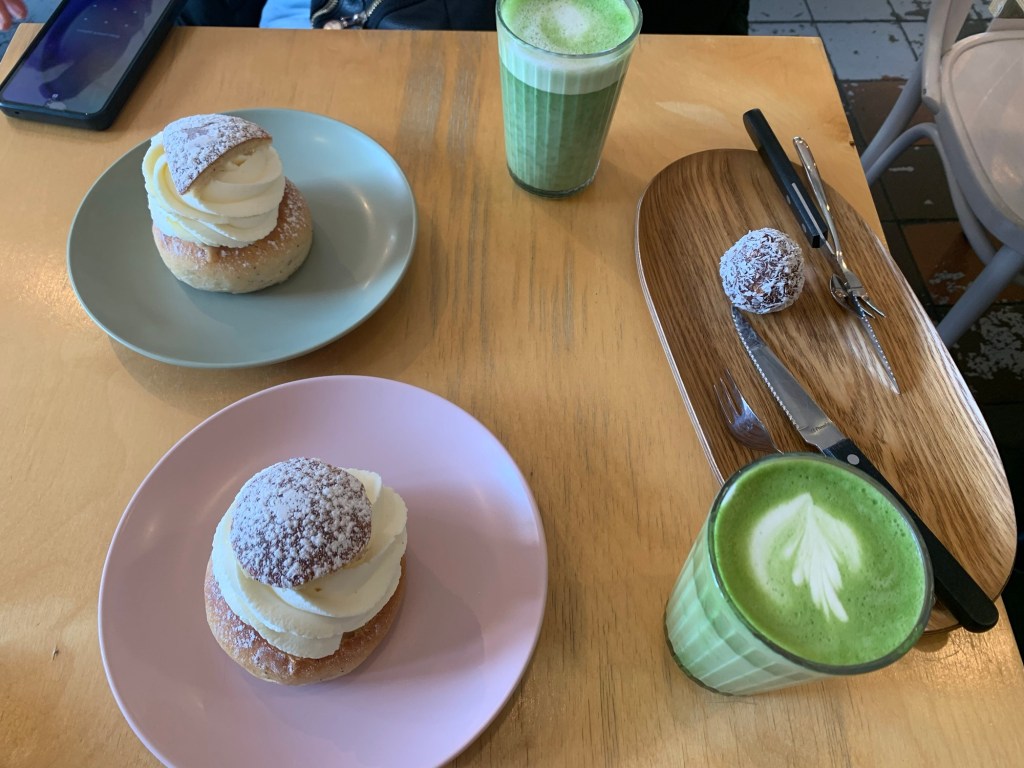
They sold 2 versions: the classic Swedish one with almond paste, and Finnish one, laskiaispulla with a fruit compote. Since I had already tried the classic one in Sweden last year, I went for the fruit compote. We had matcha latte as drink, which is not particularly Nordic but always delicious.

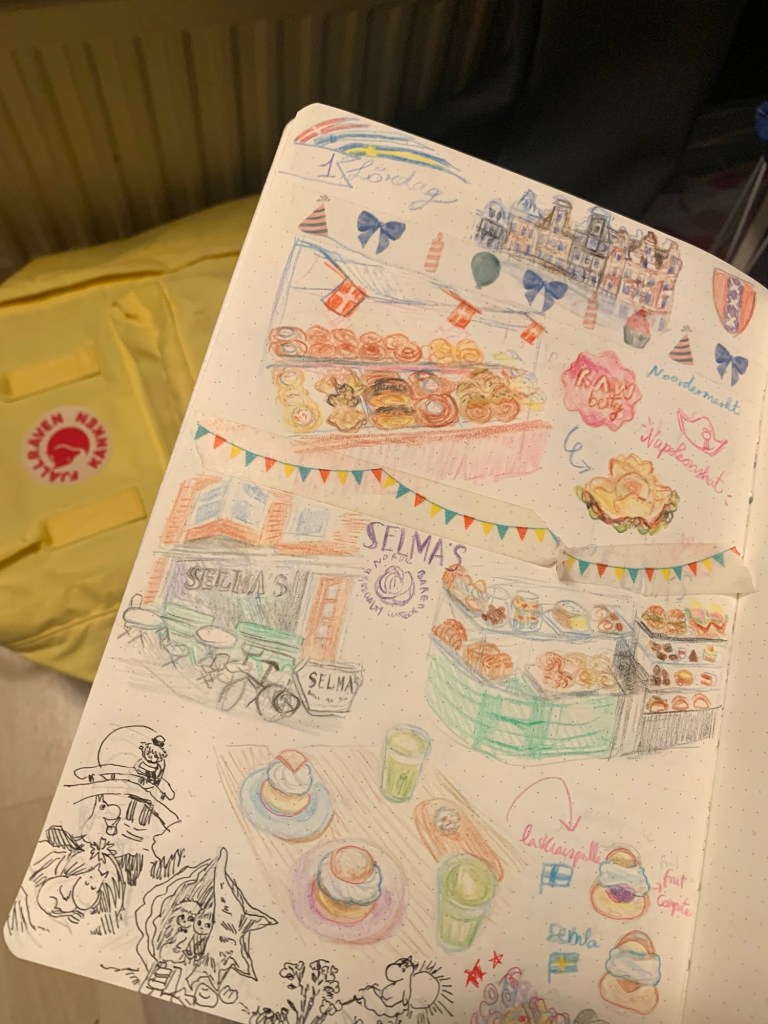
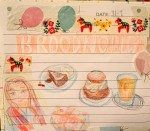
journal art nordic bakery

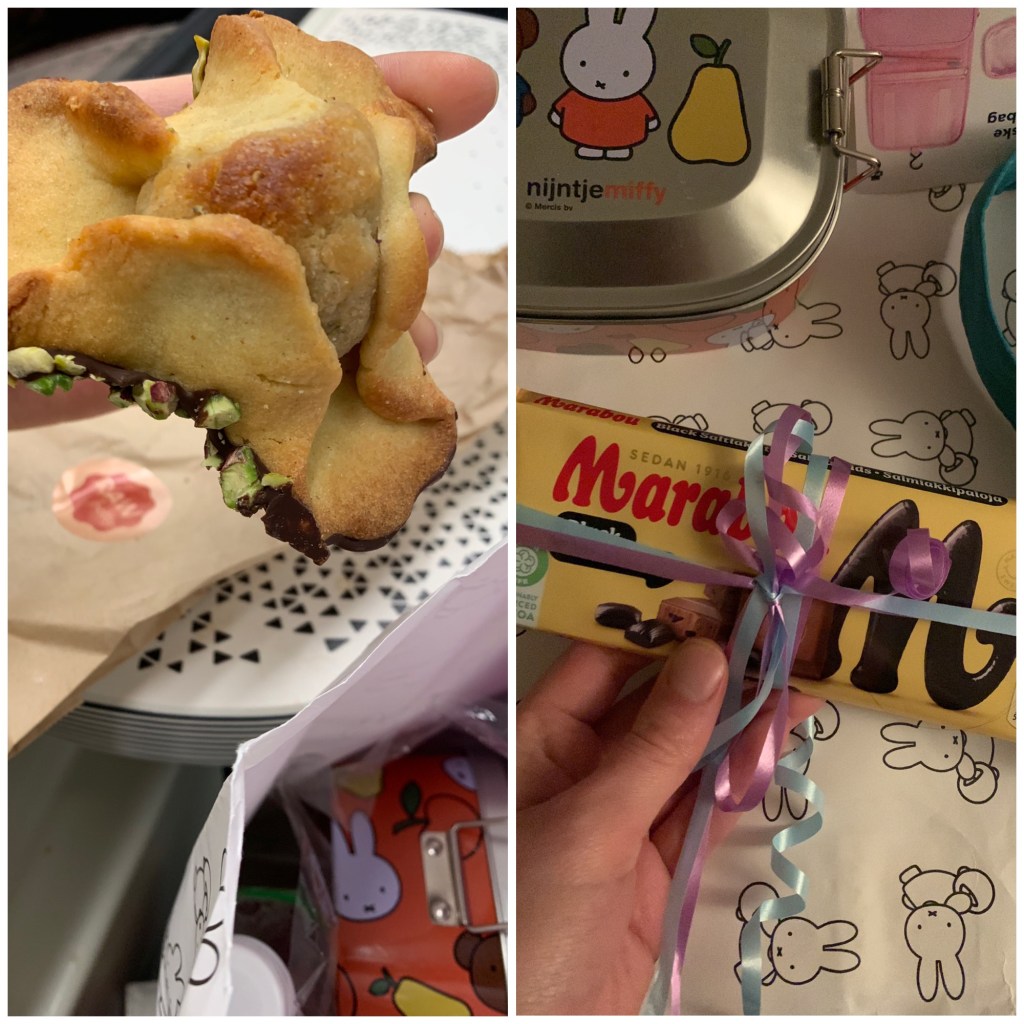
While at Selma’s, i also got my birthday present from my friend: liquorice Marabou (Sweden’s favourite chocolate brand)! I had actually got a salmiakki Fazer bar (Finland’s favourite chocolate brand) when I went to the Finnish seamen church for their Christmas market month before, and it was actually fun to compare! the Fazer one is slightly darker, with a bigger liquorice chunk, also a bit juicy, while Marabou has smaller, crispier pieces.

As for the Danish treat I got, that was a Napoleonshat! The name is as you can imagine a hint to its shape, a sort of butter cookie with marzipan inside, coated with chocolate, and in this case pistachio. mega lækker!

I already have plans for other Nordic trips to Amsterdam, so stay tuned to see more interesting places…!

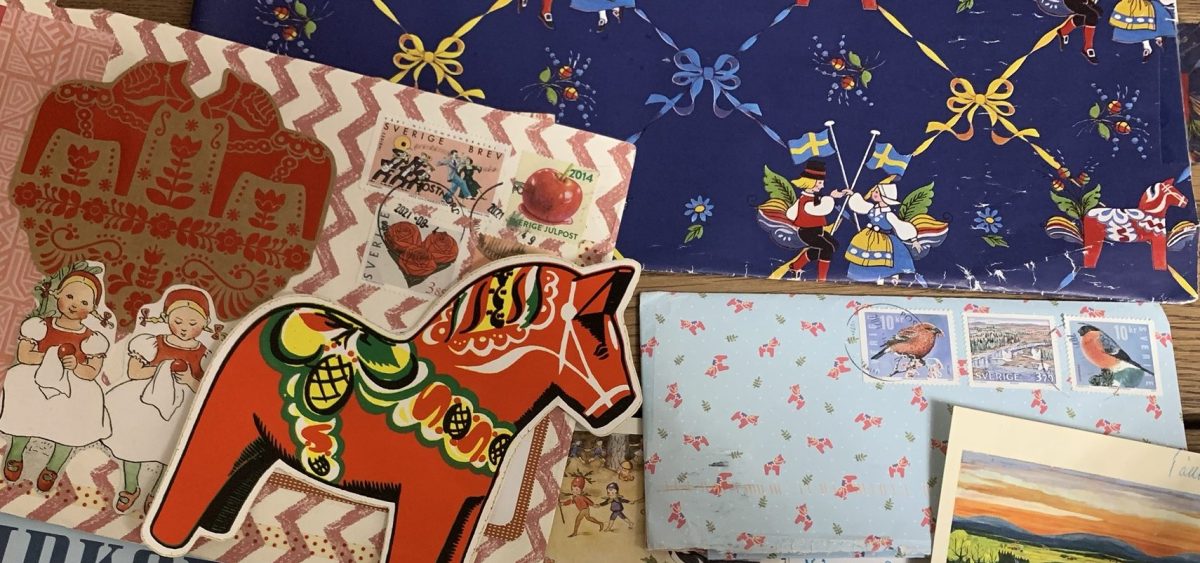
Guide to practice languages with penpals

Snailmail is a great way to practice languages at your own pace, make friends and get creative at the same time!

I have been into penpalling/snailmail since my early teenage years, and I started using this hobby more recently as a way to practice languages.

I actually started learning Danish and Norwegian by writing letters in them. I spoke decent Swedish already and could read them, but had to look for a lot of words and correct grammar forms, and that was a boost, learning actively while having fun and being creative! At the moment, I am actively using my Finnish and Japanese with my penpals from Finland and Japan.

How to find penpals: hashtags, communities, websites

One of the ways to find other people interested in penpalling is searching with the right hashtags on social media as instagram and tiktok. For example #penpalswanted , #lookingforpenpal, etc. In some cases snailmail accounts give a chance to comment and introduce themselves under a post to those looking for a penpal.

There are also websites made for people looking for a penpal, for example Global Penfriends, interpals.net... Here you can select a country and age to find your future penpals! Other websites are country-specific as Pen friends clubs of Japan.

introduce youself with a video or post adding the hashtags above, or interact and send messages to other penpal-wannabes. Talk about your interests, your aesthetic, show your letters and. No creativity, special things you’d send as stickers, postcards..

Get creative: material you need & ideas. pinterest board

There are no right or wrong things to include in a letter, but usually, the more things you include in it, the nicer it is for your penpal receiving it!

In this Pinterest board I add inspirational pictures for my letters. Some ideas:

  • washi samples, stickers
  • memo notes
  • postcards
  • cutouts (pictures from magazines..)
  • Questions for your penpal
  • songs

Similar the length of your letter is up to you. When practicing languages, the longer the more space to improve! It can be as personal as you want it to.

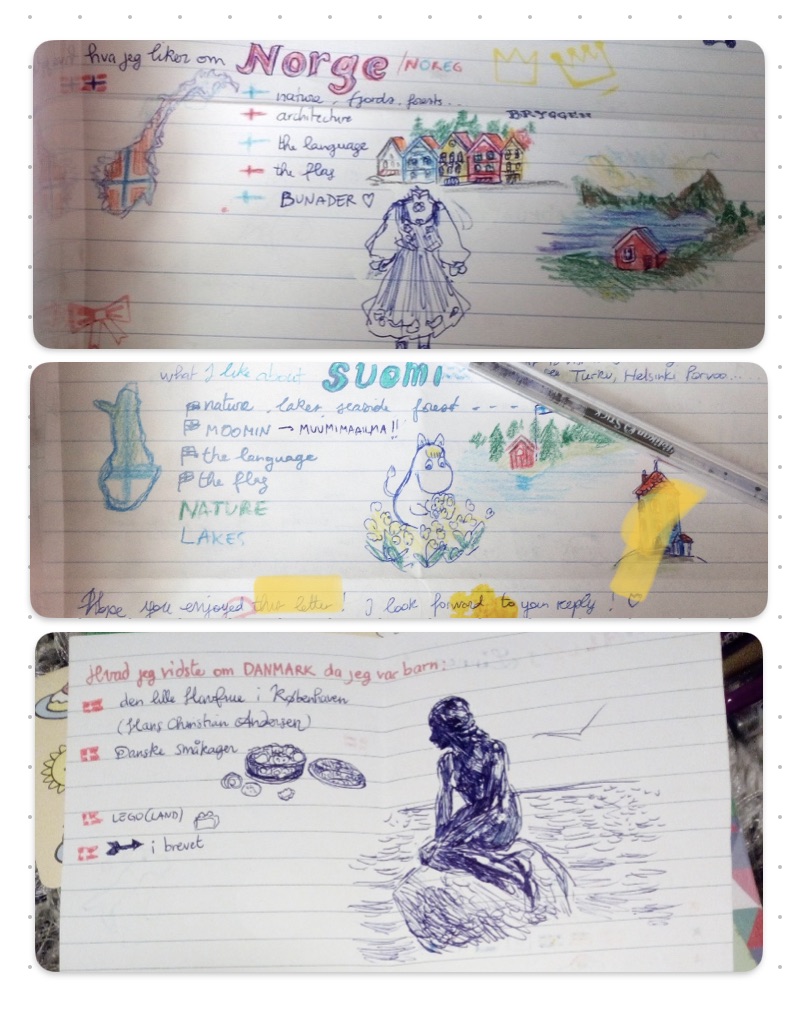
fun fact: When writing to a new penpal, I always write/doodle about things I like or know about the other person’s country, copying illustrations from books I had as a child among others 🙂

Stick to the language

As I mentioned in my blog post about practicing a language spoken in a country with high English proficiency, it is important to find a space whee you force yourself to use that language no matter what – and writing letters is a perfect solution for that. It is a relaxed, fun way to practice taking your time, both when reading others’ letters and writing your own. You can look up words, and exercise writing in other scripts too if needed! Just handwriting å, æ or ð feels quite satisfaying to me.

Penpal etiquette

  • If you are the one asking to become penpals and get a yes – write first. It is also possible to do swaps – one-shot mail exchanges where you send more things than in an ordinary penpal letter. In that case, sending it at the same time would be a fair option if you inform yourselves about what the other person likes to begin with.
  • In the first letter, introduce yourself and your interests, what you like/dislike..
  • Try to put similar effort in letters as your penpals do, or ask them what they’d like to receive – it would be a bit unfair if someone uses a lot of materials, decorations and small gifts while you send a half empty sheet in a blank envelope.
  • If you do not feel like continuing writing to a penpal – that’s totally okay, but let the penpal know.

Scandinavian bakery & lunchroom in Den Haag: Norvolk

A lovely place to have a Swedish fika or lunch in Den Haag – from bullar to Janssonsfrestelse

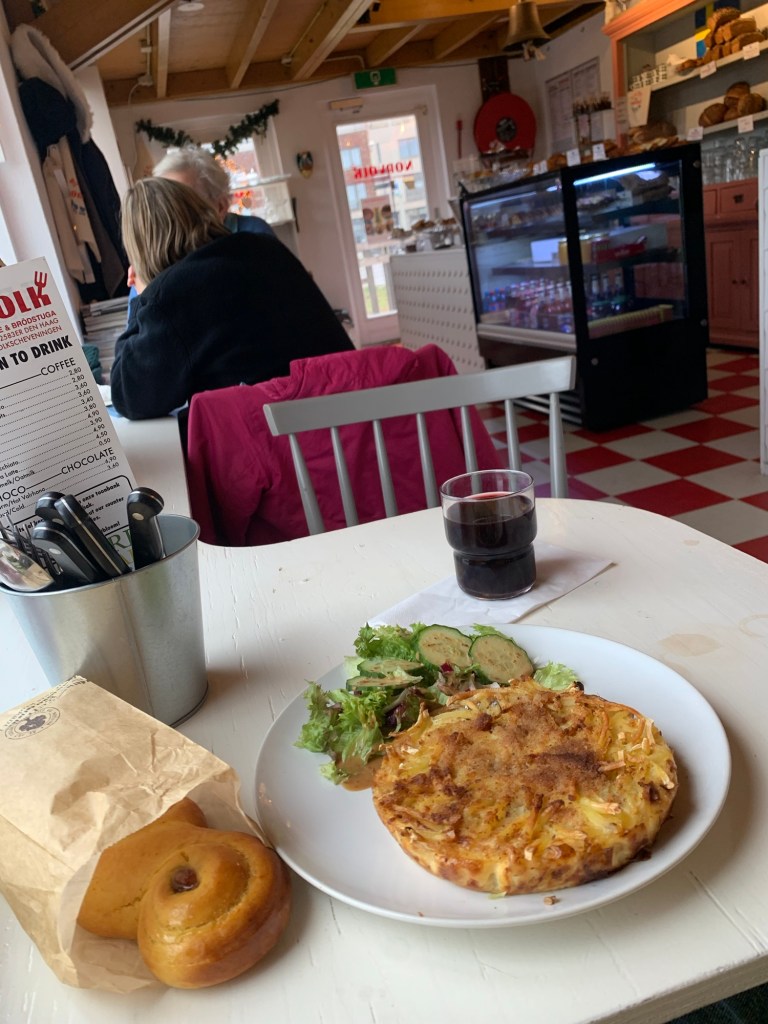
On my quest to find somewhere to buy a Lussekatt (Swedish Christmas time saffron bun) in the Netherlands, I found a lovely place in Den Haag: Norvolk. A Swedish / Scandinavian-inspired lunchroom and bakery, or Brödstuga, serving their freshly baked breadstuff, various cookies and cakes, and many open-face sandwiches.

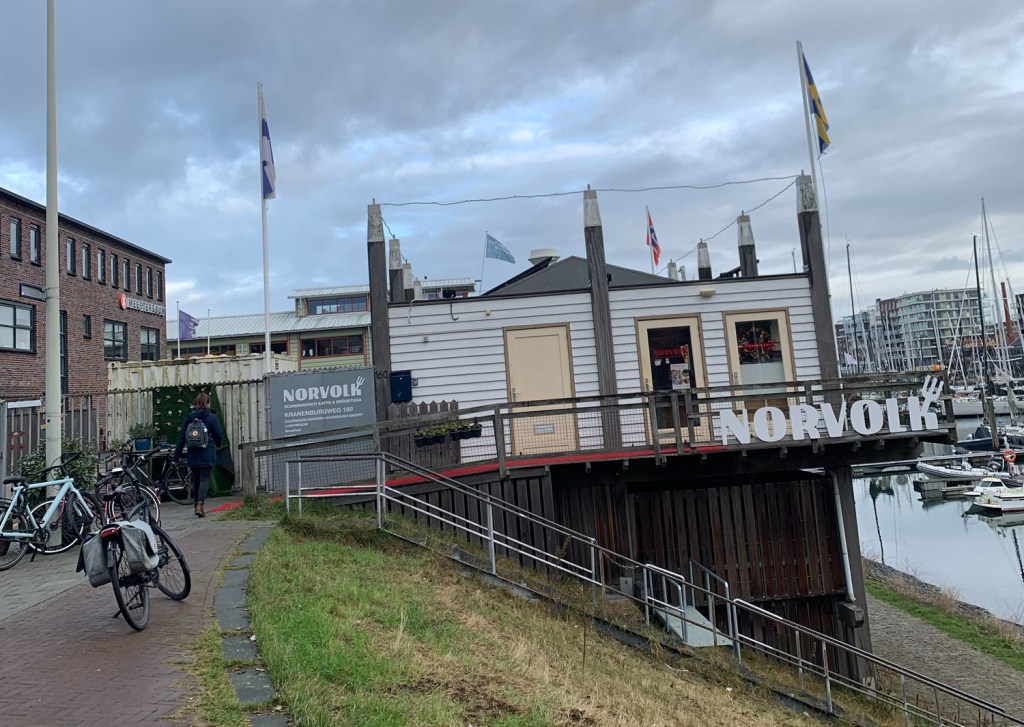
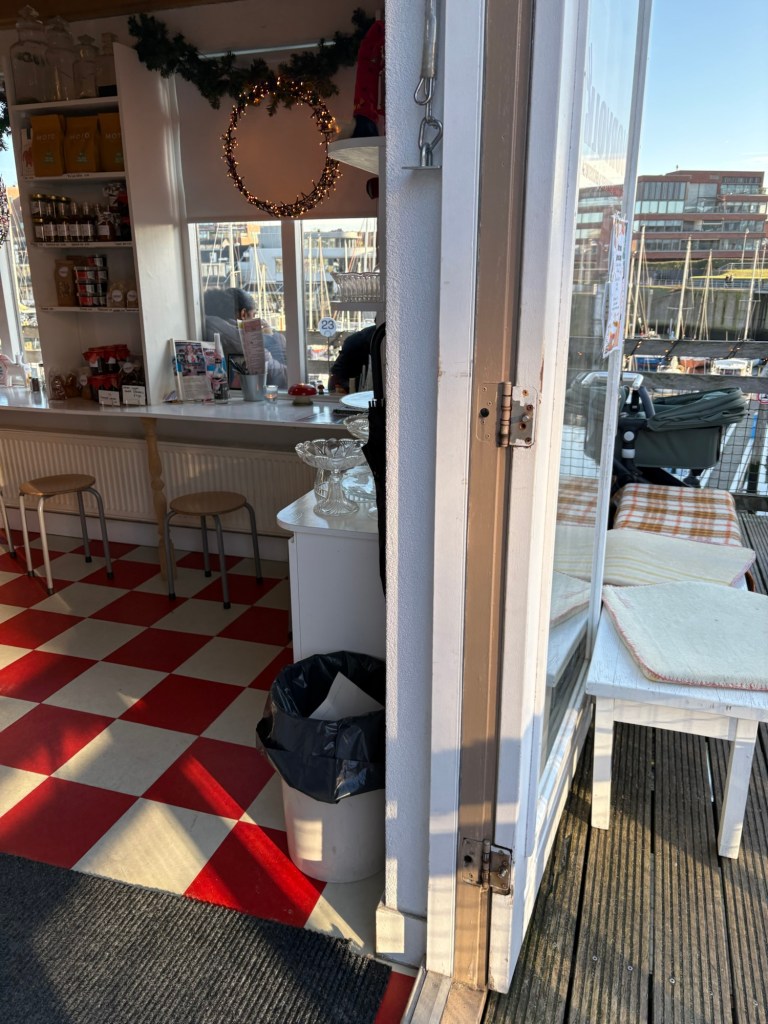
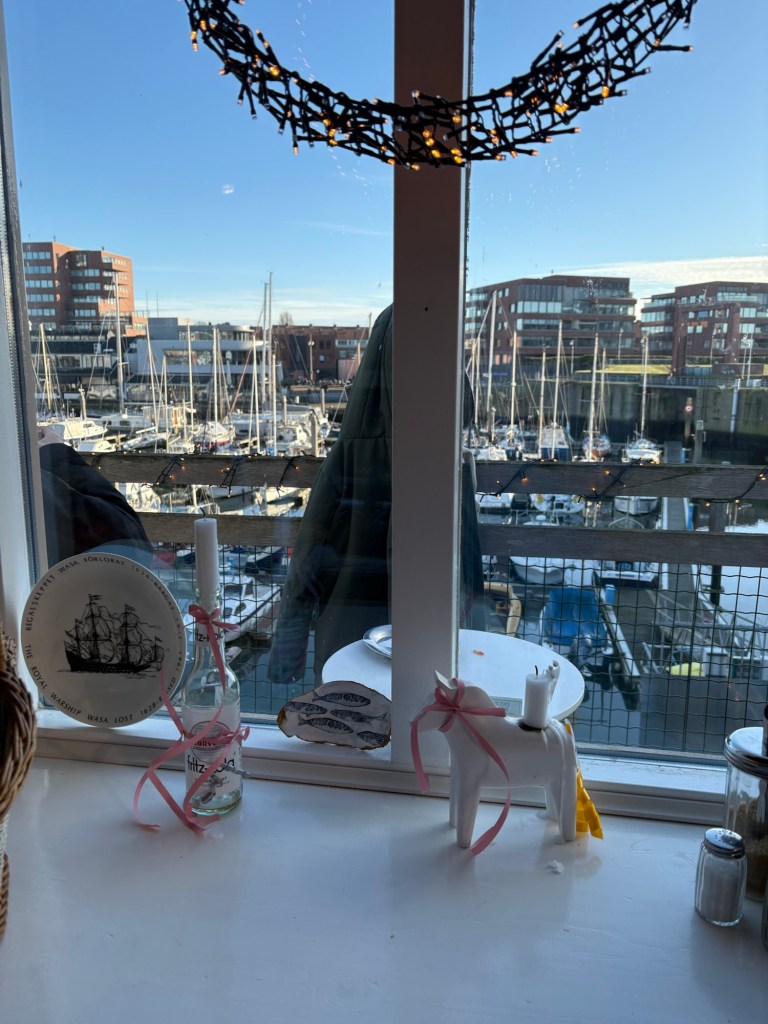
Norvolk is located in a pretty building right on the harbour of Scheveningen. You recognize it quite easily for the Nordic flags flying!

NL – Op mijn zoektocht naar een plek om een Zweedse saffraanbroodje in Nederland heb ik Norvolk gevonden, een Zweeds/Scandinavisch geïnspireerde lunchroom en bakkerij. Hier kun je vinden: kaneel- en kardemombollen; Zweedse cakjes als prinsessårta en Budapest rol; koekjes voor met de koffie vinden (hallongrottor, kokosbollar); Lunch opties als de Zweedse klassiek Janssonsfrestelse ‘Janssons verleiding’ – potato quiche with ansjovis of brood met Zweedse gehktballen, vis en meer. Zie alles onderaan!


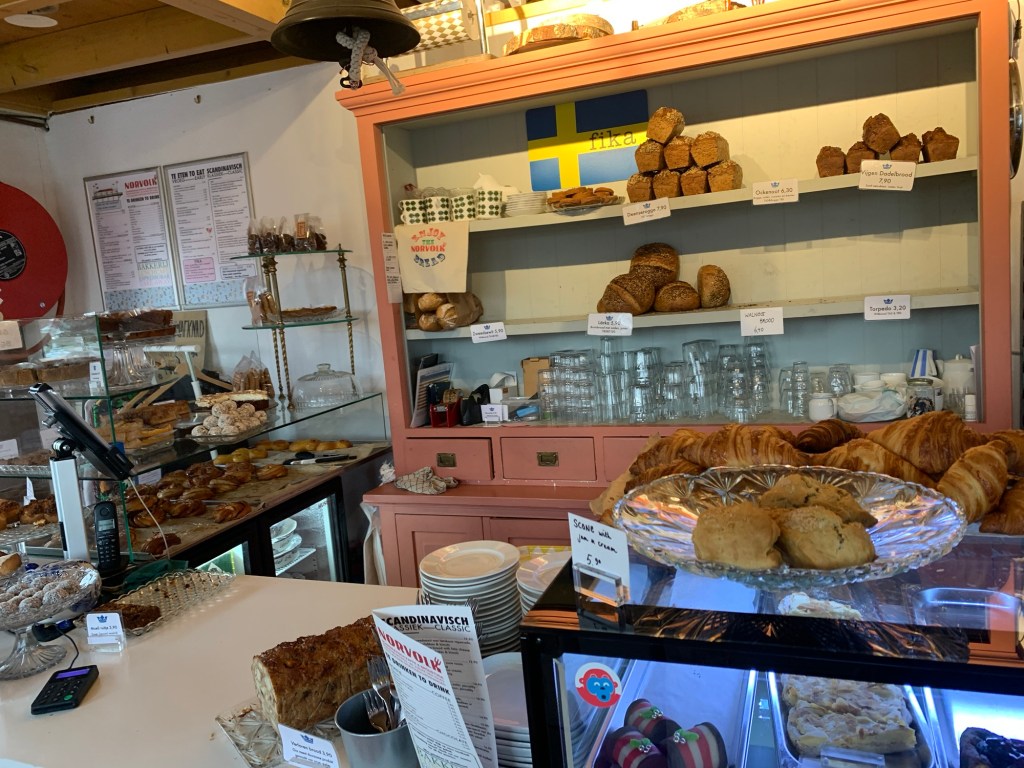
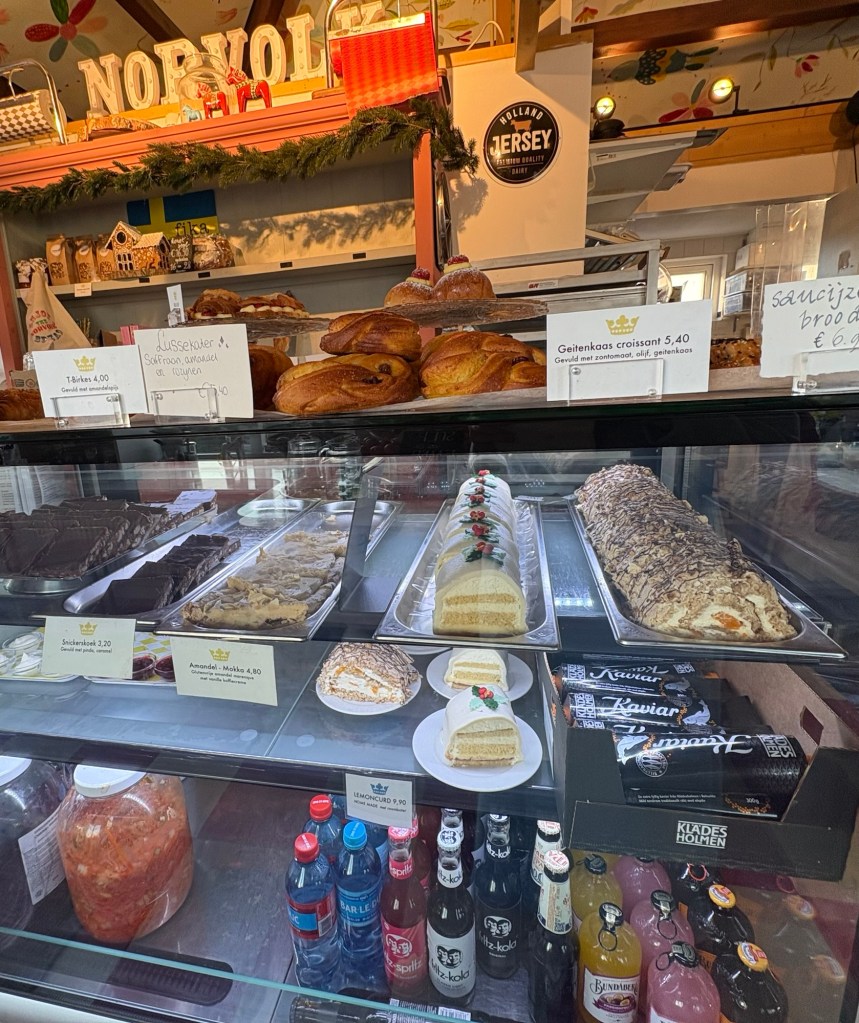
Once entered, you see some buns and cakes. Standard at Norvolk are of course cinnamon and cardamom buns – kanelbullar & kardemummabullar; lingontosca (Lingonberry jam cake topped with almonds), lemondcurd shortbread are also always there.
On the corner are fika cookies: hallongrottor cookies (butter cookies with jam), kokosbollar (chocolate-coconut balls) and ginger cookies among others.

On the inside, a detail I loved was the words in Nordic languages on the wooden beams:

  • Noitið daginn (Icelandic) – enjoy the day
  • Ei pidä ennä merta edemmäs kalaan (Finnish) – “it does not pay off to go further than the sea to fish” – do not get ahead of yourself when doing something
  • Smi mens jernet er varmt (Norwegian/Danish) – ‘forge while the iron is hot’ -seize the day. In Danish it is (man skal) smede mens jernet er varmt
  • Elsker samvær mad – either Danish or Norwegian, but I cannot find this saying online..

A bit further you have the cakes and sweet or savory breadstuff: croissant, typical Danish almond pasted filled T-birkes with poppy seeds on top, egg-filled Danishes..
Among the cakes the Swedish classics Budapest rollcake and Princess cake – with green marzipan in the classic version – at Norvolk varies its look depending on the season!

On the menu there were a few Scandinavian-inspired Lunch options as:

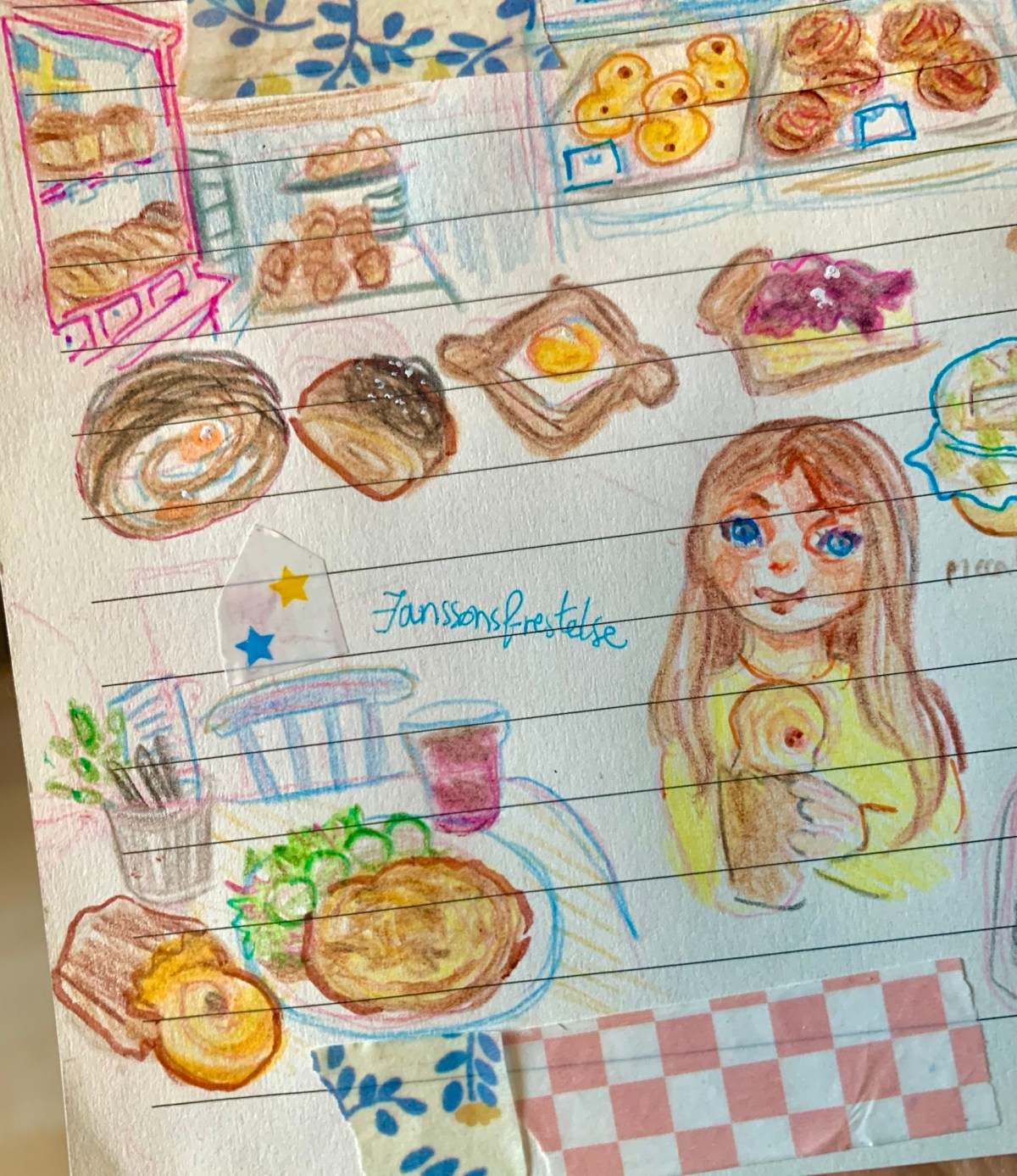
  • Swedish classic Janssonsfrestelse ‘Janssons temptation’ – potato quiche with anchovy
  • Sill o Dill – herring on rye bread with egg and pickled red onion.
  • Bullen – Meatballs with beetroot salad, red cabbage, fried onions
  • Värmland – smoked salmon on rye bread with piccalilli sauce
  • Skagen – shrimp salad and eggs
  • Laxråg – salmon and remoulade sauce and dill

I ordered Janssonsfrestelse for lunch Swedish-style, and since I was already full I saved the Lussekatt for later.

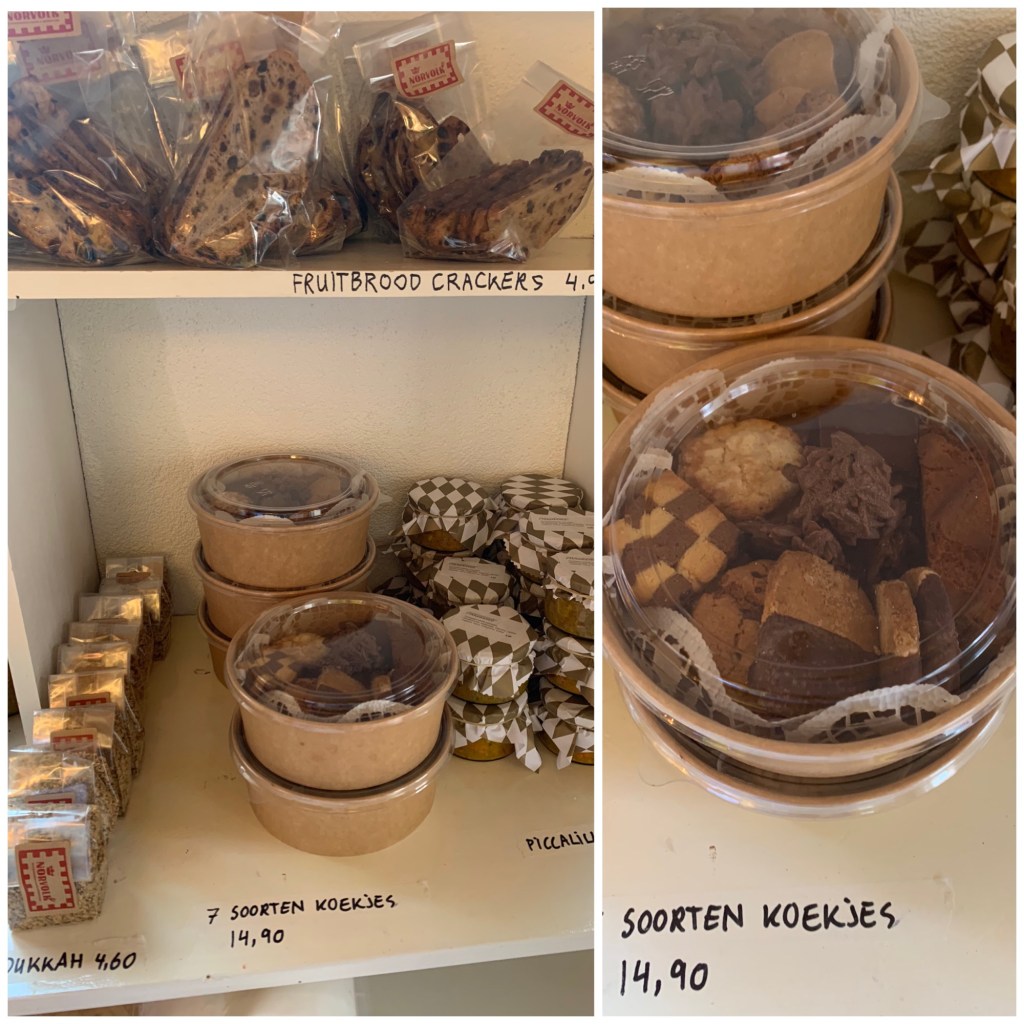
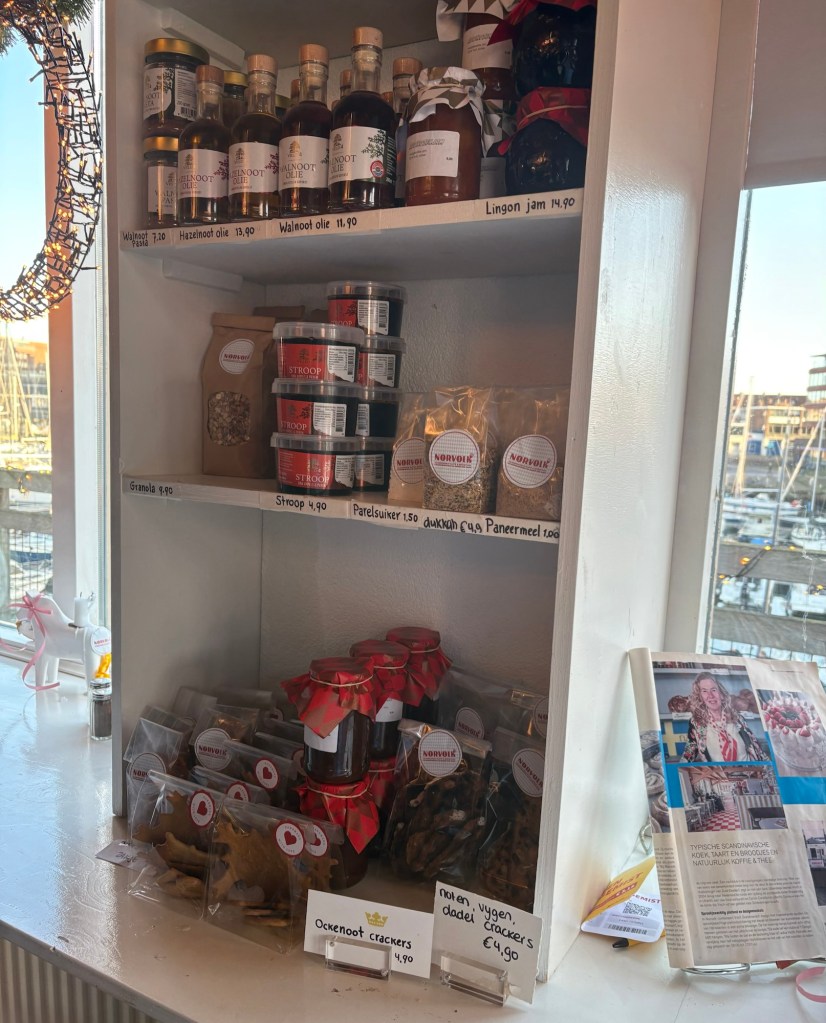
At Norvolk you can also find others products for sale, as cookies and spreads: Among these the 7 sorter (there is a Swedish/Norwegian tradition to bake 7 kinds of biscuits), fruit bread and homemade lemoncurd, Picalilly sauce, kimchi.

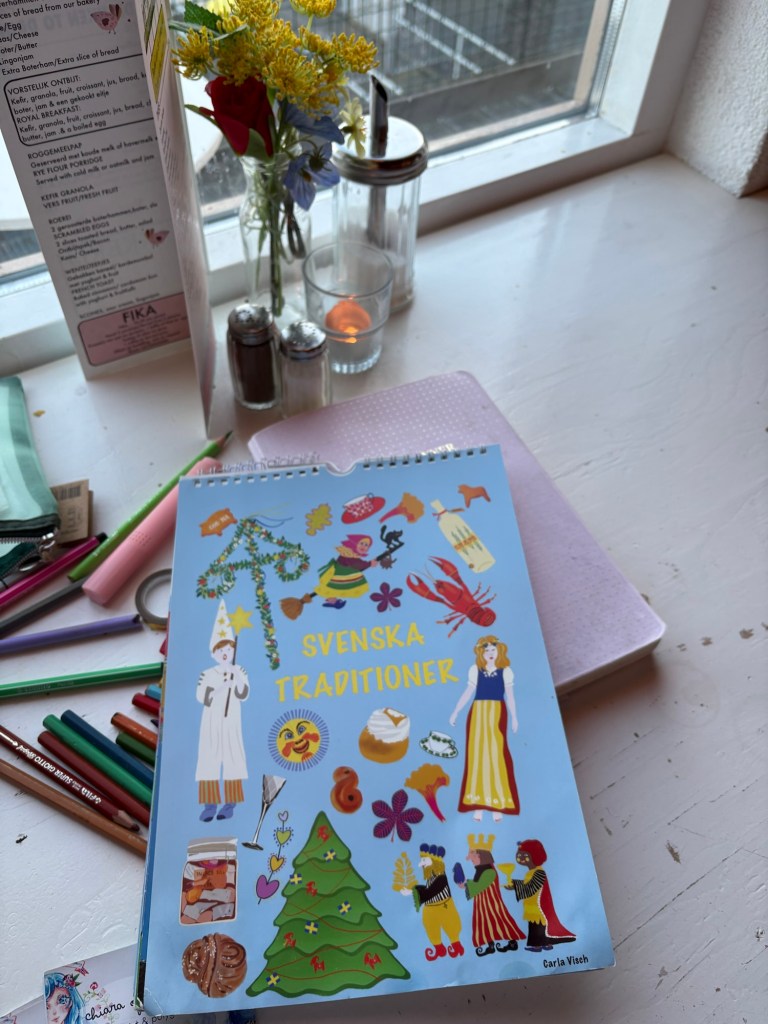
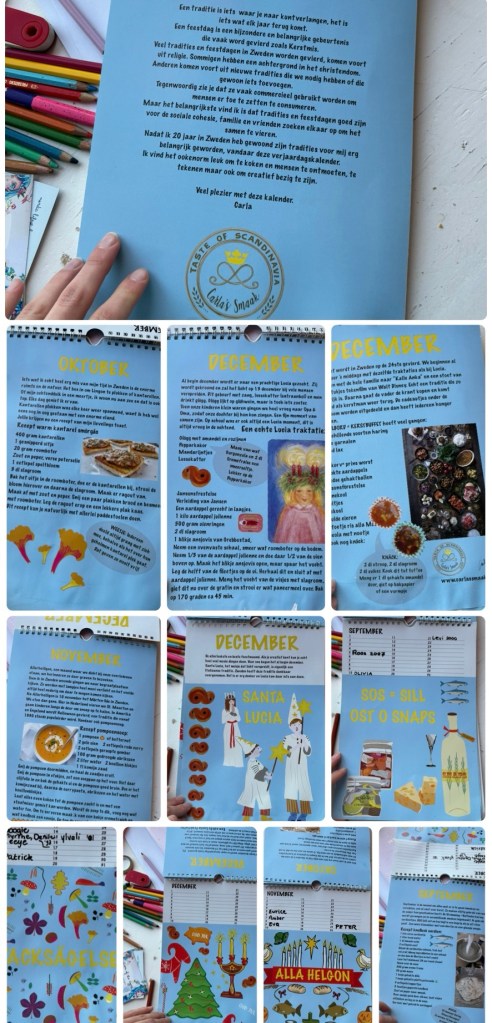
The owner Carla Visch made her own Swedish traditions birthday calendar, a really cute idea I would actually love to copy…

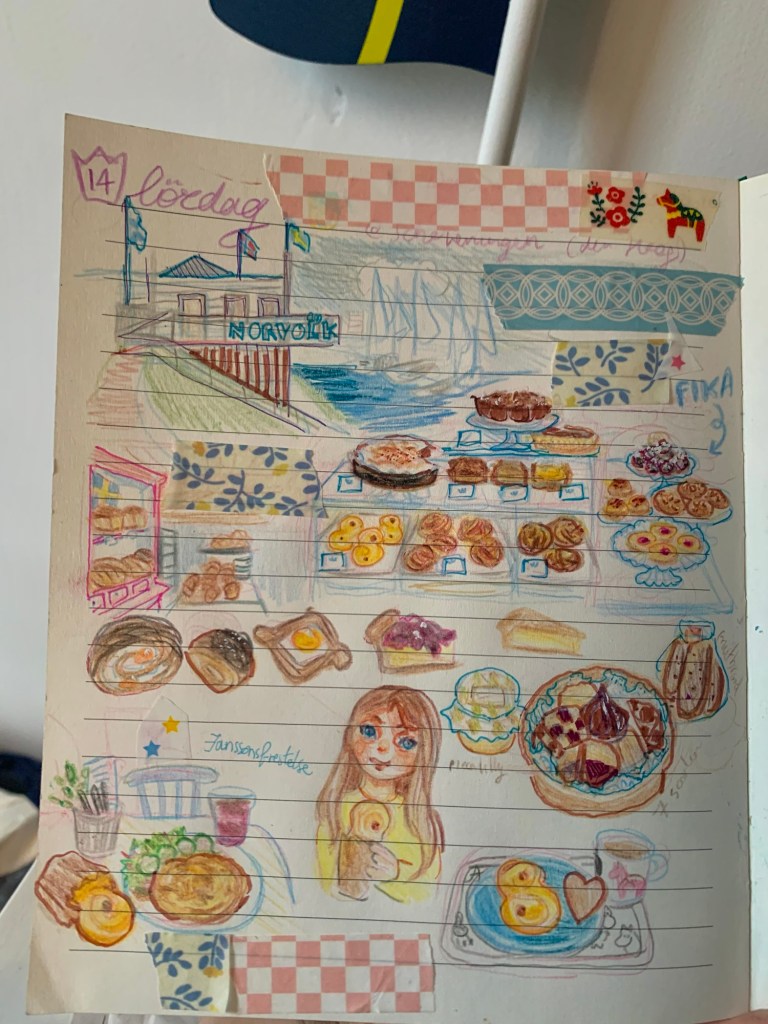
Below is the summary of Norvolk in a journal spread:

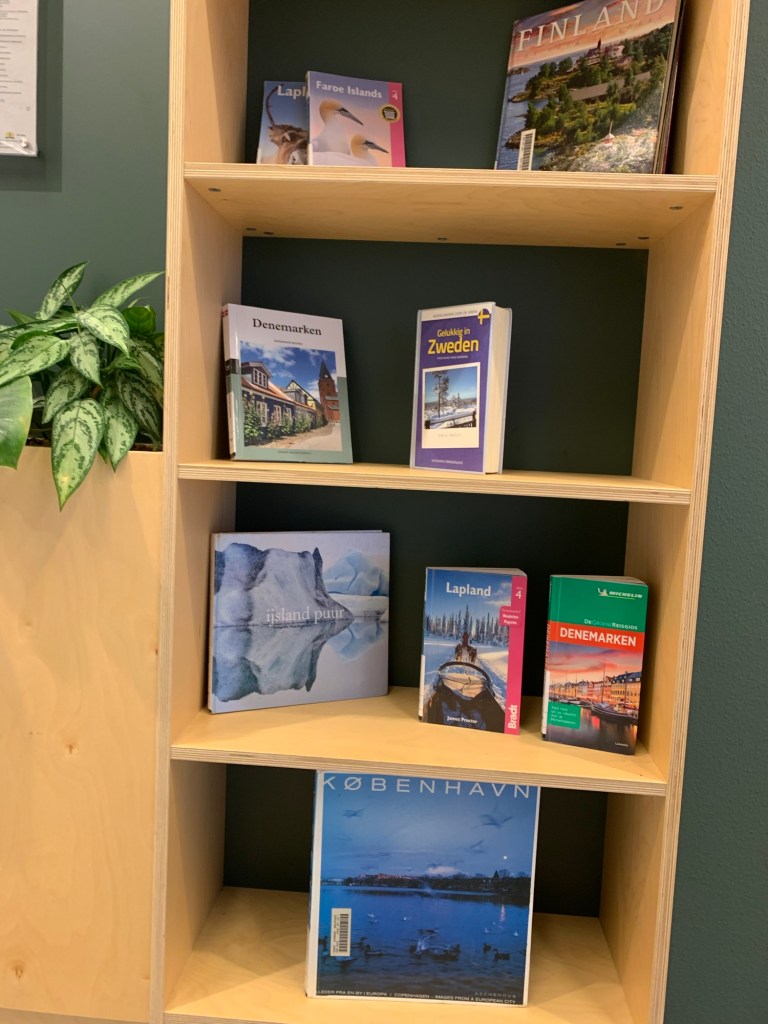
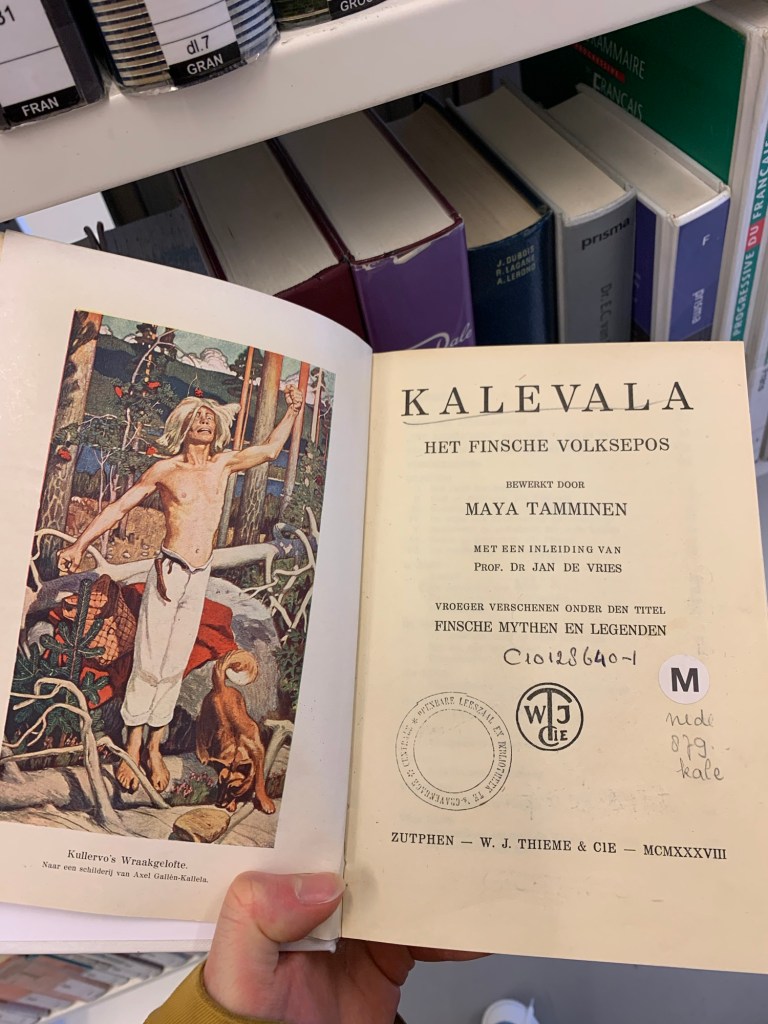
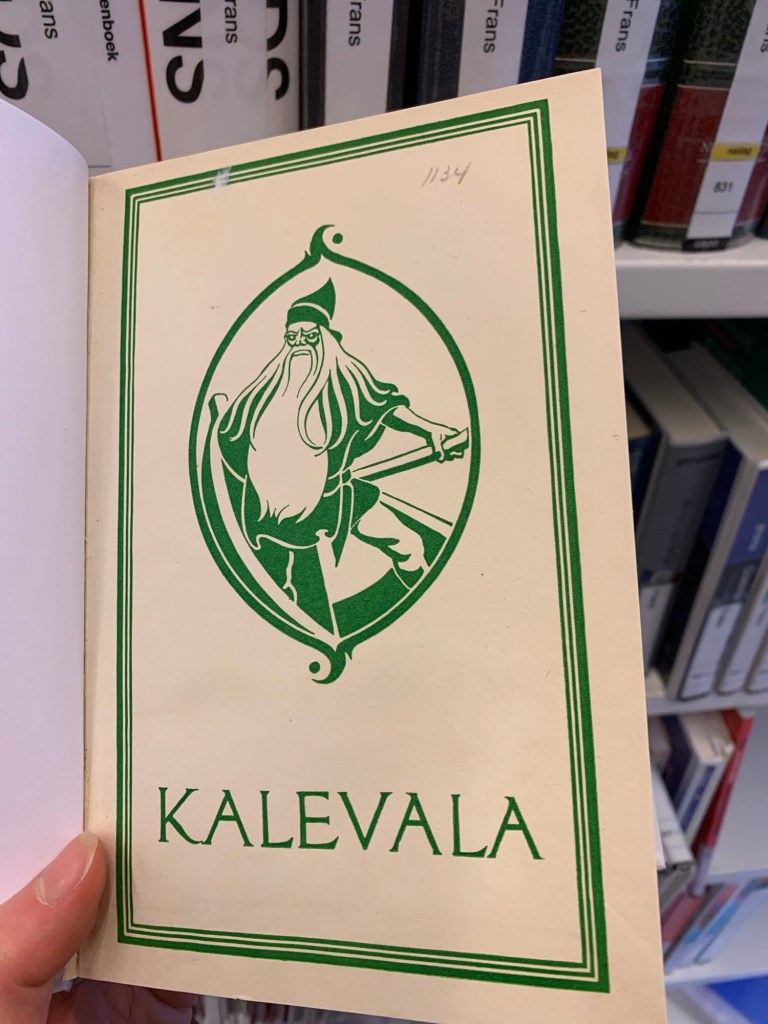
Afterwards I went to the centre, and in the library – which has a good Nordic language books collection – I stumbled upon Nordic countries-themed books, and I found a Kalevala (Finnish epic poem) in the language section…!! I hope to be back when I will have more time.

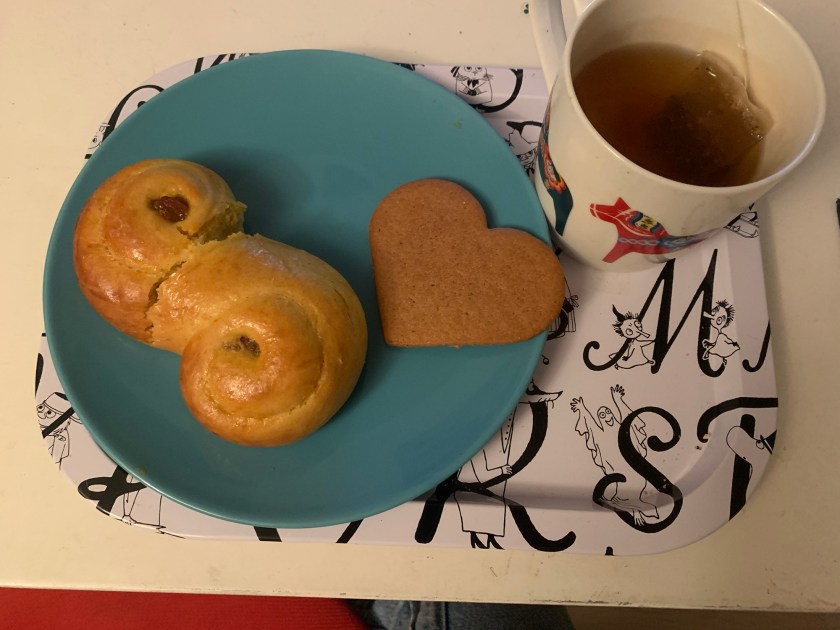
When I arrived home, I had the Lussekatt with tea in my Dala mug and a pepparkaka on my Moomin tray. Could that be more Swedish?

I definitely have reasons to go back to Norvolk someday, so expect an update and subscribe to my blog!


More posts: